Depression for NEET PG Psychiatry: ICMR Diagnosis and Severity, SSRIs, Antidepressant Side Effects, Specifiers, Persistent Depressive Disorder
Start Here
🎯 Exam priority: High. Expect: the three core symptoms and the 2-week rule, mild vs moderate vs severe counts, drugs that cause depression, ICMR SSRI doses and timelines, how long to continue, switching, SSRI sexual dysfunction, mirtazapine and trazodone, bupropion seizures, TCA overdose, MAOI cheese reaction, serotonin syndrome, atypical and melancholic features, peripartum and seasonal depression.
CBME mapping: PS 5.1–5.2 — manage depression in primary care and recognise red flags. Suicide risk assessment is article 14; ECT is article 15.
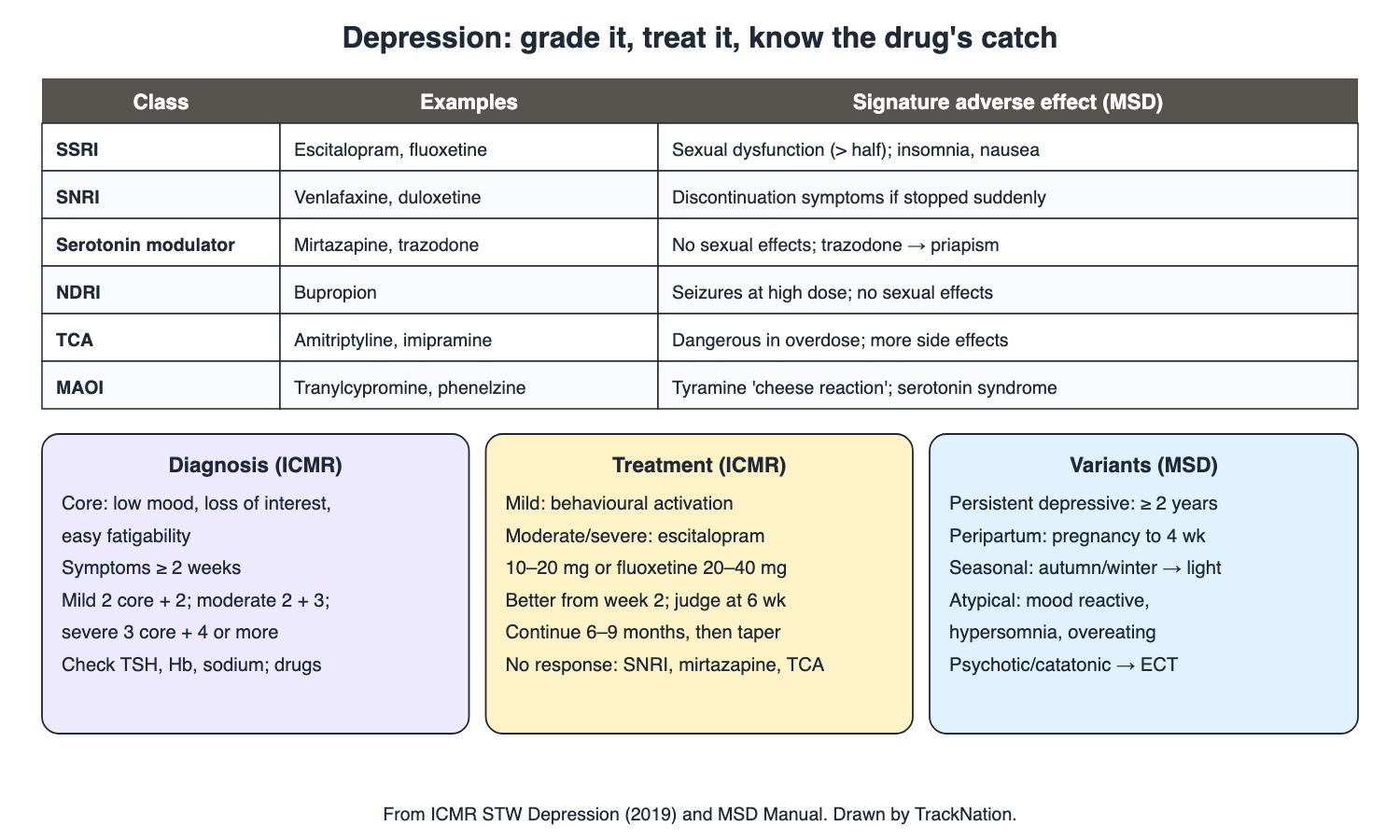
Antidepressant classes and signature adverse effects; ICMR diagnosis and treatment; depression variants. Drawn by TrackNation.
Diagnosis and Assessment (ICMR)
Core symptoms: depressed mood, loss of interest and enjoyment, easy fatigability. Additional: poor concentration, low self-esteem, guilt and worthlessness, bleak view of the future, self-harm or suicidal ideas, disturbed sleep, poor appetite. Depressive cognitions: hopelessness, helplessness, worthlessness.
Symptoms must last at least 2 weeks. Severity: mild — 2 core + 2 or more additional; moderate — 2 core + 3 or more; severe — all 3 core + 4 or more. Always assess suicide risk (thoughts, ideas, intent, immediate risk) and family support.
Investigate: haemogram, thyroid function, ECG, sodium. Exclude medical causes (hypothyroidism) and drugs — anticancer (cyclophosphamide), antiretrovirals (efavirenz, zidovudine), dapsone, ethambutol, anabolic steroids, propranolol; MSD adds corticosteroids and interferon. Rule out bipolar disorder, grief and adjustment disorder.
Women are at higher risk. Antidepressants work poorly while substance use continues.
Treatment
Mild: behavioural activation (activity scheduling, goals, sleep and diet, hygiene), supportive counselling, frequent follow-up; drugs if no improvement in 4–6 weeks.
Moderate/severe: escitalopram 10–20 mg or fluoxetine 20–40 mg daily (SSRIs first — watch GI bleeding and interactions), with clonazepam 0.25–0.5 mg for sleep or anxiety, tapered after 2 weeks. Improvement starts in week 2; judge response by 6 weeks; continue 6–9 months after response, then taper. Non-responders: switch to an SNRI (venlafaxine), mirtazapine or a TCA (amitriptyline, imipramine — watch overdose risk); add CBT or problem-solving therapy; watch for a switch into mania.
Admit when suicidal ideation is significant (especially without family support), with psychosis or physical debilitation. Refer for diagnostic doubt, no response after 4–6 weeks, special groups (elderly, pregnancy, children) and comorbidity.
Other options (MSD): ECT for psychotic or catatonic depression; light therapy for seasonal depression; ketamine/esketamine for treatment-resistant depression.
Antidepressants and Their Problems (MSD)
SSRIs: first choice; give in the morning; sexual dysfunction in more than half, insomnia, nausea, early agitation. Stopping abruptly causes a discontinuation syndrome (least with long-acting fluoxetine) — taper about 25% a week. Continue 6–12 months (up to 2 years over 50) to prevent relapse.
Mirtazapine (α2 blocker) and trazodone: no sexual dysfunction; trazodone can cause priapism and postural hypotension. Bupropion: no sexual effects, but seizures at high doses (risk higher in bulimia).
TCAs: effective but toxic in overdose — now rarely used. MAOIs: for refractory or atypical depression; tyramine-rich food (mature cheese) causes a hypertensive cheese reaction; combining with serotonergic drugs causes serotonin syndrome (confusion, hyperthermia, autonomic and neuromuscular hyperactivity) — wait 2 weeks (5 weeks after fluoxetine) when switching.
Antidepressants may increase suicidal thinking in children, adolescents and young adults — monitor closely.
Specifiers and Related Disorders (MSD)
Melancholic: loss of pleasure in nearly everything. Atypical: mood brightens with good events, plus rejection sensitivity, leaden paralysis, overeating or hypersomnia. Psychotic: delusions or hallucinations. Peripartum onset: in pregnancy or within 4 weeks of delivery; psychotic features can lead to infanticide. Seasonal: autumn or winter.
Persistent depressive disorder: symptoms for ≥ 2 years without remission; any past mania or hypomania points to bipolar disorder instead. Premenstrual dysphoric disorder: mood symptoms in the premenstrual phase, free after menstruation. Prolonged grief disorder: disabling persistent grief needing specific therapy.
Traps the Examiner Sets
2 weeks for depression; 2 years for persistent depressive disorder.
SSRIs take 2–6 weeks — do not switch after a few days.
Trazodone → priapism; bupropion → seizures; MAOI + cheese → hypertensive crisis.
Ask about past mania before starting an antidepressant.
Memory Hooks & Shortcuts
Shortcuts to lock in this article's numbers and lists. Each one only re-packages facts proven above.
🧠 ICMR grading '2+2, 2+3, 3+4': mild, moderate, severe — severity
🧠 SSRI clock: 'Two weeks to start, six to judge, six to nine to keep' — timeline
🧠 'Trazodone → Trouble down there (priapism)' — trazodone
🧠 'Bupropion: no Bedroom problems but Brain fits' — bupropion
🧠 MAOI + cheese = 'pressure peak' — tyramine
Rapid-Revision Cards
Core symptoms
Low mood, loss of interest, fatigability.
Duration
≥ 2 weeks.
Mild
2 core + 2.
Moderate
2 core + 3.
Severe
3 core + 4.
Tests
Hb, TSH, ECG, sodium.
Drug causes
Efavirenz, dapsone, propranolol, steroids.
Mild Rx
Behavioural activation.
SSRI doses
Escitalopram 10–20; fluoxetine 20–40.
Timeline
Improves week 2; judge at 6 weeks.
Duration of Rx
6–9 months, then taper.
Non-response
SNRI, mirtazapine, TCA.
SSRI problem
Sexual dysfunction > 50%.
Discontinuation
Taper; least with fluoxetine.
Trazodone
Priapism.
Bupropion
Seizures; avoid in bulimia.
MAOI
Cheese reaction; serotonin syndrome.
Fluoxetine → MAOI
Wait 5 weeks.
Atypical
Reactive mood, overeating, hypersomnia.
Peripartum
Pregnancy to 4 weeks after.
PDD
≥ 2 years.
Sources
Facts in this article were checked against these documents.
Standard Treatment Workflow: Depression — Indian Council of Medical Research, DHR, 2019 (link)
MSD Manual Professional: Depressive Disorders; Medications for Treatment of Depression — Merck & Co. (MSD Manuals), reviewed 2025–26 (link)
Competency Based Undergraduate Curriculum, Psychiatry (PS 5) — National Medical Commission, 2024
Test Yourself: Practice Questions
Thirty questions in NEET PG style, most of them clinical vignettes.
Practice Questions (NEET PG pattern)
Original questions written in the style of the exam: +4 for a correct answer, −1 for a wrong one. Every answer was checked against the sources listed above. NEET PG papers are not published by NBEMS, so these are not past-paper questions.
Q1. The three core symptoms of depression in the ICMR workflow are
(a) anxiety, panic and phobia
(b) insomnia, weight loss and guilt
(c) depressed mood, loss of interest and easy fatigability
(d) hallucinations, delusions and catatonia
Show answer
Answer: (c) — Plus additional symptoms.
Q2. To diagnose depression, symptoms must be present for at least
(a) 2 days
(b) 6 months
(c) 2 years
(d) 2 weeks
Show answer
Answer: (d) — Per ICMR.
Q3. A patient has all 3 core symptoms and 5 additional symptoms for 3 weeks. ICMR grades this as
(a) moderate depression
(b) mild depression
(c) severe depression
(d) adjustment disorder
Show answer
Answer: (c) — Severe: 3 core + 4 or more.
Q4. Before starting antidepressants, ICMR recommends checking
(a) HIV only
(b) nothing
(c) haemogram, thyroid function, ECG and sodium
(d) CT brain in all
Show answer
Answer: (c) — Rule out medical causes.
Q5. Which drug is listed by ICMR as a possible cause of depression?
(a) efavirenz
(b) metformin
(c) paracetamol
(d) amoxicillin
Show answer
Answer: (a) — Also cyclophosphamide, dapsone, ethambutol, propranolol.
Q6. Conditions ICMR asks you to rule out before diagnosing depression include
(a) schizophrenia only
(b) bipolar disorder, grief and adjustment disorder
(c) dementia only
(d) OCD only
Show answer
Answer: (b) — Differentials.
Q7. First-line management of mild depression at primary care (ICMR) is
(a) lithium
(b) behavioural activation and supportive counselling
(c) amitriptyline
(d) ECT
Show answer
Answer: (b) — Drugs if no improvement in 4–6 weeks.
Q8. ICMR drug choice for moderate to severe depression is
(a) escitalopram 10–20 mg or fluoxetine 20–40 mg daily
(b) amitriptyline 300 mg
(c) haloperidol
(d) lithium
Show answer
Answer: (a) — SSRIs first.
Q9. After starting an SSRI, improvement usually begins in
(a) never before 6 months
(b) the second week, with adequate response by 6 weeks
(c) 3 months
(d) 1 day
Show answer
Answer: (b) — Do not switch too early.
Q10. After a first depressive episode responds to an SSRI, ICMR advises continuing for
(a) 2 weeks
(b) until symptoms improve, then stop
(c) 6–9 months, then tapering
(d) lifelong
Show answer
Answer: (c) — MSD: 6–12 months.
Q11. A patient has not improved after 6 weeks of an adequate SSRI dose. ICMR suggests
(a) adding haloperidol
(b) ECT for all
(c) stopping all treatment
(d) switching to an SNRI, mirtazapine or a TCA
Show answer
Answer: (d) — Non-responder.
Q12. Clonazepam in the ICMR depression plan is used
(a) as the main antidepressant
(b) short term for sleep or anxiety, tapered after 2 weeks
(c) for 6 months
(d) never
Show answer
Answer: (b) — Avoid dependence.
Q13. The most common troublesome adverse effect of SSRIs is
(a) agranulocytosis
(b) sexual dysfunction, in more than half of patients
(c) priapism
(d) hyperthyroidism
Show answer
Answer: (b) — Anorgasmia, low libido, ED.
Q14. SSRIs are usually taken
(a) in the morning, as they can be stimulating
(b) with alcohol
(c) only at night
(d) twice weekly
Show answer
Answer: (a) — Insomnia is common.
Q15. A patient stops paroxetine abruptly and develops dizziness, nausea, irritability and insomnia. This is
(a) relapse of mania
(b) SSRI discontinuation syndrome
(c) serotonin syndrome
(d) NMS
Show answer
Answer: (b) — Least with fluoxetine.
Q16. An antidepressant that does NOT cause sexual dysfunction and blocks α2 autoreceptors is
(a) mirtazapine
(b) sertraline
(c) venlafaxine
(d) clomipramine
Show answer
Answer: (a) — Serotonin modulator.
Q17. A man on trazodone presents with a prolonged painful erection. The adverse effect is
(a) Peyronie disease
(b) NMS
(c) serotonin syndrome
(d) priapism
Show answer
Answer: (d) — Urological emergency.
Q18. Bupropion should be avoided in a patient with bulimia because it
(a) lowers the seizure threshold
(b) causes sexual dysfunction
(c) is hepatotoxic
(d) causes weight gain
Show answer
Answer: (a) — Seizure risk is higher in bulimia.
Q19. Tricyclic antidepressants are now rarely used mainly because
(a) overdose is toxic and they have more adverse effects
(b) they are ineffective
(c) they cause priapism
(d) they are expensive
Show answer
Answer: (a) — ICMR: watch overdose risk.
Q20. A patient on phenelzine eats mature cheese and develops a severe headache with very high blood pressure. This is the
(a) cheese (tyramine) reaction
(b) NMS
(c) migraine
(d) serotonin syndrome
Show answer
Answer: (a) — MAOI interaction.
Q21. When switching from fluoxetine to an MAOI, the gap should be at least
(a) 5 weeks
(b) 2 days
(c) 1 day
(d) 6 months
Show answer
Answer: (a) — 2 weeks for most others.
Q22. Combining an MAOI with an SSRI can cause
(a) hypothyroidism
(b) agranulocytosis
(c) serotonin syndrome — confusion, hyperthermia, autonomic and neuromuscular hyperactivity
(d) NMS
Show answer
Answer: (c) — Potentially life-threatening.
Q23. Antidepressants carry a warning about increased suicidal thinking in
(a) the elderly only
(b) pregnant women only
(c) children, adolescents and young adults
(d) nobody
Show answer
Answer: (c) — Monitor closely when starting.
Q24. A depressed woman's mood lifts briefly when her children visit; she oversleeps, overeats and feels her limbs are heavy. The specifier is
(a) psychotic features
(b) melancholic features
(c) catatonic features
(d) atypical features
Show answer
Answer: (d) — Leaden paralysis.
Q25. Depression with loss of pleasure in nearly all activities is called
(a) adjustment
(b) melancholic
(c) seasonal
(d) atypical
Show answer
Answer: (b) — Severe form.
Q26. Depression with a peripartum-onset specifier begins
(a) 6 months after delivery only
(b) before conception
(c) during pregnancy or within 4 weeks of delivery
(d) at menopause
Show answer
Answer: (c) — Psychotic features can risk infanticide.
Q27. Recurrent depression every winter that improves in spring is best helped by
(a) light therapy (phototherapy)
(b) clozapine
(c) lithium
(d) ECT first
Show answer
Answer: (a) — Seasonal affective disorder.
Q28. Depressive symptoms lasting at least 2 years without remission indicate
(a) cyclothymia
(b) adjustment disorder
(c) persistent depressive disorder
(d) major depression, single episode
Show answer
Answer: (c) — Formerly dysthymia.
Q29. A severely depressed patient has delusions of guilt and has stopped eating. A highly effective treatment is
(a) bupropion alone
(b) benzodiazepine
(c) counselling only
(d) ECT
Show answer
Answer: (d) — Psychotic depression or catatonia.
Q30. Which depressed patient needs hospital admission?
(a) one with significant suicidal ideation and no family support
(b) one with insomnia only
(c) one who prefers outpatient care
(d) one with mild low mood
Show answer
Answer: (a) — Also psychosis, debility.
Active Recall
From memory: list the core and additional symptoms and the ICMR severity grading, the investigations and drug causes, the ICMR treatment plan and timeline, the adverse effects of each antidepressant class, and the depression specifiers.