Psychosexual Disorders and Gender Identity for NEET PG Psychiatry: Erectile Dysfunction, Paraphilias, Gender Dysphoria, MHCA 2017 Ethics
Start Here
🎯 Exam priority: Moderate. Expect: morning erections in psychogenic ED, sex therapy, PDE5 inhibitors with nitrates and alpha-blockers, blue vision, ED as a cardiac warning, the 6-month rule for paraphilic disorder and gender dysphoria, that gender incongruence and cross-dressing are not disorders by themselves, affirming care, and MHCA 2017 protections.
CBME mapping: PS 9.1–9.2 — psychosexual disorders and the medico-legal, ethical and humanitarian principles for the LGBTQA+ community.
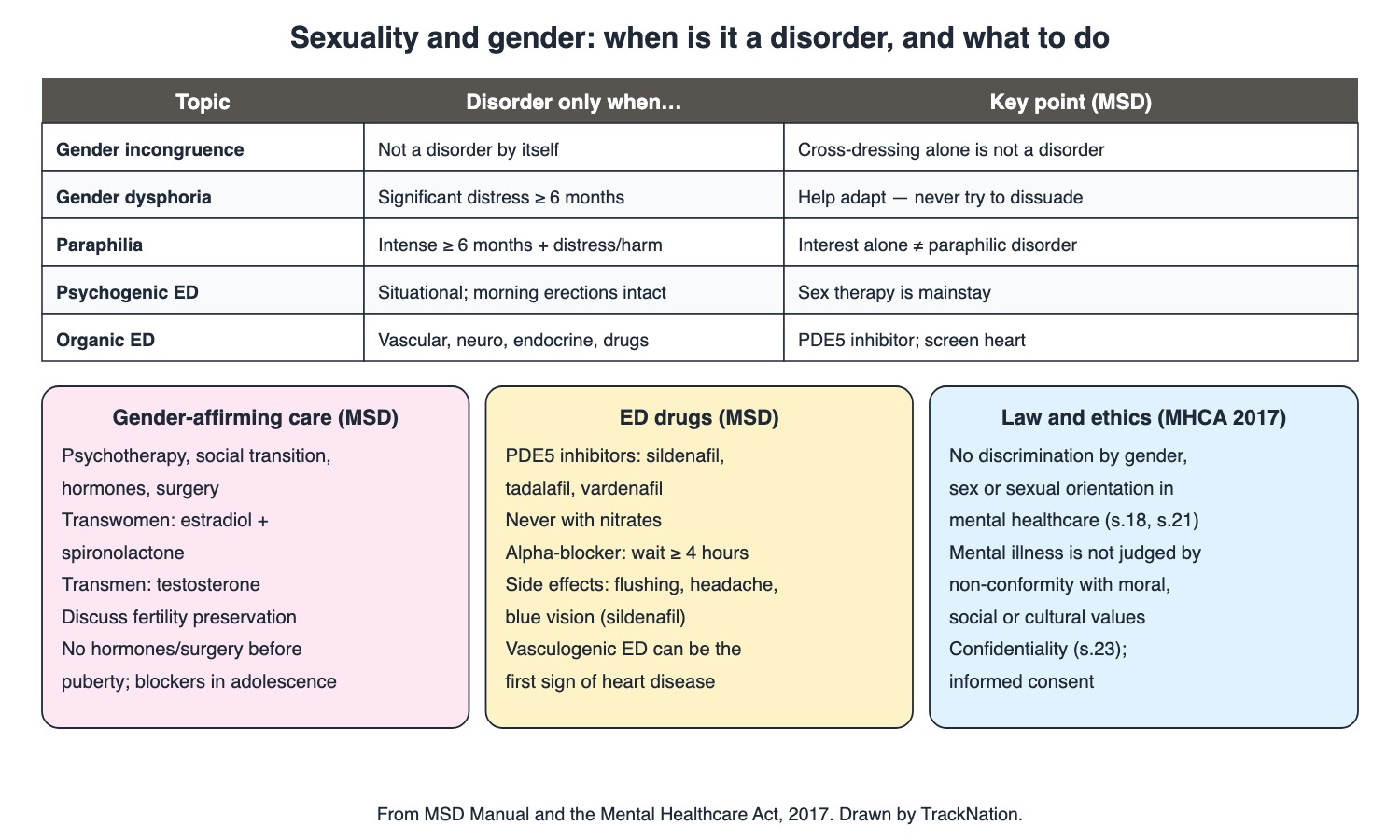
Gender dysphoria, paraphilias and erectile dysfunction: when each is a disorder; gender-affirming care; ED drugs; MHCA 2017. Drawn by TrackNation.
Erectile Dysfunction
Causes: vascular (commonest — atherosclerosis of cavernous arteries with smoking and diabetes), neurological, hormonal, psychological and drugs. Psychogenic ED is often situational (a particular place, time or partner), linked to performance anxiety, stress or depression, and the man has normal nocturnal and morning erections — usually absent in organic ED.
Evaluate every man for hormonal, neurological and vascular disease and depression; vasculogenic ED can be the first sign of cardiovascular disease.
Treatment: sex therapy is the mainstay for psychogenic ED. PDE5 inhibitors (sildenafil, tadalafil, vardenafil, avanafil): never with nitrates; wait ≥ 4 hours after an alpha-blocker; adverse effects — flushing, headache, dyspepsia, visual changes (blue haze with sildenafil/vardenafil), rarely priapism. Next: vacuum devices, intracavernosal injections, penile prosthesis.
Paraphilias and Gender Identity
A paraphilia (atypical sexual interest) is not automatically a disorder. A paraphilic disorder needs intense, persistent arousal for ≥ 6 months plus significant distress or impairment, or harm or potential harm to others (children, non-consenting adults). More than one often coexists.
Gender incongruence (ICD-11): marked, persistent mismatch between experienced gender and assigned sex — not a disorder by itself; cross-dressing without distress needs no treatment. Gender dysphoria (DSM-5-TR): distress or impairment from that mismatch — diagnose only when significant and lasting ≥ 6 months; it can appear as early as 2–3 years of age.
Treatment aims to relieve distress and help the person adapt — never to dissuade them from their identity: psychotherapy, social transition, gender-affirming hormones (estradiol with spironolactone; testosterone) and surgery, which is linked to better mental health. Discuss fertility preservation first. No hormones or surgery before puberty; GnRH agonists (e.g. leuprolide) may block puberty in early adolescence.
Ethics and the Law (Mental Healthcare Act 2017)
Every person has a right to mental healthcare without discrimination on the basis of gender, sex or sexual orientation, religion, caste or class (sections 18 and 21).
Mental illness must not be determined by non-conformity with moral, social, cultural, work or political values or religious beliefs of the community (section 3).
People with mental illness have a right to confidentiality (section 23); informed consent must be free of force, undue influence, fraud or threat and given after adequate information.
Traps the Examiner Sets
Morning erections present → psychogenic ED.
PDE5 inhibitor + nitrate = contraindicated.
Gender incongruence and cross-dressing are not disorders unless they cause distress.
"Conversion" of identity is not treatment — affirm and support.
Memory Hooks & Shortcuts
Shortcuts to lock in this article's numbers and lists. Each one only re-packages facts proven above.
🧠 'Morning glory = mind problem' — preserved morning erections point to psychogenic ED — ED
🧠 'Nitrate + sildenafil = never' — drug safety
🧠 'Different isn't disorder' — paraphilia, incongruence and cross-dressing need distress or harm — definition rule
🧠 Six-month rule: paraphilic disorder and gender dysphoria — timing
🧠 MHCA: 'no Discrimination, no Diagnosis by Dissent, Discretion (confidentiality)' — law
Rapid-Revision Cards
Commonest ED cause
Vascular (atherosclerosis).
Psychogenic ED
Situational; morning erections normal.
ED and heart
Vasculogenic ED may precede CVD.
Psychogenic ED Rx
Sex therapy.
PDE5 inhibitors
Sildenafil, tadalafil, vardenafil.
PDE5 + nitrates
Contraindicated.
Alpha-blocker
Wait ≥ 4 h.
Blue haze
Sildenafil, vardenafil.
Second line ED
Vacuum, injection, prosthesis.
Paraphilic disorder
≥ 6 months + distress or harm.
Paraphilia alone
Not a disorder.
Gender incongruence
ICD-11; not a disorder itself.
Gender dysphoria
Distress ≥ 6 months.
Cross-dressing
No distress = no disorder.
Treatment aim
Adapt, never dissuade.
Transwomen
Estradiol + spironolactone.
Transmen
Testosterone.
Before hormones
Fertility preservation.
Puberty blockers
GnRH agonists (leuprolide).
MHCA s.18, 21
No discrimination incl. sexual orientation.
MHCA s.3
No diagnosis by non-conformity.
Sources
Facts in this article were checked against these documents.
MSD Manual Professional: Erectile Dysfunction; Overview of Paraphilias and Paraphilic Disorders; Gender Incongruence and Gender Dysphoria — Merck & Co. (MSD Manuals), reviewed 2025–26 (link)
The Mental Healthcare Act, 2017 (Act No. 10 of 2017) — Gazette of India, Ministry of Law and Justice, 2017 (link)
Competency Based Undergraduate Curriculum, Psychiatry (PS 9) — National Medical Commission, 2024
Test Yourself: Practice Questions
Thirty questions in NEET PG style, most of them clinical vignettes.
Practice Questions (NEET PG pattern)
Original questions written in the style of the exam: +4 for a correct answer, −1 for a wrong one. Every answer was checked against the sources listed above. NEET PG papers are not published by NBEMS, so these are not past-paper questions.
Q1. A man has erectile failure only with his new partner but normal morning erections. The likely type is
(a) vasculogenic ED
(b) neurogenic ED
(c) psychogenic ED
(d) endocrine ED
Show answer
Answer: (c) — Situational; nocturnal erections preserved.
Q2. The most common vascular cause of erectile dysfunction is
(a) venous leak only
(b) trauma
(c) Peyronie disease
(d) atherosclerosis of the cavernous arteries
Show answer
Answer: (d) — Smoking, diabetes.
Q3. A 50-year-old smoker develops new erectile dysfunction of vascular type. An important next step is to
(a) reassure
(b) evaluate for undiagnosed cardiovascular disease
(c) start sex therapy only
(d) check prolactin only
Show answer
Answer: (b) — ED can be the first sign.
Q4. The mainstay of treatment for psychogenic ED is
(a) penile prosthesis
(b) testosterone
(c) sex therapy
(d) vacuum device
Show answer
Answer: (c) — PDE5 inhibitors may help too.
Q5. Sildenafil is absolutely contraindicated in a man who uses
(a) statins
(b) metformin
(c) nitrates
(d) aspirin
Show answer
Answer: (c) — Dangerous hypotension.
Q6. A man on tamsulosin wants to use a PDE5 inhibitor. He should
(a) take both together
(b) wait at least 4 hours after the alpha-blocker and start low
(c) use nitrates instead
(d) stop tamsulosin permanently
Show answer
Answer: (b) — Risk of hypotension.
Q7. A bluish tinge to vision after taking an ED drug is typical of
(a) alprostadil
(b) sildenafil or vardenafil
(c) testosterone
(d) tadalafil only
Show answer
Answer: (b) — Blue haze.
Q8. If oral PDE5 inhibitors fail or are not tolerated, options include
(a) SSRIs
(b) nitrates
(c) vacuum devices, intracavernosal injections or penile prosthesis
(d) antipsychotics
Show answer
Answer: (c) — Per MSD.
Q9. Every man with ED should be evaluated for hormonal, neurological and vascular disorders and
(a) autism
(b) OCD
(c) depression
(d) schizophrenia
Show answer
Answer: (c) — Psychological causes.
Q10. An atypical sexual interest becomes a paraphilic disorder only when it is intense and persistent and
(a) is unusual
(b) occurs once
(c) lasts ≥ 6 months with distress, impairment or harm to others
(d) involves fantasy only
Show answer
Answer: (c) — Interest alone is not a disorder.
Q11. Which statement about paraphilias is correct?
(a) having a paraphilic interest is not by itself a disorder
(b) every paraphilia is a disorder
(c) they are always illegal
(d) they never co-occur
Show answer
Answer: (a) — Per MSD.
Q12. People with one paraphilic disorder often
(a) have more than one
(b) never have another
(c) have schizophrenia
(d) are always women
Show answer
Answer: (a) — Per MSD.
Q13. Gender dysphoria is defined by
(a) distress or impairment from a mismatch between gender identity and assigned gender
(b) sexual orientation
(c) cross-dressing
(d) the identity itself
Show answer
Answer: (a) — Distress defines it.
Q14. Gender dysphoria should be diagnosed only when significant distress or impairment persists for at least
(a) 2 weeks
(b) 6 months
(c) 5 years
(d) 1 month
Show answer
Answer: (b) — Per MSD.
Q15. In ICD-11, a marked and persistent mismatch between experienced gender and assigned sex is called
(a) paraphilia
(b) transvestism
(c) gender identity disorder
(d) gender incongruence
Show answer
Answer: (d) — Not in the mental disorders chapter.
Q16. A man occasionally cross-dresses, feels comfortable and has no distress or impairment. He
(a) needs aversion therapy
(b) needs hormone therapy
(c) has gender dysphoria
(d) has no disorder and needs no treatment
Show answer
Answer: (d) — No distress = no disorder.
Q17. The aim of treatment in gender dysphoria is to
(a) stop transition
(b) relieve distress and help the person adapt, not dissuade them from their identity
(c) prescribe antipsychotics
(d) change their identity
Show answer
Answer: (b) — Affirming care.
Q18. Gender-affirming hormone therapy for transwomen typically uses
(a) oestradiol with spironolactone
(b) testosterone
(c) progesterone alone
(d) finasteride alone
Show answer
Answer: (a) — Transmen: testosterone.
Q19. Before gender-affirming hormones or surgery, clinicians should discuss
(a) nothing
(b) fertility preservation
(c) only surgery
(d) only cost
Show answer
Answer: (b) — Fertility may be impaired.
Q20. Hormones or surgery for gender dysphoria in prepubertal children are
(a) first line
(b) standard care
(c) not recommended by any guideline
(d) required by law
Show answer
Answer: (c) — Puberty blockers may be used in early adolescence.
Q21. Puberty blockers used in early adolescence are
(a) GnRH agonists such as leuprolide
(b) antiandrogens alone
(c) SSRIs
(d) corticosteroids
Show answer
Answer: (a) — Block sex hormone production.
Q22. Gender-affirming surgery in people with gender dysphoria is associated with
(a) improved mental health outcomes
(b) psychosis
(c) worse mental health
(d) no change
Show answer
Answer: (a) — Per MSD.
Q23. Childhood gender dysphoria can manifest as early as
(a) 2–3 years
(b) 10 years
(c) adulthood only
(d) 16 years
Show answer
Answer: (a) — Per MSD.
Q24. Under the Mental Healthcare Act 2017, mental healthcare must be provided without discrimination on the basis of
(a) nothing specified
(b) income only
(c) gender, sex and sexual orientation, among others
(d) age only
Show answer
Answer: (c) — Sections 18 and 21.
Q25. A family brings their son to a psychiatrist because he is gay and they want him 'treated'. Under MHCA 2017,
(a) he must be admitted
(b) mental illness cannot be determined by non-conformity with social or moral values
(c) he must be given ECT
(d) the doctor must inform the police
Show answer
Answer: (b) — Section 3.
Q26. MHCA 2017 gives a person with mental illness the right to
(a) free surgery
(b) no information
(c) compulsory treatment
(d) confidentiality about their mental health and treatment
Show answer
Answer: (d) — Section 23.
Q27. Under MHCA 2017, valid informed consent must be
(a) assumed in emergencies always
(b) verbal only
(c) obtained from the police
(d) given for a specific intervention without force, undue influence, fraud or threat
Show answer
Answer: (d) — After adequate information.
Q28. PDE5 inhibitors can rarely cause
(a) hyperkalaemia
(b) seizures
(c) hypertension crisis
(d) priapism
Show answer
Answer: (d) — Plus flushing, headache, dyspepsia.
Q29. Psychological causes of secondary ED include
(a) atherosclerosis
(b) spinal injury
(c) hyperprolactinaemia
(d) performance anxiety, stress or depression
Show answer
Answer: (d) — Often mixed with organic causes.
Q30. The main gender-affirming drug for transmen is
(a) oestradiol
(b) leuprolide only
(c) testosterone
(d) spironolactone
Show answer
Answer: (c) — Per MSD.
Active Recall
From memory: distinguish psychogenic from organic erectile dysfunction and outline treatment and PDE5 inhibitor safety, state when a paraphilia or gender incongruence becomes a disorder, describe gender-affirming care, and list the MHCA 2017 protections.