Bipolar Disorder for NEET PG Psychiatry: Mania vs Hypomania, Bipolar I and II, Lithium Levels and Toxicity, Valproate, Lamotrigine, Pregnancy
Start Here
🎯 Exam priority: High. Expect: mania ≥ 1 week vs hypomania ≥ 4 days, bipolar I vs II, cyclothymia (> 2 years), the symptom list, drugs that cause mania, lithium target and toxic levels, drugs that raise lithium, lithium side effects and tests, valproate and carbamazepine in pregnancy, lamotrigine rash, no antidepressant monotherapy, suicide risk.
CBME mapping: PS 6.1 — diagnose and manage an episode of mania. Lithium pharmacology is also in Pharmacology.
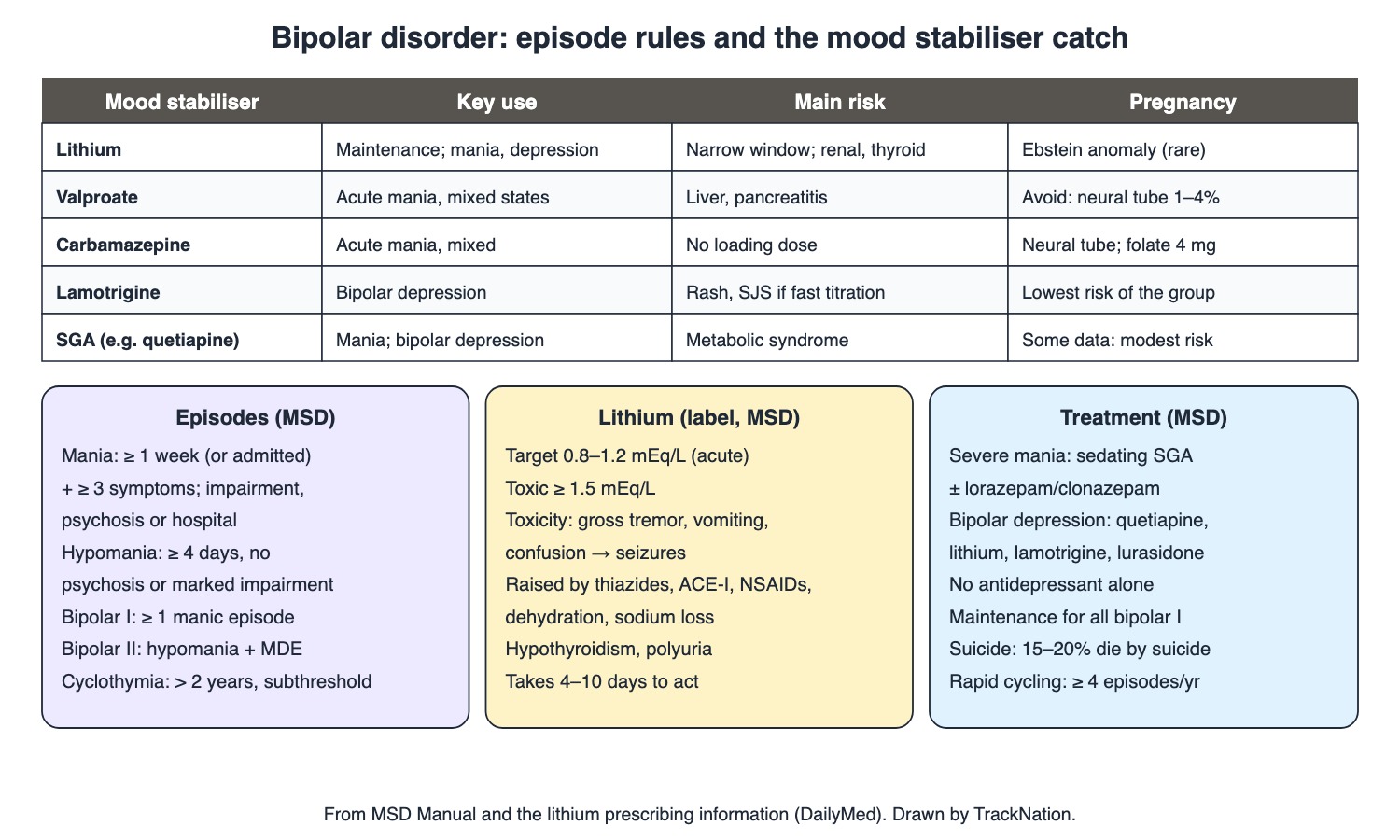
Mood stabilisers compared; mania and hypomania rules; lithium levels and toxicity; bipolar treatment. Drawn by TrackNation.
Diagnosis
Lifetime prevalence about 2.5% in men and 2.3% in women. Bipolar I: at least one manic episode (depression usually too). Bipolar II: at least one major depressive episode and one hypomanic episode, never mania. Cyclothymia: more than 2 years of hypomanic and depressive periods that never meet full criteria.
Manic episode: elevated, expansive or irritable mood with increased energy for ≥ 1 week (less if admitted) plus ≥ 3 symptoms (≥ 4 if only irritable): grandiosity, decreased need for sleep, pressured talk, flight of ideas, distractibility, increased goal-directed activity, risky behaviour (spending sprees, bad investments, sexual indiscretion) — causing severe impairment, psychosis or admission.
Hypomania: the same picture for ≥ 4 days with ≥ 3 symptoms but no psychosis, no marked impairment and no need for admission; it can even be adaptive.
Exclude causes of secondary mania: stimulants, corticosteroids, dopamine agonists, hyperthyroidism, phaeochromocytoma. Rapid cycling = ≥ 4 episodes a year. 15–20% die by suicide.
Treatment (MSD)
Severe mania: a sedating second-generation antipsychotic, sometimes with lorazepam or clonazepam; IM haloperidol for extremely hyperactive psychotic patients not eating or drinking; then lithium or an antiseizure mood stabiliser. Mood stabilisers include lithium, valproate, carbamazepine, lamotrigine and SGAs (olanzapine, quetiapine, risperidone, aripiprazole, lurasidone).
Bipolar depression: quetiapine (first line for bipolar II), lithium, lamotrigine, lurasidone, cariprazine. Antidepressants are not recommended alone.
Maintenance is indicated for all patients with bipolar I. Mixed episodes, rapid cycling, anxiety, substance use and neurological disease predict relapse. Educate about the risks of manic sexual behaviour; light therapy can help seasonal bipolar depression.
Mood Stabilisers
Lithium: dampens mood swings, not normal mood; best response with a family history of typical bipolar disorder; takes 4–10 days to work. Target 0.8–1.2 mEq/L in acute mania; toxic ≥ 1.5 mEq/L. Common effects: fine tremor, nausea, diarrhoea, polyuria, polydipsia, weight gain, worsened acne and psoriasis; longer term hypothyroidism, hypercalcaemia/hyperparathyroidism and renal damage. Toxicity: gross tremor, brisk reflexes, headache, vomiting, confusion → seizures, arrhythmias; more likely in the elderly, renal impairment, sodium loss (fever, vomiting, diarrhoea, diuretics) and with thiazides, ACE inhibitors and NSAIDs. Monitor lithium levels every 6 months and after dose changes, TSH before starting, and renal function. Atenolol for severe tremor (propranolol may worsen depression).
Valproate: acute mania and mixed states, wider window, no renal toxicity; nausea, sedation, weight gain; rarely hepatotoxicity and pancreatitis. Carbamazepine: no loading dose; titrate to level.
Lamotrigine: effective for bipolar depression and cycling; rash and Stevens–Johnson syndrome, especially with rapid dose increases — report any rash, fever or mouth sores.
Pregnancy: valproate is the most teratogenic (neural tube defects 1–4%) — avoid; carbamazepine also causes neural tube defects (if continued, folate 4 mg daily); lithium is linked to Ebstein anomaly (low absolute risk; detailed second-trimester scan); lamotrigine has the lowest risk of the group.
Traps the Examiner Sets
Mania 1 week; hypomania 4 days; any psychosis or admission makes it mania.
One manic episode = bipolar I, even if depression never occurs.
Thiazides, ACE inhibitors, NSAIDs and dehydration push lithium into the toxic range.
No antidepressant alone in bipolar depression; no valproate in pregnancy.
Memory Hooks & Shortcuts
Shortcuts to lock in this article's numbers and lists. Each one only re-packages facts proven above.
🧠 Mania 'DIG FAST': Distractibility, Indiscretion, Grandiosity, Flight of ideas, Activity up, Sleep need down, Talkative — symptoms
🧠 'Mania: a Week; Hypomania: four Days' — duration
🧠 Lithium raisers 'TAN': Thiazides, ACE inhibitors, NSAIDs — interactions
🧠 Pregnancy: 'Valproate → spine (NTD); Lithium → heart (Ebstein)' — teratogens
🧠 Lamotrigine: 'Low and slow, or the rash will show' — lamotrigine
Rapid-Revision Cards
Bipolar I
≥ 1 manic episode.
Bipolar II
Hypomania + major depression; no mania.
Cyclothymia
> 2 years subthreshold.
Mania
≥ 1 week + ≥ 3 symptoms; impairment/psychosis.
Hypomania
≥ 4 days; no psychosis or admission.
Irritable only
Needs ≥ 4 symptoms.
Secondary mania
Steroids, stimulants, hyperthyroid.
Suicide
15–20%.
Rapid cycling
≥ 4 episodes/year.
Severe mania
Sedating SGA ± benzodiazepine.
Bipolar depression
Quetiapine, lithium, lamotrigine.
Antidepressants
Never alone.
Lithium onset
4–10 days.
Lithium level
0.8–1.2; toxic ≥ 1.5 mEq/L.
Raises lithium
Thiazides, ACE-I, NSAIDs, dehydration.
Lithium toxicity
Gross tremor, vomiting, confusion.
Lithium long term
Hypothyroid, hypercalcaemia, renal.
Valproate
Liver, pancreas; NTD 1–4%.
Carbamazepine
No loading dose; NTD.
Lamotrigine
Rash/SJS; bipolar depression.
Lithium pregnancy
Ebstein anomaly.
Sources
Facts in this article were checked against these documents.
MSD Manual Professional: Bipolar Disorders; Medications for Treatment of Bipolar Disorders; Cyclothymic Disorder — Merck & Co. (MSD Manuals), reviewed 2025–26 (link)
Lithium carbonate prescribing information — U.S. National Library of Medicine, DailyMed, 2026 (link)
Competency Based Undergraduate Curriculum, Psychiatry (PS 6) — National Medical Commission, 2024
Test Yourself: Practice Questions
Thirty questions in NEET PG style, most of them clinical vignettes.
Practice Questions (NEET PG pattern)
Original questions written in the style of the exam: +4 for a correct answer, −1 for a wrong one. Every answer was checked against the sources listed above. NEET PG papers are not published by NBEMS, so these are not past-paper questions.
Q1. Bipolar I disorder is defined by
(a) at least one manic episode
(b) at least one hypomanic and one depressive episode
(c) 2 years of mild mood swings
(d) recurrent depression only
Show answer
Answer: (a) — Depression usually also occurs.
Q2. Bipolar II disorder requires
(a) at least one major depressive episode and one hypomanic episode, with no mania
(b) one manic episode
(c) psychosis
(d) only hypomania
Show answer
Answer: (a) — Never mania.
Q3. A manic episode must last at least
(a) 1 week, unless hospitalisation is needed
(b) 4 days
(c) 2 weeks
(d) 1 month
Show answer
Answer: (a) — Plus ≥ 3 symptoms.
Q4. If mood is only irritable (not elevated), a manic episode needs at least
(a) 3
(b) 4 additional symptoms
(c) 2
(d) 1
Show answer
Answer: (b) — Otherwise 3.
Q5. A man sleeps 2 hours a night yet feels energetic, talks non-stop, makes grandiose claims and has spent his savings on a buying spree, for over a week. The most likely diagnosis is
(a) hypomania
(b) schizophrenia
(c) manic episode (bipolar I)
(d) ADHD
Show answer
Answer: (c) — Decreased need for sleep, grandiosity, sprees.
Q6. Hypomania differs from mania in that hypomania
(a) needs hospitalisation
(b) always has psychosis
(c) lasts longer
(d) lasts ≥ 4 days without psychosis, marked impairment or admission
Show answer
Answer: (d) — Can even be adaptive.
Q7. More than 2 years of subthreshold hypomanic and depressive periods describes
(a) borderline personality
(b) persistent depressive disorder
(c) bipolar II
(d) cyclothymic disorder
Show answer
Answer: (d) — Never full criteria.
Q8. Which can cause secondary (drug- or medical-induced) mania?
(a) beta-blockers
(b) anaemia
(c) hypothyroidism
(d) corticosteroids or hyperthyroidism
Show answer
Answer: (d) — Also stimulants, dopamine agonists, phaeochromocytoma.
Q9. The proportion of people with bipolar disorder who die by suicide is about
(a) 50%
(b) 15–20%
(c) 1%
(d) 0.1%
Show answer
Answer: (b) — 20–60 times the general population.
Q10. Rapid-cycling bipolar disorder means
(a) episodes only in winter
(b) episodes lasting < 1 day
(c) ≥ 1 episode a year
(d) ≥ 4 mood episodes a year
Show answer
Answer: (d) — Predicts relapse.
Q11. A severely manic, psychotic patient is dangerous on the ward. Immediate control usually needs
(a) a sedating second-generation antipsychotic, ± lorazepam
(b) lithium alone
(c) ECT immediately
(d) an SSRI
Show answer
Answer: (a) — Lithium is slow.
Q12. Lithium alone is not enough for acute mania because it
(a) takes 4–10 days to work
(b) has no effect on mania
(c) causes mania
(d) is only for depression
Show answer
Answer: (a) — Add an antipsychotic or antiseizure drug.
Q13. First-line treatment for acute bipolar II depression is
(a) haloperidol
(b) valproate alone
(c) an SSRI alone
(d) quetiapine
Show answer
Answer: (d) — Per MSD.
Q14. Antidepressants in bipolar depression are
(a) not recommended as sole therapy
(b) used only in mania
(c) first line alone
(d) contraindicated with any mood stabiliser
Show answer
Answer: (a) — Risk of switch.
Q15. After remission, maintenance mood-stabiliser therapy is indicated for
(a) only those with 3 episodes
(b) all patients with bipolar I
(c) only women
(d) no one
Show answer
Answer: (b) — Including antipsychotics.
Q16. The target serum lithium level in acute mania is
(a) 0.1–0.3 mEq/L
(b) 0.8–1.2 mEq/L
(c) 2.0–3.0 mEq/L
(d) 5 mEq/L
Show answer
Answer: (b) — Narrow window.
Q17. Lithium toxicity occurs at concentrations of about
(a) any level
(b) 0.8 mEq/L
(c) 0.5 mEq/L
(d) 1.5 mEq/L or more
Show answer
Answer: (d) — Close to the therapeutic range.
Q18. A patient on lithium develops gross tremor, brisk reflexes, vomiting and confusion. This suggests
(a) hypothyroidism
(b) lithium toxicity
(c) a manic relapse
(d) NMS
Show answer
Answer: (b) — May progress to seizures and arrhythmias.
Q19. A patient stable on lithium is started on hydrochlorothiazide for hypertension. The risk is
(a) no interaction
(b) lower lithium levels
(c) raised lithium levels and toxicity
(d) hyperkalaemia only
Show answer
Answer: (c) — Also ACE inhibitors, NSAIDs.
Q20. Which situation makes lithium toxicity more likely?
(a) young age
(b) good renal function
(c) vomiting and diarrhoea causing sodium loss
(d) high salt diet
Show answer
Answer: (c) — Also fever, diuretics, old age.
Q21. Common early adverse effects of lithium include
(a) priapism
(b) hirsutism
(c) agranulocytosis
(d) fine tremor, polyuria, polydipsia, nausea and weight gain
Show answer
Answer: (d) — Atenolol for severe tremor.
Q22. Long-term lithium can cause
(a) hyperkalaemia
(b) hypothyroidism, hypercalcaemia and renal damage
(c) liver failure
(d) hyperthyroidism only
Show answer
Answer: (b) — Monitor TSH, calcium, renal function.
Q23. Lithium may worsen which skin conditions?
(a) urticaria
(b) acne and psoriasis
(c) vitiligo
(d) scabies
Show answer
Answer: (b) — Per MSD.
Q24. Serum lithium in a stable patient should be checked
(a) every 6 months and after any dose change
(b) daily
(c) every 5 years
(d) only once
Show answer
Answer: (a) — TSH before starting.
Q25. A rare but serious adverse effect of valproate is
(a) Ebstein anomaly
(b) nephrogenic diabetes insipidus
(c) hepatotoxicity or pancreatitis
(d) agranulocytosis
Show answer
Answer: (c) — Wider window than lithium.
Q26. The mood stabiliser to avoid in all pregnant women because of a 1–4% risk of neural tube defects is
(a) quetiapine
(b) valproate
(c) lamotrigine
(d) lithium
Show answer
Answer: (b) — Most teratogenic.
Q27. Lithium exposure in the first trimester is associated with
(a) neural tube defects
(b) cleft lip only
(c) Ebstein anomaly
(d) limb defects
Show answer
Answer: (c) — Low absolute risk; detailed scan.
Q28. A patient started on lamotrigine with a fast dose escalation develops fever, rash and mouth ulcers. Fear
(a) serotonin syndrome
(b) Stevens–Johnson syndrome
(c) NMS
(d) lithium toxicity
Show answer
Answer: (b) — Titrate slowly.
Q29. Lamotrigine is particularly useful for
(a) acute severe mania
(b) alcohol withdrawal
(c) bipolar depression and cycling
(d) NMS
Show answer
Answer: (c) — Low teratogenic risk.
Q30. Lithium response is more likely in patients with
(a) mixed episodes
(b) a family history of typical bipolar disorder
(c) substance use
(d) rapid cycling
Show answer
Answer: (b) — Others predict relapse.
Active Recall
From memory: define bipolar I, bipolar II and cyclothymia and the criteria for mania and hypomania, outline treatment of mania and bipolar depression, and describe lithium levels, toxicity, interactions and monitoring plus the risks of other mood stabilisers in pregnancy.