Schizophrenia and Psychotic Disorders for NEET PG Psychiatry: Symptoms, Duration Rules, Delusional and Schizoaffective Disorder, ICMR Treatment
Start Here
🎯 Exam priority: High. Expect: the 6-month rule and the 1-month symptom criterion, brief psychotic vs schizophreniform vs schizophrenia, delusional disorder subtypes, schizoaffective rules, types of delusions and voices, negative and cognitive symptoms, genetic risk figures, cannabis, ICMR risperidone with trihexyphenidyl, clozapine indications, suicide risk and prognosis.
CBME mapping: PS 4.1 — diagnose and manage schizophrenia at primary care. Antipsychotic side effects are in article 06.
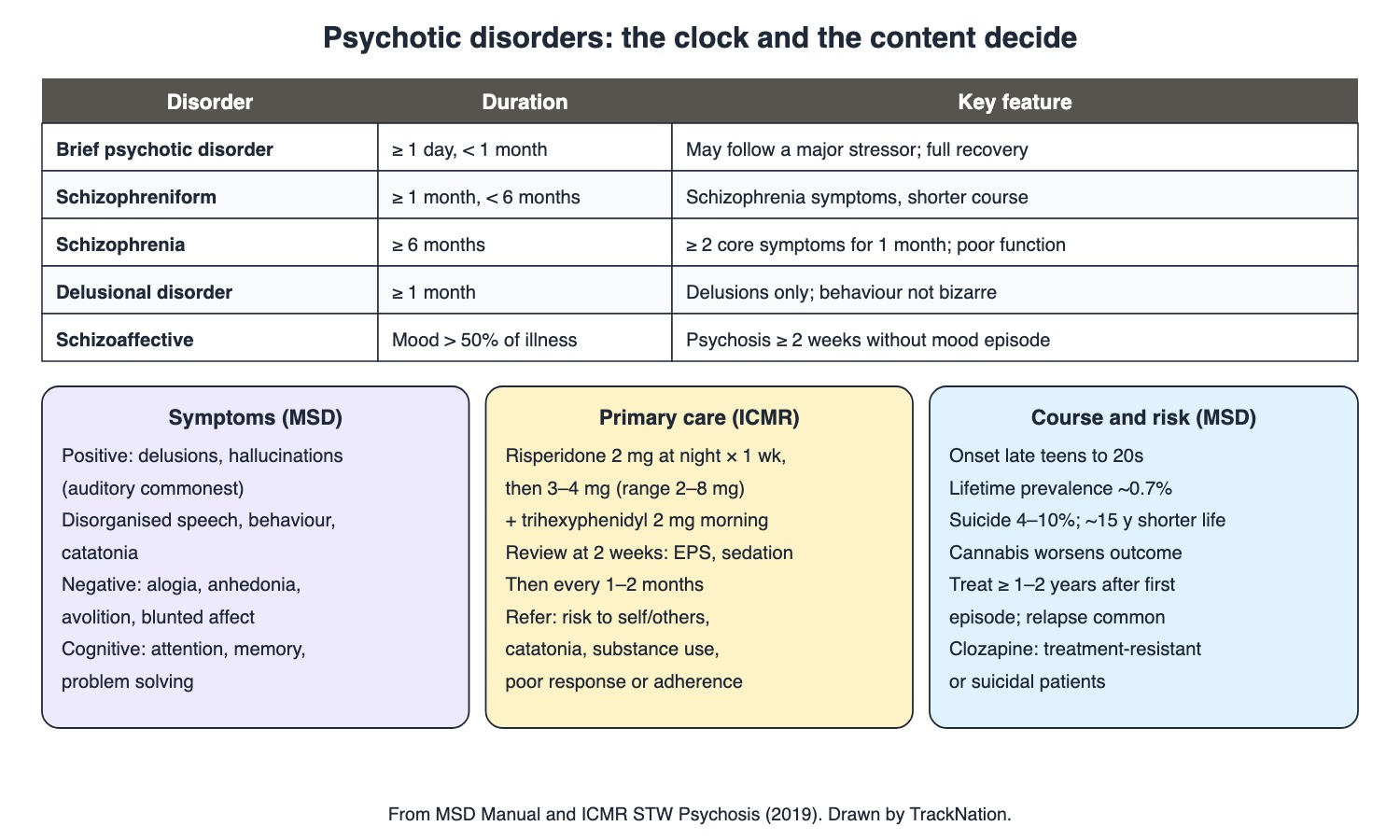
Psychotic disorders by duration; symptoms of schizophrenia; ICMR primary-care treatment; course and risk. Drawn by TrackNation.
Schizophrenia
Lifetime prevalence about 0.7%; starts in late adolescence (up to 40% of men before 20; women mid–late 20s). Heritability 60–80%; a first-degree relative raises odds 5–11-fold; monozygotic twin concordance 41–79%. Risk factors: urban living, poverty, childhood trauma, prenatal infections, and cannabis. Dopamine and glutamate transmission are implicated.
Positive symptoms: delusions (often bizarre; persecutory, reference, thought insertion/withdrawal); hallucinations, mostly auditory — voices commenting on behaviour or talking to each other; disorganised speech and behaviour; catatonia. Negative: alogia, anhedonia, avolition, blunted affect. Cognitive: attention, processing speed, memory, abstraction, social cognition — the main driver of disability. Old subtypes (paranoid, catatonic etc.) are no longer used.
Diagnosis (DSM-5-TR): ≥ 2 core symptoms for 1 month (at least one delusions, hallucinations or disorganised speech) and continuous signs for ≥ 6 months, with exclusion of medical causes. No lab or imaging test diagnoses it; collateral history matters.
ICMR primary care: risperidone 2 mg at night for 1 week, then 3–4 mg (range 2–8 mg) with trihexyphenidyl 2 mg in the morning; review at 2 weeks for EPS and sedation, then every 1–2 months for symptoms, weight, menstrual and sexual side effects. Refer for risk of harm, catatonia, diagnostic doubt, comorbid substance use or poor response.
Continue antipsychotics at least 1–2 years after a first episode (relapse falls to about 30% with continuous treatment); clozapine for treatment resistance or high suicide/aggression risk; family psychoeducation, CBT and cognitive remediation help.
Outcome: up to a quarter recover; relapses are common; substance use predicts poor outcome. Suicide 4–10% (highest in those with late onset and good premorbid function) and life is about 15 years shorter. Violence is linked to substance use, persecutory delusions, command hallucinations and non-adherence.
Other Psychotic Disorders
Brief psychotic disorder: psychosis ≥ 1 day but < 1 month, full return to normal; may follow a major stressor (brief reactive psychosis).
Schizophreniform disorder: schizophrenia-like symptoms for ≥ 1 month but < 6 months.
Delusional disorder: firm delusions for ≥ 1 month with no other psychotic symptoms and behaviour that is not bizarre; function is largely preserved apart from the delusion. Subtypes: erotomanic, grandiose, jealous, persecutory, somatic.
Schizoaffective disorder: mood episodes for most (> 50%) of the illness, plus psychosis for ≥ 2 weeks without a mood episode.
Delusion (MSD) | Belief |
Persecutory | Being tormented, followed, tricked or spied on |
Reference | Books, songs or news are directed at them |
Thought insertion / withdrawal | Thoughts are read, broadcast, or imposed by outside forces |
Erotomanic (delusional disorder) | Another person is in love with them |
Jealous | Partner is unfaithful |
Grandiose | Great talent or important discovery |
Somatic | Deformity, odour or parasite in the body |
Traps the Examiner Sets
Duration ladder: < 1 month brief, 1–6 months schizophreniform, ≥ 6 months schizophrenia.
Delusions alone with normal behaviour = delusional disorder.
Good premorbid function means better prognosis but higher suicide risk.
Clozapine is for treatment-resistant or suicidal patients.
Memory Hooks & Shortcuts
Shortcuts to lock in this article's numbers and lists. Each one only re-packages facts proven above.
🧠 Duration ladder '1 day – 1 month – 6 months': Brief → Schizophreniform → Schizophrenia — timing
🧠 Delusional disorder subtypes 'EGJPS': Erotomanic, Grandiose, Jealous, Persecutory, Somatic — delusional disorder
🧠 'Clozapine for the Can't-be-treated and the Considering-suicide' — clozapine
🧠 ICMR 'Risp + THP' — the antipsychotic comes with its anti-EPS partner — primary care
🧠 Paradox: 'good start, good outcome, greater suicide risk' — prognosis
Rapid-Revision Cards
Prevalence
~0.7% lifetime.
Onset
Late adolescence; 40% of men before 20.
Genetics
Heritability 60–80%; MZ 41–79%.
Risk factors
Cannabis, urban, trauma, prenatal infection.
Positive
Delusions, hallucinations, disorganisation.
Delusions
Persecutory, reference, insertion; bizarre.
Voices
Commenting, conversing.
Negative
Alogia, anhedonia, avolition.
Disability driver
Cognitive impairment.
Criteria
≥ 2 symptoms 1 month; ≥ 6 months total.
Brief psychotic
≥ 1 day, < 1 month.
Schizophreniform
1–6 months.
Delusional disorder
Delusion only ≥ 1 month.
Subtypes
Erotomanic, grandiose, jealous, persecutory, somatic.
Schizoaffective
Mood > 50%; psychosis 2 wk alone.
ICMR start
Risperidone 2 → 3–4 mg + THP 2 mg.
Maintenance
≥ 1–2 years after first episode.
Clozapine
Resistant or suicidal.
Suicide
4–10%.
Lifespan
~15 years shorter.
Old subtypes
No longer used.
Sources
Facts in this article were checked against these documents.
Standard Treatment Workflow: Psychosis — Indian Council of Medical Research, DHR, 2019 (link)
MSD Manual Professional: Schizophrenia; Brief Psychotic Disorder; Schizophreniform Disorder; Delusional Disorder; Schizoaffective Disorder — Merck & Co. (MSD Manuals), reviewed 2025–26 (link)
Competency Based Undergraduate Curriculum, Psychiatry (PS 4) — National Medical Commission, 2024
Test Yourself: Practice Questions
Thirty questions in NEET PG style, most of them clinical vignettes.
Practice Questions (NEET PG pattern)
Original questions written in the style of the exam: +4 for a correct answer, −1 for a wrong one. Every answer was checked against the sources listed above. NEET PG papers are not published by NBEMS, so these are not past-paper questions.
Q1. The lifetime prevalence of schizophrenia worldwide is about
(a) 0.7%
(b) 0.01%
(c) 15%
(d) 7%
Show answer
Answer: (a) — Per MSD.
Q2. Schizophrenia typically begins in
(a) infancy
(b) old age
(c) early childhood
(d) late adolescence or early adulthood
Show answer
Answer: (d) — Up to 40% of men before 20.
Q3. The concordance for schizophrenia in monozygotic twins is about
(a) 100%
(b) 10%
(c) 41–79%
(d) 1%
Show answer
Answer: (c) — Heritability 60–80%.
Q4. Which substance is singled out as a stressor that can trigger schizophrenia?
(a) nicotine
(b) caffeine
(c) cannabis
(d) alcohol only
Show answer
Answer: (c) — Also urban living, trauma, prenatal infection.
Q5. A man believes his neighbours are spying on him and following him. This is a
(a) somatic delusion
(b) grandiose delusion
(c) delusion of reference
(d) persecutory delusion
Show answer
Answer: (d) — Commonest type.
Q6. A patient says the radio announcer is sending messages meant only for her. This is a
(a) delusion of reference
(b) erotomanic delusion
(c) hallucination
(d) persecutory delusion
Show answer
Answer: (a) — Environmental cues directed at them.
Q7. A patient says thoughts are being put into his head by an outside force. This is
(a) flight of ideas
(b) thought insertion
(c) thought block
(d) obsession
Show answer
Answer: (b) — Also thought withdrawal and broadcasting.
Q8. Delusions in schizophrenia are characteristically
(a) only grandiose
(b) always plausible
(c) absent
(d) bizarre — clearly implausible
Show answer
Answer: (d) — E.g. organs removed without a scar.
Q9. A patient hears two voices discussing him and commenting on everything he does. These are typical of
(a) delirium tremens
(b) panic disorder
(c) schizophrenia (auditory hallucinations)
(d) OCD
Show answer
Answer: (c) — Auditory hallucinations are the commonest.
Q10. The major determinant of overall disability in schizophrenia is
(a) gender
(b) severity of cognitive impairment
(c) number of hallucinations
(d) age at onset only
Show answer
Answer: (b) — Attention, memory, problem solving.
Q11. DSM-5-TR schizophrenia requires continuous signs of illness for at least
(a) 6 months
(b) 1 month
(c) 2 weeks
(d) 1 year
Show answer
Answer: (a) — With ≥ 2 core symptoms for 1 month.
Q12. The characteristic-symptom criterion for schizophrenia is
(a) negative symptoms only
(b) mood symptoms for 2 weeks
(c) any 1 symptom for 1 day
(d) ≥ 2 core symptoms for at least 1 month, one being delusions, hallucinations or disorganised speech
Show answer
Answer: (d) — DSM-5-TR.
Q13. After her husband's sudden death, a woman develops hallucinations and delusions that resolve completely within 3 weeks. The diagnosis is
(a) schizophreniform disorder
(b) schizophrenia
(c) delusional disorder
(d) brief psychotic disorder
Show answer
Answer: (d) — ≥ 1 day and < 1 month.
Q14. Schizophrenia-like symptoms lasting 3 months suggest
(a) schizophreniform disorder
(b) schizophrenia
(c) brief psychotic disorder
(d) schizoaffective disorder
Show answer
Answer: (a) — ≥ 1 and < 6 months.
Q15. A man has been convinced for several months that his wife is unfaithful despite no evidence; otherwise he works normally and has no hallucinations. The diagnosis is
(a) schizophrenia
(b) paranoid personality only
(c) delusional disorder, jealous type
(d) OCD
Show answer
Answer: (c) — Delusions only; function preserved.
Q16. A woman insists that a famous actor is secretly in love with her. The delusion type is
(a) grandiose
(b) persecutory
(c) somatic
(d) erotomanic
Show answer
Answer: (d) — Delusional disorder subtype.
Q17. A man is convinced worms are crawling inside his body; otherwise he functions well. This is delusional disorder,
(a) jealous type
(b) erotomanic type
(c) somatic type
(d) grandiose type
Show answer
Answer: (c) — Bodily delusion.
Q18. Schizoaffective disorder requires
(a) mood symptoms for 2 days
(b) mood episodes for most of the illness plus psychosis for ≥ 2 weeks without a mood episode
(c) no mood symptoms
(d) psychosis only during mood episodes
Show answer
Answer: (b) — > 50% of illness duration.
Q19. The ICMR primary-care starting regimen for psychosis is
(a) clozapine 25 mg
(b) risperidone 2 mg at night for a week, then 3–4 mg, with trihexyphenidyl 2 mg
(c) haloperidol 20 mg daily
(d) olanzapine 30 mg
Show answer
Answer: (b) — Review at 2 weeks.
Q20. Why does ICMR add trihexyphenidyl to risperidone?
(a) to prevent extrapyramidal symptoms
(b) to aid sleep
(c) to boost antipsychotic effect
(d) to reduce weight gain
Show answer
Answer: (a) — EPS checked at 2 weeks.
Q21. The ICMR dose range of risperidone in maintenance is
(a) 100–200 mg/day
(b) 20–40 mg/day
(c) 0.1–0.5 mg/day
(d) 2–8 mg/day
Show answer
Answer: (d) — Adjust with THP 2–6 mg.
Q22. Which is an ICMR reason to refer a patient with psychosis from PHC?
(a) substantial risk of harm to self or others, or catatonia
(b) patient asks for follow-up
(c) first episode responding well
(d) mild sedation
Show answer
Answer: (a) — Also substance use, poor response.
Q23. After a first episode of schizophrenia, antipsychotics should be continued for at least
(a) 1–2 years
(b) 1 month
(c) lifelong in all
(d) 2 weeks
Show answer
Answer: (a) — Lowers relapse.
Q24. Clozapine is specifically recommended for schizophrenia that is
(a) mild
(b) first episode
(c) with weight gain
(d) treatment-resistant, or with high suicide or aggression risk
Show answer
Answer: (d) — APA recommendation cited by MSD.
Q25. Which intervention reduces relapse in patients living with their families?
(a) isolation from family
(b) psychoeducational family interventions
(c) stopping medication
(d) benzodiazepines
Show answer
Answer: (b) — Also CBT, cognitive remediation.
Q26. The proportion of people with schizophrenia who die by suicide is about
(a) 4–10%
(b) 0.1%
(c) 25%
(d) 50%
Show answer
Answer: (a) — About 35% attempt.
Q27. Which patients with schizophrenia have the best prognosis but also the highest suicide risk?
(a) those in institutions
(b) those with late onset and good premorbid functioning
(c) those with severe negative symptoms
(d) those with early onset
Show answer
Answer: (b) — Per MSD.
Q28. Violence in schizophrenia is more likely with
(a) negative symptoms alone
(b) good insight
(c) older age
(d) substance use, persecutory delusions, command hallucinations or non-adherence
Show answer
Answer: (d) — Per MSD.
Q29. The classic subtypes of schizophrenia (paranoid, catatonic, disorganised) are
(a) used for treatment choice
(b) no longer used because they proved unreliable
(c) required for diagnosis
(d) the basis of DSM-5-TR
Show answer
Answer: (b) — Deficit/non-deficit is an alternative.
Q30. Schizophrenia shortens average lifespan by about
(a) 15 years
(b) not at all
(c) 40 years
(d) 1 year
Show answer
Answer: (a) — Suicide and medical illness.
Active Recall
From memory: describe the epidemiology, risk factors and symptoms of schizophrenia, the diagnostic and duration rules for each psychotic disorder, the ICMR primary-care treatment, maintenance and clozapine use, and the prognosis and risks.