Bacterial Genetics and Molecular Diagnostics for NEET PG Microbiology: Transformation, Transduction, Conjugation, Mutations, PCR and MALDI-TOF
Start Here
🎯 Exam priority: Moderate. Expect: match the gene-transfer mechanism to the example (Griffith, toxin genes via phages, R plasmids by conjugation), mutation types, the Ames test, PCR temperatures and variants (RT-PCR, qPCR), Southern vs northern blot, and where MALDI-TOF and multiplex panels fit in the modern lab.
CBME mapping: MI1.3–1.4 (with MI1.1). Fact-checked against OpenStax Microbiology and the MSD Manual.
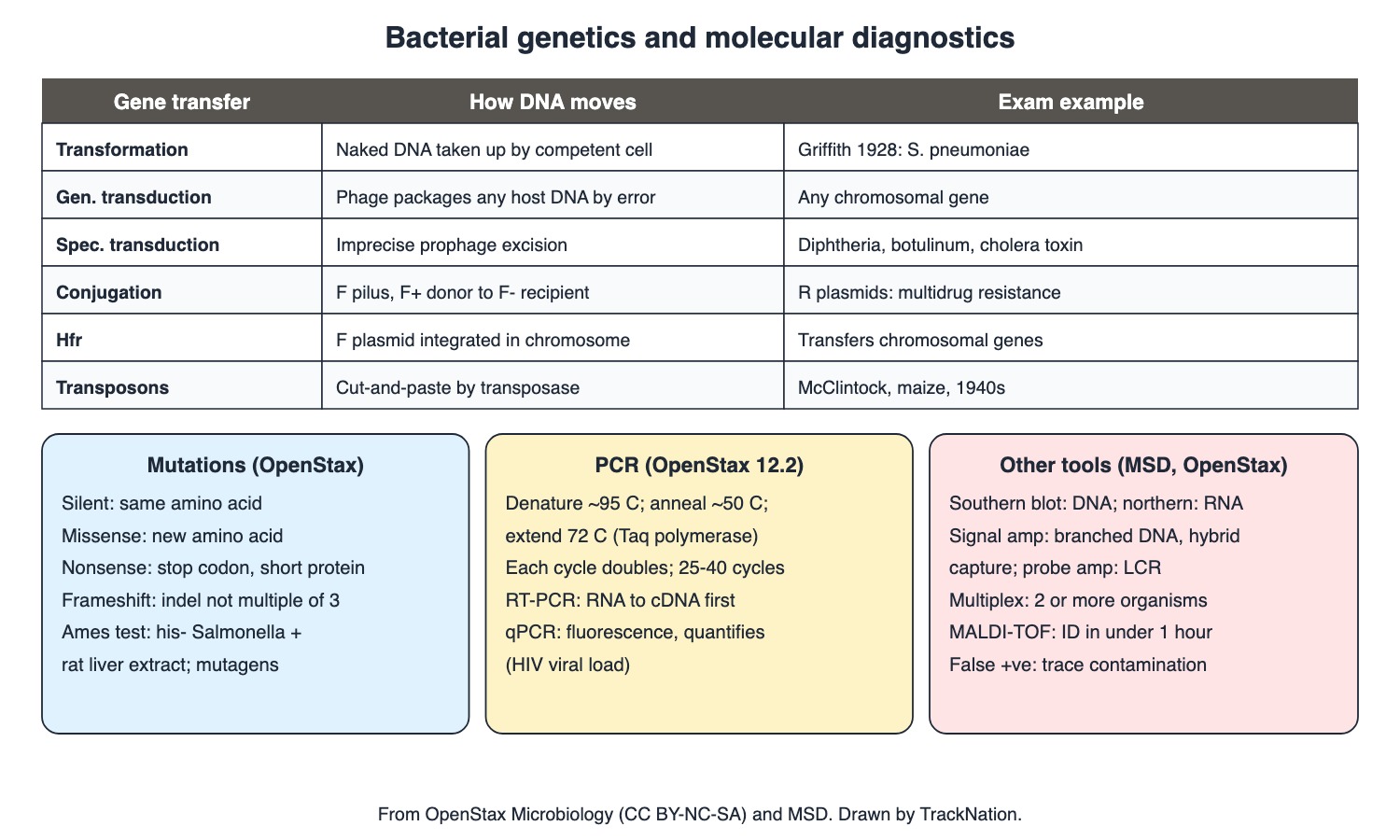
Gene transfer, mutations, PCR and molecular tools at a glance. Drawn by TrackNation.
How Bacteria Share Genes (OpenStax 11.6)
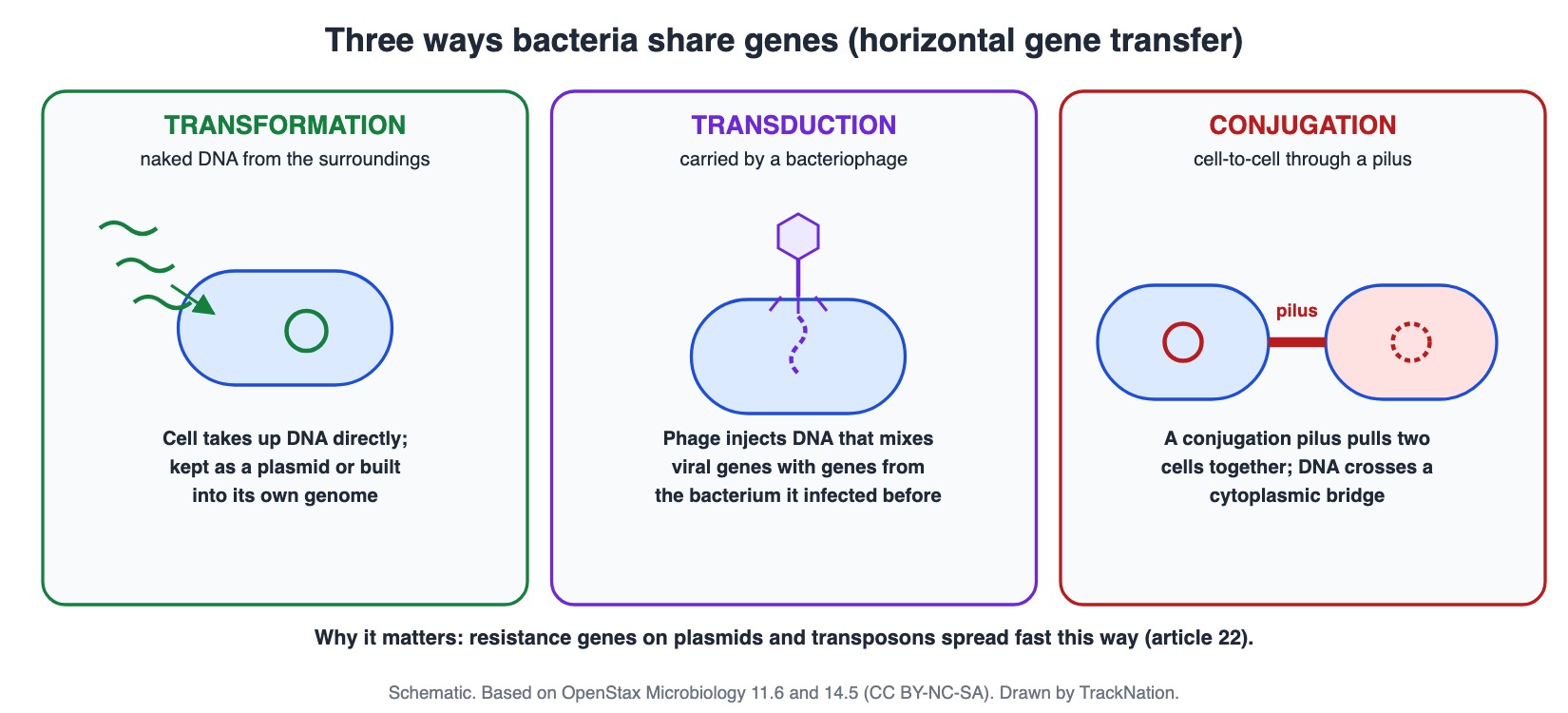
Transformation, transduction and conjugation. Drawn by TrackNation.
Bacteria divide asexually, so diversity comes from horizontal gene transfer — DNA passed between cells within the same generation, even across species.
Transformation: a competent cell takes up naked DNA from the environment. Griffith (1928) turned live non-pathogenic S. pneumoniae pathogenic with a heat-killed pathogenic strain (the "transforming principle"); Avery, MacLeod and McCarty (1944) showed it was DNA.
Transduction (by bacteriophage): generalized — any chromosomal DNA packaged into a phage head by accident; specialized — imprecise excision of a lysogenic prophage carries neighbouring genes. A phage bringing new traits is lysogenic conversion: the toxin genes of C. diphtheriae, C. botulinum and cholera toxin (CTX phage) arrive this way.
Conjugation: cell-to-cell contact through a conjugation (F) pilus. The F plasmid (fertility factor) makes a cell F+ (donor); F− cells are recipients. When F integrates into the chromosome the cell is Hfr (high frequency of recombination) and can pass chromosomal genes.
R plasmids carry resistance genes plus transfer genes, move within and between species, and one plasmid often carries resistance to several antibiotics — the engine of multidrug resistance.
Transposons ("jumping genes"): inverted repeats plus transposase; most move by cut-and-paste. Discovered in maize by Barbara McClintock (1940s); found in all organisms.
Mutations, Mutagens and Repair (OpenStax 11.5)
A mutation is a heritable change in DNA sequence. Point mutations: silent (same amino acid), missense (different amino acid), nonsense (new stop codon → short, usually non-functional protein).
Frameshift: insertion or deletion of a number of bases not a multiple of three — every codon downstream can change.
Mutagens: base analogues; nitrous acid (deaminates cytosine to uracil); intercalating agents (slide between bases → frameshifts); ionising radiation (X-rays, gamma rays: strand breaks); UV (non-ionising: thymine dimers).
Repair: photoreactivation (light repair) by photolyase for thymine dimers; nucleotide excision repair (dark repair) removes the dimer; mismatch repair fixes wrong bases right after replication.
Ames test: a histidine-requiring (his−) Salmonella typhimurium is exposed to a chemical, with rat liver extract to mimic metabolism, and plated on histidine-free medium; more revertant colonies = more mutagenic — a rapid, cheap screen for possible carcinogens.
PCR and Its Relatives (OpenStax 12.2)
PCR cycles through denaturation (~95 °C) → annealing of primers (~50 °C) → extension (72 °C) using heat-stable Taq polymerase from Thermus aquaticus. Each cycle doubles the target; protocols run 25–40 cycles.
RT-PCR: reverse transcriptase first converts RNA to cDNA — used for RNA targets, such as gene expression or RNA viruses like HIV.
Real-time (quantitative) PCR, qPCR: fluorescence tracks the product as it forms, so the starting amount can be quantified — qRT-PCR measures HIV viral load to monitor therapy.
Blots: Southern (Edwin Southern, 1975) = DNA; northern = RNA. Probes can be radioactive or fluorescent — FISH is fluorescent in situ hybridisation.
Typing and sequencing: RFLP (restriction-site differences give different bands; epidemiologists use it to trace outbreak sources); PFGE separates very large fragments; Sanger (chain-termination with ddNTPs, 1972); next-generation sequencing reads millions of short fragments quickly.
Molecular and Rapid ID in the Clinical Lab (MSD)
Nucleic acid tests are specific and highly sensitive, work for all microbe types, and are most useful for organisms that are hard or slow to grow — viruses, obligate intracellular pathogens, fungi, mycobacteria.
Three amplification families: target (PCR, RT-PCR, strand displacement, transcription amplification), signal (branched DNA, hybrid capture) and probe (ligase chain reaction). Products may then be sequenced, run on a microarray, or read by melting-curve analysis (real-time PCR).
Pitfalls: false positives from trace contamination; false negatives can still occur in symptomatic patients. Most tests target one organism, so the clinician must choose; multiplex panels detect two or more organisms at once (respiratory, enteric, neurological syndromes).
Non-nucleic identification: biochemical tests (e.g. catalase, coagulase) done step by step; MALDI-TOF mass spectrometry identifies bacteria (including mycobacteria), yeasts and moulds in under 1 hour versus 24–48 hours by traditional methods.
Traps the Examiner Sets
Toxin genes of diphtheria, botulism and cholera come by phage (lysogenic conversion), not by conjugation.
Spread of multidrug resistance between species = R plasmids by conjugation.
Southern = DNA, northern = RNA; qPCR (not standard PCR) quantifies.
A frameshift needs an insertion/deletion that is not a multiple of three.
Nucleic acid tests can also detect resistance genes — mecA in S. aureus means oxacillin (methicillin) resistance.
Memory Hooks & Shortcuts
Shortcuts to lock in this article's numbers and lists. Each one only re-packages facts proven above.
🧠 'Transformation = Taken from the environment; Transduction = Truck (phage); Conjugation = Contact (pilus)' — gene transfer
🧠 'Phages Deliver the Big Cholera toxins' — Diphtheria, Botulinum, Cholera by lysogenic conversion — lysogenic conversion
🧠 'S-D, N-R' — Southern blot = DNA, Northern blot = RNA — blots
🧠 PCR thermostat '95–50–72': Melt, Mate, Make — PCR
🧠 'Ames = Ask the Microbe if it's Edgy' — his− Salmonella reverts with mutagens — Ames test
Rapid-Revision Cards
Transformation
Naked DNA; Griffith 1928, pneumococcus.
Transforming principle
DNA (Avery, MacLeod, McCarty 1944).
Generalized transduction
Any host DNA packaged by error.
Specialized transduction
Imprecise prophage excision.
Lysogenic conversion
Diphtheria, botulinum, cholera toxins.
Conjugation
F pilus; F+ donor to F− recipient.
Hfr
F integrated; passes chromosomal genes.
R plasmid
Multidrug resistance; crosses species.
Transposon
Transposase; McClintock, maize.
Silent / missense
Same / different amino acid.
Nonsense
Stop codon; short protein.
Frameshift
Indel not a multiple of 3.
UV damage
Thymine dimers; photolyase repairs.
Ames test
his− Salmonella + rat liver extract.
PCR steps
95 → 50 → 72 °C; Taq.
RT-PCR
RNA → cDNA first.
qPCR
Quantifies; HIV viral load.
Blots
Southern DNA; northern RNA.
Signal amplification
Branched DNA, hybrid capture.
Probe amplification
Ligase chain reaction.
MALDI-TOF
ID in under 1 h vs 24–48 h.
Sources
Facts in this article were checked against these documents.
Microbiology (sections 11.5, 11.6, 12.2) — Parker N, Schneegurt M, Thi Tu A-H, Lister P, Forster BM (OpenStax), 2016 (link)
MSD Manual Professional: Nucleic Acid–Based Identification Methods; Non-Nucleic Acid–Based Identification Methods — Merck & Co. (MSD Manuals), 2024–25 (link)
Competency Based Undergraduate Curriculum, Vol I: Microbiology (MI1.3–1.4) — National Medical Commission, 2024
Test Yourself: Practice Questions
Thirty questions in NEET PG style, several of them clinical or lab scenarios.
Practice Questions (NEET PG pattern)
Original questions written in the style of the exam: +4 for a correct answer, −1 for a wrong one. Every answer was checked against the sources listed above. NEET PG papers are not published by NBEMS, so these are not past-paper questions.
Q1. Griffith's 1928 experiment, in which heat-killed virulent pneumococci made live avirulent pneumococci virulent, demonstrated
(a) transposition
(b) transformation
(c) transduction
(d) conjugation
Show answer
Answer: (b) — Transforming principle; Avery et al. showed it was DNA.
Q2. The 'transforming principle' was identified as DNA in 1944 by
(a) Hershey and Chase
(b) Watson and Crick
(c) Lederberg and Tatum
(d) Avery, MacLeod and McCarty
Show answer
Answer: (d) — OpenStax.
Q3. Bacteria that can actively bind and take up DNA from their surroundings are described as
(a) competent
(b) Hfr
(c) auxotrophic
(d) lysogenic
Show answer
Answer: (a) — Natural competence.
Q4. In generalized transduction
(a) DNA passes through a pilus
(b) only genes next to the prophage site are moved
(c) naked DNA is taken up
(d) any chromosomal DNA can be packaged into a phage head by accident
Show answer
Answer: (d) — Specialized = adjacent genes only.
Q5. Specialized transduction results from
(a) uptake of naked DNA
(b) random packaging of host DNA
(c) F plasmid transfer
(d) imprecise excision of a lysogenic prophage
Show answer
Answer: (d) — OpenStax.
Q6. A non-toxigenic strain of Corynebacterium diphtheriae becomes toxigenic after infection by a temperate bacteriophage. This is
(a) lysogenic conversion
(b) transformation
(c) mutation
(d) conjugation
Show answer
Answer: (a) — Also C. botulinum and V. cholerae (CTX phage).
Q7. The cholera toxin gene reaches Vibrio cholerae through
(a) a transposon from E. coli
(b) transformation
(c) an R plasmid
(d) the lysogenic CTX phage (specialized transduction)
Show answer
Answer: (d) — OpenStax.
Q8. Transfer of DNA between bacteria through direct contact via a pilus is
(a) transformation
(b) transduction
(c) transposition
(d) conjugation
Show answer
Answer: (d) — F pilus.
Q9. In E. coli, the plasmid that encodes the conjugation pilus is the
(a) Col plasmid
(b) R plasmid
(c) F plasmid (fertility factor)
(d) Ti plasmid
Show answer
Answer: (c) — F+ = donor.
Q10. An Hfr cell is one in which the
(a) R plasmid is present
(b) cell has lost the F plasmid
(c) F plasmid has integrated into the chromosome
(d) prophage has excised
Show answer
Answer: (c) — High frequency of recombination.
Q11. A hospital Klebsiella isolate passes resistance to several antibiotic classes to an E. coli in the same patient. The most likely vehicle is
(a) lysogenic conversion
(b) a point mutation
(c) an R plasmid transferred by conjugation
(d) transformation by a bacteriophage
Show answer
Answer: (c) — R plasmids cross species and carry multiple genes.
Q12. 'Jumping genes' carry inverted repeats and a gene for
(a) reverse transcriptase
(b) transposase
(c) integrase only
(d) beta-lactamase only
Show answer
Answer: (b) — Transposons.
Q13. Transposons were first discovered by
(a) Barbara McClintock in maize
(b) Griffith in pneumococci
(c) Ames in Salmonella
(d) Lederberg in E. coli
Show answer
Answer: (a) — 1940s.
Q14. A point mutation that changes a codon to one coding for the same amino acid is
(a) frameshift
(b) missense
(c) nonsense
(d) silent
Show answer
Answer: (d) — No protein change.
Q15. A mutation that converts a sense codon into a stop codon is a
(a) nonsense mutation
(b) missense mutation
(c) frameshift mutation
(d) silent mutation
Show answer
Answer: (a) — Truncated protein.
Q16. A frameshift mutation results from insertion or deletion of
(a) a number of bases that is not a multiple of three
(b) a single base substitution
(c) a whole gene
(d) exactly three bases
Show answer
Answer: (a) — Reading frame shifts.
Q17. Nitrous acid causes mutation by
(a) deaminating cytosine to uracil
(b) forming thymine dimers
(c) breaking both strands
(d) intercalating between bases
Show answer
Answer: (a) — GC to AT.
Q18. Ultraviolet light damages DNA mainly by forming
(a) thymine dimers
(b) cross-links with protein
(c) double-strand breaks
(d) uracil
Show answer
Answer: (a) — Ionising radiation breaks strands.
Q19. Thymine dimers are repaired directly in visible light by
(a) DNA ligase alone
(b) transposase
(c) reverse transcriptase
(d) photolyase (photoreactivation)
Show answer
Answer: (d) — Light repair.
Q20. The Ames test screens chemicals for carcinogenic potential using
(a) human lymphocytes
(b) E. coli lac mutants
(c) a histidine-requiring Salmonella typhimurium strain with rat liver extract
(d) mice only
Show answer
Answer: (c) — Revertants on histidine-free medium.
Q21. In PCR, the step at about 50 °C is
(a) denaturation
(b) extension
(c) reverse transcription
(d) primer annealing
Show answer
Answer: (d) — 95 → 50 → 72 °C.
Q22. Taq polymerase is used in PCR because it
(a) is heat-stable, coming from Thermus aquaticus
(b) copies RNA directly
(c) is cheap to make from E. coli
(d) works without primers
Show answer
Answer: (a) — Survives 95 °C.
Q23. To detect an RNA virus by PCR, the extra first step needed is
(a) reverse transcription of RNA to cDNA
(b) restriction digestion
(c) Southern blotting
(d) bisulfite treatment
Show answer
Answer: (a) — RT-PCR.
Q24. HIV viral load to monitor antiretroviral therapy is measured by
(a) MALDI-TOF
(b) Sanger sequencing
(c) quantitative (real-time) RT-PCR
(d) Southern blot
Show answer
Answer: (c) — Fluorescence quantifies.
Q25. A northern blot detects
(a) RNA
(b) DNA
(c) carbohydrate antigen
(d) protein
Show answer
Answer: (a) — Southern = DNA.
Q26. Sanger sequencing uses chain termination by
(a) dideoxynucleotides (ddNTPs)
(b) reverse transcriptase
(c) restriction enzymes
(d) ligase
Show answer
Answer: (a) — Frederick Sanger, 1972.
Q27. Branched DNA assays and hybrid capture are examples of
(a) target amplification
(b) probe amplification
(c) signal amplification
(d) mass spectrometry
Show answer
Answer: (c) — MSD.
Q28. The ligase chain reaction is a form of
(a) probe amplification
(b) signal amplification
(c) culture
(d) target amplification
Show answer
Answer: (a) — MSD.
Q29. A PCR panel is positive for an organism the patient is unlikely to have; the commonest technical cause of such a false positive is
(a) too few cycles
(b) absence of a cell wall
(c) trace contamination of the specimen or equipment
(d) low sensitivity
Show answer
Answer: (c) — Highly sensitive methods.
Q30. MALDI-TOF mass spectrometry in the microbiology lab mainly allows
(a) serology
(b) antibiotic susceptibility testing
(c) identification of bacteria and yeasts in under an hour
(d) viral load measurement
Show answer
Answer: (c) — Traditional ID takes 24–48 h.
Active Recall
From memory: describe the three routes of horizontal gene transfer with an example each, explain lysogenic conversion and R plasmids, classify mutations and mutagens, outline the Ames test, give the PCR steps and its variants, and list the molecular and rapid identification methods with their pitfalls.