Immunology I for NEET PG Microbiology: Innate Immunity, Complement, Antibody Classes, MHC, T and B Cells
Start Here
🎯 Exam priority: High. Expect: antibody-class one-liners (crosses placenta, first made, secretory dimer, mast-cell bound), the three complement pathways and what C3b, C3a/C5a and C5b–9 do, MHC I vs II, CD4 vs CD8, T-helper subsets, superantigens, haptens, T-dependent vs T-independent antigens, and the primary vs secondary response.
CBME mapping: MI2.1–2.4. Fact-checked against OpenStax Microbiology chapters 17–18.
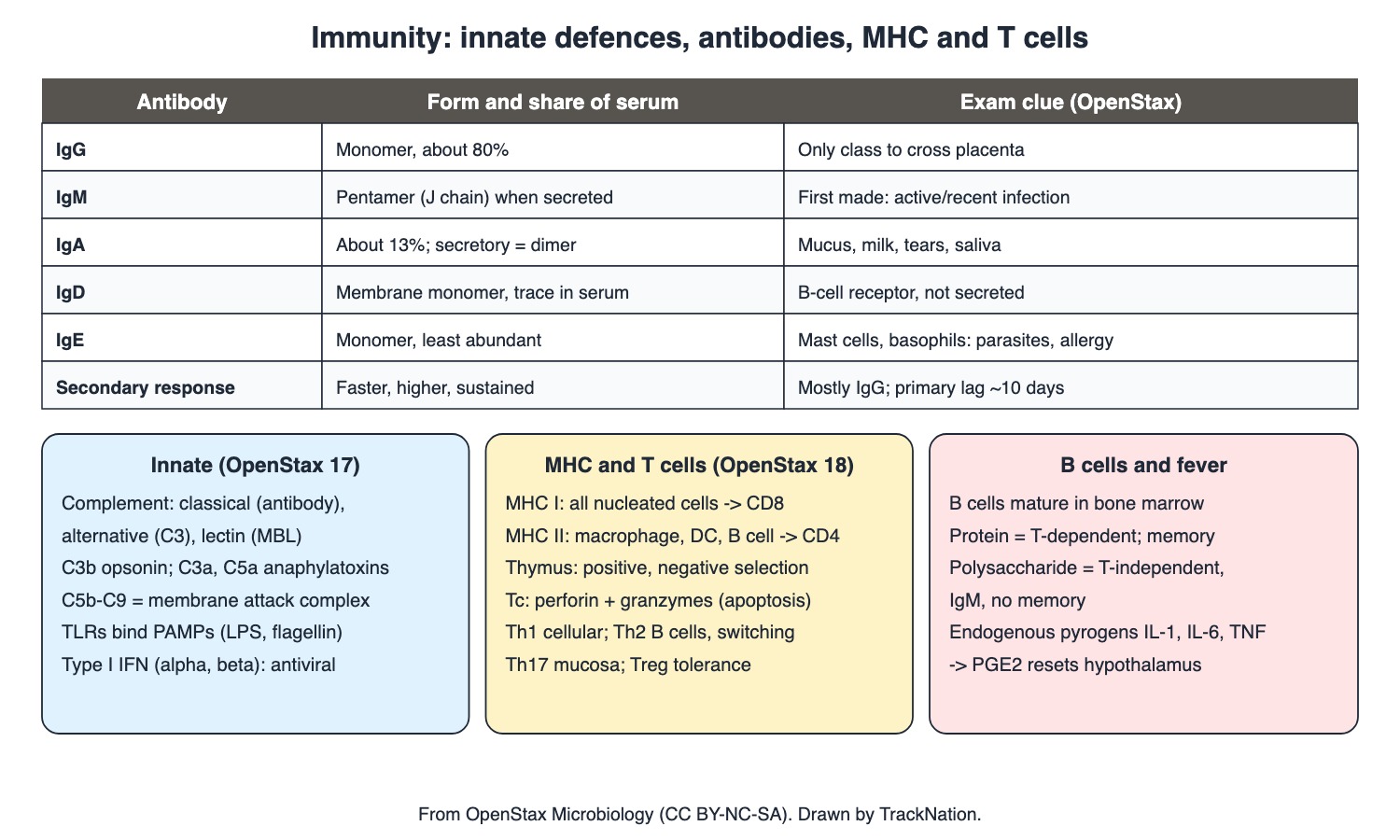
Antibody classes, innate defences, MHC, T and B cells. Drawn by TrackNation.
Innate Defences (OpenStax 17.2–17.4)
Chemical barriers: lysozyme (secretions, Paneth cells), stomach acid, defensins (antimicrobial peptides that damage membranes).
Complement: three pathways — classical (starts when antibody binds antigen), alternative (spontaneous C3 hydrolysis; C3b sticks to microbes) and lectin (mannose-binding lectin). All lead to opsonisation, inflammation, chemotaxis and cytolysis. C3b opsonises; C3a and C5a are anaphylatoxins (mast-cell degranulation; C5a is a potent chemoattractant); C5b–C9 form the membrane attack complex.
Type I interferons (α, β) come from virus-infected cells and make neighbours shut down protein synthesis — antiviral. Acute-phase proteins: CRP (opsonises bacteria), serum amyloid A, ferritin, transferrin, fibrinogen, MBL.
Cells: neutrophils kill extracellular bacteria; eosinophils fight protozoa and helminths (major basic protein) and join allergy; basophils in blood and mast cells in tissue drive inflammation; monocytes become macrophages and dendritic cells; NK cells kill virus-infected and cancer cells non-specifically.
Recognition: PAMPs (peptidoglycan, flagellin, LPS, lipopeptides, viral nucleic acids) bind pattern-recognition receptors such as toll-like receptors. Opsonins: antibody, C1q, C3b, C4b, lectins. Killing: phagolysosome and the respiratory burst (superoxide, H2O2, hydroxyl radicals).
Inflammation and Fever (OpenStax 17.5)
Signs: redness, swelling, heat, pain, altered function, from vasodilation and leaky vessels.
LPS (endotoxin) is an exogenous pyrogen; it triggers endogenous pyrogens IL-1, IL-6, IFN-γ and TNF, which release PGE2 to reset the hypothalamic thermostat.
Chronic inflammation can wall off infection as a granuloma — tuberculosis is the classic example.
Antigens and Antibodies (OpenStax 18.1, 18.4)
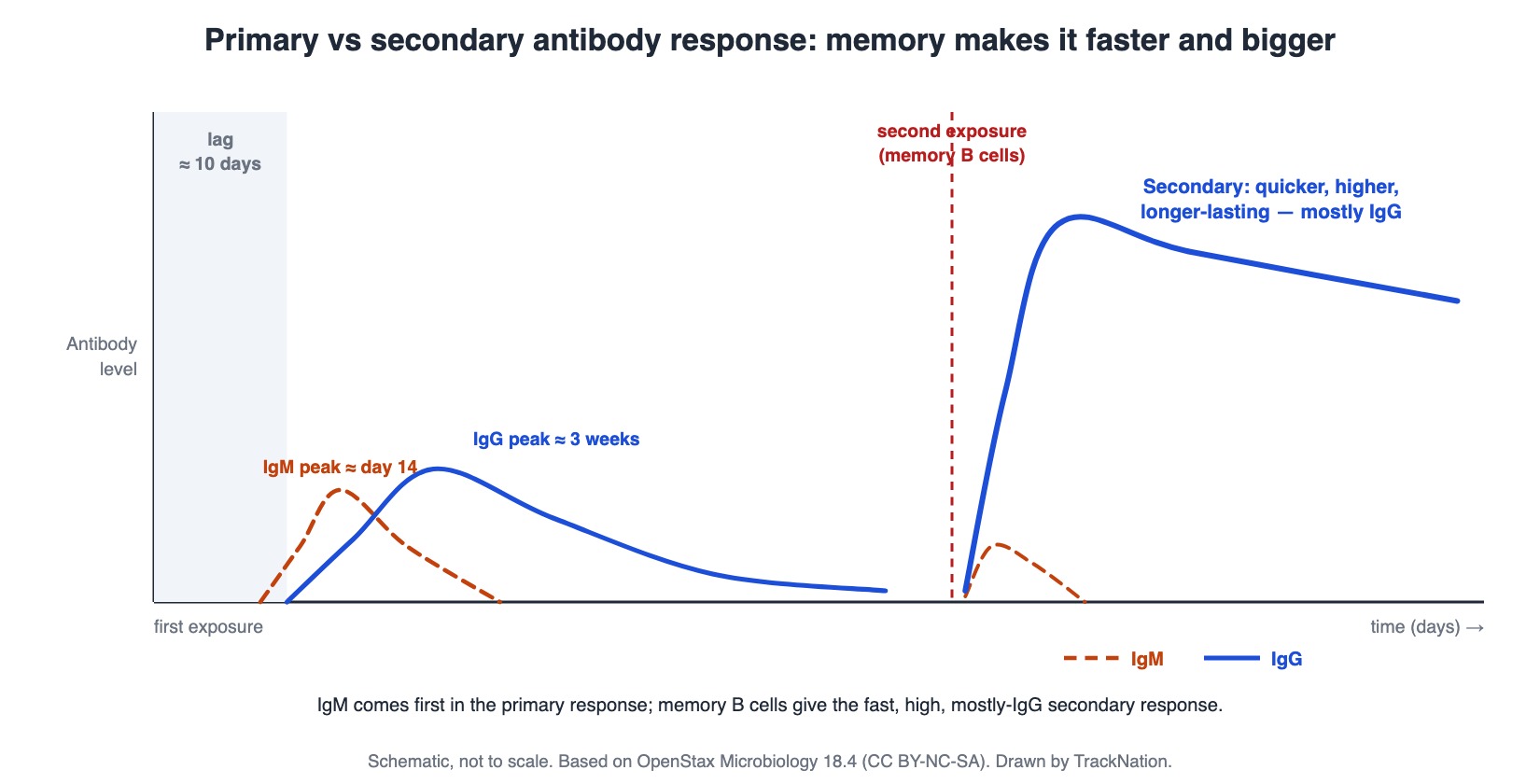
Primary vs secondary antibody response: lag, IgM then IgG, and the faster memory response. Drawn by TrackNation.
An antigen carries many epitopes. A hapten is a free epitope too small to be immunogenic alone — it must bind a carrier protein (e.g. penicillin allergy, poison-ivy urushiol).
Antibody structure: Fab with the variable region binds antigen; Fc binds complement and phagocytes (opsonisation). The constant region sets the class.
IgG: monomer, ~80% of serum antibody, the only class that crosses the placenta. IgM: secreted as a pentamer (J chain), the first antibody made — marker of active or recent infection. IgA: ~13% of serum; secretory IgA is a dimer (secretory component) in mucus, milk, tears, saliva. IgD: B-cell surface receptor, not secreted. IgE: least abundant; binds mast cells and basophils — parasites and allergy.
B cells mature in bone marrow. Protein antigens are T-dependent (B cell presents on MHC II to helper T cells; class switching and memory). Polysaccharides and LPS are T-independent — plasma cells make IgM and no memory B cells form.
Primary response: lag of ~10 days with no detectable antibody. Secondary response: faster, higher, longer, and mostly IgG. TH2 cytokines drive class switching (same epitope, new class).
MHC and T Cells (OpenStax 18.2–18.3)
MHC I: on all nucleated cells; presents to CD8 cytotoxic T cells. MHC II: only on macrophages, dendritic cells and B cells; presents to CD4 helper T cells.
T cells mature in the thymus through positive selection (must recognise MHC) and negative selection (remove defective or self-reactive cells). Escapees are controlled by anergy and regulatory T cells (peripheral tolerance).
CD4 = helper and regulatory T cells; CD8 = cytotoxic. Cytotoxic T cells kill with perforin (pores) and granzymes (apoptosis).
TH1: cellular immunity — activate cytotoxic T cells and macrophages for intracellular killing. TH2: humoral — activate B cells, class switching. TH17: defence against chronic mucocutaneous infections (low in HIV mucosa).
Superantigens (TSST, staphylococcal enterotoxins, streptococcal pyrogenic toxins; EBV, CMV) bridge MHC II and the TCR β-chain variable region outside the antigen groove — massive T-cell activation and a cytokine storm.
Traps the Examiner Sets
Only IgG crosses the placenta, so pathogen-specific IgM in a newborn was made by the baby — it points to fetal or neonatal infection.
Most abundant in serum = IgG; most abundant in secretions = secretory IgA; least = IgE.
Polysaccharide antigens give IgM without memory (T-independent) — the reason conjugate vaccines join a protein to the capsule polysaccharide.
Superantigens bind outside the peptide groove — non-specific activation, not true antigen presentation.
Memory Hooks & Shortcuts
Shortcuts to lock in this article's numbers and lists. Each one only re-packages facts proven above.
🧠 'G goes to the Growing baby' — IgG crosses the placenta; 'M is the Messenger who arrives first' — antibodies
🧠 'A is At the surfaces (secretions), D is on the Dock (B-cell receptor), E for Eosinophil-era Enemies and allergy' — antibodies
🧠 'MHC × CD = 8': MHC I with CD8, MHC II with CD4 (1×8 = 2×4 = 8) — MHC
🧠 'C-3-5, a-for-Anaphylaxis, b-for-Binding' — C3a/C5a anaphylatoxins; C3b opsonin, C5b starts MAC — complement
🧠 'Sugar alone gives no Memory' — polysaccharides are T-independent — B cells
Rapid-Revision Cards
IgG
~80%; crosses placenta.
IgM
Pentamer; first made.
IgA
~13%; secretory dimer.
IgD
B-cell receptor; not secreted.
IgE
Least; mast cells, basophils.
Fab / Fc
Antigen binding / complement, phagocytes.
Hapten
Needs carrier protein (penicillin).
Classical pathway
Antibody–antigen start.
Alternative pathway
Spontaneous C3.
Lectin pathway
Mannose-binding lectin.
Anaphylatoxins
C3a, C5a.
MAC
C5b–C9.
Type I IFN
α, β; antiviral.
CRP
Acute phase; opsonin.
Pyrogens
IL-1, IL-6, TNF → PGE2.
MHC I / II
All nucleated → CD8 / APCs → CD4.
Tc killing
Perforin + granzymes.
TH1 / TH2 / TH17
Cellular / humoral / mucocutaneous.
Superantigen
MHC II + TCR β outside groove.
T-independent
Polysaccharide; IgM, no memory.
Secondary response
Faster, higher, IgG.
Sources
Facts in this article were checked against these documents.
Microbiology (sections 17.2–17.5, 18.1–18.4) — Parker N, Schneegurt M, Thi Tu A-H, Lister P, Forster BM (OpenStax), 2016 (link)
Competency Based Undergraduate Curriculum, Vol I: Microbiology (MI2.1–2.4) — National Medical Commission, 2024
Test Yourself: Practice Questions
Thirty questions in NEET PG style, several of them clinical scenarios.
Practice Questions (NEET PG pattern)
Original questions written in the style of the exam: +4 for a correct answer, −1 for a wrong one. Every answer was checked against the sources listed above. NEET PG papers are not published by NBEMS, so these are not past-paper questions.
Q1. The only antibody class that crosses the placenta is
(a) IgG
(b) IgE
(c) IgM
(d) IgA
Show answer
Answer: (a) — Passive immunity to fetus.
Q2. A newborn has raised pathogen-specific IgM. This suggests
(a) vaccination of the mother
(b) normal finding
(c) maternal antibody transfer
(d) infection of the fetus or newborn itself
Show answer
Answer: (d) — IgM is first made; maternal transfer is IgG only.
Q3. IgG makes up about what share of total serum antibody?
(a) 13%
(b) 50%
(c) 80%
(d) 5%
Show answer
Answer: (c) — IgA ~13%.
Q4. Secreted IgM is a
(a) monomer
(b) trimer
(c) pentamer joined by a J chain
(d) dimer with a secretory component
Show answer
Answer: (c) — Ten Fab sites.
Q5. The antibody found as a dimer in breast milk, tears and saliva is
(a) IgG
(b) IgM
(c) IgD
(d) secretory IgA
Show answer
Answer: (d) — Secretory component.
Q6. The antibody that is a B-cell surface receptor and is not secreted is
(a) IgD
(b) IgG
(c) IgE
(d) IgA
Show answer
Answer: (a) — Trace in serum.
Q7. The least abundant serum antibody, bound to mast cells and basophils, is
(a) IgE
(b) IgA
(c) IgM
(d) IgD
Show answer
Answer: (a) — Parasites, allergy.
Q8. The part of an antibody that binds complement and phagocytes is the
(a) variable region
(b) Fc region
(c) light chain
(d) hinge only
Show answer
Answer: (b) — Fab binds antigen.
Q9. Penicillin causes allergy despite being a small molecule because it acts as a
(a) T-independent antigen
(b) superantigen
(c) complete antigen alone
(d) hapten bound to a carrier protein
Show answer
Answer: (d) — OpenStax.
Q10. The complement pathway that begins with antibody bound to antigen is the
(a) alternative pathway
(b) terminal pathway
(c) lectin pathway
(d) classical pathway
Show answer
Answer: (d) — OpenStax.
Q11. The alternative complement pathway starts with
(a) C5 cleavage
(b) C1q binding antibody
(c) spontaneous activation of C3
(d) mannose-binding lectin
Show answer
Answer: (c) — C3b binds microbes.
Q12. C3a and C5a are
(a) antibodies
(b) anaphylatoxins
(c) parts of the membrane attack complex
(d) opsonins only
Show answer
Answer: (b) — Mast-cell degranulation.
Q13. The membrane attack complex is formed by
(a) C5b with C6–C9
(b) C3a and C5a
(c) C1q, C1r, C1s
(d) C4b and C2a
Show answer
Answer: (a) — Lyses cells.
Q14. Interferon-α and -β are produced by
(a) virus-infected cells, to limit viral spread
(b) plasma cells
(c) mast cells
(d) eosinophils
Show answer
Answer: (a) — Type I IFN.
Q15. An acute-phase protein that coats bacteria to aid phagocytosis is
(a) C-reactive protein
(b) perforin
(c) albumin
(d) IgD
Show answer
Answer: (a) — Opsonisation.
Q16. Eosinophils mainly protect against
(a) fungi only
(b) extracellular bacteria
(c) helminths and protozoa
(d) viruses
Show answer
Answer: (c) — Major basic protein.
Q17. Lymphocytes that kill virus-infected and tumour cells without prior sensitisation are
(a) B cells
(b) NK cells
(c) plasma cells
(d) helper T cells
Show answer
Answer: (b) — Innate.
Q18. Toll-like receptors on phagocytes recognise
(a) pathogen-associated molecular patterns such as LPS and flagellin
(b) self antigens
(c) MHC II–peptide complexes
(d) IgE
Show answer
Answer: (a) — PRRs.
Q19. Endogenous pyrogens that reset the hypothalamus via PGE2 include
(a) IL-4 and IL-5
(b) C3b and C4b
(c) IgG and IgM
(d) IL-1, IL-6 and TNF
Show answer
Answer: (d) — LPS is exogenous.
Q20. Granuloma formation is a feature of chronic inflammation as seen classically in
(a) tetanus
(b) tuberculosis
(c) influenza
(d) cholera
Show answer
Answer: (b) — OpenStax.
Q21. MHC class I molecules are present on
(a) only T cells
(b) only macrophages, dendritic cells and B cells
(c) all nucleated cells
(d) only red cells
Show answer
Answer: (c) — Present to CD8.
Q22. MHC class II molecules are found on
(a) all nucleated cells
(b) neutrophils only
(c) erythrocytes
(d) macrophages, dendritic cells and B cells
Show answer
Answer: (d) — Present to CD4.
Q23. Cytotoxic T cells carry the marker
(a) CD4
(b) CD56
(c) CD8
(d) CD19
Show answer
Answer: (c) — Helper and Treg are CD4.
Q24. Cytotoxic T cells kill infected cells mainly by
(a) IgE release
(b) phagocytosis
(c) complement fixation
(d) perforin and granzymes inducing apoptosis
Show answer
Answer: (d) — OpenStax.
Q25. Recurrent chronic mucocutaneous infections point to a defect in
(a) TH2 cells
(b) complement C3
(c) IgE
(d) TH17 cells
Show answer
Answer: (d) — OpenStax.
Q26. The T-helper subset that drives B-cell activation and class switching is
(a) Treg
(b) TH17
(c) TH1
(d) TH2
Show answer
Answer: (d) — Humoral.
Q27. Toxic shock syndrome toxin causes massive cytokine release because it
(a) binds IgE
(b) is presented on MHC I
(c) binds MHC II and the TCR β-chain outside the peptide groove
(d) activates complement directly
Show answer
Answer: (c) — Superantigen.
Q28. Thymic selection that deletes T cells with defective receptors is
(a) class switching
(b) anergy
(c) negative selection
(d) positive selection
Show answer
Answer: (c) — OpenStax.
Q29. Pure polysaccharide antigens produce
(a) IgE only
(b) T-independent IgM responses without memory B cells
(c) strong T-dependent memory
(d) cytotoxic T cells
Show answer
Answer: (b) — OpenStax.
Q30. Compared with the primary response, the secondary antibody response is
(a) faster, higher and mostly IgG
(b) only IgA
(c) slower and mostly IgM
(d) the same
Show answer
Answer: (a) — Primary lag ~10 days.
Active Recall
From memory: describe the innate chemical and cellular defences, the three complement pathways and their products, pyrogens and fever, antigen, epitope and hapten, the five antibody classes with one clue each, MHC I and II with their T-cell partners, thymic selection, T-helper subsets, superantigens, and T-dependent vs T-independent and primary vs secondary responses.