Sterilisation, Disinfection and Biomedical Waste for NEET PG Microbiology: Autoclave, Dry Heat, Disinfectants, Spaulding Levels and BMW Colour Codes
Start Here
🎯 Exam priority: High. Expect: autoclave and hot-air-oven parameters, the biological indicator for each method, which disinfectant for which job (endoscopes, skin, heat-sensitive kit), what kills prions, critical vs semicritical items, biosafety levels, and the BMW colour code — which bag for which waste, storage limits and the 2018 changes.
CBME mapping: MI1.12–1.13 and MI10.3. Fact-checked against OpenStax Microbiology and the Bio-Medical Waste Management Rules 2016 with their 2018, 2019 and 2026 amendments.
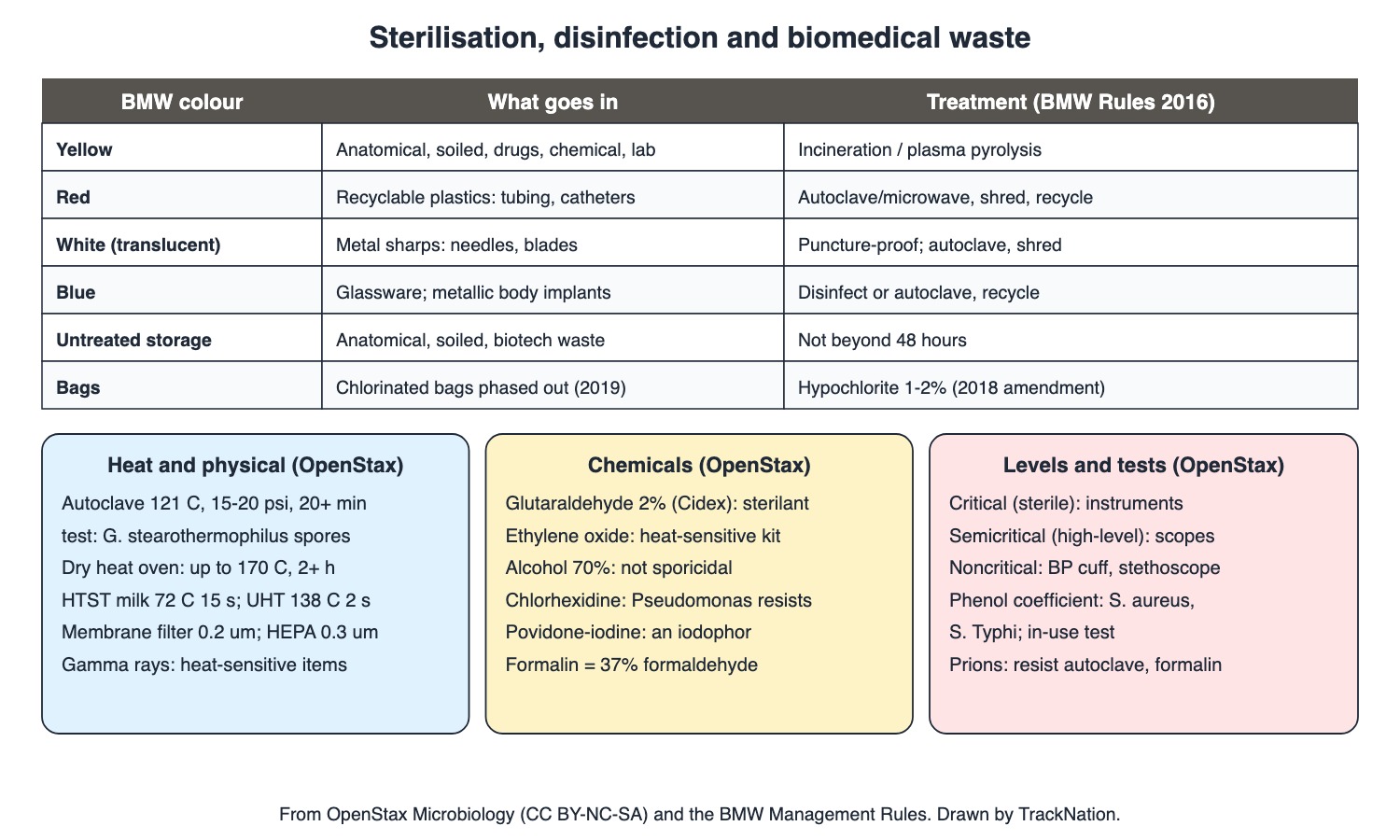
BMW colours, heat and physical methods, chemicals and Spaulding levels. Drawn by TrackNation.
Words That Get Confused (OpenStax 13.1)
Sterilisation: removal or killing of all vegetative cells, endospores and viruses. Disinfection: on non-living surfaces; endospores usually survive, so the item is not sterile.
Antiseptics are safe on living skin or tissue (e.g. hydrogen peroxide, isopropyl alcohol). Degerming (handwashing, alcohol swab) reduces numbers; sanitisation brings fomites to a safe level.
-cidal kills; -static stops growth. The D-value (decimal reduction time) is the time to kill 90% (one log) of a population.
Spaulding levels: critical items enter sterile tissue or blood — surgical instruments, catheters, IV fluids — must be sterile; semicritical items touch mucosa or broken skin — GI endoscopes, respiratory equipment — need high-level disinfection; noncritical items touch intact skin — linen, crutches, stethoscopes, BP cuffs — need cleaning.
Biosafety levels: BSL-1 — agents that do not infect healthy adults (non-pathogenic E. coli, B. subtilis); BSL-2 — moderate risk (S. aureus, Salmonella, hepatitis viruses), biological safety cabinet for aerosols; BSL-3 — lethal by inhalation (M. tuberculosis, B. anthracis, West Nile virus, HIV); BSL-4 — most dangerous, no treatment or vaccine (Ebola, Marburg).
Heat, Filtration and Radiation (OpenStax 13.2)
Moist heat beats dry heat because it penetrates cells better. The autoclave (Chamberland, 1879) is the most effective sterilisation method: 121 °C (sometimes 132 °C) at 15–20 psi, typically 20 minutes or more, longer for large loads.
Biological indicator for the autoclave: spores of Geobacillus stearothermophilus (gold standard; extreme heat resistance).
Dry heat: flaming or incinerating a loop; an oven for at least 2 hours at up to 170 °C. Boiling kills vegetative cells but some spores survive up to 20 hours of boiling.
Pasteurisation does not sterilise: HTST 72 °C for 15 s; UHT 138 °C for ≥2 s (shelf-stable).
Filtration: membrane filters of 0.2 µm for heat-sensitive solutions (e.g. antibiotic solutions); HEPA 0.3 µm for air. Ionising radiation (gamma, X-rays: double-strand breaks) sterilises heat-sensitive items, tissues and drugs; UV (non-ionising; thymine dimers) does not penetrate cells or packaging, so it is used for disinfection, not for sterilising packed items.
Chemical Agents (OpenStax 13.3–13.4)
Alcohols (ethanol, isopropanol) work best at ~70% — water helps them coagulate proteins and penetrate; they are not sporicidal and act on enveloped viruses only.
Halogens: iodine; povidone-iodine is an iodophor (slow release). Chlorine forms hypochlorous acid (drinking-water treatment; bleach).
Chlorhexidine (bisbiguanide): broad, but Pseudomonas can resist; poor against M. tuberculosis and non-enveloped viruses; not sporicidal. Quats (benzalkonium): cationic detergents; endospores unaffected.
Alkylating agents: formalin (37% formaldehyde) — carcinogenic, never an antiseptic; glutaraldehyde 2% (Cidex) — sterilant for surgical and medical equipment, too irritant to be an antiseptic; OPA — newer, less irritating; ethylene oxide gas — for heat-sensitive items, but carcinogenic and explosive. Hydrogen peroxide and peracetic acid can be used as plasma sterilants.
Heavy metals are oligodynamic (tiny amounts act). Phenol: Lister's carbolic acid; the phenol coefficient compares a disinfectant with phenol against S. aureus and S. Typhi. The in-use test checks a bottle in use on the ward for contamination.
Germicide levels: high-level kills spores too (sterilisation with long exposure); low-level kills only vegetative cells and some enveloped viruses.
Prions resist heat, chemicals and radiation: autoclaving alone is not completely effective, nor are phenol, alcohol or formalin (formalin-fixed brain stays infectious). Skin contact: wash, then 1 N NaOH or 1:10 bleach for 1 minute.
Biomedical Waste Rules 2016, as Amended
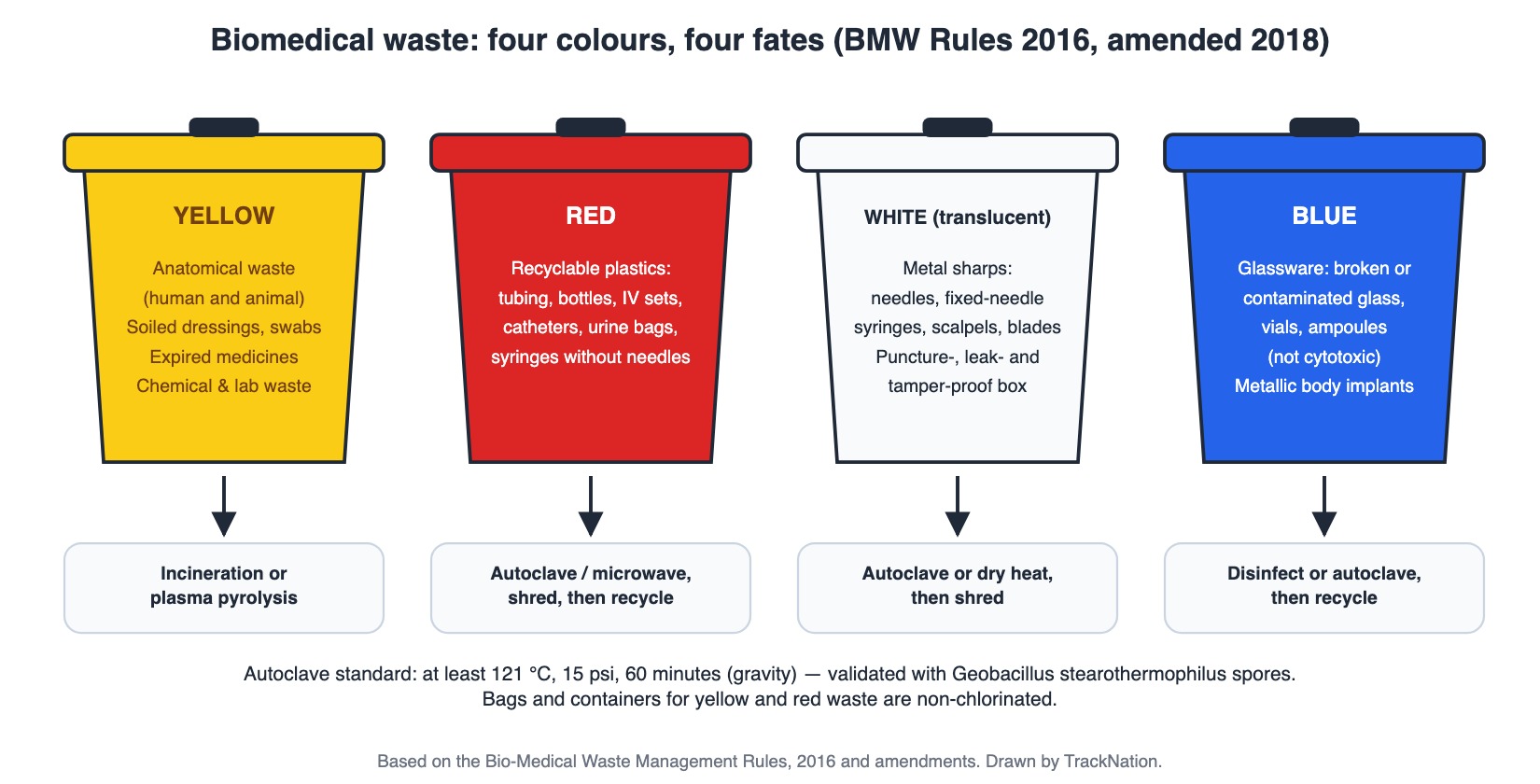
The four biomedical waste colours, what goes in each and how it is treated. Drawn by TrackNation.
Yellow (non-chlorinated bags): human and animal anatomical waste (including fetus below viability), soiled waste (dressings, plaster casts, swabs, blood bags with residual blood), expired medicines including cytotoxics (cytotoxic incineration >1200 °C), chemical waste, contaminated linen (and, since 2018, routine masks and gowns), and microbiology/biotech lab waste (cultures, stocks, live or attenuated vaccines) — pre-treated on site per WHO Blue Book 2014 (2018 amendment), then incinerated.
Red (non-chlorinated bags/containers): contaminated recyclable plastics — tubing, bottles, IV sets, catheters, urine bags, syringes without needles, gloves → autoclave/microwave/hydroclave, shred, recycle.
White (translucent), puncture-proof, leak-proof, tamper-proof: metal sharps — needles, fixed-needle syringes, scalpels, blades.
Blue (puncture- and leak-proof boxes with blue marking, 2018): glassware (vials, ampoules — except cytotoxic) and metallic body implants.
Untreated anatomical, soiled and biotechnology waste is not stored beyond 48 hours. Chemical treatment: sodium hypochlorite 1–2% (2018 amendment; was 10%). Chlorinated plastic bags (except blood bags) and gloves phased out by 27 March 2019; urine, drainage and similar bags are not counted as chlorinated bags (2019). Bar codes and GPS are required. Deep burial (pit about 2 m deep) only in rural or remote areas without a common treatment facility.
Standards: gravity autoclave for waste ≥121 °C, 15 psi, 60 minutes (vacuum autoclave 45 minutes), validated with G. stearothermophilus spores; microwave validated with Bacillus atrophaeus; incinerator primary chamber ≥800 °C, secondary 1050 ± 50 °C with ≥2 s gas residence. The 2026 amendment adds AYUSH to the State Advisory Committee and the District Level Monitoring Committee.
Traps the Examiner Sets
Endoscopes are semicritical — high-level disinfection, not necessarily sterilisation.
Absolute (100%) alcohol is less effective than 70%.
Autoclave → G. stearothermophilus; microwave (BMW) → Bacillus atrophaeus.
Needles go in white translucent containers; broken glass in blue; IV sets and catheters in red; dressings and lab cultures in yellow.
The textbook autoclave cycle (OpenStax: 121 °C, 20+ min) differs from the BMW waste standard (121 °C, 60 min gravity) — waste loads are large.
Memory Hooks & Shortcuts
Shortcuts to lock in this article's numbers and lists. Each one only re-packages facts proven above.
🧠 'Spaulding by touch': Cuts in → Critical (sterile); Coats mucosa → semiCritical (high-level); Contacts skin → non-Critical — Spaulding
🧠 'Steam-Stearo, Microwave-Atro' — G. stearothermophilus for autoclave, B. atrophaeus for BMW microwave — indicators
🧠 BMW colours as a body: Yellow = Your body bits and dirty dressings; Red = Recyclable plastic; White = Weapons (sharps); Blue = Breakable glass — BMW
🧠 'Seventy beats a hundred' — 70% alcohol needs water to coagulate proteins — alcohol
🧠 Pasteurisation '72 for 15, 138 for 2' — pasteurisation
Rapid-Revision Cards
Sterilisation
Kills all, including spores.
Disinfection
Surfaces; spores survive.
D-value
Time to kill 90%.
Critical item
Sterile: instruments, catheters.
Semicritical
High-level disinfection: endoscopes.
BSL-3
M. tb, anthrax, HIV.
BSL-4
Ebola, Marburg.
Autoclave
121 °C, 15–20 psi, 20+ min.
Autoclave indicator
G. stearothermophilus.
Microwave indicator (BMW)
Bacillus atrophaeus.
Hot air oven
≥2 h, up to 170 °C.
Pasteurisation
HTST 72 °C 15 s; UHT 138 °C 2 s.
Filters
Membrane 0.2 µm; HEPA 0.3 µm.
Alcohol
70%; not sporicidal.
Glutaraldehyde
2% Cidex; sterilant.
Ethylene oxide
Heat-sensitive; carcinogenic, explosive.
Chlorhexidine
Pseudomonas may resist.
Prions
Resist autoclave, formalin; NaOH/bleach.
Yellow / Red
Anatomical, soiled, lab / recyclable plastics.
White / Blue
Metal sharps / glass, implants.
BMW limits
48 h storage; hypochlorite 1–2%.
Sources
Facts in this article were checked against these documents.
Microbiology (sections 13.1–13.4) — Parker N, Schneegurt M, Thi Tu A-H, Lister P, Forster BM (OpenStax), 2016 (link)
Bio-Medical Waste Management Rules, 2016 (G.S.R. 343(E)) — Ministry of Environment, Forest and Climate Change, 2016 (link)
Bio-Medical Waste Management (Amendment) Rules 2018, 2019 (two) and 2026 — Ministry of Environment, Forest and Climate Change, 2018–2026
Competency Based Undergraduate Curriculum, Vol I: Microbiology (MI1.12–1.13, MI10.3) — National Medical Commission, 2024
Test Yourself: Practice Questions
Thirty questions in NEET PG style, several of them ward or lab scenarios.
Practice Questions (NEET PG pattern)
Original questions written in the style of the exam: +4 for a correct answer, −1 for a wrong one. Every answer was checked against the sources listed above. NEET PG papers are not published by NBEMS, so these are not past-paper questions.
Q1. Complete destruction of all microbes including endospores and viruses is
(a) disinfection
(b) antisepsis
(c) sanitisation
(d) sterilisation
Show answer
Answer: (d) — Disinfection spares spores.
Q2. An antimicrobial chemical safe enough to apply to living skin is
(a) an alkylating gas
(b) a disinfectant only
(c) a sterilant
(d) an antiseptic
Show answer
Answer: (d) — OpenStax.
Q3. The D-value is the time needed to kill
(a) 50% of the population
(b) 99.9999% of the population
(c) 90% of the population
(d) all spores
Show answer
Answer: (c) — One log.
Q4. A gastrointestinal endoscope is classified (Spaulding) as
(a) disposable only
(b) semicritical — needs high-level disinfection
(c) noncritical — clean only
(d) critical — must be sterile
Show answer
Answer: (b) — Contacts mucosa.
Q5. Which item must be sterile?
(a) blood pressure cuff
(b) crutches
(c) stethoscope
(d) urinary catheter
Show answer
Answer: (d) — Critical item.
Q6. Culture of Mycobacterium tuberculosis should be done at biosafety level
(a) 3
(b) 4
(c) 1
(d) 2
Show answer
Answer: (a) — Lethal by inhalation.
Q7. Ebola and Marburg viruses require biosafety level
(a) 4
(b) 2
(c) 1
(d) 3
Show answer
Answer: (a) — No treatment or vaccine.
Q8. Standard autoclave operating conditions are
(a) 100 °C at atmospheric pressure for 10 minutes
(b) 160 °C dry heat for 1 hour
(c) 72 °C for 15 seconds
(d) 121 °C at 15–20 psi for typically 20 minutes or more
Show answer
Answer: (d) — OpenStax.
Q9. The biological indicator used to validate an autoclave is spores of
(a) Bacillus anthracis
(b) Clostridium tetani
(c) Bacillus atrophaeus
(d) Geobacillus stearothermophilus
Show answer
Answer: (d) — Extreme heat resistance.
Q10. Under the BMW Rules, a microwave treatment unit is validated with spores of
(a) Geobacillus stearothermophilus
(b) Bacillus atrophaeus
(c) Bacillus cereus
(d) Clostridium sporogenes
Show answer
Answer: (b) — BMW Schedule.
Q11. Moist heat sterilises more effectively than dry heat because it
(a) penetrates cells better
(b) works at higher temperatures
(c) needs no pressure
(d) oxidises cell walls
Show answer
Answer: (a) — OpenStax.
Q12. Dry-heat sterilisation in an oven needs
(a) 15 seconds at 72 °C
(b) 2 seconds at 138 °C
(c) 15 minutes at 121 °C
(d) at least 2 hours at up to 170 °C
Show answer
Answer: (d) — OpenStax.
Q13. High-temperature short-time (HTST) pasteurisation of milk uses
(a) 138 °C for 2 seconds
(b) 121 °C for 15 minutes
(c) 72 °C for 15 seconds
(d) 63 °C for 2 hours
Show answer
Answer: (c) — UHT 138 °C ≥2 s.
Q14. A heat-labile antibiotic solution is best sterilised by
(a) boiling
(b) hot air oven
(c) autoclaving
(d) membrane filtration (0.2 µm)
Show answer
Answer: (d) — OpenStax.
Q15. Tissues for transplantation and other heat-sensitive medical materials can be sterilised by
(a) UV light
(b) boiling
(c) ionising (gamma) radiation
(d) HTST pasteurisation
Show answer
Answer: (c) — UV does not penetrate.
Q16. Alcohol is used at about 70% rather than 100% because
(a) 100% alcohol is sporicidal
(b) it is cheaper only
(c) water is needed for protein coagulation and penetration
(d) 70% evaporates faster
Show answer
Answer: (c) — OpenStax.
Q17. An agent that is NOT sporicidal is
(a) ethylene oxide
(b) 70% alcohol
(c) glutaraldehyde 2%
(d) formaldehyde
Show answer
Answer: (b) — Alcohol inhibits sporulation only.
Q18. A 2% solution used to sterilise surgical and medical equipment (brand Cidex), too irritating for skin, is
(a) povidone-iodine
(b) benzalkonium chloride
(c) glutaraldehyde
(d) chlorhexidine
Show answer
Answer: (c) — OpenStax.
Q19. A gas sterilant for heat-sensitive items that is carcinogenic and explosive is
(a) ozone
(b) ethylene oxide
(c) hydrogen peroxide vapour
(d) chlorine
Show answer
Answer: (b) — Needs aeration.
Q20. Formalin is
(a) 10% povidone-iodine
(b) 37% formaldehyde
(c) 70% ethanol
(d) 2% glutaraldehyde
Show answer
Answer: (b) — Carcinogenic; not an antiseptic.
Q21. The organism that may become resistant to chlorhexidine on repeated exposure is
(a) Candida albicans
(b) Staphylococcus aureus
(c) Pseudomonas aeruginosa
(d) Streptococcus pyogenes
Show answer
Answer: (c) — Also poor vs M. tb.
Q22. Povidone-iodine is an example of
(a) a phenolic
(b) a quaternary ammonium compound
(c) a bisbiguanide
(d) an iodophor
Show answer
Answer: (d) — Slow iodine release.
Q23. The 'oligodynamic' action refers to
(a) alcohols at 70%
(b) detergents
(c) UV light
(d) heavy metals acting at very small concentrations
Show answer
Answer: (d) — OpenStax.
Q24. Instruments used on a patient with Creutzfeldt–Jakob disease pose a problem because prions
(a) are not completely inactivated by standard autoclaving or formalin
(b) are removed by 0.2 µm filters
(c) are killed by 70% alcohol
(d) are destroyed by boiling
Show answer
Answer: (a) — Extreme resistance.
Q25. The phenol coefficient test uses
(a) E. coli and Pseudomonas
(b) Bacillus spores
(c) Staphylococcus aureus and Salmonella Typhi
(d) Candida and Aspergillus
Show answer
Answer: (c) — OpenStax.
Q26. Under the BMW Rules 2016, a used IV set and urinary catheter go in the
(a) white translucent container
(b) red bag
(c) yellow bag
(d) blue box
Show answer
Answer: (b) — Contaminated recyclable plastics.
Q27. Used needles and scalpel blades are disposed of in
(a) yellow bags
(b) white translucent puncture-proof containers
(c) black bags
(d) red bags
Show answer
Answer: (b) — BMW Schedule I.
Q28. Broken glass vials (not cytotoxic) go into the
(a) blue marked puncture-proof box
(b) red bag
(c) yellow bag
(d) white container
Show answer
Answer: (a) — Also metal implants.
Q29. A microbiology lab discards culture plates and stocks. Under the amended BMW Rules they are
(a) put in blue boxes
(b) pre-treated on site per WHO Blue Book and sent for incineration (yellow)
(c) landfilled directly
(d) put in red bags for recycling
Show answer
Answer: (b) — 2018 amendment.
Q30. Untreated human anatomical and soiled waste may not be stored beyond
(a) 72 hours
(b) 24 hours
(c) 7 days
(d) 48 hours
Show answer
Answer: (d) — BMW Rules 2016.
Active Recall
From memory: define sterilisation, disinfection and antisepsis, give the Spaulding categories and biosafety levels with examples, state autoclave, dry heat and pasteurisation parameters with biological indicators, match common chemical agents to their uses and limits, explain prion decontamination, and give the BMW colour codes with storage and treatment rules.