Staphylococci, Streptococci and Pneumococci for NEET PG Microbiology: Coagulase, Lancefield Groups, Toxins, Rheumatic Fever and Endocarditis
Start Here
🎯 Exam priority: Very high. Expect: catalase and coagulase, which toxin causes which syndrome, food-poisoning incubation, haemolysis and Lancefield groups, scarlet fever signs, PSGN and rheumatic fever timing, the Jones rule, prophylaxis duration, pneumococcal lab clues and risk groups, VRE, and endocarditis organisms and peripheral signs.
CBME mapping: MI3.1–3.4. Fact-checked against the MSD Manual, the ICMR rheumatic fever workflow (2024) and OpenStax Microbiology.
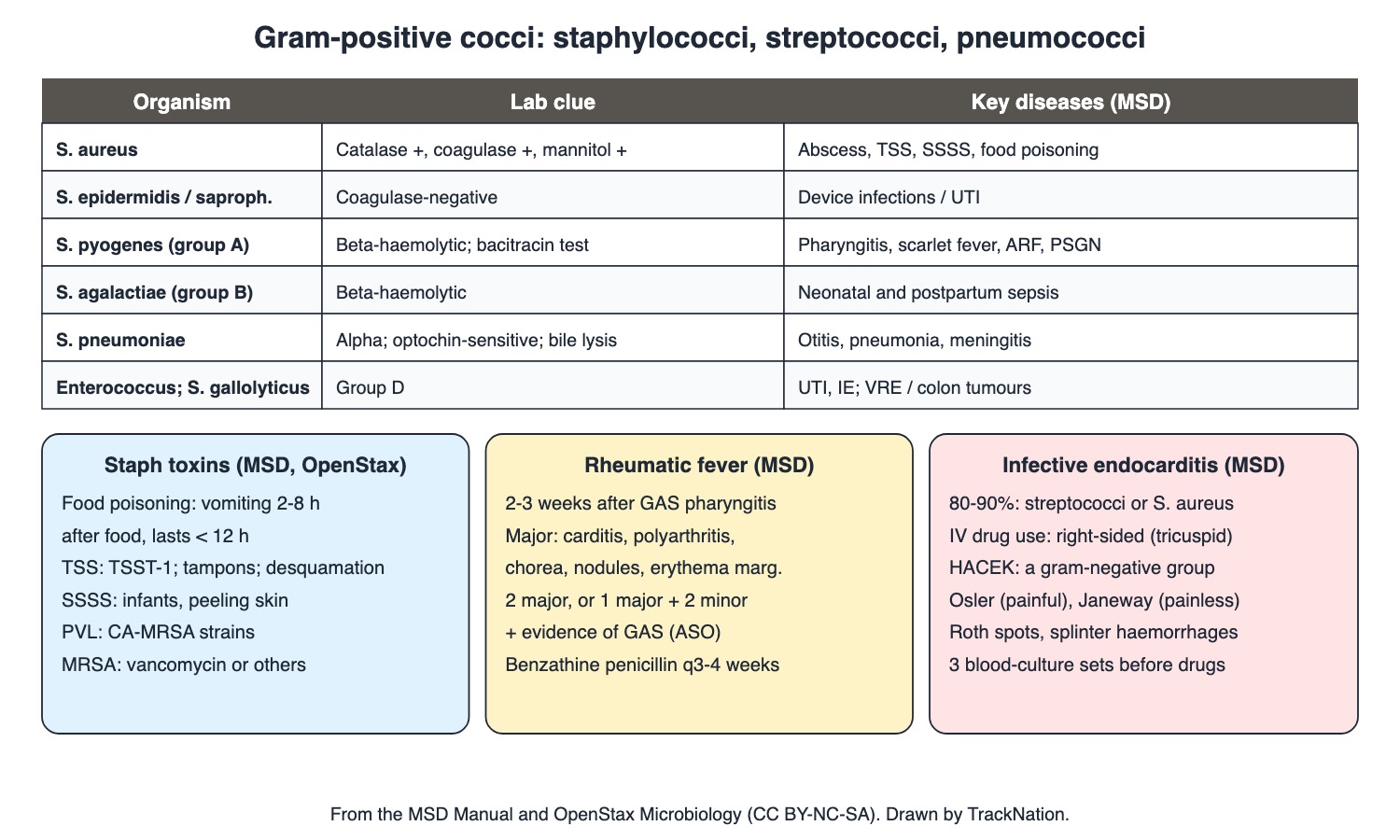
Gram-positive cocci, staphylococcal toxins, rheumatic fever and endocarditis. Drawn by TrackNation.
Staphylococci (MSD, OpenStax 21.2)
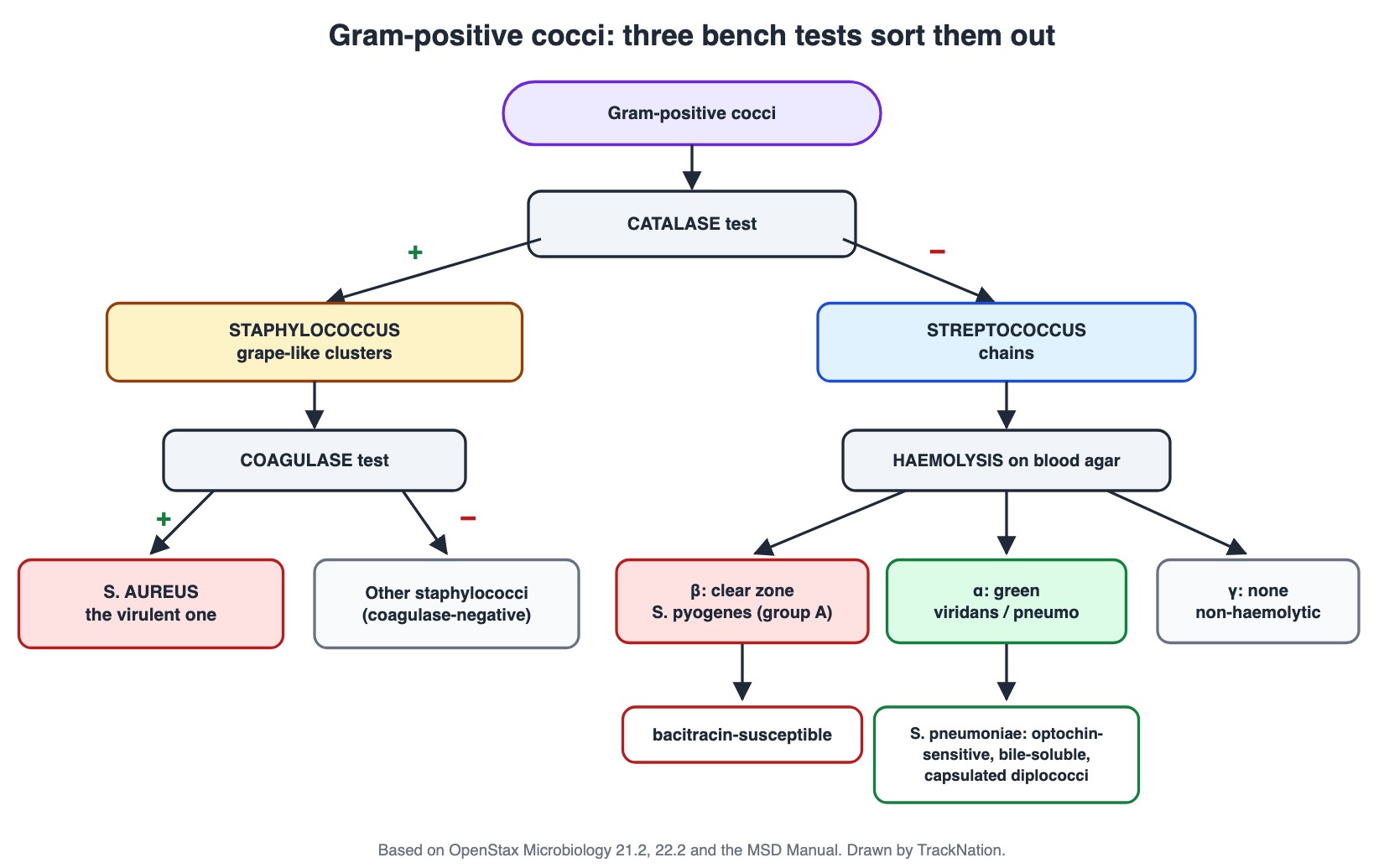
Catalase, coagulase and haemolysis: how gram-positive cocci are identified. Drawn by TrackNation.
Gram-positive cocci in grape-like clusters. Catalase-positive (streptococci are catalase-negative). Coagulase separates the virulent S. aureus from coagulase-negative species; S. aureus also ferments mannitol on mannitol salt agar (7.5% NaCl) and makes protein A (anti-phagocytic).
Carriage: anterior nares in about 32% of healthy adults; spread is mostly via hands of health workers.
Disease: abscesses, furuncles and carbuncles, impetigo (honey-coloured crust), cellulitis, pneumonia, endocarditis, osteomyelitis. S. epidermidis → hospital/device infections; S. saprophyticus → urinary infection.
Toxin diseases: food poisoning from preformed heat-stable enterotoxin — vomiting 2–8 hours after eating, over within ~12 hours; scalded skin syndrome (exfoliatins ETA, ETB) in infants; toxic shock syndrome (TSST-1; tampons and vaginal devices; palm/sole desquamation 3–7 days later).
PVL toxin is typical of CA-MRSA. Treatment: penicillinase-resistant beta-lactams; resistance often needs vancomycin or others; VISA and VRSA exist.
Streptococci and Enterococci (MSD, OpenStax)
On sheep blood agar: beta = clear haemolysis; alpha = green, incomplete (viridans group); gamma = none. Lancefield groups (A–H, K–V) are based on cell-wall carbohydrate.
Group A — S. pyogenes (beta; bacitracin-susceptible): commonest bacterial cause of acute pharyngitis; skin and wound infection, necrotising fasciitis (spreads along fascial planes), scarlet fever (erythrogenic toxin — phage conversion; sandpaper rash, Pastia lines, circumoral pallor, strawberry tongue), streptococcal TSS. Virulence: M protein, capsule, streptolysins O and S, hyaluronidase, streptokinase.
Non-suppurative sequelae 1–3 weeks later: acute rheumatic fever and post-streptococcal glomerulonephritis (5–25% after nephritogenic strains, after throat or skin infection). Diagnosis: culture; rapid antigen tests are >95% specific — a negative test in a child needs culture; ASO, anti-DNase B for past infection. Treat pharyngitis with penicillin/amoxicillin for 10 days.
Group B — S. agalactiae (beta): neonatal and postpartum sepsis, meningitis. Viridans (S. mutans, sanguis, mitis; S. anginosus → abscesses): endocarditis after bacteraemia. S. gallolyticus (formerly S. bovis): endocarditis linked with colonic adenoma or carcinoma.
Enterococci (formerly group D; gut flora): UTI, endocarditis, intra-abdominal infection; resistant to most cephalosporins and aztreonam; E. faecium more penicillin-resistant than E. faecalis; VRE → linezolid or daptomycin.
Pneumococcus (MSD, OpenStax 22.2)
Lancet-shaped, alpha-haemolytic, encapsulated diplococci; identified by optochin sensitivity and bile (deoxycholate) lysis; serotyped by the quellung reaction — the polysaccharide capsule determines serotype.
A major cause of otitis media, pneumonia, sepsis and meningitis. Highest risk: asplenia (cannot clear encapsulated organisms), sickle cell disease, CKD/nephrotic syndrome, CSF leak, cochlear implants, malignancy, smoking.
Vaccines: conjugate vaccines; PPSV23 protects strongly against invasive disease (bacteraemia, meningitis) but less against pneumonia.
Rheumatic Fever and Infective Endocarditis (MSD)
Acute rheumatic fever follows GAS pharyngitis by about 2–3 weeks. Major manifestations: migratory polyarthritis (commonest), carditis (50–70% of first attacks; mitral regurgitation commonest acutely), Sydenham chorea, subcutaneous nodules, erythema marginatum. Minor: arthralgia, raised ESR/CRP, fever, prolonged PR.
Modified Jones: 2 major, or 1 major + 2 minor, plus evidence of GAS (rising ASO/anti-DNase B, culture or rapid test); chorea alone suffices. Chronic RHD (mitral, aortic) remains a major heart disease in resource-poor regions.
India (ICMR STW, 2024): first episode mostly at 5–15 years; arthritis ~80% (migratory, large joints, prompt NSAID response), carditis ~50% (most devastating), chorea ~10% (2–6 months after the sore throat), erythema marginatum ~5%, nodules rare. In moderate/high-risk populations (like India) monoarthritis or polyarthralgia can count as major; ASO >320 U supports GAS infection. Recurrence in known RHD needs only 2 minor criteria.
Secondary prophylaxis: benzathine penicillin IM (6 lakh U ≤27 kg; 12 lakh U >27 kg) every 3–4 weeks. Duration (ICMR): no carditis — 5 years or to age 21; carditis without RHD — 10 years or to age 25; RHD after valve surgery — at least to age 40, preferably lifelong (MSD/AHA quote 10 years or age 21 for carditis without residual damage).
Infective endocarditis: 80–90% from streptococci or S. aureus (S. aureus attacks normal valves; viridans after gum bacteraemia); staphylococcal and enterococcal cases are rising. IV drug users → right-sided (tricuspid). Others: HACEK group, fungi.
Signs: Osler nodes (painful, finger tips), Janeway lesions (painless palms/soles), Roth spots, splinter haemorrhages. Take at least 3 blood-culture sets before antibiotics; criteria: 2023 Duke–ISCVID.
Traps the Examiner Sets
Staph food poisoning is fast (2–8 h) because the toxin is preformed and heat-stable — reheating does not help.
PSGN can follow skin or throat infection; rheumatic fever follows pharyngitis.
Chorea alone is enough for rheumatic fever.
S. gallolyticus endocarditis → look for colonic tumour.
Enterococci are not killed by cephalosporins.
Memory Hooks & Shortcuts
Shortcuts to lock in this article's numbers and lists. Each one only re-packages facts proven above.
🧠 'Cat-Staph, Coag-Aureus' — catalase splits staph from strep; coagulase picks S. aureus — staph
🧠 'B for Babies' — group B strep in neonates; 'A for Angina (throat)' — group A pharyngitis — streptococci
🧠 'OPTOchin = OPTimal for pneumO'; 'BACitracin Attacks group A' — lab clues
🧠 Jones major 'J♥NES': Joints, ♥ carditis, Nodules, Erythema marginatum, Sydenham chorea — rheumatic fever
🧠 'Osler Ouch, Janeway Just there' — Osler nodes painful, Janeway lesions painless — endocarditis
Rapid-Revision Cards
Catalase
Staph +, strep −.
Coagulase
S. aureus.
Carriage
Anterior nares ~32%.
Staph food poisoning
Preformed heat-stable toxin; 2–8 h.
SSSS
Exfoliatins; infants.
TSS
TSST-1; tampons; desquamation.
PVL
CA-MRSA.
CoNS
S. epidermidis devices; S. saprophyticus UTI.
Haemolysis
Beta clear; alpha green; gamma none.
Group A
Bacitracin; pharyngitis, scarlet fever.
Scarlet fever
Erythrogenic toxin; Pastia lines; phage.
Sequelae
ARF, PSGN 1–3 weeks.
Rapid strep test
Negative in child → culture.
Group B
Neonatal, postpartum sepsis.
S. gallolyticus
IE + colon tumour.
Pneumococcus
Optochin, bile lysis, quellung.
VRE
Linezolid, daptomycin.
Jones
2 major / 1 major + 2 minor + GAS.
RF prophylaxis (ICMR)
No carditis 5 y/21; carditis 10 y/25; post-surgery ≥40 y.
IE organisms
Strep or S. aureus 80–90%; IVDU tricuspid.
IE signs
Osler painful; Janeway painless; Roth.
Sources
Facts in this article were checked against these documents.
MSD Manual Professional: Staphylococcal, Streptococcal, Pneumococcal and Enterococcal Infections; Toxic Shock Syndrome; Rheumatic Fever; Infective Endocarditis — Merck & Co. (MSD Manuals), 2024–26 (link)
Standard Treatment Workflow: Acute Rheumatic Fever — Indian Council of Medical Research / Department of Health Research, 2024
Microbiology (sections 21.2, 22.2) — Parker N, Schneegurt M, Thi Tu A-H, Lister P, Forster BM (OpenStax), 2016 (link)
Competency Based Undergraduate Curriculum, Vol I: Microbiology (MI3.1–3.4) — National Medical Commission, 2024
Test Yourself: Practice Questions
Thirty questions in NEET PG style, most of them clinical vignettes.
Practice Questions (NEET PG pattern)
Original questions written in the style of the exam: +4 for a correct answer, −1 for a wrong one. Every answer was checked against the sources listed above. NEET PG papers are not published by NBEMS, so these are not past-paper questions.
Q1. Gram-positive cocci in clusters from a pus sample are catalase-positive. The test that separates S. aureus from other staphylococci is
(a) bile solubility
(b) optochin
(c) bacitracin
(d) coagulase
Show answer
Answer: (d) — Catalase separates staph from strep.
Q2. On mannitol salt agar, S. aureus
(a) turns the medium green
(b) shows beta-haemolysis only
(c) grows and ferments mannitol
(d) does not grow because of salt
Show answer
Answer: (c) — 7.5% NaCl.
Q3. The commonest site of S. aureus carriage in healthy adults is the
(a) oropharynx only
(b) anterior nares
(c) vagina
(d) colon
Show answer
Answer: (b) — About 32%.
Q4. Several people vomit 3 hours after eating a dish left at room temperature; symptoms settle within hours. The likely cause is
(a) Salmonella
(b) preformed staphylococcal enterotoxin
(c) Vibrio cholerae
(d) Clostridium perfringens
Show answer
Answer: (b) — Onset 2–8 h.
Q5. Staphylococcal scalded skin syndrome in an infant is caused by
(a) PVL
(b) enterotoxin B
(c) TSST-1
(d) exfoliatins (ETA, ETB)
Show answer
Answer: (d) — MSD.
Q6. A woman using a tampon develops fever, hypotension and a rash that later peels on the palms. The toxin is
(a) erythrogenic toxin
(b) streptolysin O
(c) TSST-1
(d) exfoliatin
Show answer
Answer: (c) — Staph TSS.
Q7. Panton–Valentine leukocidin is typically produced by
(a) enterococci
(b) community-associated MRSA
(c) S. pyogenes
(d) S. epidermidis
Show answer
Answer: (b) — MSD.
Q8. A patient has cystitis with gram-positive cocci that are coagulase-negative. The likely organism is
(a) S. epidermidis
(b) S. aureus
(c) E. faecium
(d) S. saprophyticus
Show answer
Answer: (d) — UTI.
Q9. Infection of a prosthetic device by a coagulase-negative staphylococcus is most often due to
(a) S. saprophyticus
(b) S. epidermidis
(c) S. lugdunensis only
(d) S. pyogenes
Show answer
Answer: (b) — Hospital-acquired.
Q10. Streptococci showing a clear zone of haemolysis around colonies are
(a) beta-haemolytic
(b) gamma-haemolytic
(c) viridans
(d) alpha-haemolytic
Show answer
Answer: (a) — Sheep blood agar.
Q11. Lancefield grouping of streptococci is based on
(a) capsular polysaccharide
(b) cell-wall carbohydrate antigens
(c) M protein only
(d) type of haemolysis
Show answer
Answer: (b) — Groups A–H, K–V.
Q12. A beta-haemolytic streptococcus from a throat swab is bacitracin-susceptible. It is most likely
(a) S. agalactiae
(b) Enterococcus
(c) S. pneumoniae
(d) S. pyogenes (group A)
Show answer
Answer: (d) — OpenStax.
Q13. A child with sore throat develops a sandpaper-like rash, Pastia lines and circumoral pallor. The toxin responsible is
(a) erythrogenic toxin of group A streptococci
(b) TSST-1
(c) exfoliatin
(d) diphtheria toxin
Show answer
Answer: (a) — Scarlet fever.
Q14. The scarlet fever toxin gene is acquired by S. pyogenes through
(a) mutation
(b) transformation
(c) conjugation
(d) phage conversion
Show answer
Answer: (d) — Lysogenic phage.
Q15. Post-streptococcal glomerulonephritis typically appears
(a) only after skin infection
(b) 6 months later
(c) within 24 hours
(d) 1–3 weeks after throat or skin infection
Show answer
Answer: (d) — MSD.
Q16. A negative rapid antigen test for group A streptococcus in a child with pharyngitis should be
(a) taken as ruling out GAS
(b) followed by ASO only
(c) repeated after 6 months
(d) confirmed by throat culture
Show answer
Answer: (d) — Sensitivity varies.
Q17. Streptococcal pharyngitis treated with oral penicillin needs a course of
(a) 1 day
(b) 3 days
(c) 10 days
(d) 6 weeks
Show answer
Answer: (c) — MSD.
Q18. Neonatal sepsis and meningitis are classically due to
(a) S. gallolyticus
(b) group B streptococcus (S. agalactiae)
(c) S. mutans
(d) S. pyogenes
Show answer
Answer: (b) — Also postpartum sepsis.
Q19. Endocarditis due to S. gallolyticus (formerly S. bovis) should prompt
(a) dental extraction
(b) echocardiography only
(c) HIV testing
(d) colonoscopy for adenoma or carcinoma
Show answer
Answer: (d) — Colonic tumours.
Q20. Lancet-shaped alpha-haemolytic diplococci that are optochin-sensitive and bile-soluble are
(a) S. pneumoniae
(b) Neisseria
(c) viridans streptococci
(d) Enterococcus
Show answer
Answer: (a) — Quellung for serotype.
Q21. The patient group at greatest risk of overwhelming pneumococcal infection is
(a) pregnant women only
(b) people with hypertension
(c) healthy young adults
(d) people with asplenia or sickle cell disease
Show answer
Answer: (d) — Can't clear encapsulated organisms.
Q22. The 23-valent polysaccharide pneumococcal vaccine protects best against
(a) non-bacteraemic pneumonia
(b) invasive disease such as bacteraemia and meningitis
(c) otitis media in infants
(d) carriage
Show answer
Answer: (b) — MSD.
Q23. Vancomycin-resistant enterococci are treated with
(a) aztreonam
(b) penicillin alone
(c) linezolid or daptomycin
(d) ceftriaxone
Show answer
Answer: (c) — MSD.
Q24. Enterococci are intrinsically resistant to
(a) vancomycin always
(b) ampicillin always
(c) most cephalosporins
(d) linezolid
Show answer
Answer: (c) — Also aztreonam.
Q25. The commonest manifestation of acute rheumatic fever is
(a) migratory polyarthritis
(b) chorea
(c) carditis
(d) erythema marginatum
Show answer
Answer: (a) — Carditis 50–70%.
Q26. The modified Jones criteria require, with evidence of preceding GAS infection,
(a) 2 major, or 1 major and 2 minor manifestations
(b) 1 minor manifestation
(c) 3 minor manifestations
(d) carditis in every case
Show answer
Answer: (a) — Chorea alone suffices.
Q27. A child with rheumatic fever without carditis should receive secondary prophylaxis for
(a) 5 years or until age 21, whichever is longer
(b) lifelong in all
(c) 1 year
(d) until symptoms settle
Show answer
Answer: (a) — ICMR: carditis without RHD 10 years or to age 25.
Q28. An injecting drug user with fever and a new murmur most likely has endocarditis of the
(a) tricuspid valve
(b) aortic valve
(c) pulmonary artery
(d) mitral valve
Show answer
Answer: (a) — Right-sided.
Q29. Painful nodules on the finger pads in endocarditis are
(a) splinter haemorrhages
(b) Roth spots
(c) Janeway lesions
(d) Osler nodes
Show answer
Answer: (d) — Janeway are painless.
Q30. Before starting antibiotics in suspected infective endocarditis, collect
(a) a throat swab
(b) urine culture only
(c) one blood culture
(d) at least 3 sets of blood cultures
Show answer
Answer: (d) — MSD.
Active Recall
From memory: identify staphylococci and streptococci in the lab, list staphylococcal toxin diseases with timing, classify streptococci by haemolysis and Lancefield group with their diseases, describe scarlet fever and post-streptococcal sequelae, give pneumococcal lab clues and risk groups, describe enterococcal resistance, state the Jones rule and prophylaxis, and list endocarditis organisms and signs.