Viral Skin Infections for NEET PG Dermatology: Varicella, Herpes Zoster, Hutchinson Sign, Herpes Simplex, Warts and Molluscum
Start Here
🎯 Exam priority: High. Expect: dew drop on a rose petal and lesions in all stages, incubation and infectious period, aspirin and Reye syndrome, congenital varicella, ICMR acyclovir doses and IV indications, zoster pain before rash, Hutchinson sign, Ramsay Hunt syndrome, postherpetic neuralgia drugs, Tzanck giant cells vs PCR, HSV-1 vs HSV-2, HPV types of warts and molluscum in HIV.
CBME mapping: DR 8.1–8.5. Viral morphology is in Microbiology; congenital varicella in OBG and Paediatrics.
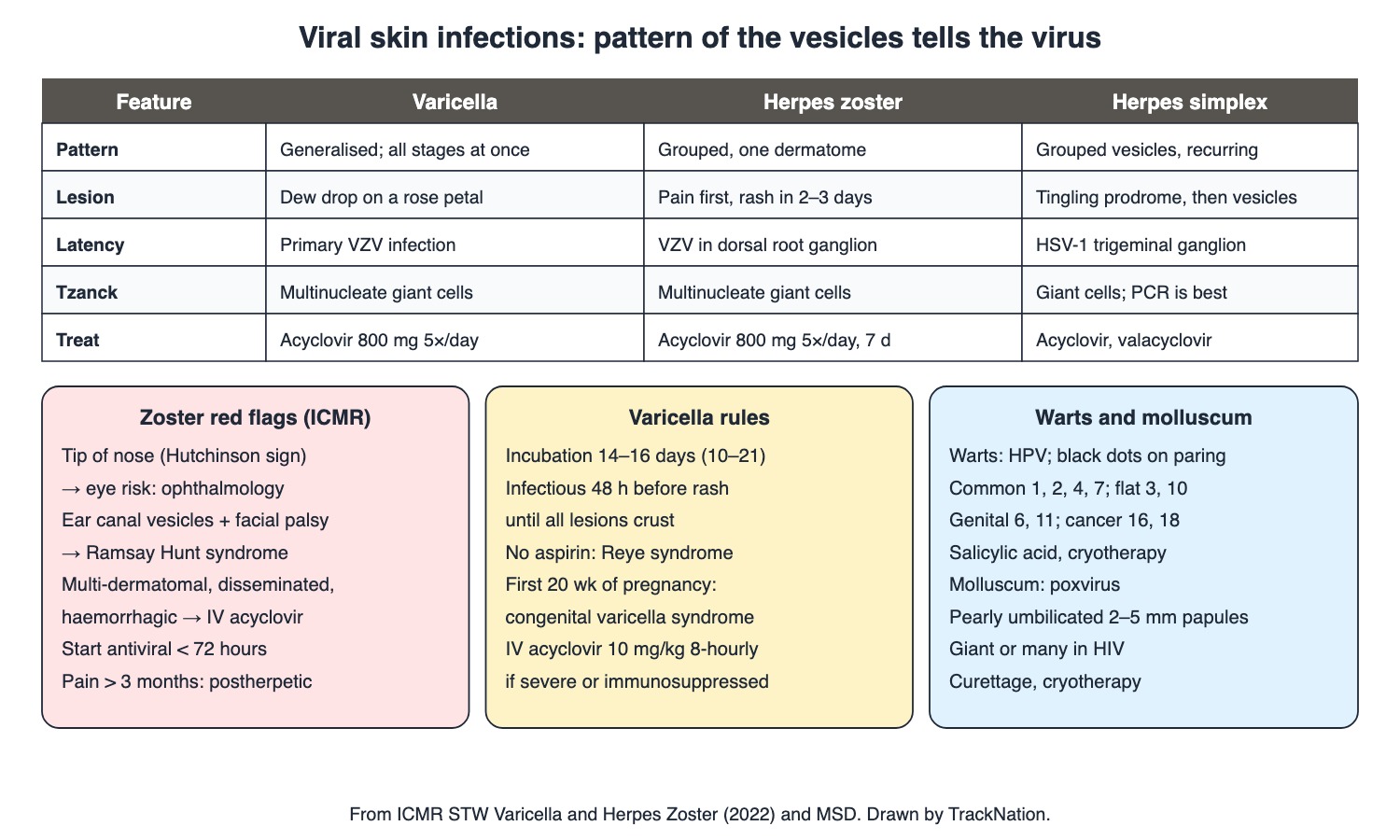
Varicella, herpes zoster and herpes simplex compared; zoster red flags; varicella rules; warts and molluscum. Drawn by TrackNation.
Varicella (Chickenpox)
Fever and malaise, then a generalised vesicular rash on a red base — "dew drop on a rose petal" — with lesions in different stages (macules, papules, vesicles, crusts) at the same time. Incubation 14–16 days (range 10–21). Infectious from 48 hours before the rash until all lesions crust; keep the patient off school or work until then and away from high-risk contacts.
Red flags: haemorrhagic vesicles, breathlessness, chest or abdominal pain, stiff neck or confusion, haemodynamic instability. Complications: secondary infection, pneumonia (adults, neonates, immunosuppressed), encephalitis, hepatitis, cerebellar ataxia, Reye syndrome — give paracetamol, never aspirin.
Pregnancy: infection in the first 20 weeks can cause congenital varicella syndrome — treat with acyclovir; perinatal maternal varicella risks neonatal varicella.
Prevention: live vaccine — 12–15 months and 4–6 years (2 doses at 13 years or older); contraindicated in pregnancy and immunosuppression, where varicella-zoster immunoglobulin is used instead (also for neonates whose mother developed chickenpox 5 days before to 2 days after delivery).
Situation (ICMR) | Antiviral |
Varicella, adult or child > 40 kg | Oral acyclovir 800 mg 5 times a day for 5–7 days (or valacyclovir 1 g three times a day); best within 24 h of rash |
Varicella, child < 40 kg | Acyclovir 20 mg/kg/dose (max 800 mg) four times a day for 7 days |
Who must get antivirals | Infants, children > 12 y, adults, pregnant women, immunosuppressed (risk of severe varicella) |
IV acyclovir 10 mg/kg 8-hourly | Systemic complications, haemorrhagic varicella, immunosuppression, neonatal varicella |
Herpes zoster | Acyclovir 800 mg 5 times a day or valacyclovir 1 g three times a day for 7 days; start < 72 h (later if new lesions, eye or ear involvement) |
Zoster, IV | Multi-segmental, disseminated or systemic complications |
Herpes Zoster
Reactivation of latent VZV from a dorsal root ganglion; commoner over 50, in HIV and immunosuppression (diabetes, cancer, transplant). Dermatomal pain comes first, then grouped vesicles in one or more adjacent dermatomes (usually thoracic or lumbar) 2–3 days later.
Hutchinson sign: vesicles on the side or tip of the nose (nasociliary branch) → high risk of eye disease (herpes zoster ophthalmicus) — refer to ophthalmology. Ramsay Hunt syndrome: geniculate ganglion — ear-canal vesicles with facial palsy, vertigo, hearing loss. Multi-dermatomal, disseminated or haemorrhagic zoster suggests immunosuppression → IV acyclovir.
Postherpetic neuralgia: pain for more than 3 months, commoner in the elderly. ICMR pain ladder: NSAIDs, then pregabalin, gabapentin, amitriptyline or nortriptyline, carbamazepine. Antivirals do not clearly prevent it.
Prevention: zoster vaccine for adults over 50 even after a previous episode.
Herpes Simplex, Warts and Molluscum
HSV-1: gingivostomatitis (primary, in children), herpes labialis, herpes gladiatorum, keratitis; lies dormant in the trigeminal ganglion. HSV-2: genital herpes (either type can be anywhere). Prodromal tingling, then clusters of small tense vesicles on a red base. Severe forms: eczema herpeticum, encephalitis (IV acyclovir), neonatal herpes, disseminated disease in immunosuppression. Herpetic whitlow heals in 2–3 weeks.
Tzanck smear (fresh vesicle base) shows multinucleate giant cells in HSV and VZV but is insensitive and cannot separate them; PCR is the gold standard. Treating primary HSV does not prevent recurrence; acyclovir-resistant HSV (immunocompromised) → foscarnet.
Warts (HPV): common warts types 1, 2, 4, 7; plantar 1, 2, 4; flat warts 3, 10 (face, along scratch marks); genital warts 6 and 11; types 16 and 18 cause cervical cancer. Paring shows black dots (thrombosed capillaries). Treatment: salicylic acid (commonest topical), liquid-nitrogen cryotherapy, cautery; HPV vaccine prevents some types.
Molluscum contagiosum (poxvirus): clusters of pearly, dome-shaped, umbilicated 2–5 mm papules — face, trunk and limbs in children, genitals in adults; large or widespread in HIV. Curettage or cryotherapy.
Traps the Examiner Sets
Varicella: lesions in all stages at once.
Never aspirin in varicella (Reye syndrome).
Vesicles on the nose tip in zoster = eye at risk.
Tzanck giant cells cannot tell HSV from VZV; PCR can.
Memory Hooks & Shortcuts
Shortcuts to lock in this article's numbers and lists. Each one only re-packages facts proven above.
🧠 Varicella 'dew drop on a rose petal, every stage at once' — varicella
🧠 Zoster 'Pain before rash, one band only' — zoster
🧠 'Nose tip = eye risk' (Hutchinson) — zoster ophthalmicus
🧠 '800 × 5' — acyclovir 800 mg five times a day for VZV — dose
🧠 HPV warts '6 and 11 grow, 16 and 18 kill' — HPV types
Rapid-Revision Cards
Varicella sign
Dew drop on a rose petal.
Varicella stages
All stages at once.
Incubation
14–16 days (10–21).
Infectious
48 h before rash → all crusted.
Reye
No aspirin in varicella.
Pregnancy < 20 wk
Congenital varicella syndrome.
Acyclovir varicella
800 mg 5×/day, 5–7 days.
IV acyclovir
10 mg/kg 8-hourly: severe, haemorrhagic, immunosuppressed.
VZIG
Pregnant, immunosuppressed, neonates.
Zoster latency
Dorsal root ganglion.
Zoster course
Pain, then rash in 2–3 days.
Hutchinson sign
Nose tip → eye risk.
Ramsay Hunt
Ear vesicles + facial palsy.
Zoster antiviral
Within 72 h, 7 days.
PHN
Pain > 3 months; pregabalin.
Tzanck
Multinucleate giant cells.
HSV best test
PCR.
HSV-1 latency
Trigeminal ganglion.
Warts sign
Black dots on paring.
HPV types
Common 1,2,4,7; flat 3,10; genital 6,11.
Molluscum
Poxvirus; umbilicated; giant in HIV.
Sources
Facts in this article were checked against these documents.
Standard Treatment Workflow: Varicella and Herpes Zoster — Indian Council of Medical Research, DHR, 2022 (link)
MSD Manual Professional: Chickenpox; Herpes Zoster; Herpes Simplex Virus Infections; Warts; Molluscum Contagiosum — Merck & Co. (MSD Manuals), reviewed 2025–26 (link)
Competency Based Undergraduate Curriculum, Dermatology (DR 8) — National Medical Commission, 2024
Test Yourself: Practice Questions
Thirty questions in NEET PG style, most of them clinical vignettes.
Practice Questions (NEET PG pattern)
Original questions written in the style of the exam: +4 for a correct answer, −1 for a wrong one. Every answer was checked against the sources listed above. NEET PG papers are not published by NBEMS, so these are not past-paper questions.
Q1. A child has fever followed by an itchy generalised rash with macules, papules, vesicles and crusts present at the same time; the vesicles sit on a red base. The diagnosis is
(a) measles
(b) varicella
(c) hand-foot-mouth disease
(d) herpes zoster
Show answer
Answer: (b) — Dew drop on a rose petal; different stages.
Q2. The average incubation period of chickenpox is
(a) 14–16 days
(b) 6 months
(c) 6 weeks
(d) 2–3 days
Show answer
Answer: (a) — Range 10–21 days.
Q3. A child with chickenpox can return to school when
(a) after 3 days
(b) fever settles
(c) all lesions have crusted
(d) the first lesions crust
Show answer
Answer: (c) — Infectious from 48 h before rash until crusting.
Q4. For fever in a child with varicella, aspirin is avoided because of
(a) allergy
(b) renal failure
(c) bleeding only
(d) Reye syndrome
Show answer
Answer: (d) — Use paracetamol.
Q5. Maternal varicella in the first 20 weeks of pregnancy can cause
(a) hydrops from parvovirus
(b) congenital varicella syndrome
(c) congenital rubella syndrome
(d) neonatal herpes
Show answer
Answer: (b) — Treat with acyclovir.
Q6. The ICMR oral acyclovir dose for varicella in an adult is
(a) 10 mg/kg once
(b) 400 mg twice daily for 1 day
(c) 200 mg once daily
(d) 800 mg five times a day for 5–7 days
Show answer
Answer: (d) — Children < 40 kg: 20 mg/kg four times daily.
Q7. Acyclovir gives maximum benefit in varicella when started within
(a) 2 weeks
(b) 7 days
(c) 24 hours of the rash
(d) any time
Show answer
Answer: (c) — Per ICMR.
Q8. An adult with chickenpox develops haemorrhagic vesicles and breathlessness. ICMR advises
(a) IV acyclovir 10 mg/kg 8-hourly and referral
(b) IV steroids
(c) oral acyclovir only
(d) aspirin and rest
Show answer
Answer: (a) — Systemic complications.
Q9. Varicella pneumonia is most likely in
(a) vaccinated teenagers only
(b) healthy young children
(c) adults, neonates and immunocompromised patients
(d) no group
Show answer
Answer: (c) — Not usually in healthy children.
Q10. A susceptible pregnant woman is exposed to chickenpox. The appropriate prophylaxis is
(a) live varicella vaccine
(b) nothing
(c) varicella-zoster immunoglobulin
(d) aspirin
Show answer
Answer: (c) — Live vaccine is contraindicated in pregnancy.
Q11. Herpes zoster results from reactivation of VZV latent in the
(a) skin
(b) trigeminal nucleus only
(c) lymph nodes
(d) dorsal root (sensory) ganglion
Show answer
Answer: (d) — Or cranial nerve ganglia.
Q12. A 65-year-old has burning pain over one side of the chest for 2 days, then grouped vesicles in the same band. The diagnosis is
(a) contact dermatitis
(b) herpes zoster
(c) angina
(d) herpes simplex
Show answer
Answer: (b) — Pain before rash.
Q13. In zoster of the forehead, vesicles on the side or tip of the nose (Hutchinson sign) mean
(a) dissemination
(b) bacterial infection
(c) Ramsay Hunt syndrome
(d) involvement of the nasociliary nerve and high risk of eye disease
Show answer
Answer: (d) — Refer to ophthalmology.
Q14. A patient has vesicles in the ear canal with facial weakness on the same side. This is
(a) Ramsay Hunt syndrome (geniculate ganglion)
(b) Bell palsy only
(c) otitis externa
(d) herpes simplex labialis
Show answer
Answer: (a) — Herpes zoster oticus.
Q15. ICMR antiviral treatment for herpes zoster is
(a) acyclovir 200 mg once
(b) acyclovir 800 mg five times a day or valacyclovir 1 g three times a day for 7 days
(c) oral steroids only
(d) topical acyclovir only
Show answer
Answer: (b) — Start within 72 hours.
Q16. Antiviral therapy for zoster gives maximum benefit if started within
(a) 1 month
(b) 2 weeks
(c) 72 hours of onset
(d) 6 hours only
Show answer
Answer: (c) — Can start later if new lesions, eye or ear involvement.
Q17. Herpes zoster involving several dermatomes or disseminated in a patient with HIV is treated with
(a) no antiviral
(b) oral acyclovir 200 mg
(c) topical acyclovir
(d) IV acyclovir
Show answer
Answer: (d) — Per ICMR.
Q18. Postherpetic neuralgia is pain persisting after zoster for more than
(a) 2 years
(b) 3 months
(c) 1 week
(d) 3 days
Show answer
Answer: (b) — Commoner in the elderly.
Q19. A drug in the ICMR pain ladder for zoster neuralgia is
(a) aspirin
(b) morphine first line
(c) pregabalin
(d) prednisolone
Show answer
Answer: (c) — Also gabapentin, amitriptyline, nortriptyline, carbamazepine.
Q20. ICMR suggests zoster vaccination may be offered to people older than
(a) 18 years only if never had chickenpox
(b) 5 years
(c) 80 years only
(d) 50 years
Show answer
Answer: (d) — Irrespective of previous zoster.
Q21. A Tzanck smear from a fresh vesicle in herpes infections shows
(a) acid-fast bacilli
(b) multinucleate giant cells
(c) Donovan bodies
(d) spaghetti and meatballs
Show answer
Answer: (b) — Seen in HSV and VZV alike.
Q22. The most sensitive and specific test for herpes simplex is
(a) PCR
(b) culture only
(c) Tzanck smear
(d) serology IgG
Show answer
Answer: (a) — Gold standard.
Q23. A young child has painful inflamed gums with many intraoral ulcers. The likely cause is
(a) VZV
(b) primary HSV-1 (herpetic gingivostomatitis)
(c) HPV
(d) HSV-2
Show answer
Answer: (b) — Primary HSV-1 in children.
Q24. After herpes labialis heals, HSV-1 remains dormant in the
(a) skin
(b) lymph nodes
(c) dorsal root ganglion of S2
(d) trigeminal ganglion
Show answer
Answer: (d) — Basis of recurrences.
Q25. HSV encephalitis is treated with
(a) oral famciclovir
(b) IV acyclovir
(c) foscarnet first
(d) steroids alone
Show answer
Answer: (b) — Foscarnet is for acyclovir-resistant HSV.
Q26. Shaving the surface of a hand wart reveals
(a) white Wickham striae
(b) a central umbilication
(c) silvery scale
(d) pinpoint black dots (thrombosed capillaries)
Show answer
Answer: (d) — Cardinal sign; dermatoglyphs disrupted.
Q27. Genital warts are most commonly caused by HPV types
(a) 6 and 11
(b) 16 and 18
(c) 3 and 10
(d) 1 and 2
Show answer
Answer: (a) — 16 and 18 cause cervical cancer.
Q28. Smooth flat-topped papules on the face arranged along scratch marks are
(a) milia
(b) flat (plane) warts — HPV 3 and 10
(c) molluscum
(d) lichen planus
Show answer
Answer: (b) — Common on the face.
Q29. A child has clusters of pearly, dome-shaped papules 2–5 mm across with a central dimple. The causative virus is
(a) HPV
(b) VZV
(c) HSV-1
(d) a poxvirus (molluscum contagiosum)
Show answer
Answer: (d) — Umbilicated papules.
Q30. An adult with numerous large (10–15 mm) molluscum lesions should be tested for
(a) coeliac disease
(b) HIV
(c) diabetes
(d) thyroid disease
Show answer
Answer: (b) — Giant molluscum in immunodeficiency.
Active Recall
From memory: describe varicella, its infectivity, complications and ICMR treatment, then herpes zoster with its red flags and postherpetic neuralgia, then herpes simplex diagnosis, warts by HPV type and molluscum contagiosum.