Child and Adolescent Psychiatry for NEET PG: ADHD, ODD, Conduct Disorder, Autism Spectrum Disorder, Childhood Depression and Anxiety
Start Here
🎯 Exam priority: High. Expect: ADHD criteria (6 symptoms, 6 months, 2 settings, before 12), types and sex ratio, stimulant adverse effects and growth, atomoxetine, ODD vs conduct disorder, ICMR parent management training, autism core features, sex ratio, fragile X, seizures, vaccines not causal, M-CHAT, ABA and risperidone, and childhood depression and anxiety cautions.
CBME mapping: PS 10.1 — classify and describe childhood and adolescent disorders, with emphasis on ADHD and autism. Intellectual disability is article 13.
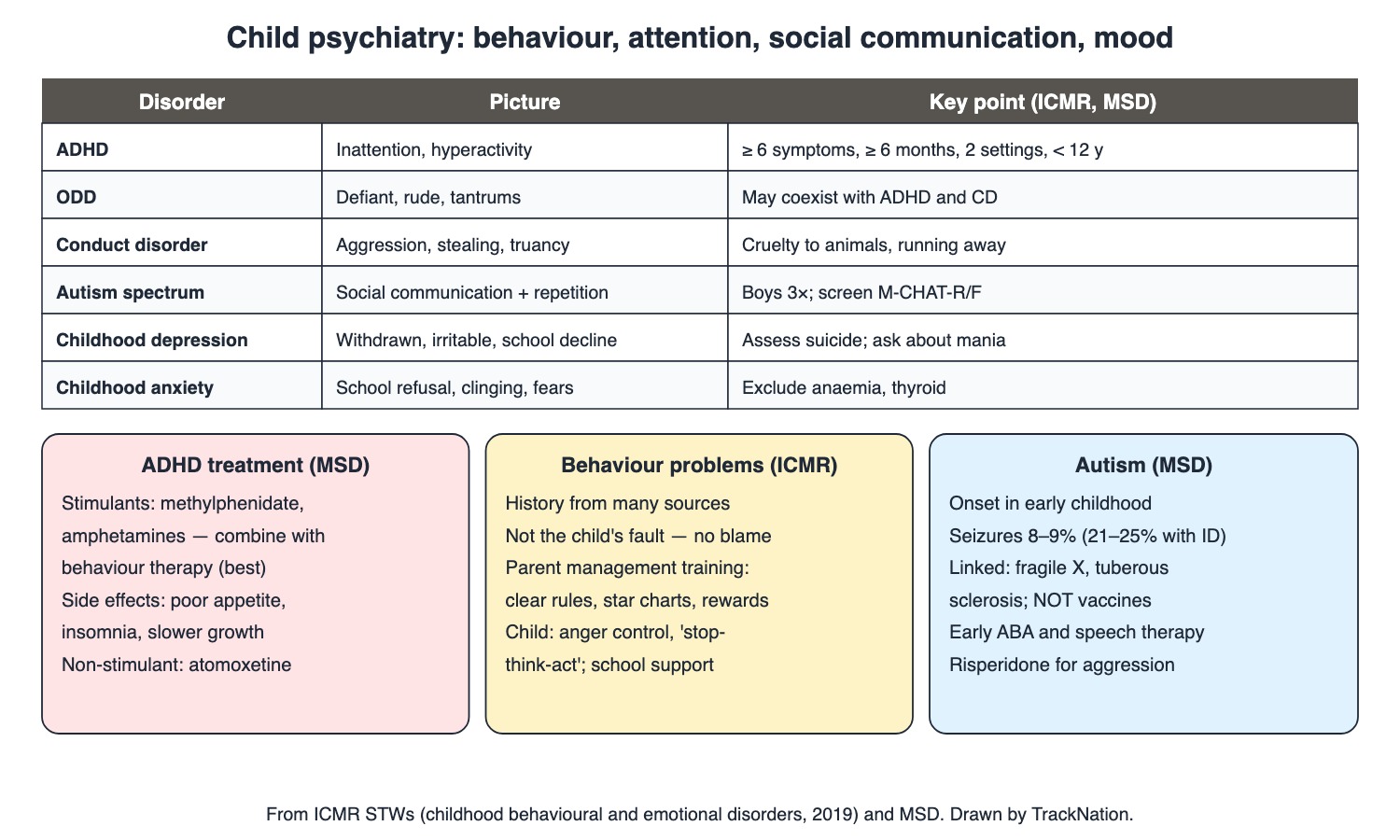
ADHD, ODD, conduct disorder, autism and childhood emotional disorders compared; ADHD treatment; ICMR behaviour management; autism. Drawn by TrackNation.
Behavioural Disorders (ICMR)
ADHD: restless, always on the move, can't sit still, talkative; poor attention, easily distracted, disorganised; impatient, can't wait, acts without thinking. ODD: disobedient, back-answering, rude, demanding, stubborn, tantrums. Conduct disorder: aggression, bullying, damage, stealing, lying, truancy, running away, cruelty to animals. All three affect school performance; ADHD may occur with or without ODD and CD.
Caution: abrupt or recent onset or sudden worsening suggests another disorder such as bipolar disorder (hypomania or mania).
Assess from multiple sources — parents, child, school; family health, harmony and parenting (criticism, comparison, physical punishment); development, stress, substance use.
Management: psychoeducation — behaviours are not intentional, not the child's fault; parent management training — analyse triggers, enjoyable activities together, clear rules, withholding privileges, star charts and rewards; child — anger management, "stop-think-act" for ADHD; school — extra attention and support, coaching for learning problems; treat parental depression or alcohol problems.
ADHD and Autism (MSD)
ADHD: inattentive, hyperactive-impulsive or combined; about twice as common in boys (inattentive type equal). Diagnosis: ≥ 6 of 9 symptoms in one or both groups, present often for ≥ 6 months, beyond developmental level, in ≥ 2 settings (home and school), starting before 12. Can persist into adulthood.
Treatment: stimulants (methylphenidate, amphetamine salts) plus behaviour therapy — the combination works best; behaviour therapy alone may suit preschoolers. Stimulant adverse effects: insomnia, headache, stomach ache, appetite suppression, slow weight gain, raised pulse and BP, and slower height growth. Non-stimulant: atomoxetine (noradrenaline reuptake inhibitor).
Autism spectrum disorder: impaired social interaction and communication plus repetitive, stereotyped behaviour, beginning in early childhood; about 3 times more common in boys; often intellectual disability. Associated with fragile X, tuberous sclerosis, Down syndrome, congenital rubella or CMV, PKU; vaccines (MMR) do not cause it. Seizures in 8–9% (21–25% with intellectual disability). Screen toddlers with M-CHAT-R/F; test for fragile X (family history) and Rett syndrome in girls. Treatment: early applied behaviour analysis and speech therapy; risperidone or aripiprazole for self-injury, aggression and rituals.
Emotional Disorders in Children (ICMR)
Somatic: tiredness, aches, headache, non-epileptic fainting attacks, chest or stomach pain, hyperventilation under stress. Depressive: loss of interest, falling school performance, withdrawal, irritability, crying, poor sleep and appetite, talk of death, self-harm. Anxiety: constant worry, exam tension, fears (animals, ghosts), school refusal, shyness, clinging to mother.
Depression is commoner in adolescents. Always assess suicide risk; in moderate–severe depression ask about mania (possible bipolar disorder). Exclude anaemia, thyroid disease, malaria, chronic infection, PCOD.
Manage: psychoeducation (not the child's fault), avoid criticism, comparison and punishment, reduce stress, relaxation and emotional regulation skills, school feedback and support.
Traps the Examiner Sets
ADHD needs onset before 12 and two settings.
Cruelty to animals and running away = conduct disorder, not ODD.
Autism is not caused by vaccines.
Sudden new hyperactivity in a teenager → think mania.
Memory Hooks & Shortcuts
Shortcuts to lock in this article's numbers and lists. Each one only re-packages facts proven above.
🧠 ADHD '6-6-2-12': 6 symptoms, 6 months, 2 settings, before 12 — criteria
🧠 'ODD argues; CD breaks laws (and hurts animals)' — ODD vs CD
🧠 Stimulants: 'Less food, less sleep, less height' — adverse effects
🧠 Autism 'boys 3×, Fragile X, not vaccines' — autism
🧠 ICMR: 'not the child's fault' — psychoeducation first — approach
Rapid-Revision Cards
ADHD picture
Restless, distractible, impulsive.
ADHD criteria
≥ 6 symptoms, ≥ 6 months, 2 settings, < 12 y.
ADHD types
Inattentive, hyperactive, combined.
ADHD sex ratio
Boys 2× (inattentive equal).
ADHD Rx
Stimulant + behaviour therapy.
Stimulant effects
Appetite ↓, insomnia, growth ↓.
Non-stimulant
Atomoxetine.
Preschool ADHD
Non-drug first.
ODD
Defiant, tantrums.
Conduct disorder
Aggression, stealing, cruelty, running away.
Abrupt onset
Think mania.
Assessment
Multiple sources.
PMT
Rules, privileges, star charts.
ADHD skill
Stop-think-act.
Autism core
Social communication + repetition.
Autism sex ratio
Boys 3×.
Autism associations
Fragile X, TSC, Down, rubella.
Vaccines
Not causative.
Autism screen
M-CHAT-R/F.
Autism Rx
ABA, speech; risperidone for aggression.
Child depression
Assess suicide; ask about mania.
Sources
Facts in this article were checked against these documents.
Standard Treatment Workflows: Childhood Behavioral Disorders; Childhood Emotional Disorders — Indian Council of Medical Research, DHR, 2019 (link)
MSD Manual Professional: Attention-Deficit/Hyperactivity Disorder; Autism Spectrum Disorder — Merck & Co. (MSD Manuals), reviewed 2025–26 (link)
Competency Based Undergraduate Curriculum, Psychiatry (PS 10) — National Medical Commission, 2024
Test Yourself: Practice Questions
Thirty questions in NEET PG style, most of them clinical vignettes.
Practice Questions (NEET PG pattern)
Original questions written in the style of the exam: +4 for a correct answer, −1 for a wrong one. Every answer was checked against the sources listed above. NEET PG papers are not published by NBEMS, so these are not past-paper questions.
Q1. A school-age child cannot sit still, talks constantly, is easily distracted at home and at school and acts without thinking, for more than 6 months. The likely diagnosis is
(a) conduct disorder
(b) autism
(c) childhood depression
(d) ADHD
Show answer
Answer: (d) — ≥ 2 settings, ≥ 6 months.
Q2. ADHD symptoms must have been present before the age of
(a) 12 years
(b) 3 years
(c) 6 years
(d) 18 years
Show answer
Answer: (a) — DSM-5-TR via MSD.
Q3. ADHD diagnosis needs at least how many symptoms from one or both symptom groups?
(a) 9
(b) 3
(c) 2
(d) 6
Show answer
Answer: (d) — Out of 9 in each group.
Q4. Which ADHD type occurs about equally in boys and girls?
(a) combined
(b) predominantly hyperactive-impulsive
(c) none
(d) predominantly inattentive
Show answer
Answer: (d) — Overall boys 2×.
Q5. For school-aged children with ADHD, the most effective approach is
(a) diet alone
(b) behaviour therapy alone
(c) stimulant medication combined with behaviour therapy
(d) antipsychotics
Show answer
Answer: (c) — Combination is best.
Q6. The most widely used ADHD drugs are
(a) methylphenidate or amphetamine salts
(b) SSRIs
(c) lithium
(d) risperidone
Show answer
Answer: (a) — Stimulants.
Q7. A boy on methylphenidate loses weight and sleeps poorly. These are
(a) common stimulant adverse effects (appetite suppression, insomnia)
(b) signs of mania
(c) drug allergy
(d) unrelated
Show answer
Answer: (a) — Also headache, stomach ache.
Q8. A long-term concern with stimulant treatment in children is
(a) cataract
(b) slowed growth in height
(c) hypothyroidism
(d) deafness
Show answer
Answer: (b) — Monitor growth.
Q9. A non-stimulant ADHD drug that inhibits noradrenaline reuptake is
(a) methylphenidate
(b) clonidine only
(c) atomoxetine
(d) haloperidol
Show answer
Answer: (c) — Selective NRI.
Q10. For a preschool child with ADHD symptoms, MSD suggests
(a) high-dose stimulants first
(b) ECT
(c) non-drug interventions alone may be appropriate
(d) antipsychotics
Show answer
Answer: (c) — Behaviour-based help first.
Q11. A school-age child is disobedient, argues and throws tantrums when demands are not met, but does not hurt people or break rules seriously. This is
(a) ADHD
(b) autism
(c) conduct disorder
(d) oppositional defiant disorder
Show answer
Answer: (d) — Defiance without serious violations.
Q12. An adolescent bullies others, steals, skips school, runs away from home and has been cruel to animals. The diagnosis is
(a) depression
(b) ADHD
(c) conduct disorder
(d) ODD
Show answer
Answer: (c) — Serious rule violations.
Q13. ICMR cautions that an abrupt onset or sudden worsening of hyperactivity should make you consider
(a) normal childhood
(b) bipolar disorder (hypomania or mania)
(c) intellectual disability
(d) autism
Show answer
Answer: (b) — Follow the relevant STW.
Q14. In childhood behavioural disorders, ICMR advises taking the history from
(a) the child only
(b) teachers only
(c) a single parent only
(d) multiple sources: parents, child and school
Show answer
Answer: (d) — Family and parenting too.
Q15. A key psychoeducation message to parents of a child with behaviour problems is that
(a) the child is lazy
(b) the behaviours are not intentional and not the child's fault
(c) punishment cures it
(d) nothing can help
Show answer
Answer: (b) — Do not blame the child.
Q16. Parent management training includes
(a) physical punishment
(b) ignoring the child
(c) clear rules, withholding privileges and star charts with rewards
(d) medication only
Show answer
Answer: (c) — Contingency management.
Q17. A self-control technique ICMR teaches children with ADHD is
(a) time-out in a dark room
(b) fasting
(c) hypnosis
(d) 'stop-think-act'
Show answer
Answer: (d) — Also anger management.
Q18. Autism spectrum disorder is characterised by
(a) hallucinations
(b) impaired social interaction and communication with repetitive, stereotyped behaviour
(c) low mood
(d) hyperactivity only
Show answer
Answer: (b) — Starts in early childhood.
Q19. Autism is about how many times more common in boys?
(a) 3
(b) 1
(c) 10
(d) 0.5
Show answer
Answer: (a) — Per MSD.
Q20. Parents ask if the MMR vaccine caused their child's autism. The correct answer is that
(a) MMR causes autism
(b) it is unknown
(c) studies have disproved any link
(d) only the second dose causes it
Show answer
Answer: (c) — Vaccines are not causative.
Q21. A genetic condition associated with autism that should be tested for when family history suggests it is
(a) Marfan syndrome
(b) fragile X syndrome
(c) Turner syndrome
(d) haemophilia
Show answer
Answer: (b) — Also Rett in girls, tuberous sclerosis.
Q22. Seizures occur in about what proportion of people with both autism and intellectual disability?
(a) 8–9%
(b) 21–25%
(c) 1%
(d) 75%
Show answer
Answer: (b) — 8–9% in autism overall.
Q23. A screening tool for autism in toddlers is the
(a) M-CHAT-R/F
(b) MMSE
(c) Conners scale
(d) AUDIT
Show answer
Answer: (a) — Social Communication Questionnaire for older children.
Q24. The core treatment for a young child with autism is
(a) antiepileptics only
(b) stimulants
(c) no treatment
(d) early intensive behavioural therapy (ABA) and speech-language therapy
Show answer
Answer: (d) — Start early.
Q25. A child with autism has severe self-injury and aggression. A drug with evidence is
(a) methylphenidate
(b) lithium
(c) risperidone or aripiprazole
(d) fluoxetine
Show answer
Answer: (c) — Atypical antipsychotics.
Q26. An adolescent has become withdrawn and irritable, school marks have fallen, sleep and appetite are poor, and the adolescent talks about death. The most important first step is
(a) start stimulants
(b) wait and watch
(c) assess suicide risk
(d) scold her about studies
Show answer
Answer: (c) — Depression in adolescents.
Q27. In a child with moderate to severe depression, ICMR advises asking about
(a) handedness
(b) vaccination
(c) food allergies
(d) past hypomania or mania
Show answer
Answer: (d) — Consider bipolar disorder.
Q28. A child refuses to go to school and clings to the mother, fearing separation. This is a symptom of
(a) childhood anxiety
(b) ADHD
(c) autism
(d) conduct disorder
Show answer
Answer: (a) — ICMR emotional disorders.
Q29. Physical conditions ICMR asks you to exclude in childhood emotional disorders include
(a) asthma only
(b) fractures
(c) myopia
(d) anaemia and thyroid disease
Show answer
Answer: (d) — Also malaria, chronic infection, PCOD.
Q30. ICMR advice to parents of a child with emotional disorders is to avoid
(a) undue criticism, over-expectation, unfair comparison and punishment
(b) all school work
(c) friends
(d) medical care
Show answer
Answer: (a) — Support and encouragement.
Active Recall
From memory: give the ADHD criteria and treatment, contrast ODD and conduct disorder, outline the ICMR approach to behaviour problems, describe autism with its associations, screening and treatment, and list the key cautions in childhood depression and anxiety.