Puberty and Amenorrhoea for NEET PG OBG: Primary vs Secondary, MRKH vs Androgen Insensitivity, Turner, POI, Progestin Challenge and Abnormal Puberty
Start Here
🎯 Exam priority: High. Expect: definitions (15 years, 13 years, 3/6 months), the absent-uterus karyotype question (MRKH vs CAIS), Turner features, POI definition, the progestin challenge logic, Asherman, Sheehan, Kallmann, hyperprolactinaemia and the ages for precocious/delayed puberty.
CBME mapping: OG23 (puberty) and OG25 (amenorrhoea).
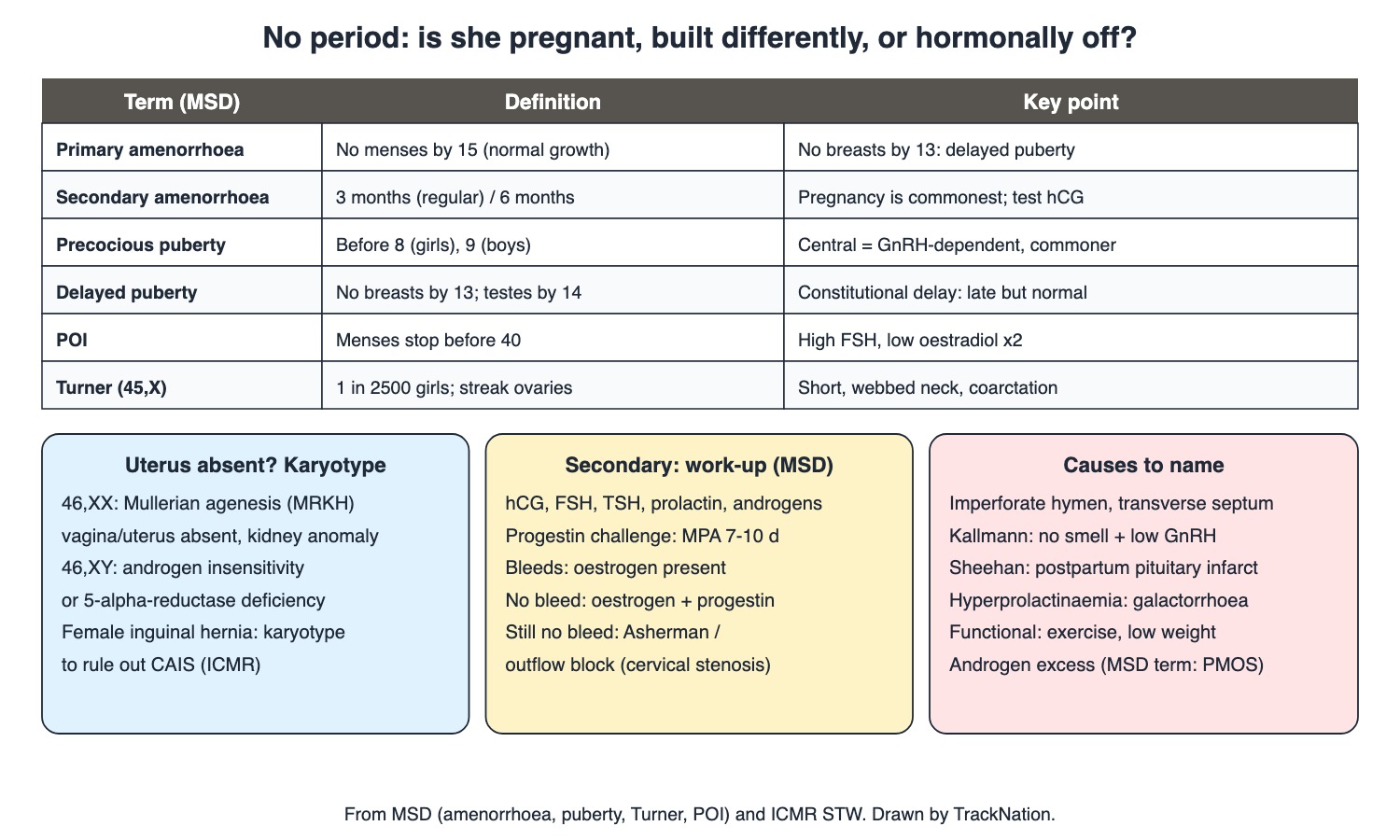
Definitions, the karyotype pathway, the challenge tests and key causes. Drawn by TrackNation.
Definitions and First Steps (MSD)
Primary amenorrhoea: no menses by 15 years with normal growth and secondary sexual characters; no breast development by 13 → evaluate for delayed puberty. Secondary: no menses for 3 months (previously regular) or 6 months (previously irregular).
Pregnancy is the commonest cause in reproductive-age women — test hCG first. Ovulatory dysfunction is the commonest mechanism overall.
Baseline tests: hCG, FSH, TSH, prolactin, testosterone/DHEAS. Primary amenorrhoea with normal breasts → pelvic ultrasound first (outflow obstruction). Galactorrhoea, headache or field defects → pituitary MRI.
Clues: short stature + webbed neck → Turner; hirsutism/acne → androgen excess (MSD's 'polyendocrine metabolic ovarian syndrome', an androgen-secreting tumour, Cushing); hot flushes → POI or hypothalamic; galactorrhoea → hyperprolactinaemia.
Causes by Level (MSD, ICMR)
Outflow/uterus: imperforate hymen, transverse vaginal septum (blood collects — haematometra); Müllerian agenesis (MRKH), ~1 in 5000, absent uterus/upper vagina, often renal anomalies; Asherman syndrome (intrauterine adhesions after infection or an intrauterine procedure), endometrial TB, cervical stenosis.
Absent uterus → karyotype: 46,XX = MRKH; 46,XY = complete androgen insensitivity or 5α-reductase deficiency. Girls with inguinal hernia get a karyotype to rule out CAIS (ICMR). Y material (e.g. Swyer 46,XY) raises gonadal germ-cell cancer risk.
Ovary: Turner (45,X) — 1 in 2500 girls, streak ovaries, short stature, webbed neck, lymphoedema of hands and feet at birth, coarctation/bicuspid aortic valve; only 2–10% menstruate spontaneously; growth hormone + oestrogen. Primary ovarian insufficiency: menses stop before 40, high FSH + low oestradiol on two tests a month apart; causes — Turner, fragile X premutation, autoimmune, chemo/radiation; treat with oestrogen-progestogen.
Hypothalamus/pituitary: functional hypothalamic (exercise, eating disorders, stress); Kallmann (GnRH deficiency + anosmia); hyperprolactinaemia (adenoma, antipsychotics, lactation); Sheehan (postpartum pituitary infarction); hypothyroidism.
Challenge Tests and Abnormal Puberty (MSD)
Progestin challenge (secondary amenorrhoea, normal prolactin, FSH, TSH, no virilisation): medroxyprogesterone 5–10 mg for 7–10 days. Withdrawal bleed = enough oestrogen (anovulation). No bleed → oestrogen 21 days + progestin; still no bleed → Asherman or outflow obstruction.
Precocious puberty: before 8 in girls, 9 in boys (being re-evaluated). Central (GnRH-dependent) is commoner, especially in girls; confirm with LH / leuprolide stimulation. Peripheral causes: ovarian cysts, granulosa cell tumours, McCune–Albright (cysts + polyostotic fibrous dysplasia + café-au-lait), 21-hydroxylase CAH.
Delayed puberty: no breasts by 13 (girls), no testicular enlargement by 14 (boys). Constitutional delay is self-limiting and familial; Kallmann is the commonest genetic cause of hypogonadotropic hypogonadism.
Traps the Examiner Sets
Rule out pregnancy first in any amenorrhoea.
Breasts present but uterus absent: the karyotype decides MRKH (46,XX) vs CAIS (46,XY).
Withdrawal bleed after progestin means oestrogen is present.
POI is before 40 with high FSH — not low.
Memory Hooks & Shortcuts
Shortcuts to lock in this article's numbers and lists. Each one only re-packages facts proven above.
🧠 Amenorrhoea numbers '15-13-3-6': 15 no menses, 13 no breasts, 3 months regular, 6 irregular — definitions
🧠 Absent uterus: 'XX = MRKH (kidney check), XY = CAIS (gonad check)' — karyotype
🧠 Progestin challenge: 'Bleed = oestrogen there; no bleed after E+P = the pipe is blocked' — challenge
🧠 'K for Kallmann, K for can't smell' — Kallmann
🧠 Turner 'Short, Shield chest, Streak ovaries, coarctation' — Turner
Rapid-Revision Cards
Primary amenorrhoea
No menses by 15.
No breasts by 13
Evaluate delayed puberty.
Secondary
3 mo (regular) / 6 mo.
First test
hCG.
Normal breasts, no period
Pelvic USG first.
Absent uterus + 46,XX
MRKH.
Absent uterus + 46,XY
CAIS / 5αRD.
MRKH association
Renal anomalies.
Girl with inguinal hernia
Karyotype (CAIS).
Y material
Germ-cell cancer risk.
Turner
45,X; 1/2500; streak ovaries.
Turner heart
Coarctation, bicuspid AV.
POI
<40; FSH high, E2 low.
POI genetics
Fragile X premutation.
Asherman
Adhesions after D&C/infection.
Sheehan
Postpartum pituitary infarct.
Kallmann
Anosmia + low GnRH.
Progestin challenge
MPA 5–10 mg × 7–10 d.
No bleed after E+P
Asherman / obstruction.
Precocious
<8 girls; <9 boys.
McCune–Albright
Cysts, bone, café-au-lait.
Sources
Facts in this article were checked against these documents.
MSD Manual Professional: Amenorrhea; Primary Ovarian Insufficiency; Precocious Puberty; Delayed Puberty; Turner Syndrome — Merck & Co. (MSD Manuals), 2024–26 (link)
Standard Treatment Workflow: Congenital Inguinal Hernias (Paediatric Surgery) — Indian Council of Medical Research, 2022
Competency Based Undergraduate Curriculum, Vol III: Obstetrics & Gynaecology (OG23, OG25) — National Medical Commission, 2024
Test Yourself: Practice Questions
Thirty questions in NEET PG style, most of them clinical vignettes.
Practice Questions (NEET PG pattern)
Original questions written in the style of the exam: +4 for a correct answer, −1 for a wrong one. Every answer was checked against the sources listed above. NEET PG papers are not published by NBEMS, so these are not past-paper questions.
Q1. Primary amenorrhoea is defined (MSD) as no menses by age
(a) 12 years
(b) 15 years with normal growth and secondary sex characters
(c) 13 years regardless of breasts
(d) 18 years
Show answer
Answer: (b) — No breasts by 13 → evaluate.
Q2. A girl of 13 has no breast development and no periods. Next:
(a) wait till 18
(b) start OCPs
(c) reassure only
(d) evaluate for delayed puberty now
Show answer
Answer: (d) — MSD.
Q3. A woman with regular cycles has had no period for 3 months. This is
(a) secondary amenorrhoea
(b) oligomenorrhoea only
(c) primary amenorrhoea
(d) normal
Show answer
Answer: (a) — 6 months if irregular.
Q4. The first test in a sexually active woman with secondary amenorrhoea is
(a) serum or urine hCG
(b) laparoscopy
(c) pelvic MRI
(d) karyotype
Show answer
Answer: (a) — Commonest cause.
Q5. A 16-year-old with normal breasts and pubic hair has primary amenorrhoea. First imaging:
(a) chest X-ray
(b) brain MRI
(c) pelvic ultrasound
(d) DEXA scan
Show answer
Answer: (c) — Look for obstruction/uterus.
Q6. A 14-year-old with normal breasts has no periods; examination shows a membrane closing the vaginal opening with blood collected behind it. Diagnosis:
(a) imperforate hymen
(b) Asherman syndrome
(c) Turner syndrome
(d) MRKH
Show answer
Answer: (a) — Haematocolpos/haematometra.
Q7. A 17-year-old with normal breasts and pubic hair has an absent uterus and short vagina; karyotype 46,XX. Diagnosis:
(a) Kallmann syndrome
(b) Turner syndrome
(c) Müllerian agenesis (MRKH)
(d) complete androgen insensitivity
Show answer
Answer: (c) — Check kidneys.
Q8. In MRKH, the associated anomaly to look for is
(a) urinary tract anomalies such as pelvic kidney
(b) coarctation of aorta
(c) café-au-lait spots
(d) anosmia
Show answer
Answer: (a) — MSD.
Q9. A phenotypic girl with absent uterus has a 46,XY karyotype. Possible diagnoses:
(a) complete androgen insensitivity or 5α-reductase deficiency
(b) Sheehan syndrome
(c) Turner syndrome
(d) MRKH
Show answer
Answer: (a) — Testosterone helps.
Q10. ICMR advises a karyotype in a girl with inguinal hernia to exclude
(a) Turner syndrome
(b) MRKH
(c) complete androgen insensitivity syndrome
(d) Kallmann syndrome
Show answer
Answer: (c) — Testes in the sac.
Q11. Why are gonads with Y-chromosome material (e.g. Swyer 46,XY) a concern?
(a) they produce prolactin
(b) they cause hypertension
(c) raised risk of germ-cell cancer
(d) they cause anosmia
Show answer
Answer: (c) — MSD.
Q12. A short 15-year-old with webbed neck and widely spaced nipples has primary amenorrhoea. Likely karyotype:
(a) 47,XXY
(b) 45,X
(c) 46,XY
(d) 46,XX normal
Show answer
Answer: (b) — Turner.
Q13. The cardiac lesions typical of Turner syndrome are
(a) mitral stenosis
(b) coarctation of aorta and bicuspid aortic valve
(c) ASD only
(d) tetralogy of Fallot
Show answer
Answer: (b) — Also aortic dilatation.
Q14. A newborn girl has puffy hands and feet from lymphoedema. Consider
(a) Down syndrome only
(b) MRKH
(c) Turner syndrome
(d) CAH
Show answer
Answer: (c) — Neck folds too.
Q15. In Turner syndrome the ovaries are typically
(a) normal
(b) enlarged with cysts
(c) polycystic
(d) streaks of fibrous stroma without ova
Show answer
Answer: (d) — Gonadal dysgenesis.
Q16. Primary ovarian insufficiency is cessation of menses before
(a) 50 years
(b) 45 years with low FSH
(c) 35 years with high prolactin
(d) 40 years with high FSH and low oestradiol
Show answer
Answer: (d) — Two tests a month apart.
Q17. A genetic cause of POI to test for is
(a) fragile X (FMR1) premutation
(b) HLA-B27
(c) CFTR
(d) BRCA1
Show answer
Answer: (a) — Also Turner.
Q18. A woman stopped menstruating after a dilatation and curettage complicated by infection. Likely
(a) Asherman syndrome (intrauterine adhesions)
(b) Sheehan syndrome
(c) POI
(d) PCOS
Show answer
Answer: (a) — Fails both challenges.
Q19. A woman has amenorrhoea after postpartum infarction and necrosis of the pituitary. Diagnosis:
(a) Sheehan syndrome
(b) Kallmann syndrome
(c) Asherman syndrome
(d) Turner syndrome
Show answer
Answer: (a) — Pituitary infarction.
Q20. A 17-year-old with delayed puberty cannot smell. Diagnosis:
(a) Turner syndrome
(b) CAIS
(c) Kallmann syndrome
(d) MRKH
Show answer
Answer: (c) — GnRH deficiency.
Q21. A woman on an antipsychotic has amenorrhoea and galactorrhoea. Likely mechanism:
(a) POI
(b) Asherman
(c) hyperprolactinaemia
(d) hyperandrogenism
Show answer
Answer: (c) — Also adenoma, lactation.
Q22. A marathon runner with low weight has secondary amenorrhoea. Likely
(a) Asherman
(b) Turner mosaic
(c) functional hypothalamic amenorrhoea
(d) POI
Show answer
Answer: (c) — Energy deficit.
Q23. In the progestin challenge test, medroxyprogesterone is given as
(a) 100 mg once
(b) 1 mg daily for 3 months
(c) 150 mg IM once
(d) 5–10 mg daily for 7–10 days
Show answer
Answer: (d) — Then watch for bleed.
Q24. A withdrawal bleed after the progestin challenge indicates
(a) oestrogen deficiency
(b) Asherman syndrome
(c) adequate oestrogen with an intact outflow tract
(d) pregnancy
Show answer
Answer: (c) — Anovulation likely.
Q25. No bleed even after oestrogen followed by progestin suggests
(a) hyperprolactinaemia
(b) Asherman syndrome or outflow obstruction
(c) hypothalamic amenorrhoea
(d) PCOS
Show answer
Answer: (b) — End-organ problem.
Q26. Precocious puberty in girls is traditionally sexual maturation before age
(a) 8
(b) 6
(c) 12
(d) 10
Show answer
Answer: (a) — 9 in boys.
Q27. The commoner type of precocious puberty, especially in girls, is
(a) exogenous only
(b) peripheral (GnRH-independent)
(c) central (GnRH-dependent)
(d) adrenal tumour
Show answer
Answer: (c) — MSD.
Q28. A 6-year-old girl with early breast development, café-au-lait macules and bone lesions has
(a) MRKH
(b) McCune–Albright syndrome
(c) Turner syndrome
(d) Kallmann syndrome
Show answer
Answer: (b) — Peripheral precocity.
Q29. Delayed puberty in a girl means no breast development by
(a) 16 years
(b) 18 years
(c) 13 years
(d) 10 years
Show answer
Answer: (c) — Boys: testes by 14.
Q30. Only a small fraction of girls with Turner syndrome menstruate spontaneously, about
(a) 2–10%
(b) 90%
(c) none at all
(d) 50%
Show answer
Answer: (a) — Puberty 15–40%.
Active Recall
From memory: define primary and secondary amenorrhoea, outline the first tests, classify causes by level, distinguish MRKH from CAIS, describe Turner syndrome and POI, explain the progestin and oestrogen-progestin challenge, and define precocious and delayed puberty.