Infertility for NEET PG OBG: ICMR Female and Male Work-up, WHO 2021 Semen Values, Ovulation Induction, IVF/ICSI, ART Act and Surrogacy Act 2021
Start Here
🎯 Exam priority: High. Expect: the 12/6-month rule, cumulative conception rates, first-line tests for each partner, WHO 2021 semen values, AFC/AMH cut-offs, which factor leads to IUI vs IVF/ICSI, letrozole vs clomiphene, OHSS, and the age limits and rules in the ART and Surrogacy Acts.
CBME mapping: OG28. Indian anchors: ICMR STWs on female (2022) and male (2025) infertility; ART (Regulation) Act 2021 and Surrogacy (Regulation) Act 2021 (gazette texts).
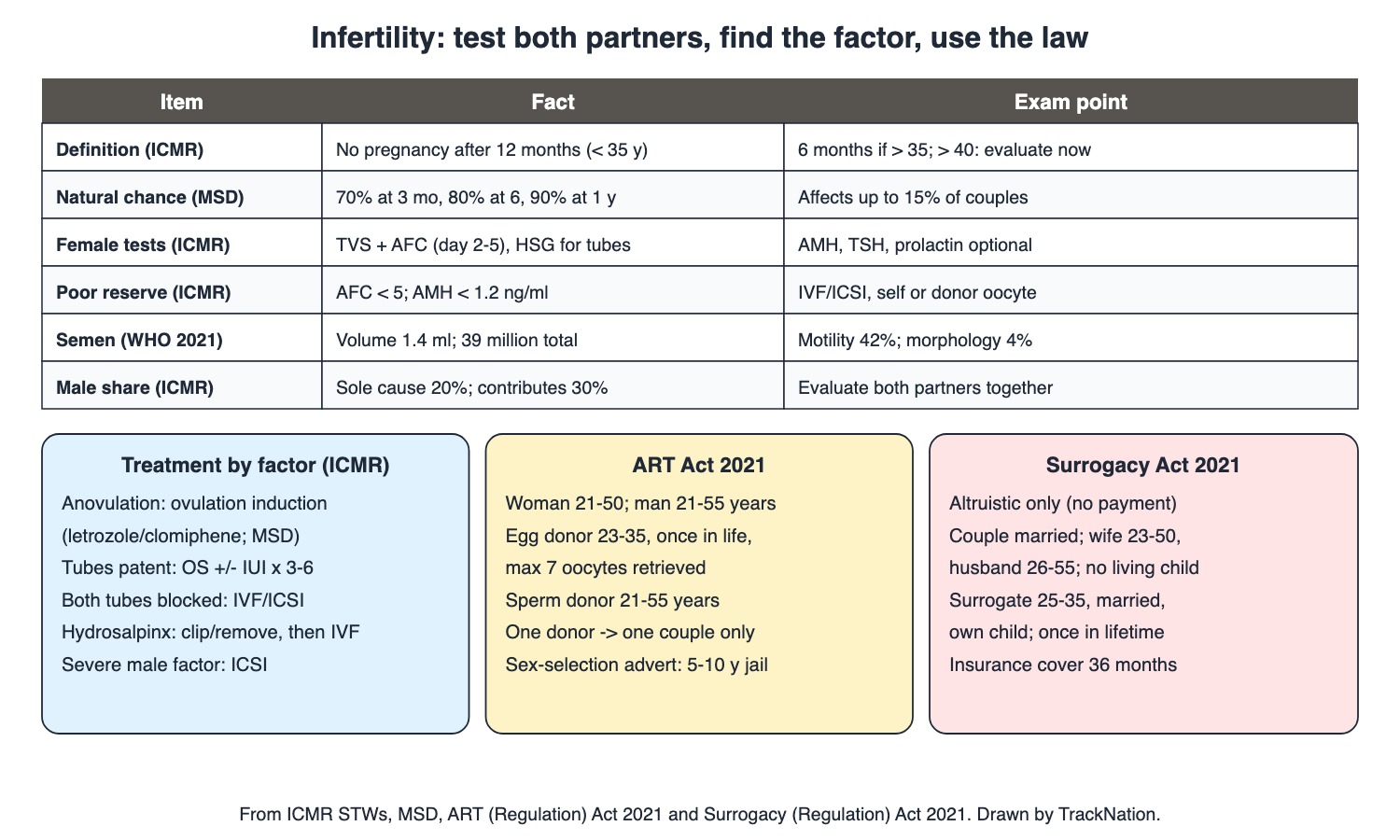
Definitions, tests, treatment by factor, and the ART and Surrogacy Acts. Drawn by TrackNation.
Definition and Who to Evaluate (ICMR, MSD)
Infertility = no pregnancy after 12 months of regular unprotected intercourse (women <35) or 6 months (women >35). Affects up to 15% of couples. Women >35: expedited, >40: immediate evaluation; also early if oligo/amenorrhoea, known tubal/uterine disease, endometriosis, prior chemo/radiotherapy or suspected male factor.
Natural conception (MSD): about 70% in 3 months, 80% in 6, 90% in 1 year. Causes: sperm disorders 24–35%, ovulatory dysfunction 21–25%, tubal, endometriosis, uterine, unexplained. Female age is the most important prognostic factor (ICMR).
Evaluate both partners together (ICMR male STW): the male factor is the sole cause in 20% and contributes in another 30%.
Female Work-up and Treatment (ICMR, MSD)
Essential: transvaginal ultrasound (uterus, adnexa, antral follicle count on day 2–5) and HSG for tubal patency. Optional: AMH, day 2/3 FSH/LH, TSH, prolactin, endometrial aspirate for TB (AFB/PCR), viral markers, rubella. Ovulation is confirmed by mid-luteal progesterone ≥3 ng/ml (MSD).
Poor ovarian reserve: AFC <5, AMH <1.2 ng/ml → IVF/ICSI with own or donor oocytes.
Tubes patent + ovulation documented → ovarian stimulation ± IUI for 3–6 cycles, then IVF. Both tubes blocked → confirm by laparoscopy with chromopertubation → IVF/ICSI. Hydrosalpinx → salpingectomy or clipping, then IVF.
Anovulation (commonest cause: polyendocrine metabolic ovarian syndrome, as MSD names it) → ovulation induction. MSD: letrozole (aromatase inhibitor) is preferred by many and works better than clomiphene in obese women with this syndrome; clomiphene → twins ~5%, OHSS ≤1%, never in pregnancy. Uterine factor (polyp, septum, adhesions, cavity-distorting fibroid) → hysteroscopic/laparoscopic correction.
IVF (MSD): stimulation → hCG trigger → oocyte retrieval ~34 hours later → fertilisation (ICSI if sperm are abnormal) → embryo transfer. GnRH-agonist trigger lowers OHSS risk.
Male Work-up (ICMR 2025)
Causes: pretesticular (hypogonadotropic hypogonadism, sexual dysfunction), testicular (primary failure, cryptorchidism, varicocele, tumours), post-testicular (congenital absence of vas, ejaculatory duct obstruction, post-vasectomy).
Semen analysis (essential): 2 samples 2–4 weeks apart, 1–3 days' abstinence, delivered within an hour at room temperature. WHO 2021 lower reference limits: volume 1.4 ml, total count 39 million, total motility 42%, progressive 30%, morphology 4%.
Azoospermia must be confirmed on a centrifuged pellet; obstructive vs non-obstructive. No ejaculate → think retrograde ejaculation/anejaculation. Extended tests: hormones, karyotype (Klinefelter), Y-microdeletion, CFTR (absent vas).
ART Act and Surrogacy Act 2021
ART (Regulation) Act 2021 (No. 42): services for a woman 21–50 and a man 21–55; sperm donors 21–55; oocyte donors 23–35, once in a lifetime, no more than 7 oocytes retrieved; one donor's gametes to only one couple. The child is the biological child of the commissioning couple; donors give up all parental rights. Advertising sex-selective ART: 5–10 years and a fine.
Surrogacy (Regulation) Act 2021 (No. 47): altruistic only — no payment beyond medical costs and insurance. Intending couple: married, wife 23–50, husband 26–55, no surviving child (exceptions for a child with serious illness/disability), with a certificate of essentiality. Surrogate: ever-married, own child, 25–35 years, once in a lifetime, may not use her own eggs, insured for 36 months. Commercial surrogacy rackets, advertising, exploitation, sale of embryos and sex selection: up to 10 years and Rs 10 lakh.
Traps the Examiner Sets
Over 35: start evaluation after 6 months; over 40: at once.
Test the man early — male factor is involved in about half of couples.
Both tubes blocked → IVF, not IUI.
A surrogate cannot donate her own egg; surrogacy is altruistic only.
Memory Hooks & Shortcuts
Shortcuts to lock in this article's numbers and lists. Each one only re-packages facts proven above.
🧠 Evaluation clock '12-6-0': under 35 wait 12, over 35 wait 6, over 40 wait 0 — timing
🧠 WHO 2021 semen '1.4 – 39 – 42 – 4' — semen
🧠 Reserve '5 and 1.2': AFC under 5 or AMH under 1.2 = poor — reserve
🧠 ART Act ages '21-50 her, 21-55 him; egg donor 23-35, once, 7 eggs' — ART
🧠 Surrogacy '23-50 / 26-55 couple; 25-35 surrogate, once, never her own egg' — surrogacy
Rapid-Revision Cards
Infertility
12 months (<35); 6 months (>35).
>40 years
Evaluate immediately.
Prevalence
Up to 15% couples.
Natural conception
70/80/90% at 3/6/12 mo.
Best prognostic factor
Female age.
Male factor
Sole 20%; contributes 30%.
AFC timing
Day 2–5.
Poor reserve
AFC <5; AMH <1.2.
Tubes
HSG; confirm laparoscopy.
Both tubes blocked
IVF/ICSI.
Hydrosalpinx
Clip/remove before IVF.
Ovulation proof
Progesterone ≥3 ng/ml.
PMOS + obesity
Letrozole.
Clomiphene
Twins ~5%; OHSS ≤1%.
Retrieval
34 h after hCG.
Semen collection
2 samples; 1–3 d abstinence.
WHO 2021
1.4 ml; 39 M; 42%; 4%.
ART ages
Woman 21–50; man 21–55.
Egg donor
23–35; once; ≤7 oocytes.
Surrogacy couple
Wife 23–50; husband 26–55.
Surrogate
25–35; own child; once; no own eggs.
Sources
Facts in this article were checked against these documents.
Standard Treatment Workflows: Female Infertility (2022); Male Infertility (2025) — Indian Council of Medical Research / DHR, 2022–2025
The Assisted Reproductive Technology (Regulation) Act, 2021 (No. 42 of 2021) — Ministry of Law and Justice, Gazette of India, 2021
The Surrogacy (Regulation) Act, 2021 (No. 47 of 2021) — Ministry of Law and Justice, Gazette of India, 2021
MSD Manual Professional: Overview of Infertility; Ovulatory Dysfunction; Assisted Reproductive Technologies — Merck & Co. (MSD Manuals), 2024–26 (link)
Competency Based Undergraduate Curriculum, Vol III: Obstetrics & Gynaecology (OG28) — National Medical Commission, 2024
Test Yourself: Practice Questions
Thirty questions in NEET PG style, most of them clinical vignettes.
Practice Questions (NEET PG pattern)
Original questions written in the style of the exam: +4 for a correct answer, −1 for a wrong one. Every answer was checked against the sources listed above. NEET PG papers are not published by NBEMS, so these are not past-paper questions.
Q1. A 29-year-old woman has not conceived after 8 months of regular unprotected intercourse. Per ICMR/MSD
(a) evaluation is usually started at 12 months
(b) infertility is confirmed
(c) start IVF now
(d) test only the husband
Show answer
Answer: (a) — 6 months if >35.
Q2. A 37-year-old has tried for 7 months without conceiving. Next:
(a) start clomiphene blindly
(b) reassure
(c) start evaluation now (6-month rule over 35)
(d) wait 1 more year
Show answer
Answer: (c) — >40: immediate.
Q3. Cumulative natural conception within 1 year is about
(a) 50%
(b) 90%
(c) 30%
(d) 99%
Show answer
Answer: (b) — 70% at 3 mo, 80% at 6.
Q4. Per ICMR, the single most important prognostic factor in female infertility is
(a) BMI
(b) parity
(c) AMH alone
(d) the woman's age
Show answer
Answer: (d) — Caution box.
Q5. ICMR advises evaluating the male partner
(a) simultaneously with the female partner
(b) only after the woman is fully investigated
(c) only if the woman is normal after 2 years
(d) never
Show answer
Answer: (a) — Male factor ~half.
Q6. The male factor is the sole cause of infertility in about
(a) 90%
(b) 60%
(c) 20% of couples
(d) 2%
Show answer
Answer: (c) — Contributory in 30% more.
Q7. The antral follicle count is measured on
(a) day 2–5 of the cycle
(b) any day
(c) day 21
(d) day 14
Show answer
Answer: (a) — TVS.
Q8. The essential first test of tubal patency per ICMR is
(a) CT scan
(b) colposcopy
(c) hysterosalpingography
(d) laparotomy
Show answer
Answer: (c) — Laparoscopy confirms.
Q9. A woman has AFC 3 and AMH 0.8 ng/ml. This indicates
(a) tubal block
(b) PCOS
(c) poor ovarian reserve — IVF with own or donor oocytes
(d) normal reserve
Show answer
Answer: (c) — AFC <5, AMH <1.2.
Q10. HSG shows both tubes blocked. Next per ICMR:
(a) observe
(b) clomiphene
(c) IUI for 6 cycles
(d) confirm with laparoscopic chromopertubation, then IVF/ICSI
Show answer
Answer: (d) — IUI needs a patent tube.
Q11. Before IVF, a large hydrosalpinx should be
(a) drained vaginally only
(b) left alone
(c) treated with antibiotics only
(d) removed or clipped
Show answer
Answer: (d) — ICMR.
Q12. With patent tubes and documented ovulation, ICMR suggests
(a) laparotomy
(b) ovarian stimulation ± IUI for 3–6 cycles
(c) immediate IVF
(d) nothing
Show answer
Answer: (b) — Then IVF if failed.
Q13. In an infertile woman, genital TB is looked for by
(a) endometrial aspirate for AFB/PCR
(b) HSG only
(c) semen culture
(d) Pap smear
Show answer
Answer: (a) — Optional test.
Q14. Ovulation is confirmed by a mid-luteal serum progesterone of at least
(a) 3 ng/ml
(b) 300 ng/ml
(c) 0.3 ng/ml
(d) 30 ng/ml
Show answer
Answer: (a) — MSD.
Q15. For ovulation induction in an obese woman with polyendocrine metabolic ovarian syndrome (PCOS), MSD favours
(a) tamoxifen
(b) danazol
(c) letrozole
(d) clomiphene
Show answer
Answer: (c) — More ovulation.
Q16. Clomiphene causes multiple (mostly twin) pregnancy in about
(a) 5%
(b) 0.01%
(c) 25%
(d) 50%
Show answer
Answer: (a) — OHSS ≤1%.
Q17. In IVF, oocytes are retrieved after the hCG trigger at about
(a) 72 hours
(b) 4 hours
(c) 7 days
(d) 34 hours
Show answer
Answer: (d) — Before ovulation.
Q18. ICSI is particularly indicated when
(a) never
(b) the woman is anovulatory only
(c) tubes are blocked but sperm normal
(d) sperm production is abnormal
Show answer
Answer: (d) — Single sperm injected.
Q19. To reduce OHSS risk in a high-risk woman, the final trigger can be
(a) oxytocin
(b) clomiphene
(c) a GnRH agonist instead of hCG
(d) double-dose hCG
Show answer
Answer: (c) — MSD.
Q20. For semen analysis ICMR advises
(a) one sample after 10 days' abstinence
(b) a sample kept overnight in a fridge
(c) 2 samples 2–4 weeks apart after 1–3 days' abstinence
(d) a blood test instead
Show answer
Answer: (c) — Deliver within 1 h.
Q21. WHO 2021 lower reference limit for total sperm count is
(a) 100 million
(b) 5 million
(c) 39 million per ejaculate
(d) 15 million
Show answer
Answer: (c) — Volume 1.4 ml.
Q22. WHO 2021 lower reference limit for normal morphology is
(a) 30%
(b) 4%
(c) 14%
(d) 50%
Show answer
Answer: (b) — Motility 42%.
Q23. A semen report shows no sperm. Before labelling azoospermia
(a) examine a centrifuged pellet
(b) repeat in 1 year
(c) start IVF
(d) give testosterone
Show answer
Answer: (a) — ICMR.
Q24. A man produces no semen sample despite orgasm. ICMR says consider
(a) retrograde ejaculation
(b) normal finding
(c) varicocele
(d) Klinefelter syndrome
Show answer
Answer: (a) — Or anejaculation.
Q25. Under the ART Act 2021, ART services may be given to a woman aged
(a) 18–45
(b) any age
(c) 25–55
(d) above 21 and below 50
Show answer
Answer: (d) — Man 21–55.
Q26. An oocyte donor under the ART Act must be
(a) 23–35 years, donating once in her life, max 7 oocytes retrieved
(b) 21–50, twice
(c) 18–40, any number of times
(d) any age with consent
Show answer
Answer: (a) — One couple only.
Q27. A child born through ART with donor gametes is legally
(a) the clinic's responsibility
(b) the biological child of the commissioning couple
(c) a ward of the state
(d) the donor's child
Show answer
Answer: (b) — Donor relinquishes rights.
Q28. Under the Surrogacy Act 2021, surrogacy in India must be
(a) allowed for any single man
(b) altruistic — no payment beyond medical expenses and insurance
(c) allowed for foreigners freely
(d) commercial with fixed fees
Show answer
Answer: (b) — Commercial banned.
Q29. The intending couple for surrogacy must be married with the wife aged
(a) any age
(b) 25–35 and husband 25–40
(c) 21–45 and husband 21–50
(d) 23–50 and husband 26–55
Show answer
Answer: (d) — No surviving child.
Q30. A woman offers to be a surrogate. She must be
(a) aged 40 with no children
(b) unmarried and 21
(c) ever-married with her own child, aged 25–35, a surrogate only once, not using her own eggs
(d) paid a fixed fee
Show answer
Answer: (c) — 36 months insurance.
Active Recall
From memory: define infertility and when to evaluate, list female and male tests with WHO 2021 semen values and reserve cut-offs, match each factor to its treatment, compare letrozole and clomiphene, outline IVF/ICSI, and state the main ART Act and Surrogacy Act rules.