Abnormal Uterine Bleeding, Fibroids and Polyps for NEET PG OBG: PALM-COEIN, ICMR HMB Pathway, Endometrial Sampling, FIGO Fibroid Types and Hysterectomy Rules
Start Here
🎯 Exam priority: Very high. Expect: normal cycle limits, PALM-COEIN, when to sample the endometrium, first-line medical treatment, acute heavy bleeding, hyperplasia with/without atypia, FIGO fibroid types, red degeneration, adenomyosis vs fibroid, and the ICMR rules on when not to do a hysterectomy.
CBME mapping: OG24 (AUB) and OG29 (fibroids). Indian anchors: ICMR Standard Treatment Workflows (December 2025) for heavy menstrual bleeding, uterine fibroids and polyps, and hysterectomy for benign conditions.
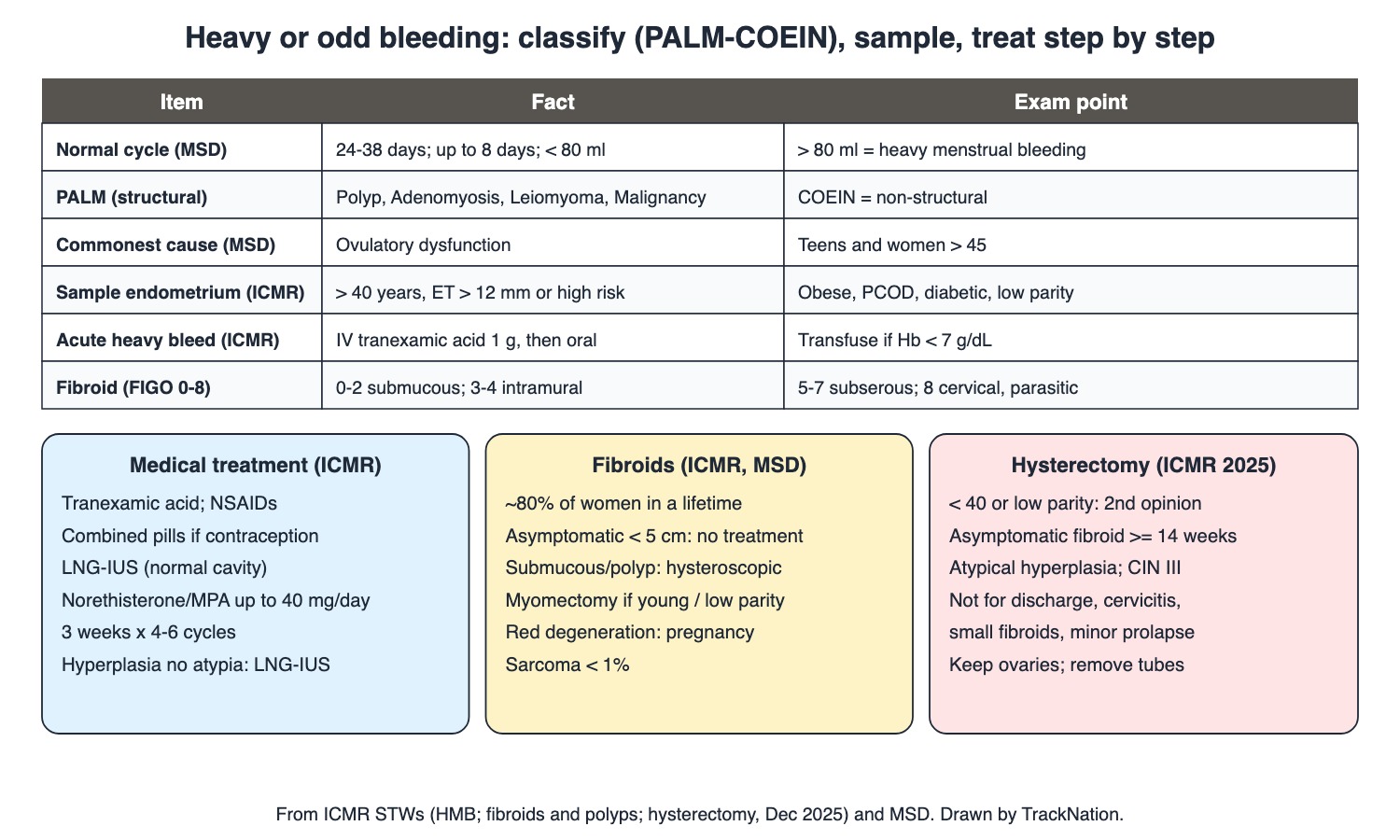
PALM-COEIN, the ICMR heavy-bleeding pathway, fibroid types and hysterectomy rules. Drawn by TrackNation.
Definitions and Work-up (MSD, ICMR)
Normal cycle (MSD): every 24–38 days, bleeding ≤8 days, volume <80 ml. More than 80 ml = heavy menstrual bleeding (ICMR uses the pictorial blood assessment chart).
PALM-COEIN: structural — Polyp, Adenomyosis, Leiomyoma, Malignancy/hyperplasia; non-structural — Coagulopathy, Ovulatory dysfunction, Endometrial, Iatrogenic, Not yet classified. Ovulatory dysfunction is the commonest cause, mostly in adolescents and women >45. Regular heavy periods suggest a structural cause.
Exclude pregnancy in every woman of reproductive age. Tests: Hb, CBC with smear, BT/CT (and von Willebrand tests where indicated), LFT, TSH, USG. Luteal progesterone ≥3 ng/ml confirms ovulation.
Endometrial sampling (ICMR): women >40 with endometrial thickness >12 mm or high risk (low parity, obesity, PCOD, diabetes). Postmenopausal bleeding is referred to a higher centre.
Treating Heavy Menstrual Bleeding (ICMR 2025)
Conservative treatment first, especially in younger women. Options: tranexamic acid during bleeding (+ mefenamic acid if painful), NSAIDs, combined pills if contraception is wanted, progestogens, LNG-IUS, ormeloxifene; ablation if these fail.
Norethisterone gives the best haemostasis among progestogens. Regimen: norethisterone or MPA (max 40 mg/day) from day 5 for 3 weeks, for 4–6 cycles; LNG-IUS is the alternative.
Acute heavy bleed: IV tranexamic acid 1 g slowly, then 0.5–1 g orally 6–8-hourly for 5 days; transfuse if Hb <7 g/dL; Hb <7 or ongoing loss at a lower level → refer.
Hyperplasia without atypia: LNG-IUS or progestogens for 6 months (hysterectomy if medical treatment fails). Atypical hyperplasia/malignancy → refer; hysterectomy.
Fibroids, Polyps and Adenomyosis (ICMR, MSD)
Fibroids (leiomyomas): the commonest pelvic/benign uterine tumour, ~80% of women in a lifetime (ICMR); monoclonal, oestrogen-dependent — grow in reproductive years, shrink after menopause. Risk ↑ early menarche, obesity, hypertension; ↓ with parity ≥3. Sarcoma <1%.
FIGO types: 0 pedunculated intracavitary, 1 <50% intramural, 2 >50% intramural (0–2 submucous); 3–4 intramural; 5–7 subserous (7 pedunculated); 8 cervical/parasitic.
Symptoms: heavy bleeding, pressure/urinary symptoms, mass, pain, infertility. Red flags: severe anaemia, pain of degeneration or torsion, acute urinary retention. Degenerations: hyaline, cystic, calcific, fatty, red (pregnancy).
Treatment: asymptomatic fibroids <5 cm need no treatment. Medical — tranexamic acid, LNG-IUS (normal cavity), progestogens; GnRH analogues short-term only (rebound). Polyps and suitable submucous fibroids → hysteroscopic removal. Myomectomy for younger or low-parity women; UAE; hysterectomy avoided under 35 where possible.
Adenomyosis: endometrium inside the myometrium → heavy, painful periods and a diffusely (globularly) enlarged uterus, usually not beyond 12 weeks size; TVS or MRI.
When to Do — and Not Do — a Hysterectomy (ICMR 2025)
Only when childbearing is complete; in women under 40 or of low parity a second gynaecologist's opinion is mandatory.
Indications: symptomatic fibroids failing medical treatment, asymptomatic fibroid uterus ≥14 weeks, fibroids causing hydroureteronephrosis, rapid growth or severe anaemia; HMB failing medical treatment; endometriosis failing treatment; third/fourth-degree prolapse; atypical hyperplasia; CIN II with poor compliance or CIN III; recurrent postmenopausal bleeding.
Not for: white discharge, cervicitis, minor prolapse, small (<5 cm) asymptomatic fibroids (<12-week uterus), simple ovarian cysts ≤5 cm, non-specific pain.
Preserve ovaries in most premenopausal women; add bilateral salpingectomy to cut later ovarian cancer risk. After surgery: no heavy lifting and abstinence for 8 weeks.
Traps the Examiner Sets
Rule out pregnancy first, even in teenagers.
Endometrial thickness >12 mm in a woman over 40 → sample, don't just treat.
Asymptomatic fibroid under 5 cm → no treatment.
Hysterectomy in a young woman needs a second opinion; ovaries are kept.
Memory Hooks & Shortcuts
Shortcuts to lock in this article's numbers and lists. Each one only re-packages facts proven above.
🧠 PALM is solid (you can see it), COEIN is not — PALM-COEIN
🧠 ICMR sampling rule '40-12': over 40 and ET over 12 mm → sample — sampling
🧠 Fibroid FIGO: '0-1-2 inside, 3-4 in the wall, 5-6-7 outside, 8 elsewhere' — FIGO
🧠 'Red in pregnancy' — red degeneration — degeneration
🧠 Hysterectomy under 40: 'two gynaecologists, two ovaries kept, two tubes out' — hysterectomy
Rapid-Revision Cards
Normal cycle
24–38 d; ≤8 d; <80 ml.
PALM
Polyp, Adenomyosis, Leiomyoma, Malignancy.
COEIN
Coagulopathy, Ovulatory, Endometrial, Iatrogenic, NYC.
Commonest AUB
Ovulatory dysfunction.
First step
Exclude pregnancy.
Abnormal clotting tests
Test for vWD.
Sample endometrium
>40 + ET >12 mm or high risk.
High risk
Obese, PCOD, diabetic, low parity.
Best progestogen
Norethisterone.
Regimen
3 wk × 4–6 cycles; ≤40 mg/d.
Acute bleed
IV TXA 1 g; transfuse if Hb <7.
Hyperplasia no atypia
LNG-IUS / progestogen 6 mo.
Atypia
Hysterectomy.
Fibroid lifetime
~80%.
FIGO 0–2
Submucous.
FIGO 7 / 8
Pedunculated subserous / cervical.
Asymptomatic <5 cm
No treatment.
Red degeneration
Pregnancy.
Adenomyosis
Globular uterus ≤12 wk.
Hysterectomy <40
Second opinion.
At hysterectomy
Keep ovaries; remove tubes.
Sources
Facts in this article were checked against these documents.
Standard Treatment Workflows: Heavy Menstrual Bleeding; Uterine Fibroids and Polyps; Hysterectomy for Benign Gynaecological Conditions — Indian Council of Medical Research / DHR, 2025
MSD Manual Professional: Abnormal Uterine Bleeding; Uterine Fibroids; Uterine Adenomyosis — Merck & Co. (MSD Manuals), 2024–26 (link)
Competency Based Undergraduate Curriculum, Vol III: Obstetrics & Gynaecology (OG24, OG29) — National Medical Commission, 2024
Test Yourself: Practice Questions
Thirty questions in NEET PG style, most of them clinical vignettes.
Practice Questions (NEET PG pattern)
Original questions written in the style of the exam: +4 for a correct answer, −1 for a wrong one. Every answer was checked against the sources listed above. NEET PG papers are not published by NBEMS, so these are not past-paper questions.
Q1. A normal menstrual cycle (MSD) has a frequency of
(a) 24–38 days
(b) 14–21 days
(c) 35–45 days
(d) 21–28 days only
Show answer
Answer: (a) — ≤8 days, <80 ml.
Q2. Heavy menstrual bleeding is blood loss per period of more than
(a) 30 ml
(b) 500 ml
(c) 80 ml
(d) 200 ml
Show answer
Answer: (c) — MSD.
Q3. In PALM-COEIN, the structural causes are
(a) coagulopathy and ovulatory dysfunction
(b) iatrogenic only
(c) polyp, adenomyosis, leiomyoma, malignancy/hyperplasia
(d) endometrial and not classified
Show answer
Answer: (c) — COEIN non-structural.
Q4. The commonest cause of AUB is
(a) fibroids
(b) ovulatory dysfunction
(c) coagulopathy
(d) endometrial cancer
Show answer
Answer: (b) — Teens and >45.
Q5. A 15-year-old has heavy, irregular bleeding since menarche. First test per MSD and ICMR includes
(a) hysteroscopy
(b) MRI pelvis
(c) pregnancy test
(d) endometrial biopsy
Show answer
Answer: (c) — Exclude pregnancy even in adolescents.
Q6. A teenager with heavy periods has abnormal initial coagulation tests. MSD advises further testing for
(a) PCOS only
(b) endometrial cancer
(c) von Willebrand disease
(d) Turner syndrome
Show answer
Answer: (c) — Coagulopathy.
Q7. Regular cycles with heavy prolonged bleeding most suggest
(a) a structural cause
(b) pregnancy
(c) anovulation
(d) menopause
Show answer
Answer: (a) — Irregular = ovulatory.
Q8. A 44-year-old with heavy bleeding has endometrial thickness of 15 mm. Per ICMR, next:
(a) hysterectomy
(b) start OCPs only
(c) reassure
(d) endometrial sampling for histopathology
Show answer
Answer: (d) — ET >12 mm.
Q9. Per ICMR, a high risk for endometrial cancer in HMB includes
(a) high parity
(b) smoking only
(c) obesity, diabetes, PCOD, low parity
(d) IUCD use
Show answer
Answer: (c) — Sample.
Q10. Among progestogens, the best haemostasis in HMB (ICMR) is with
(a) desogestrel
(b) dydrogesterone
(c) micronised progesterone
(d) norethisterone
Show answer
Answer: (d) — Max 40 mg/day.
Q11. Cyclical progestogen regimen for HMB per ICMR is given for
(a) 3 weeks from day 5, repeated for 4–6 cycles
(b) continuously for 2 years
(c) 5 days only
(d) 1 day per month
Show answer
Answer: (a) — Norethisterone or MPA.
Q12. A woman bleeding heavily with Hb 6.5 g/dL arrives at the tertiary centre. ICMR acute management:
(a) oral iron only
(b) IV tranexamic acid 1 g and blood transfusion
(c) OCPs and discharge
(d) immediate hysterectomy
Show answer
Answer: (b) — Then oral TXA 5 days.
Q13. After IV tranexamic acid, oral tranexamic acid per ICMR is
(a) 100 mg daily for 3 months
(b) not needed
(c) 5 g once
(d) 0.5–1 g every 6–8 hours for 5 days
Show answer
Answer: (d) — Acute episode.
Q14. Endometrial hyperplasia without atypia is first treated with
(a) observation only
(b) oestrogen therapy
(c) LNG-IUS or progestogens for 6 months
(d) immediate hysterectomy
Show answer
Answer: (c) — ICMR.
Q15. Endometrial hyperplasia with atypia in a woman who has completed her family is an indication for
(a) hysterectomy
(b) OCPs
(c) tranexamic acid only
(d) observation
Show answer
Answer: (a) — ICMR hysterectomy STW.
Q16. Approximately what proportion of women will have fibroids in their lifetime (ICMR)?
(a) 5%
(b) 20%
(c) 80%
(d) 100%
Show answer
Answer: (c) — Commonest benign uterine tumour.
Q17. A FIGO type 0 fibroid is
(a) cervical
(b) subserosal pedunculated
(c) pedunculated and intracavitary
(d) entirely intramural
Show answer
Answer: (c) — Submucous.
Q18. A FIGO type 7 fibroid is
(a) subserosal pedunculated
(b) intracavitary
(c) >50% intramural submucous
(d) cervical
Show answer
Answer: (a) — 5–7 subserous.
Q19. A 38-year-old has a 3 cm asymptomatic intramural fibroid found on scan. ICMR advice:
(a) hysterectomy
(b) no treatment needed
(c) GnRH agonist for a year
(d) myomectomy
Show answer
Answer: (b) — <5 cm asymptomatic.
Q20. Fibroids enlarge in reproductive years and shrink after menopause because they are
(a) progesterone-deficient
(b) androgen-dependent
(c) oestrogen-responsive
(d) infection-driven
Show answer
Answer: (c) — MSD.
Q21. A pregnant woman at 20 weeks with a known fibroid develops acute pain over it. Likely
(a) torsion of ovary
(b) sarcomatous change
(c) red degeneration
(d) calcific degeneration
Show answer
Answer: (c) — Pregnancy.
Q22. Malignant (sarcomatous) change in fibroids occurs in
(a) about 25%
(b) about 10%
(c) half
(d) less than 1%
Show answer
Answer: (d) — MSD.
Q23. A factor associated with lower fibroid risk is
(a) obesity
(b) hypertension
(c) parity of 3 or more
(d) early menarche
Show answer
Answer: (c) — MSD.
Q24. A thin-stalked endometrial polyp causing intermenstrual bleeding is best managed by
(a) OCPs
(b) hysteroscopic removal
(c) hysterectomy
(d) observation forever
Show answer
Answer: (b) — ICMR.
Q25. A 28-year-old nulliparous woman with a symptomatic 7 cm fibroid wants children. Preferred surgery:
(a) endometrial ablation
(b) hysterectomy
(c) bilateral oophorectomy
(d) myomectomy
Show answer
Answer: (d) — Young/low parity.
Q26. A 42-year-old with heavy painful periods has a diffusely enlarged, globular uterus of about 10 weeks' size. Most likely
(a) adenomyosis
(b) pedunculated subserous fibroid
(c) pregnancy
(d) ovarian cyst
Show answer
Answer: (a) — Rarely >12 weeks.
Q27. Before a hysterectomy for a benign condition in a 34-year-old, ICMR mandates
(a) a second opinion from a qualified gynaecologist
(b) a court order
(c) a CT scan
(d) husband's consent
Show answer
Answer: (a) — <40 or low parity.
Q28. Per ICMR, hysterectomy is indicated for an asymptomatic fibroid uterus of size
(a) any size
(b) never
(c) 8 weeks
(d) 14 weeks or more
Show answer
Answer: (d) — Or hydroureteronephrosis.
Q29. ICMR lists which as NOT an indication for hysterectomy?
(a) fibroid causing hydroureteronephrosis
(b) CIN III
(c) atypical endometrial hyperplasia
(d) white discharge or cervicitis
Show answer
Answer: (d) — Also minor prolapse.
Q30. During hysterectomy for a benign condition in a premenopausal woman, ICMR recommends
(a) removing the ovaries only
(b) removing both ovaries routinely
(c) preserving the ovaries and removing both tubes
(d) leaving the tubes
Show answer
Answer: (c) — Reduces ovarian cancer.
Active Recall
From memory: give normal menstrual limits and PALM-COEIN, outline the ICMR work-up and medical treatment of heavy menstrual bleeding including the acute episode, describe when to sample the endometrium and how to treat hyperplasia, classify and manage fibroids and polyps, and list ICMR indications and non-indications for hysterectomy.