NSAIDs, Paracetamol, Gout and Migraine Drugs for NEET PG Pharmacology: COX-2, Overdose Antidotes, Allopurinol, Triptans, Methotrexate
Start Here
🎯 Exam priority: High. Expect vignettes: a teenager after a paracetamol overdose, an older adult with confusion and tachypnoea (aspirin), a gout patient on azathioprine starting allopurinol, a migraine patient with angina asking for a triptan.
CBME mapping: PH 2.4–2.8 (autacoids, NSAIDs, gout, rheumatoid arthritis, migraine) and PH 9 (poisoning).
NSAIDs and Paracetamol
NSAIDs block cyclooxygenase (COX) and so reduce prostaglandin production. Neither NSAIDs nor paracetamol cause physical dependence or tolerance.
Drug or group | Key fact (source) |
Non-selective NSAIDs (ibuprofen, naproxen) | Block COX-1 and COX-2 reversibly |
Aspirin | Blocks COX-1 and COX-2 irreversibly |
Coxibs (celecoxib) | Mainly COX-2; lowest ulcer risk, but no GI advantage if taken with low-dose aspirin; not kidney-sparing; contraindicated in sulfonamide allergy and around CABG |
Ketorolac | Opioid-level acute pain; total use (injection + tablets) not more than 5 days |
Paracetamol | No anti-inflammatory or antiplatelet effect, no gastric irritation; liver toxicity above 4 g a day or with liver disease or alcohol |
All NSAIDs | Prothrombotic (MI, stroke): risk lower with ibuprofen, naproxen, celecoxib than with ketorolac, diclofenac; caution in kidney disease |
Gut protection: misoprostol reduces the risk of NSAID-induced (including aspirin-induced) gastric ulcers in high-risk patients, but it can cause abortion, birth defects and uterine rupture, so it must not be given to pregnant women for this purpose.
Paracetamol Poisoning
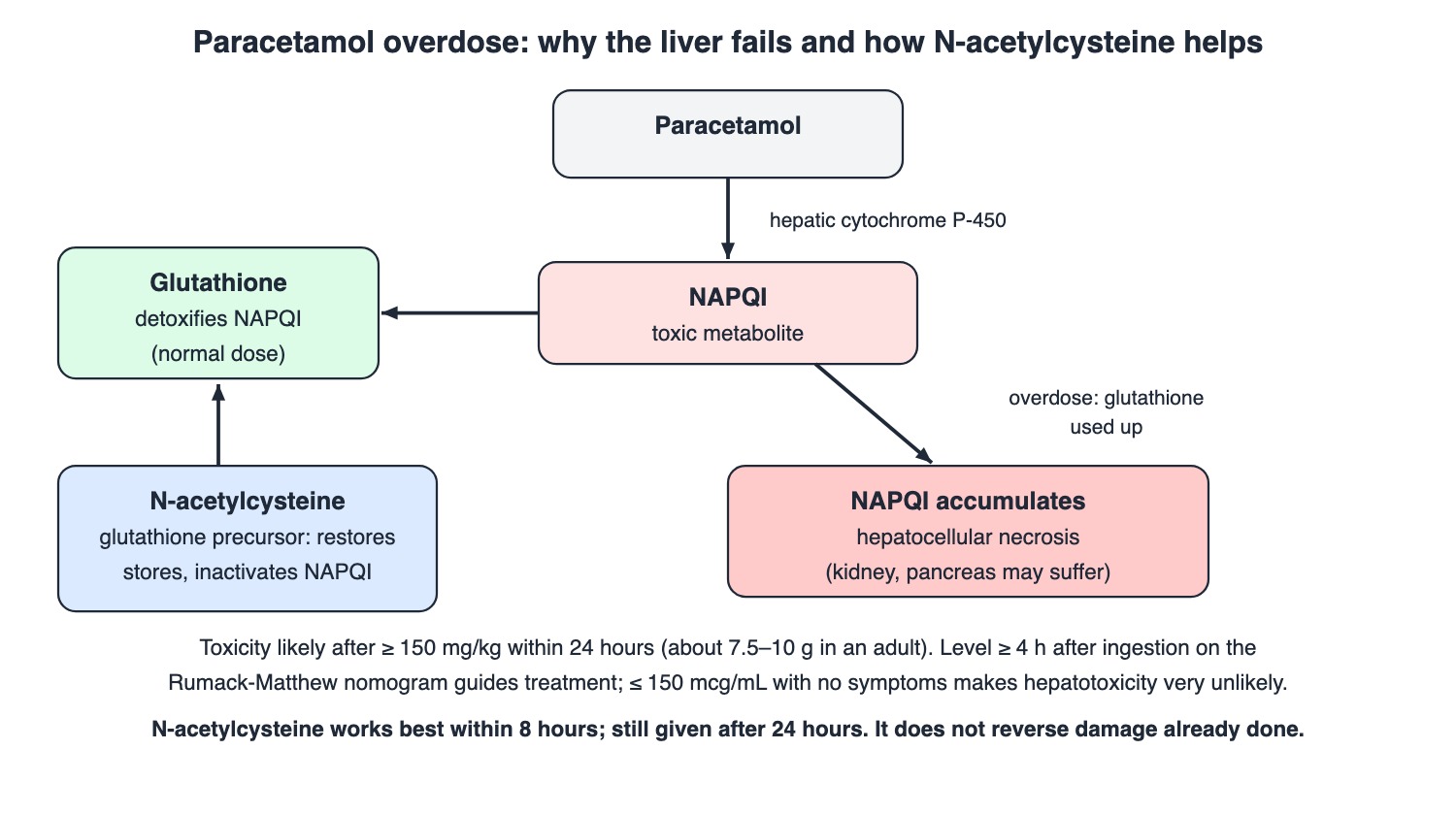
Paracetamol overdose: CYP450 makes NAPQI; glutathione detoxifies it until it runs out; N-acetylcysteine restores glutathione. Drawn by TrackNation from the MSD Manual and the Acetadote label.
Toxic dose: ≥ 150 mg/kg within 24 hours (about 7.5–10 g in an adult). Symptoms are minor until ≥ 48 hours, so a well-looking patient is not safe.
Decide with a level taken ≥ 4 hours after a single acute ingestion, on the Rumack-Matthew nomogram. The nomogram may underestimate risk in chronic alcoholism, malnutrition or with CYP2E1 inducers such as isoniazid.
N-acetylcysteine: best within 8 hours; still given after 24 hours; IV and oral are equally effective. The IV three-bag regimen is 150 mg/kg over 1 hour, 50 mg/kg over 4 hours, 100 mg/kg over 16 hours.
Aspirin (Salicylate) Poisoning
Toxic dose: ≥ 150 mg/kg. Oil of wintergreen (methyl salicylate) is the most concentrated form: less than 5 mL can kill a young child.
Acid-base: salicylates stimulate the respiratory centre (primary respiratory alkalosis) and, independently, cause metabolic acidosis by uncoupling oxidative phosphorylation.
Early: nausea, vomiting, tinnitus, hyperventilation. Chronic poisoning in older adults can look like sepsis (confusion, fever, hypoxia, non-cardiogenic pulmonary oedema).
Treatment: activated charcoal and alkaline diuresis (salicylate excretion rises as urine pH rises), or haemodialysis.
Gout
Hyperuricaemia (urate > 6.8 mg/dL) is almost always present, but the diagnosis needs crystals in synovial fluid. Thiazide and loop diuretics raise urate. Long-term target: urate usually < 6 mg/dL.
Drug | Role | Must know (source) |
NSAIDs, colchicine, glucocorticoids | Treat the acute flare | Colchicine: reduce or avoid in renal failure and with CYP3A4/P-gp inhibitors (e.g. macrolides) |
Allopurinol | Preferred first urate-lowering drug (xanthine oxidase inhibitor) | HLA-B*5801 → hypersensitivity; raises azathioprine and 6-mercaptopurine levels; not for asymptomatic hyperuricaemia |
Febuxostat | Xanthine oxidase inhibitor when allopurinol unsuitable | Boxed warning: higher cardiovascular death than allopurinol in gout with CV disease |
Probenecid | Uricosuric | Loses effect when GFR < 50 |
Pegloticase | Recombinant uricase (urate → allantoin) | Refractory or tophaceous gout |
Migraine
Triptans (sumatriptan): 5-HT1B/1D agonists for the acute attack only — not for prophylaxis or cluster headache. Contraindicated in ischaemic heart disease, coronary vasospasm (Prinzmetal angina) and WPW syndrome.
Prevention (MSD): beta-blockers, amitriptyline, topiramate, divalproex, monoclonal antibodies. The migraine attack involves trigeminovascular release of neuropeptides such as CGRP.
India's ICMR headache workflow (PHC level): acute attack — paracetamol 650 mg or indomethacin 50 mg, with prochlorperazine 10 mg for nausea; start prophylaxis if more than 2 attacks a month — propranolol 40 mg or flunarizine 10 mg once daily, tried for 2 months. Chronic tension-type headache: amitriptyline 10 mg at night.
Rheumatoid Arthritis Drugs and Antihistamines
Methotrexate (a dihydrofolate reductase inhibitor) is the usual starting DMARD: 10–15 mg once a week with folic acid 1 mg daily. Contraindicated in pregnancy for non-cancer use. Triple therapy = methotrexate + hydroxychloroquine + sulfasalazine.
Hydroxychloroquine: retinopathy rises with daily doses above 5 mg/kg of actual body weight.
Diphenhydramine (first-generation H1 antihistamine): sedating and anticholinergic (drying); in anaphylaxis it is only an adjunct after adrenaline.
Traps the Examiner Sets
Aspirin's COX block is irreversible; other NSAIDs are reversible.
Coxibs spare the stomach but not the kidney or the heart.
Paracetamol level before 4 hours cannot be plotted; treat with NAC if the time is unknown or the level is delayed.
Aspirin poisoning: alkalinise the urine.
Allopurinol + azathioprine = marrow suppression; reduce the azathioprine dose.
Febuxostat carries a CV-death boxed warning; allopurinol is preferred.
Triptans: acute attack only, never with angina; propranolol or flunarizine prevent.
Methotrexate for RA is weekly, not daily.
Memory Hooks & Shortcuts
Shortcuts to lock in this article's numbers and lists. Each one only re-packages facts proven above.
🧠 Aspirin Arrests for good — aspirin is the irreversible COX blocker
🧠 4 hours to plot, 8 hours to save — paracetamol level at ≥ 4 h; NAC best within 8 h
🧠 150 for both poisons — paracetamol and aspirin toxicity both start around 150 mg/kg
🧠 Salicylate: Alkalose then Acid, Alkalinise the urine — respiratory alkalosis + metabolic acidosis; alkaline diuresis
🧠 Allo + Aza = Agranulocytosis risk — allopurinol raises azathioprine and 6-MP exposure
🧠 Triptan stops the attack, Propranolol prevents the next — triptans acute only; propranolol or flunarizine prophylaxis
🧠 Methotrexate on Mondays only — weekly dosing in RA, with folic acid
Rapid-Revision Cards
Aspirin and COX
Irreversible COX-1 + COX-2 block.
Coxibs
Least ulcers; no GI edge with low-dose aspirin; not renal-sparing.
Celecoxib contraindications
Sulfonamide allergy, NSAID asthma, CABG.
NSAID CV risk
Lower with ibuprofen, naproxen, celecoxib; higher with ketorolac, diclofenac.
Ketorolac limit
≤ 5 days total.
Paracetamol vs NSAIDs
No anti-inflammatory or antiplatelet effect; no gastric irritation.
Paracetamol daily limit
Hepatotoxicity risk above 4 g/day.
Toxic paracetamol dose
≥ 150 mg/kg (7.5–10 g adult).
NAPQI
Toxic CYP450 metabolite; detoxified by glutathione.
Nomogram
Level ≥ 4 h after single acute ingestion; ≤ 150 mcg/mL = very unlikely toxicity.
NAC timing
Best within 8 h; still give after 24 h.
NAC IV regimen
150/1 h → 50/4 h → 100/16 h (mg/kg).
Salicylate acid-base
Respiratory alkalosis + metabolic acidosis.
Salicylate treatment
Charcoal, alkaline diuresis, haemodialysis.
Oil of wintergreen
< 5 mL can kill a child.
Misoprostol
Prevents NSAID ulcers; abortifacient — avoid in pregnancy.
Gout diagnosis
Crystals in synovial fluid; urate may be normal.
Urate target
Usually < 6 mg/dL.
Allopurinol
First-line XOI; HLA-B*5801; ↑ azathioprine.
Febuxostat
Boxed warning: CV death.
Colchicine
Flares + prophylaxis + FMF; toxic with CYP3A4/P-gp inhibitors.
Probenecid
Uricosuric; fails if GFR < 50.
Triptan contraindications
IHD, Prinzmetal, WPW.
ICMR migraine prophylaxis
> 2/month: propranolol 40 mg or flunarizine 10 mg.
Methotrexate in RA
10–15 mg weekly + folic acid; not in pregnancy.
Hydroxychloroquine
Retinopathy > 5 mg/kg/day.
Sources
Facts in this article were checked against these documents.
MSD Manual Professional Edition: Treatment of Pain; Acetaminophen Poisoning; Aspirin and Other Salicylate Poisoning; Gout; Migraine; Rheumatoid Arthritis — Merck & Co. (MSD Manuals), 2025–2026 (link)
Standard Treatment Workflow: Management of Headache — Indian Council of Medical Research / Department of Health Research, MoHFW, 2019 (link)
Prescribing labels: Celebrex, ketorolac, indomethacin, Acetadote, allopurinol, Uloric, Colcrys, probenecid, Imitrex, methotrexate, Plaquenil, Cytotec, diphenhydramine injection — DailyMed, US National Library of Medicine, current labels, accessed November 2026 (link)
Competency Based Undergraduate Curriculum, Pharmacology (PH 2.4–2.8, PH 9) — National Medical Commission, 2024
Test Yourself: Practice Questions
Twenty-five questions in NEET PG style, most of them clinical vignettes.
Practice Questions (NEET PG pattern)
Original questions written in the style of the exam: +4 for a correct answer, −1 for a wrong one. Every answer was checked against the sources listed above. NEET PG papers are not published by NBEMS, so these are not past-paper questions.
Q1. A 19-year-old took 40 paracetamol tablets of 500 mg (20 g) 3 hours ago and feels well. The best next step is to
(a) reassure and discharge, as she has no symptoms
(b) measure a paracetamol level at 4 hours after ingestion and plot it on the nomogram, starting N-acetylcysteine as indicated
(c) give activated charcoal and discharge
(d) start haemodialysis
Show answer
Answer: (b) — Symptoms are minor until ≥ 48 hours; the level is taken ≥ 4 hours after ingestion and plotted on the Rumack-Matthew nomogram.
Q2. N-acetylcysteine protects the liver in paracetamol overdose mainly by
(a) blocking cytochrome P-450
(b) reversing established necrosis
(c) increasing renal excretion of paracetamol
(d) restoring glutathione, which detoxifies NAPQI
Show answer
Answer: (d) — It is a glutathione precursor; it does not reverse damage already done.
Q3. N-acetylcysteine is most effective if started within
(a) 48 hours
(b) 8 hours of ingestion
(c) 24 hours
(d) 72 hours
Show answer
Answer: (b) — Most effective within 8 hours; benefit after 24 hours is questionable but it is still given.
Q4. The IV three-bag N-acetylcysteine regimen gives, in order,
(a) 140 mg/kg once orally
(b) 70 mg/kg every 4 h for 17 doses IV
(c) 150 mg/kg over 1 h, 50 mg/kg over 4 h, 100 mg/kg over 16 h
(d) 50, 100, 150 mg/kg each over 8 h
Show answer
Answer: (c) — Acetadote label: 150 mg/kg over 1 hour, then 50 over 4 hours, then 100 over 16 hours.
Q5. In which patient may the paracetamol nomogram underestimate liver risk?
(a) A patient on paracetamol 1 g a day
(b) A child after an accidental single small dose
(c) A healthy young woman
(d) A man with chronic alcoholism on isoniazid
Show answer
Answer: (d) — Chronic alcoholism, malnutrition and CYP2E1 inducers such as isoniazid.
Q6. A 70-year-old on long-term aspirin for arthritis is confused, febrile and tachypnoeic with tinnitus; sepsis is suspected. Arterial gas shows mixed respiratory alkalosis and metabolic acidosis. Treatment should include
(a) acidifying the urine
(b) activated charcoal and alkaline diuresis (or haemodialysis)
(c) naloxone
(d) N-acetylcysteine
Show answer
Answer: (b) — Chronic salicylate poisoning mimics sepsis; excretion rises as urine pH rises; severe cases need haemodialysis.
Q7. The acid-base picture in early salicylate poisoning is
(a) primary respiratory alkalosis with an independent metabolic acidosis
(b) normal acid-base status
(c) pure metabolic alkalosis
(d) respiratory acidosis only
Show answer
Answer: (a) — Salicylates stimulate the medullary respiratory centre and independently cause metabolic acidosis.
Q8. Which NSAID inhibits cyclooxygenase irreversibly?
(a) Celecoxib
(b) Ibuprofen
(c) Naproxen
(d) Aspirin
Show answer
Answer: (d) — Aspirin irreversibly inhibits both COX-1 and COX-2; others are typically reversible.
Q9. A patient with a sulfonamide allergy needs an NSAID. Which is contraindicated?
(a) Indomethacin
(b) Naproxen
(c) Ibuprofen
(d) Celecoxib
Show answer
Answer: (d) — Celebrex is contraindicated with allergic-type reactions to sulfonamides, in aspirin/NSAID asthma, and around CABG.
Q10. A man takes low-dose aspirin for coronary disease and needs long-term NSAID therapy. Adding celecoxib instead of ibuprofen
(a) abolishes all GI risk
(b) is renal-sparing
(c) removes all cardiovascular risk
(d) may give no GI advantage, because coxib benefit is lost with low-dose aspirin
Show answer
Answer: (d) — When a coxib is used with low-dose aspirin it may have no GI benefit over other NSAIDs; coxibs are not renal-sparing.
Q11. Ketorolac (injection plus tablets) may be used for a total of at most
(a) 2 days
(b) 30 days
(c) 14 days
(d) 5 days
Show answer
Answer: (d) — The combined duration should not exceed 5 days.
Q12. Misoprostol, given to prevent NSAID ulcers, is contraindicated in pregnancy because it
(a) can cause abortion, birth defects and uterine rupture
(b) raises blood pressure
(c) is hepatotoxic
(d) causes neural tube defects only
Show answer
Answer: (a) — Cytotec's boxed warning.
Q13. A man with a red, hot first MTP joint has serum urate 5.9 mg/dL. Gout is
(a) confirmed by the urate level
(b) still possible; definite diagnosis needs urate crystals in synovial fluid
(c) excluded because urate is normal
(d) ruled out without X-ray changes
Show answer
Answer: (b) — Hyperuricaemia is almost always present, but diagnosis requires crystals in synovial fluid.
Q14. A renal-transplant patient on azathioprine develops gout. If allopurinol is started, the azathioprine dose must be reduced because
(a) azathioprine blocks allopurinol
(b) allopurinol raises azathioprine exposure, risking myelosuppression
(c) both cause hyperuricaemia
(d) allopurinol induces azathioprine metabolism
Show answer
Answer: (b) — Allopurinol increases exposure to azathioprine and mercaptopurine.
Q15. Severe hypersensitivity to allopurinol is more likely in carriers of
(a) HLA-DR4
(b) HLA-B*1502
(c) HLA-B27
(d) HLA-B*5801
Show answer
Answer: (d) — HLA-B*5801 carriers are at higher risk of allopurinol hypersensitivity syndrome.
Q16. Febuxostat carries a boxed warning for
(a) Stevens-Johnson syndrome in HLA-B*5801 carriers
(b) agranulocytosis
(c) higher cardiovascular death than allopurinol in gout patients with CV disease
(d) hepatic failure in children
Show answer
Answer: (c) — Uloric boxed warning: cardiovascular death.
Q17. A gout patient on colchicine prophylaxis is prescribed clarithromycin. The concern is
(a) reduced colchicine effect
(b) colchicine toxicity from CYP3A4/P-gp inhibition
(c) QT shortening
(d) hyperuricaemia
Show answer
Answer: (b) — CYP3A4/P-gp inhibitors increase colchicine toxicity; reduce dose or avoid.
Q18. Probenecid becomes ineffective when
(a) GFR falls below about 50 mL/min/1.73 m²
(b) colchicine is co-prescribed
(c) serum urate exceeds 9 mg/dL
(d) the patient is over 60
Show answer
Answer: (a) — Uricosurics lose efficacy with declining renal function.
Q19. Pegloticase lowers urate by
(a) increasing renal excretion
(b) binding urate in the gut
(c) blocking xanthine oxidase
(d) converting urate to allantoin as a recombinant uricase
Show answer
Answer: (d) — Uricase, absent in humans, converts urate to more soluble allantoin.
Q20. A 45-year-old with migraine has had angina for a year. For acute attacks, sumatriptan is
(a) safe if taken with aspirin
(b) safe in a lower dose
(c) contraindicated because of ischaemic heart disease
(d) first choice
Show answer
Answer: (c) — Triptans are contraindicated in ischaemic CAD, coronary vasospasm (Prinzmetal) and WPW syndrome.
Q21. Under India's ICMR headache workflow, migraine prophylaxis is started when attacks exceed
(a) 1 a year
(b) never; only acute treatment is used
(c) 2 a month, with propranolol 40 mg or flunarizine 10 mg daily
(d) 10 a month only
Show answer
Answer: (c) — Frequency > 2/month: trial of propranolol 40 mg OD or flunarizine 10 mg OD for 2 months.
Q22. Sumatriptan is indicated for
(a) tension-type headache prophylaxis
(b) prophylaxis of migraine
(c) cluster headache prevention
(d) the acute treatment of migraine
Show answer
Answer: (d) — Imitrex: acute treatment only; not for prophylaxis or cluster headache.
Q23. A woman with rheumatoid arthritis is starting methotrexate. The correct schedule is
(a) 15 mg twice daily
(b) 10 mg daily
(c) monthly injection only
(d) 10–15 mg once a week with daily folic acid
Show answer
Answer: (d) — MSD: methotrexate 10–15 mg once a week with folic acid 1 mg daily; weekly, not daily.
Q24. The risk of retinopathy with hydroxychloroquine rises above a daily dose of
(a) 400 mg regardless of weight
(b) 1 mg/kg
(c) 5 mg/kg of actual body weight
(d) 20 mg/kg
Show answer
Answer: (c) — Plaquenil: daily doses exceeding 5 mg/kg actual weight increase the incidence of retinopathy.
Q25. In anaphylaxis, diphenhydramine is
(a) contraindicated
(b) an adjunct after adrenaline
(c) the first-line drug
(d) a replacement for adrenaline in children
Show answer
Answer: (b) — The label: in anaphylaxis as an adjunct to epinephrine and other standard measures.
Active Recall
From memory: compare aspirin, non-selective NSAIDs, coxibs and paracetamol; explain paracetamol toxicity, the nomogram and the N-acetylcysteine regimen; describe salicylate poisoning and its treatment; list the drugs for gout flares and urate lowering with their key cautions; and give the acute and preventive treatment of migraine and the methotrexate schedule in RA.