Antidepressants, Antipsychotics and Lithium for NEET PG Pharmacology: ICMR Workflows, Serotonin Syndrome, Clozapine, Lithium Toxicity
Start Here
🎯 Exam priority: High. Expect vignettes on serotonin syndrome after a drug switch, tyramine reactions, TCA overdose, a fever-and-rigidity picture on an antipsychotic (NMS), clozapine monitoring, lithium toxicity after a diuretic or NSAID, and the first-choice drug in pregnancy.
CBME mapping: PH 3.4–3.6. Choices and doses follow India's ICMR workflows for depression and psychosis.
Depression: the ICMR Ladder
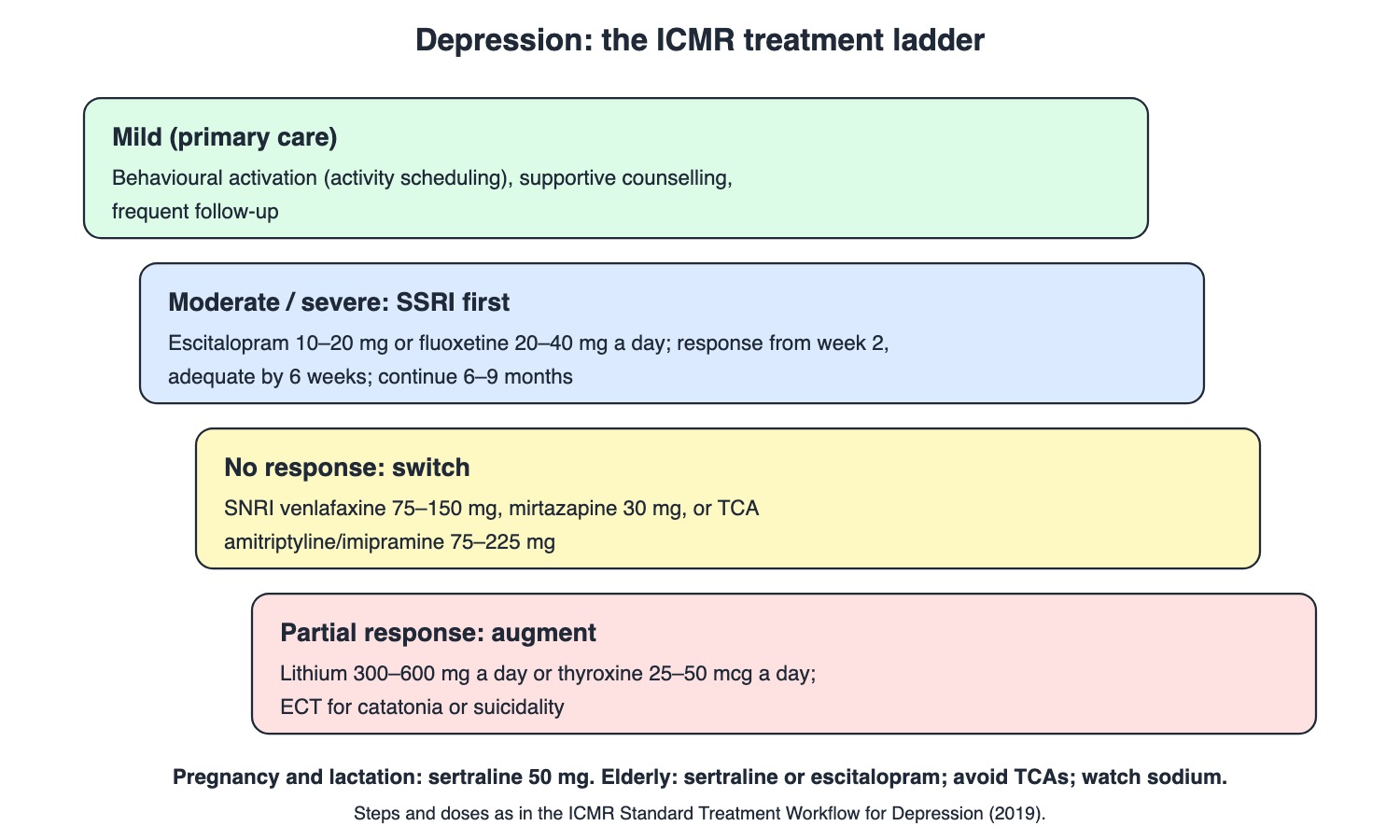
Depression treatment steps and doses from the ICMR Standard Treatment Workflow for Depression. Drawn by TrackNation.
Diagnosis needs symptoms for at least 2 weeks. Rule out secondary causes such as hypothyroidism and drugs (some anticancer and antiretroviral drugs such as efavirenz).
SSRIs first: improvement from the 2nd week, adequate response by 6 weeks, then continue 6–9 months and taper.
Pregnancy and lactation: sertraline 50 mg. Elderly: sertraline or escitalopram, avoid TCAs (anticholinergic), monitor sodium.
Antidepressant Safety
Drug or group | Key fact (source) |
SSRIs (escitalopram, fluoxetine, sertraline) | First choice (ICMR); boxed: suicidality in children, adolescents, young adults; hyponatraemia (SIADH); bleeding with NSAIDs, aspirin, warfarin |
Fluoxetine and MAOIs | No MAOI within 5 weeks of stopping fluoxetine; no fluoxetine within 14 days of stopping an MAOI; not with linezolid or IV methylene blue (serotonin syndrome) |
Serotonin syndrome | Agitation, delirium; tachycardia, labile BP, sweating, hyperthermia; tremor, rigidity, myoclonus, hyperreflexia; seizures; nausea, diarrhoea |
MAOIs (phenelzine) | Avoid aged, fermented, pickled or smoked protein foods, aged cheese, pickled herring, beer, wine (tyramine): hypertensive crisis with occipital headache, palpitation, neck stiffness |
TCAs (amitriptyline, imipramine) | Overdose: arrhythmias, hypotension, convulsions, coma; ECG QRS widening; avoid in the elderly (anticholinergic) |
Venlafaxine (SNRI) | Raises blood pressure: control hypertension first |
Bupropion | Dose-related seizure risk: increase slowly |
Mirtazapine | Agranulocytosis: stop if sore throat, fever and low WBC |
Psychosis: the ICMR Approach and Antipsychotics
Give each antipsychotic an adequate dose for 6–8 weeks before judging it. If 2 or more fail, use clozapine. Long-acting (depot) preparations help non-adherence.
After response: same dose for 6 months, then the lowest effective dose — about 2 years after a first episode, indefinitely after more than one.
ECT at any point for serious suicide risk, catatonia not responding to lorazepam, refusal of food and fluids, severe violence, or clozapine failure.
Drug | Key fact (source) |
Risperidone | ICMR first choice: 2 mg at night for a week, then 3–4 mg (range 2–8) with trihexyphenidyl 2 mg; hyperprolactinaemia |
Haloperidol | Tardive dyskinesia; QT prolongation and torsades |
Olanzapine | Weight gain and dyslipidaemia |
Clozapine | For schizophrenia not responding to standard drugs (ICMR: after 2+ antipsychotics); boxed: severe neutropenia, seizures, myocarditis, orthostatic hypotension |
All antipsychotics | Boxed: higher death rate in elderly patients with dementia-related psychosis; NMS |
Neuroleptic malignant syndrome: hyperpyrexia, muscle rigidity, altered mental status and autonomic instability.
Lithium
Therapeutic range 0.8–1.2 mEq/L; toxicity from ≥ 1.5 mEq/L — close to the therapeutic range, so levels must be monitored (boxed warning). Toxicity starts with fine tremor, lightheadedness and incoordination and progresses to ataxia, drowsiness and worse. There is no specific antidote.
Levels rise with diuretics, NSAIDs, ACE inhibitors or ARBs, and metronidazole.
Long-term effects: nephrogenic diabetes insipidus, hypothyroidism (or hyperthyroidism), hypercalcaemia and hyperparathyroidism. First-trimester use has been linked to Ebstein's anomaly.
In depression, ICMR uses lithium 300–600 mg a day to augment a partial response.
Traps the Examiner Sets
Fluoxetine → MAOI: wait 5 weeks; MAOI → fluoxetine: wait 14 days.
Wide QRS after an overdose = tricyclic.
Pregnancy: sertraline; elderly: avoid TCAs.
Clozapine only after 2+ antipsychotics fail; watch neutrophils, seizures, myocarditis.
Lithium + thiazide or NSAID = toxicity.
Antidepressant suicidality warning applies to children, adolescents and young adults.
Galactorrhoea or amenorrhoea on an antipsychotic = hyperprolactinaemia (risperidone).
Memory Hooks & Shortcuts
Shortcuts to lock in this article's numbers and lists. Each one only re-packages facts proven above.
🧠 2 – 6 – 9 — SSRI: better by week 2, full by week 6, continue 6–9 months
🧠 Sertraline is Safe for the bump — ICMR choice in pregnancy and lactation
🧠 Five weeks Flu, fourteen days back — fluoxetine → MAOI 5 weeks; MAOI → fluoxetine 14 days
🧠 Cheese, Chianti, Crisis — tyramine foods with MAOIs cause hypertensive crisis
🧠 Tricyclic = Three Cs and a wide QRS — convulsions, coma, cardiac arrhythmias; QRS widening
🧠 Two strikes, then Clozapine — clozapine after 2+ antipsychotics fail; watch neutrophils
🧠 Lithium hates Lasix and Ibuprofen — diuretics and NSAIDs raise lithium levels
Rapid-Revision Cards
Depression diagnosis
Symptoms ≥ 2 weeks.
First-line (ICMR)
Escitalopram 10–20 mg or fluoxetine 20–40 mg.
SSRI timeline
Better from week 2; adequate by 6 weeks; continue 6–9 months.
Non-responder (ICMR)
Venlafaxine, mirtazapine or TCA.
Augment (ICMR)
Lithium 300–600 mg or thyroxine.
Pregnancy depression
Sertraline 50 mg.
Elderly depression
Sertraline/escitalopram; avoid TCAs; watch sodium.
SSRI warnings
Suicidality in young; SIADH; bleeding with NSAIDs/warfarin.
Fluoxetine ↔ MAOI
5 weeks after fluoxetine; 14 days after MAOI.
Hidden MAOIs
Linezolid, IV methylene blue.
Tyramine foods
Aged cheese, pickled/fermented/smoked protein, beer, wine.
TCA overdose
Arrhythmia, hypotension, seizures, coma; wide QRS.
Bupropion
Seizure risk; titrate slowly.
Venlafaxine
Raises BP.
Mirtazapine
Agranulocytosis.
Psychosis first-line (ICMR)
Risperidone 2→3–4 mg + trihexyphenidyl 2 mg.
Antipsychotic trial
Adequate dose 6–8 weeks.
Clozapine
After 2+ failures; neutropenia, seizures, myocarditis.
Maintenance
6 months stable; ~2 years after first episode; indefinite after more.
NMS
Fever, rigidity, confusion, autonomic instability.
Risperidone
Hyperprolactinaemia.
Haloperidol
Tardive dyskinesia, QT/torsades.
Olanzapine
Weight gain, dyslipidaemia.
Antipsychotics in dementia
Boxed: higher mortality.
Lithium range
0.8–1.2; toxic ≥ 1.5 mEq/L; no antidote.
Lithium interactions
Diuretics, NSAIDs, ACEI/ARB, metronidazole raise levels.
Lithium long-term
Nephrogenic DI, thyroid, hypercalcaemia; Ebstein's.
Sources
Facts in this article were checked against these documents.
Standard Treatment Workflows: Management of Depression; Management of Psychosis — Indian Council of Medical Research / Department of Health Research, MoHFW, October 2019 (link)
Prescribing labels: Prozac, Lexapro, sertraline, amitriptyline, Effexor XR, Wellbutrin SR, Remeron, Nardil, lithium carbonate, haloperidol decanoate, chlorpromazine, Risperdal, Zyprexa, Clozaril, Seroquel — DailyMed, US National Library of Medicine, current labels, accessed November 2026 (link)
Competency Based Undergraduate Curriculum, Pharmacology (PH 3.4–3.6) — National Medical Commission, 2024
Test Yourself: Practice Questions
Twenty-four questions in NEET PG style, most of them clinical vignettes.
Practice Questions (NEET PG pattern)
Original questions written in the style of the exam: +4 for a correct answer, −1 for a wrong one. Every answer was checked against the sources listed above. NEET PG papers are not published by NBEMS, so these are not past-paper questions.
Q1. A 28-year-old has moderate depression for 3 weeks. Under the ICMR workflow, the first-line drug is
(a) lithium
(b) haloperidol
(c) amitriptyline 150 mg
(d) an SSRI such as escitalopram 10–20 mg or fluoxetine 20–40 mg daily
Show answer
Answer: (d) — SSRIs are usually first choice for moderate or severe depression.
Q2. A patient started on fluoxetine 3 weeks ago asks when to expect full benefit. ICMR says
(a) never without ECT
(b) only after 6 months
(c) within 2 days
(d) improvement starts in week 2 and adequate response is expected by 6 weeks
Show answer
Answer: (d) — Improvement starts in the 2nd week; adequate response by 6 weeks; continue 6–9 months.
Q3. A pregnant woman with moderate depression needs an antidepressant. The ICMR preferred drug is
(a) phenelzine
(b) sertraline 50 mg
(c) amitriptyline
(d) lithium
Show answer
Answer: (b) — Pregnancy/lactation: pre-conception counselling and sertraline 50 mg.
Q4. A 75-year-old with depression should avoid
(a) counselling
(b) sertraline
(c) escitalopram
(d) tricyclic antidepressants, because of anticholinergic effects
Show answer
Answer: (d) — Elderly: avoid TCAs (anticholinergic); monitor sodium with SSRIs.
Q5. An elderly woman on escitalopram becomes confused with sodium 121 mmol/L. The mechanism is
(a) water loss
(b) lithium toxicity
(c) SIADH caused by the SSRI
(d) adrenal failure
Show answer
Answer: (c) — Lexapro: hyponatraemia with SIADH.
Q6. A depressed patient does not respond to an adequate SSRI trial. The ICMR next step is to
(a) stop all drugs
(b) switch to venlafaxine, mirtazapine or a TCA
(c) start clozapine
(d) add haloperidol
Show answer
Answer: (b) — Non-responder: switch to SNRI (venlafaxine 75–150 mg), mirtazapine 30 mg or TCA.
Q7. A partial responder to an antidepressant may be augmented (ICMR) with
(a) olanzapine 20 mg
(b) lithium 300–600 mg a day or thyroxine
(c) phenytoin
(d) diazepam
Show answer
Answer: (b) — Augment with lithium 300–600 mg/day or thyroxine 25–50 mcg/day.
Q8. A patient stops fluoxetine and is to start phenelzine. The minimum wait is
(a) 2 days
(b) no wait
(c) 14 days
(d) 5 weeks
Show answer
Answer: (d) — No MAOI within 5 weeks of stopping fluoxetine (long half-life); no fluoxetine within 14 days of stopping an MAOI.
Q9. A man on an SSRI is given IV methylene blue during surgery and develops agitation, hyperthermia, myoclonus and diarrhoea. This is
(a) malignant hyperthermia
(b) neuroleptic malignant syndrome
(c) serotonin syndrome
(d) anticholinergic toxicity
Show answer
Answer: (c) — Linezolid and IV methylene blue are reversible MAOIs; with SSRIs they can cause serotonin syndrome (mental, autonomic, neuromuscular and GI signs).
Q10. A patient on phenelzine eats aged cheese and drinks wine, then develops a severe occipital headache and very high blood pressure. The cause is
(a) tyramine interaction with the MAO inhibitor
(b) SIADH
(c) serotonin syndrome
(d) lithium toxicity
Show answer
Answer: (a) — Nardil: avoid aged, fermented, pickled, smoked protein foods, aged cheese, beer and wine.
Q11. After an overdose, a patient has seizures, hypotension and a wide QRS. The likely drug is
(a) sertraline
(b) amitriptyline
(c) lithium
(d) risperidone
Show answer
Answer: (b) — TCA overdose: dysrhythmias, hypotension, convulsions, coma; QRS changes on ECG.
Q12. Which antidepressant carries a dose-related seizure risk, so the dose is increased slowly?
(a) Sertraline
(b) Escitalopram
(c) Mirtazapine
(d) Bupropion
Show answer
Answer: (d) — Wellbutrin: increase dose gradually to reduce seizure risk.
Q13. Before starting venlafaxine, a clinician should
(a) check HLA-B*1502
(b) control the patient's hypertension
(c) check serum lithium
(d) do an EEG
Show answer
Answer: (b) — Effexor: elevated blood pressure — control hypertension first and monitor.
Q14. The boxed suicidality warning for antidepressants applies to
(a) only patients on MAOIs
(b) children, adolescents and young adults
(c) all patients equally
(d) patients over 65
Show answer
Answer: (b) — Short-term studies showed increased suicidal thoughts and behaviour in children, adolescents and young adults.
Q15. A first-episode schizophrenia patient at a PHC is started (ICMR) on
(a) lithium
(b) haloperidol decanoate
(c) clozapine
(d) risperidone 2 mg at night, rising to 3–4 mg, with trihexyphenidyl 2 mg
Show answer
Answer: (d) — Risperidone 2 mg HS for a week then 3–4 mg HS plus trihexyphenidyl 2 mg in the morning.
Q16. A patient with schizophrenia has not improved on two antipsychotics, each given at an adequate dose for 6–8 weeks. The next drug is
(a) an SSRI alone
(b) a third typical antipsychotic
(c) lithium alone
(d) clozapine
Show answer
Answer: (d) — ICMR: inadequate effect with 2+ antipsychotics → clozapine; the label: for schizophrenia failing standard treatment.
Q17. A patient on clozapine develops fever and sore throat. The urgent test is
(a) absolute neutrophil count, for severe neutropenia
(b) prolactin
(c) HbA1c
(d) serum lithium
Show answer
Answer: (a) — Clozaril boxed warning: severe neutropenia (also seizures, myocarditis, orthostatic hypotension).
Q18. Two days after starting haloperidol, a man has high fever, muscle rigidity, confusion and labile blood pressure. The diagnosis is
(a) acute dystonia
(b) serotonin syndrome
(c) neuroleptic malignant syndrome
(d) tardive dyskinesia
Show answer
Answer: (c) — NMS: hyperpyrexia, muscle rigidity, altered mental status, autonomic instability.
Q19. A woman on risperidone develops galactorrhoea and amenorrhoea. The cause is
(a) pregnancy until proved otherwise only
(b) lithium toxicity
(c) hyperprolactinaemia
(d) hypothyroidism
Show answer
Answer: (c) — Risperdal: prolactin elevations occur and persist.
Q20. An 82-year-old with dementia and agitation is considered for quetiapine. The boxed warning is
(a) hepatic failure
(b) increased mortality in elderly patients with dementia-related psychosis
(c) agranulocytosis
(d) SJS
Show answer
Answer: (b) — All antipsychotics carry this boxed warning.
Q21. A man on lithium for bipolar disorder is started on hydrochlorothiazide and ibuprofen. He develops tremor, vomiting and confusion. The cause is
(a) serotonin syndrome
(b) NMS
(c) hypoglycaemia
(d) lithium toxicity from diuretic and NSAID interactions
Show answer
Answer: (d) — Diuretics, NSAIDs, ACE inhibitors/ARBs and metronidazole raise lithium levels.
Q22. The therapeutic serum lithium range in the US label is
(a) 5–10 mEq/L
(b) 0.8–1.2 mEq/L, with toxicity from 1.5 mEq/L
(c) 0.1–0.3 mEq/L
(d) 2–3 mEq/L
Show answer
Answer: (b) — Toxic levels (≥ 1.5) are close to the therapeutic range (0.8–1.2).
Q23. A patient on long-term lithium passes large volumes of dilute urine. The likely cause is
(a) nephrogenic diabetes insipidus
(b) SIADH
(c) diabetes mellitus
(d) central diabetes insipidus
Show answer
Answer: (a) — Lithium causes nephrogenic DI; it can also cause hypothyroidism and hypercalcaemia.
Q24. First-trimester lithium exposure has been associated with
(a) Ebstein's anomaly
(b) phocomelia
(c) neural tube defects
(d) cleft palate only
Show answer
Answer: (a) — Lithium label: Ebstein's anomaly reported with first-trimester use (risk likely small).
Active Recall
From memory: outline the ICMR depression ladder with drugs, doses and timelines; give the choices in pregnancy and old age; list the MAOI and serotonin-syndrome rules and the TCA overdose picture; outline the ICMR psychosis approach including clozapine; describe NMS and the boxed warnings; and give lithium's range, interactions and long-term effects.