Antiepileptics, Status Epilepticus and Parkinson's Drugs for NEET PG Pharmacology: ICMR Workflow, Boxed Warnings, Benzodiazepines
Start Here
🎯 Exam priority: High. Expect a status epilepticus vignette, a drug choice for a woman of child-bearing age, a signature adverse effect (gum hyperplasia, hyponatraemia, weight gain, kidney stones), or a Parkinson's drug interaction.
CBME mapping: PH 3.1–3.3. Doses and choices below follow India's ICMR Standard Treatment Workflow for epilepsy.
When to Treat and What to Choose
Epilepsy = 2 or more unprovoked seizures; treat then. Treat a single seizure only if recurrence risk is high (focal seizures, neurological deficit, family history, abnormal EEG or imaging). First rule out provoked seizures (fever, acute CNS insult, metabolic causes). Start low, go slow.
Drug | ICMR use | Adverse effects (ICMR) and boxed or key warnings (label) |
Valproate | Generalised (broad spectrum) | Weight gain, tremor, hair loss, PCOS, thrombocytopenia; boxed: fatal hepatotoxicity (first 6 months), pancreatitis, neural tube defects — avoid in women of child-bearing age unless others fail |
Lamotrigine | Generalised | Rash and SJS (lower with slow titration); boxed: serious rash, higher with valproate co-use |
Levetiracetam | Generalised | Somnolence, cognitive slowing, psychosis, aggression |
Topiramate | Generalised | Weight loss, word-finding difficulty, kidney stones; acute myopia with angle-closure glaucoma; reduced sweating |
Carbamazepine | Focal | Hyponatraemia, rash, SJS; boxed: SJS/TEN with HLA-B*1502 (screen at-risk ancestry), aplastic anaemia; autoinduction; also trigeminal neuralgia |
Phenytoin | Focal | Gum hyperplasia, coarse facies, hirsutism, ataxia, osteomalacia; saturable (zero-order) metabolism; enzyme inducer; fetal harm |
Phenobarbitone | Focal (and generalised) | Sedation, depression, hyperactivity in children |
Ethosuximide | Absence (petit mal) seizures (label) | — |
Women of child-bearing age: add folic acid 5 mg a day with any antiepileptic; avoid valproate and polytherapy.
Status Epilepticus
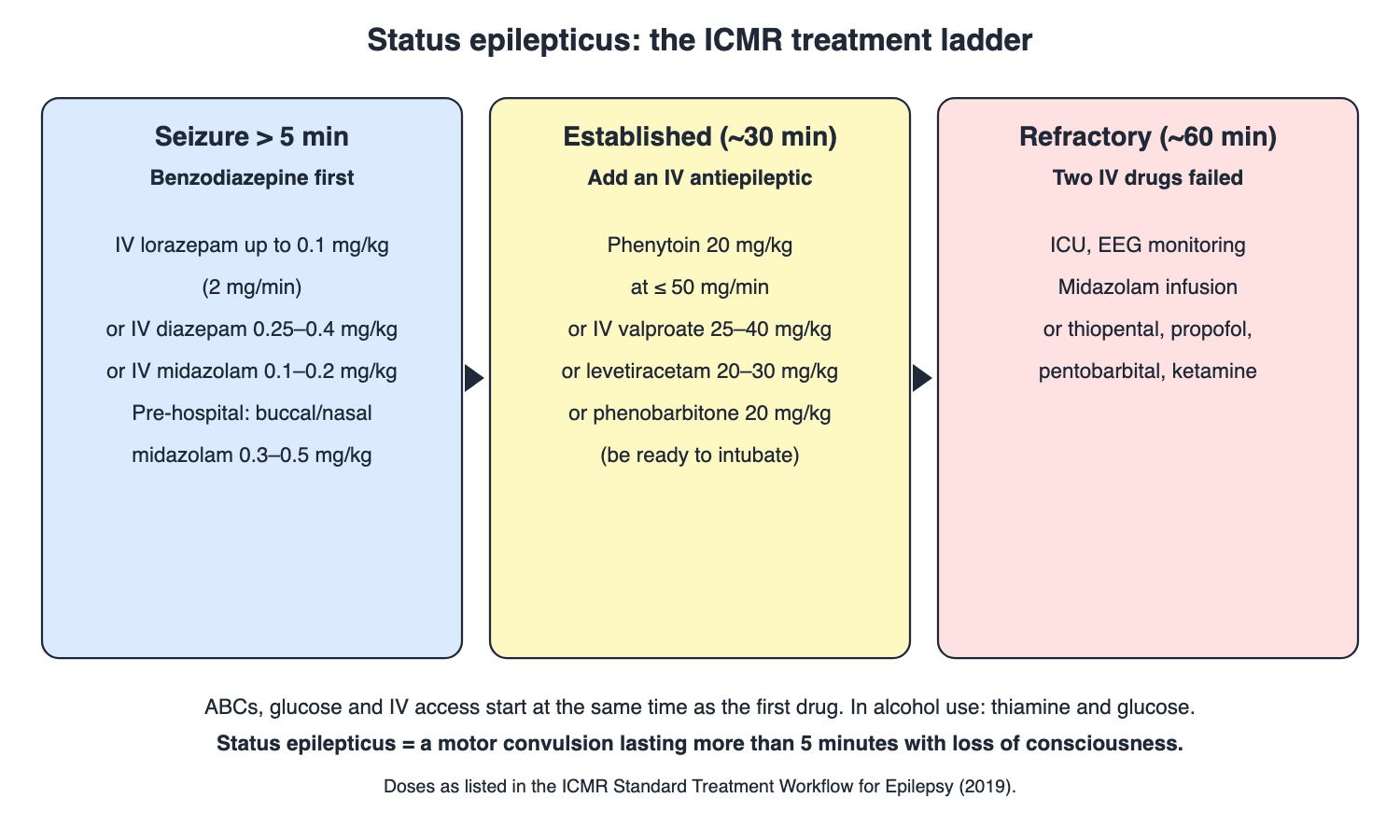
Status epilepticus: benzodiazepine first, then an IV antiepileptic, then refractory ICU treatment. Doses from the ICMR Standard Treatment Workflow for Epilepsy. Drawn by TrackNation.
A convulsion lasting more than 5 minutes with loss of consciousness is status epilepticus — a medical emergency.
Fosphenytoin (boxed warning): infuse no faster than 150 mg phenytoin equivalents per minute in adults — faster rates cause severe hypotension and arrhythmias. ICMR gives phenytoin itself at ≤ 50 mg/min.
In a patient who drinks, give thiamine and glucose.
Benzodiazepines, Flumazenil and Z-drugs
Benzodiazepines + opioids (boxed warning): profound sedation, respiratory depression, coma and death.
Flumazenil reverses benzodiazepines, not opioids. It can precipitate seizures in benzodiazepine-dependent patients and in large tricyclic (cyclic antidepressant) overdoses, and each dose takes 6–10 minutes for full effect.
Zolpidem (boxed warning): complex sleep behaviours such as sleep-walking and sleep-driving, sometimes fatal — stop it at once if they occur.
Parkinson's Disease and Dementia
Levodopa + carbidopa: carbidopa blocks peripheral decarboxylation of levodopa and does not enter the brain, so less levodopa is wasted and nausea and vomiting are less. Dyskinesias can appear sooner and at lower doses than with levodopa alone.
Non-selective MAO inhibitors are contraindicated with levodopa-carbidopa (stop them at least 2 weeks before); MAO-B selective inhibitors can be combined.
Selegiline: irreversible MAO inhibitor, mainly MAO-B, used as an adjunct when the response to levodopa-carbidopa deteriorates.
Pramipexole (dopamine agonist): sudden falling asleep during daily activities; impulse-control disorders (pathological gambling, hypersexuality, compulsive eating).
Donepezil: acetylcholinesterase inhibitor for Alzheimer dementia; vagotonic — bradycardia or heart block.
Traps the Examiner Sets
Benzodiazepine first in status epilepticus; phenytoin, valproate or levetiracetam second.
Valproate in a young woman: avoid (neural tube defects); add folic acid 5 mg to any antiepileptic.
Carbamazepine: screen HLA-B*1502 in at-risk ancestry; watch sodium; it induces its own metabolism over 3–5 weeks.
Phenytoin's metabolism saturates — small dose rises can cause big level rises.
Ethosuximide is for absence seizures only.
Flumazenil does not reverse opioids and can provoke seizures.
Carbidopa acts outside the brain; non-selective MAOIs are banned with levodopa.
Memory Hooks & Shortcuts
Shortcuts to lock in this article's numbers and lists. Each one only re-packages facts proven above.
🧠 Five minutes, then Benzo, then Phenytoin — status epilepticus: > 5 min; benzodiazepine first, IV antiepileptic second
🧠 Valproate and the Very young mother — avoid valproate in women of child-bearing age; folic acid 5 mg
🧠 Carba-1502 and low Sodium — carbamazepine: HLA-B*1502 SJS and hyponatraemia
🧠 Phenytoin's Gums, Hair and Face — gum hyperplasia, hirsutism, coarse facies
🧠 Topiramate makes you Thin, Tongue-tied and Stony — weight loss, word-finding difficulty, kidney stones
🧠 Etho for the Empty stare — ethosuximide for absence seizures
🧠 Carbidopa stays outside — peripheral decarboxylase inhibitor that does not cross the BBB
Rapid-Revision Cards
Status epilepticus
> 5 min convulsion with loss of consciousness.
SE step 1
IV lorazepam ≤ 0.1 mg/kg (2 mg/min) / diazepam / midazolam.
SE pre-hospital
Buccal/nasal midazolam 0.3–0.5 mg/kg.
SE step 2
Phenytoin 20 mg/kg ≤ 50 mg/min, or valproate, levetiracetam, phenobarbitone.
Refractory SE
Benzo + IV AED failed: ICU, midazolam/thiopental/propofol infusion.
Fosphenytoin rate
≤ 150 mg PE/min (hypotension, arrhythmia).
When to treat
≥ 2 unprovoked seizures; single seizure if high recurrence risk.
Generalised (ICMR)
Valproate, lamotrigine, levetiracetam, topiramate.
Focal (ICMR)
Carbamazepine, oxcarbazepine, phenytoin, phenobarbitone.
Women of child-bearing age
Folic acid 5 mg/day; avoid valproate and polytherapy.
Valproate boxed
Hepatotoxicity (first 6 mo), pancreatitis, neural tube defects.
Carbamazepine boxed
HLA-B*1502 SJS/TEN; aplastic anaemia.
Carbamazepine extras
Hyponatraemia; autoinduction 3–5 wk; trigeminal neuralgia.
Phenytoin
Gum hyperplasia, hirsutism, coarse facies; saturable kinetics; inducer.
Lamotrigine
Rash/SJS; worse with valproate or fast titration.
Topiramate
Weight loss, word-finding, kidney stones, angle closure.
Levetiracetam
Psychosis, aggression.
Ethosuximide
Absence seizures.
Benzo + opioid
Respiratory depression, death (boxed).
Flumazenil
Reverses benzos, not opioids; may cause seizures (TCA overdose, dependence).
Zolpidem boxed
Complex sleep behaviours.
Carbidopa
Peripheral decarboxylase inhibitor; no BBB entry.
Levodopa + MAOI
Non-selective MAOIs contraindicated (stop 2 weeks).
Selegiline
MAO-B inhibitor; adjunct to levodopa.
Pramipexole
Sleep attacks; impulse-control disorders.
Donepezil
AChE inhibitor; bradycardia, heart block.
Sources
Facts in this article were checked against these documents.
Standard Treatment Workflow: Management of Epilepsy — Indian Council of Medical Research / Department of Health Research, MoHFW, October 2019 (link)
Prescribing labels: Dilantin, Cerebyx, Tegretol, Depakote, Lamictal XR, Keppra, Zarontin, Topamax, Ativan injection, flumazenil, Ambien CR, Sinemet, selegiline, Mirapex, Aricept — DailyMed, US National Library of Medicine, current labels, accessed November 2026 (link)
Competency Based Undergraduate Curriculum, Pharmacology (PH 3.1–3.3) — National Medical Commission, 2024
Test Yourself: Practice Questions
Twenty-four questions in NEET PG style, most of them clinical vignettes.
Practice Questions (NEET PG pattern)
Original questions written in the style of the exam: +4 for a correct answer, −1 for a wrong one. Every answer was checked against the sources listed above. NEET PG papers are not published by NBEMS, so these are not past-paper questions.
Q1. A 30-year-old has had a generalised tonic-clonic convulsion for 7 minutes and is unconscious. After ABCs and glucose, the first drug under the ICMR workflow is
(a) IV phenytoin 20 mg/kg
(b) IV lorazepam up to 0.1 mg/kg (or IV diazepam / midazolam)
(c) thiopental infusion
(d) IV levetiracetam
Show answer
Answer: (b) — Status epilepticus: benzodiazepine first; an IV antiepileptic follows if seizures continue.
Q2. A child is having a prolonged seizure at home. The pre-hospital option listed by ICMR is
(a) IM phenobarbitone 20 mg/kg
(b) rectal paracetamol
(c) buccal or intranasal midazolam 0.3–0.5 mg/kg
(d) oral phenytoin
Show answer
Answer: (c) — Out of hospital: buccal/intranasal midazolam 0.3–0.5 mg/kg.
Q3. Seizures continue after two doses of lorazepam. The next step (ICMR) is
(a) oral carbamazepine
(b) flumazenil
(c) a third benzodiazepine dose and wait
(d) IV phenytoin 20 mg/kg at ≤ 50 mg/min, or IV valproate, levetiracetam or phenobarbitone
Show answer
Answer: (d) — Established status: an IV antiepileptic — phenytoin, valproate, levetiracetam or phenobarbitone.
Q4. Fosphenytoin must not be infused faster than 150 mg PE/min in adults because of
(a) SJS
(b) gum hyperplasia
(c) hepatic failure
(d) severe hypotension and cardiac arrhythmias
Show answer
Answer: (d) — Boxed warning: cardiovascular risk with rapid infusion.
Q5. A 24-year-old woman planning pregnancy has juvenile myoclonic (generalised) epilepsy. Which drug should be avoided?
(a) Lamotrigine
(b) Levetiracetam
(c) Folic acid
(d) Valproate
Show answer
Answer: (d) — ICMR: avoid valproate in women of child-bearing age; label: neural tube defects. Add folic acid 5 mg/day.
Q6. The folic acid dose ICMR advises with antiepileptics in women of child-bearing age is
(a) not needed
(b) 5 mg a day
(c) 0.4 mg a week
(d) 1 mg a month
Show answer
Answer: (b) — Folic acid 5 mg/day with AEDs in all women of child-bearing age.
Q7. Before starting carbamazepine in a patient of South-East Asian ancestry, test for
(a) G6PD
(b) HLA-B*1502
(c) HLA-B*5801
(d) TPMT
Show answer
Answer: (b) — Tegretol boxed warning: screen at-risk ancestry for HLA-B*1502 (SJS/TEN).
Q8. An elderly man on carbamazepine for focal epilepsy becomes confused. Sodium is 122 mmol/L. The likely cause is
(a) levetiracetam psychosis
(b) phenytoin toxicity
(c) valproate encephalopathy
(d) carbamazepine-induced hyponatraemia
Show answer
Answer: (d) — ICMR lists hyponatraemia among carbamazepine (and oxcarbazepine) adverse effects.
Q9. Carbamazepine's half-life falls over the first weeks of therapy because it
(a) induces its own metabolism (autoinduction over 3–5 weeks)
(b) is excreted unchanged
(c) inhibits CYP3A4
(d) binds to albumin
Show answer
Answer: (a) — Autoinduction is complete after 3–5 weeks.
Q10. Carbamazepine is also the specific drug for
(a) trigeminal neuralgia
(b) essential tremor
(c) absence seizures
(d) myasthenia gravis
Show answer
Answer: (a) — Tegretol is an anticonvulsant and specific analgesic for trigeminal neuralgia.
Q11. Gum hyperplasia, hirsutism and coarse facial features suggest long-term use of
(a) valproate
(b) lamotrigine
(c) phenytoin
(d) levetiracetam
Show answer
Answer: (c) — ICMR: phenytoin — ataxia, sedation, gum hyperplasia, coarsening of facial features, hirsutism, osteomalacia.
Q12. A small increase in phenytoin dose causes a large rise in serum level because phenytoin
(a) undergoes saturable metabolism
(b) is renally excreted
(c) is a prodrug
(d) has a large Vd
Show answer
Answer: (a) — Saturable (zero-order at higher levels) metabolism; also a potent enzyme inducer.
Q13. Valproate's boxed hepatotoxicity risk is greatest
(a) only in overdose
(b) only with alcohol
(c) during the first six months of treatment
(d) after 10 years
Show answer
Answer: (c) — Fatal hepatic failure usually occurred during the first six months.
Q14. Serious rash with lamotrigine is more likely when it is
(a) co-prescribed with valproate or titrated too fast
(b) used for absence seizures
(c) combined with folic acid
(d) taken with food
Show answer
Answer: (a) — Risk factors: valproate co-use, exceeding initial dose or escalation; slow titration lowers risk.
Q15. A child is diagnosed with absence (petit mal) seizures — brief staring spells. A drug indicated specifically for this is
(a) phenytoin
(b) phenobarbitone
(c) carbamazepine
(d) ethosuximide
Show answer
Answer: (d) — Zarontin is indicated for absence (petit mal) epilepsy.
Q16. A patient on topiramate develops sudden blurred vision and eye pain. Suspect
(a) cataract
(b) acute myopia with secondary angle-closure glaucoma
(c) optic neuritis
(d) retinal detachment
Show answer
Answer: (b) — Topamax warning: acute myopia and secondary angle-closure glaucoma — stop the drug.
Q17. Behavioural change, aggression and psychotic symptoms are recognised adverse effects of
(a) valproate
(b) levetiracetam
(c) lamotrigine
(d) ethosuximide
Show answer
Answer: (b) — Keppra warning; ICMR also lists psychosis.
Q18. A man on long-term lorazepam and methadone is found deeply sedated with slow breathing. The combination is dangerous because
(a) methadone induces lorazepam metabolism
(b) they cause hyponatraemia
(c) benzodiazepines with opioids can cause profound sedation, respiratory depression and death
(d) lorazepam blocks opioid receptors
Show answer
Answer: (c) — Boxed warning on concomitant benzodiazepine and opioid use.
Q19. Flumazenil given to an unconscious patient after a mixed overdose including a tricyclic antidepressant may
(a) reverse the tricyclic toxicity
(b) cause hypertension only
(c) reverse opioid respiratory depression
(d) precipitate seizures
Show answer
Answer: (d) — Seizures with flumazenil occurred mostly in large cyclic antidepressant overdoses and in benzodiazepine dependence; it does not reverse opioids.
Q20. Zolpidem carries a boxed warning for
(a) agranulocytosis
(b) complex sleep behaviours such as sleep-driving
(c) hepatic failure
(d) QT prolongation
Show answer
Answer: (b) — Ambien boxed warning: complex sleep behaviours; discontinue immediately.
Q21. Carbidopa is combined with levodopa because carbidopa
(a) crosses the BBB to release dopamine
(b) blocks peripheral decarboxylation of levodopa and does not enter the brain
(c) is a dopamine agonist
(d) inhibits MAO-B
Show answer
Answer: (b) — More levodopa reaches the brain and nausea/vomiting are less.
Q22. A patient on levodopa-carbidopa is prescribed a non-selective MAO inhibitor antidepressant. This is
(a) recommended
(b) contraindicated: non-selective MAO inhibitors must be stopped 2 weeks before
(c) safe if the dose is halved
(d) safe
Show answer
Answer: (b) — Non-selective MAOIs are contraindicated with Sinemet; MAO-B selective inhibitors may be combined.
Q23. A man with Parkinson's disease on pramipexole starts gambling heavily. This is
(a) an impulse-control disorder caused by the dopamine agonist
(b) a levodopa withdrawal effect
(c) a sign of dementia
(d) unrelated to drugs
Show answer
Answer: (a) — Mirapex: pathological gambling, hypersexuality, compulsive eating; also sudden sleep episodes.
Q24. A woman with Alzheimer dementia started on donepezil has a pulse of 44/min. The likely cause is
(a) vagotonic effect of the cholinesterase inhibitor
(b) beta-blockade
(c) hypothyroidism caused by donepezil
(d) hyperkalaemia
Show answer
Answer: (a) — Cholinesterase inhibitors may cause bradycardia or heart block.
Active Recall
From memory: give the ICMR drug choices for generalised and focal epilepsy with one adverse effect each; describe the status epilepticus ladder with doses; list the boxed warnings of valproate, carbamazepine and lamotrigine; explain flumazenil's risks; and explain levodopa-carbidopa, its MAOI interaction, selegiline, pramipexole and donepezil.