Male Genital Tract for NEET PG Pathology: Testicular Tumours and Markers, Cryptorchidism, Torsion, BPH, Prostate Cancer and Gleason, Penile Cancer
Start Here
🎯 Exam priority: Medium–high. Expect: seminoma vs non-seminoma and which markers they make, raised AFP with a "pure seminoma", cryptorchidism and cancer, torsion signs and the salvage window, epididymitis organisms by age, BPH zone, Gleason score and Grade Groups, osteoblastic metastases, and penile cancer precursors.
CBME mapping: PA 28.1–28.6. Tumour markers in general are in article 4; Klinefelter syndrome in article 8.
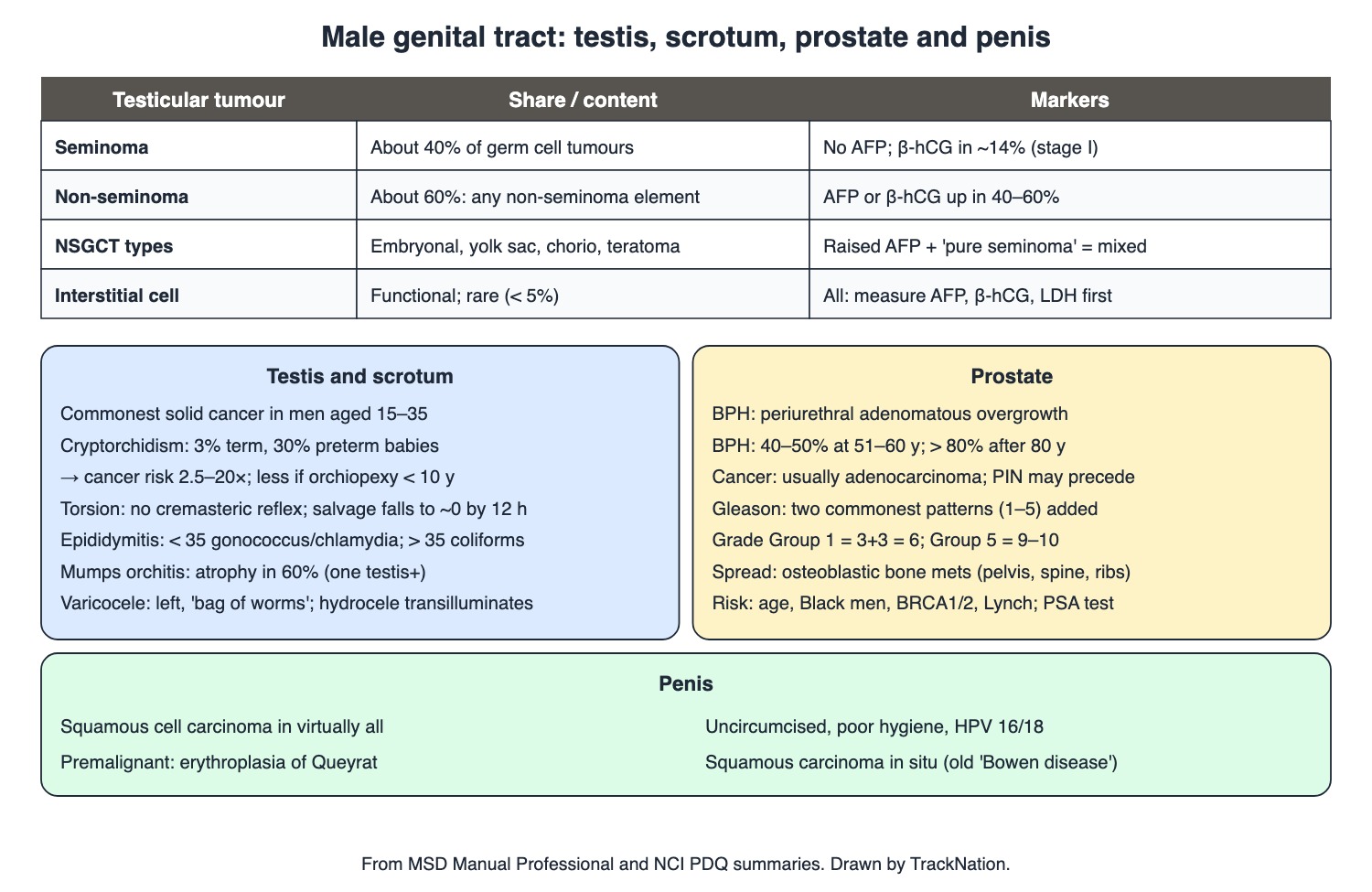
Testicular tumours and markers, scrotal lesions, prostate and penis. Drawn by TrackNation.
Testicular Tumours
The commonest solid cancer in men aged 15–35; usually a painless scrotal mass. Most arise from primordial germ cells; the classification also lists intratubular germ cell neoplasia.
Seminoma about 40%; non-seminoma about 60% (any non-seminoma element): embryonal carcinoma, yolk sac (endodermal sinus) tumour, choriocarcinoma, teratoma, and mixtures (teratocarcinoma = teratoma + embryonal carcinoma). Functional interstitial cell tumours are rare (< 5%); rhabdomyosarcoma occurs mainly in children.
Markers — measure AFP, β-hCG and LDH before orchiectomy. Seminomas do not make AFP; β-hCG is raised in about 14% of stage I seminomas. AFP or β-hCG is raised in 40–60% of non-seminomas. A raised AFP with a "pure seminoma" on histology means a mixed (non-seminomatous) tumour unless something like liver disease explains it.
Cryptorchidism (3% of term, 30% of preterm boys) raises testicular cancer risk 2.5–20 times — less if orchiopexy is done before age 10 — and cancer can also arise in the normally descended testis.
Scrotum: Acute and Painless
Testicular torsion: tender, high-riding, horizontal testis; cremasteric reflex absent. The defect is usually bilateral. Salvage is 80–100% at 6–8 hours and near zero at 12 hours.
Epididymitis: under 35 — N. gonorrhoeae or C. trachomatis; over 35 — gram-negative coliforms.
Mumps orchitis: post-pubertal; atrophy of at least one testis in 60%.
Painless masses: hydrocele (transilluminates), hernia, varicocele (up to 20% of men; left side; "bag of worms", bigger on standing and Valsalva), spermatocele. Testicular cancer is the most concerning cause.
Prostate
Benign prostatic hyperplasia: non-malignant adenomatous overgrowth of the periurethral gland, causing bladder outlet obstruction. Autopsy prevalence 40–50% at 51–60 years and over 80% after 80. Treated with 5-alpha-reductase inhibitors, alpha-blockers or surgery.
Prostate cancer: usually adenocarcinoma; prostatic intraepithelial neoplasia is a possible precursor. Risk: age, Black ancestry, BRCA1/2, Lynch syndrome. Cancer may feel stony hard and nodular on rectal examination; diagnosis by DRE or PSA, confirmed by biopsy.
Gleason score: the most and next-most prevalent patterns are each graded 1–5 and added. ≤ 6 well, 7 moderately, 8–10 poorly differentiated. The WHO 2016 Grade Groups simplify this (table).
Spread to bone gives osteoblastic metastases — pelvis, ribs, vertebrae.
Grade Group | Gleason score | Differentiation |
1 | 6 (3 + 3) | Well differentiated |
2 | 7 (3 + 4) | Moderate |
3 | 7 (4 + 3) | Moderate |
4 | 8 | Poor |
5 | 9 or 10 | Poor |
Penis
Virtually all penile cancers are squamous cell carcinomas (verrucous, warty and basaloid variants), mostly in uncircumcised men with poor hygiene; HPV 16 and 18 contribute.
Precursors: erythroplasia of Queyrat, squamous carcinoma in situ (formerly Bowen disease) and bowenoid papulosis.
Traps the Examiner Sets
Seminoma never makes AFP — a raised AFP means a non-seminoma element.
BPH = periurethral (inner) gland; cancer = adenocarcinoma with osteoblastic bone metastases.
Gleason 3 + 4 (Group 2) is not the same as 4 + 3 (Group 3).
Torsion: absent cremasteric reflex; time is testis (near zero salvage by 12 hours).
Memory Hooks & Shortcuts
Shortcuts to lock in this article's numbers and lists. Each one only re-packages facts proven above.
🧠 Seminoma Says 'no' to AFP — markers
🧠 Time is Testis: 6 hours good, 12 hours gone — torsion
🧠 Under 35 = STI; over 35 = E. coli — epididymitis
🧠 Varicocele on the Left — 'bag of worms' — varicocele
🧠 BPH sits By the Pee-pipe (periurethral) — BPH zone
🧠 Prostate Paints bone white (osteoblastic) — prostate metastases
Rapid-Revision Cards
Testis cancer age
Commonest solid cancer in men 15–35.
Seminoma share
About 40% of germ cell tumours.
Non-seminomas
Embryonal, yolk sac, choriocarcinoma, teratoma (60%).
Seminoma and AFP
Never; raised AFP = non-seminoma element.
Seminoma and hCG
Raised in ~14% (stage I).
NSGCT markers
AFP or β-hCG up in 40–60%.
Markers before surgery
AFP, β-hCG, LDH.
Cryptorchidism
3% term, 30% preterm; cancer 2.5–20×.
Orchiopexy
Before 10 years cuts cancer risk.
Torsion
No cremasteric reflex; ~0 salvage by 12 h.
Epididymitis
< 35 GC/chlamydia; > 35 coliforms.
Mumps orchitis
Atrophy in 60%.
Varicocele
Left; bag of worms; 20% of men.
Hydrocele
Transilluminates.
BPH
Periurethral; > 80% over 80.
Prostate cancer type
Adenocarcinoma; PIN precursor.
Gleason
Two commonest patterns (1–5) added.
Grade Groups
1 = 3+3; 2 = 3+4; 3 = 4+3; 4 = 8; 5 = 9–10.
Prostate mets
Osteoblastic: pelvis, ribs, spine.
Penile cancer
SCC; uncircumcised; HPV 16/18.
Queyrat
Erythroplasia: SCC in situ of glans.
Sources
Facts in this article were checked against these documents.
MSD Manual Professional: Testicular Cancer; Prostate Cancer; Penile Cancer — Merck & Co. (MSD Manuals), reviewed 2025 (link)
MSD Manual Professional: Benign Prostatic Hyperplasia; Prostatitis; Orchitis; Epididymitis; Testicular Torsion; Painless Scrotal Mass — Merck & Co. (MSD Manuals), reviewed 2025 (link)
MSD Manual Professional: Cryptorchidism — Merck & Co. (MSD Manuals), reviewed 2025 (link)
PDQ Testicular, Prostate and Penile Cancer Treatment (Health Professional Version) — US National Cancer Institute, 2025–26 (link)
Competency Based Undergraduate Curriculum, Pathology (PA 28) — National Medical Commission, 2024
Test Yourself: Practice Questions
Twenty-eight questions in NEET PG style, most of them clinical vignettes.
Practice Questions (NEET PG pattern)
Original questions written in the style of the exam: +4 for a correct answer, −1 for a wrong one. Every answer was checked against the sources listed above. NEET PG papers are not published by NBEMS, so these are not past-paper questions.
Q1. A 25-year-old man notices a painless, firm testicular swelling. In his age group, this is most likely
(a) a varicocele
(b) a hydrocele
(c) epididymitis
(d) a testicular germ cell tumour
Show answer
Answer: (d) — The commonest solid cancer in men aged 15–35.
Q2. The commonest single type of testicular germ cell tumour is
(a) choriocarcinoma
(b) yolk sac tumour
(c) seminoma (about 40%)
(d) Leydig cell tumour
Show answer
Answer: (c) — Non-seminomas together make up about 60%.
Q3. A man's orchiectomy specimen is reported as pure seminoma, but his serum AFP is clearly raised and his liver is normal. He should be managed as
(a) a non-seminomatous (mixed) germ cell tumour
(b) a lymphoma
(c) a benign lesion
(d) a pure seminoma
Show answer
Answer: (a) — Seminomas do not produce AFP.
Q4. Which tumour marker is never produced by a pure seminoma?
(a) alpha-fetoprotein
(b) none of these is ever raised
(c) beta-hCG
(d) LDH
Show answer
Answer: (a) — β-hCG is raised in about 14% of stage I seminomas.
Q5. Before orchiectomy for a testicular mass, the serum markers to measure are
(a) calcitonin and CEA
(b) AFP, beta-hCG and LDH
(c) PSA and CA-125
(d) CEA and CA 19-9
Show answer
Answer: (b) — They help staging and follow-up.
Q6. A testicular tumour is composed of teratoma mixed with embryonal carcinoma. It is called
(a) gonadoblastoma
(b) polyembryoma only
(c) seminoma
(d) teratocarcinoma
Show answer
Answer: (d) — Histological combinations are common.
Q7. Which of these is a non-seminomatous germ cell tumour?
(a) yolk sac (endodermal sinus) tumour
(b) spermatocytic tumour counted as seminoma
(c) Leydig cell tumour
(d) lymphoma
Show answer
Answer: (a) — Also embryonal carcinoma, choriocarcinoma and teratoma.
Q8. In men with non-seminomatous germ cell tumours, serum AFP is raised in about
(a) 5%
(b) never
(c) 40–60%
(d) 100%
Show answer
Answer: (c) — β-hCG is raised in a similar proportion.
Q9. A man had an undescended testis corrected at age 14. His risk of testicular cancer is
(a) normal after surgery at any age
(b) raised only for lymphoma
(c) raised (2.5–20 times), including in the other testis
(d) lower than average
Show answer
Answer: (c) — Orchiopexy before age 10 reduces or removes the excess risk.
Q10. Cryptorchidism is present in about what proportion of preterm boys?
(a) 3%
(b) 0.3%
(c) 70%
(d) 30%
Show answer
Answer: (d) — About 3% of term boys.
Q11. A boy has rapid-onset severe scrotal pain with vomiting; the testis is tender, elevated and horizontal and the cremasteric reflex is absent. The diagnosis and urgency are
(a) mumps orchitis — supportive care
(b) varicocele — elective
(c) epididymitis — antibiotics
(d) torsion — salvage falls to near zero by 12 hours
Show answer
Answer: (d) — Salvage is 80–100% at 6–8 hours.
Q12. After fixing a torsed testis, the surgeon also fixes the other side because
(a) the anatomical defect is usually bilateral
(b) mumps is likely
(c) the vas is absent
(d) cancer is likely
Show answer
Answer: (a) — The contralateral testis may also lie horizontally.
Q13. A sexually active 24-year-old has acute epididymitis. The likely organisms are
(a) E. coli and coliforms
(b) Neisseria gonorrhoeae or Chlamydia trachomatis
(c) Mycobacterium tuberculosis
(d) mumps virus
Show answer
Answer: (b) — Over 35, coliforms predominate.
Q14. A 65-year-old man has acute epididymitis without sexual risk factors. The likely organisms are
(a) Treponema pallidum
(b) gram-negative coliform bacilli
(c) Chlamydia trachomatis
(d) Candida
Show answer
Answer: (b) — Under 35, gonococcus and chlamydia.
Q15. After mumps, a young man's testis shrinks. Testicular atrophy follows mumps orchitis in about
(a) 1%
(b) 60% (at least one testis)
(c) 100%
(d) never
Show answer
Answer: (b) — Atrophy does not track fertility or severity.
Q16. A man has a left scrotal swelling that feels like a bag of worms and gets bigger on standing and straining. This is
(a) a hydrocele
(b) a varicocele
(c) a spermatocele
(d) a seminoma
Show answer
Answer: (b) — Present in up to 20% of adult men.
Q17. A painless cystic scrotal swelling that lights up when a torch is held behind it is most likely
(a) an incarcerated hernia
(b) a varicocele
(c) a hydrocele
(d) a testicular tumour
Show answer
Answer: (c) — Solid tumours do not transilluminate.
Q18. Benign prostatic hyperplasia arises in the
(a) peripheral zone only
(b) periurethral prostate gland
(c) seminal vesicles
(d) bladder neck muscle only
Show answer
Answer: (b) — So it obstructs the urethra early.
Q19. On autopsy studies, the prevalence of BPH in men over 80 is
(a) more than 80%
(b) about 8%
(c) about 50% only in Black men
(d) about 20%
Show answer
Answer: (a) — 40–50% at 51–60 years.
Q20. Besides alpha-blockers, a standard drug class for treating BPH is
(a) corticosteroids
(b) anticholinergics as first choice
(c) loop diuretics
(d) 5-alpha-reductase inhibitors
Show answer
Answer: (d) — Tadalafil, minimally invasive procedures and surgery are other options.
Q21. The commonest histological type of prostate cancer is
(a) squamous cell carcinoma
(b) transitional cell carcinoma
(c) sarcoma
(d) adenocarcinoma
Show answer
Answer: (d) — Sarcoma occurs mainly in children.
Q22. A possible premalignant change in the prostate is
(a) squamous metaplasia after infarct
(b) prostatic intraepithelial neoplasia
(c) nodular hyperplasia
(d) corpora amylacea
Show answer
Answer: (b) — High-grade PIN may precede adenocarcinoma.
Q23. A prostate biopsy shows a most prevalent pattern of grade 4 and a second pattern of grade 3. The Gleason score and Grade Group are
(a) 4, Grade Group 1
(b) 7 (4 + 3), Grade Group 3
(c) 7 (3 + 4), Grade Group 2
(d) 12, Grade Group 5
Show answer
Answer: (b) — The two patterns are added; the order matters for the Grade Group.
Q24. The lowest Gleason score usually reported on a biopsy, 3 + 3, corresponds to
(a) Grade Group 5
(b) poorly differentiated
(c) Grade Group 1, well differentiated
(d) Grade Group 3
Show answer
Answer: (c) — ≤ 6 well, 7 moderate, 8–10 poor.
Q25. An elderly man with back pain has sclerotic (dense) lesions in the pelvis and vertebrae on X-ray. The most likely primary is
(a) renal cell carcinoma
(b) multiple myeloma
(c) prostate adenocarcinoma
(d) thyroid follicular carcinoma
Show answer
Answer: (c) — Prostate cancer gives osteoblastic metastases.
Q26. An inherited predisposition to prostate cancer is
(a) HFE mutation
(b) APC mutation only
(c) factor V Leiden
(d) BRCA2 mutation
Show answer
Answer: (d) — BRCA1/2 and Lynch syndrome.
Q27. An uncircumcised man with poor local hygiene develops penile cancer. The likely histology and viral co-factor are
(a) adenocarcinoma — EBV
(b) squamous cell carcinoma — HPV 16/18
(c) basal cell carcinoma — HPV 6
(d) melanoma — HHV-8
Show answer
Answer: (b) — Virtually all penile cancers are squamous.
Q28. Squamous carcinoma in situ affecting the glans or inner prepuce is called
(a) condyloma acuminatum
(b) erythroplasia of Queyrat
(c) lichen planus
(d) balanitis xerotica only
Show answer
Answer: (b) — On the shaft it is SCC in situ (formerly Bowen disease); both progress in 5–10%.
Active Recall
From memory: classify testicular germ cell tumours and state which markers each makes; explain the raised-AFP 'pure seminoma'; give cryptorchidism's cancer risk; describe torsion, epididymitis by age and mumps orchitis; describe BPH; explain the Gleason score and Grade Groups and where prostate cancer spreads; and name penile cancer's type, risks and precursors.