Financial Inclusion Schemes for UPSC: Jan Dhan, PMJJBY vs PMSBY, MUDRA (Shishu to Tarun Plus), Stand-Up India, SVANidhi, Vishwakarma and the FI-Index
Financial Inclusion at a Glance
🎯 Exam priority: Important. UPSC asked MUDRA and Stand-Up India in 2016 and the RBI's Financial Inclusion Index in 2026. The questions test what each scheme is for, who runs it and its limits. Learn the numbers in the tables.
Financial inclusion means that low-income households can use banking, credit, insurance and pensions at an affordable cost. The Government's approach is often summed up as JAM: Jan Dhan accounts, Aadhaar identity and Mobile phones, which together carry direct benefit transfers; the RBI counts the JAM ecosystem in its measure of access.
Need | Scheme | Run by |
A bank account | PM Jan Dhan Yojana (2014) | Department of Financial Services, through banks and Bank Mitras |
Life and accident insurance | PMJJBY and PMSBY (2015) | Banks and post offices with insurers |
Old-age pension | Atal Pension Yojana (2015), NPS Vatsalya (2024) | PFRDA |
Small business credit | PM MUDRA Yojana (2015) | Banks, NBFCs and MFIs; guarantee by NCGTC |
Credit for SC/ST and women entrepreneurs | Stand-Up India (2016) | Scheduled commercial banks; SIDBI refinance |
Credit for street vendors and artisans | PM SVANidhi, PM Vishwakarma (2023) | Housing and Urban Affairs; MSME |
The RBI tracks progress through its Financial Inclusion Index (FI-Index), built from three sub-indices, Access, Usage and Quality. It rose from 53.9 in 2018 to 67 in 2025, with gains in all three.
PM Jan Dhan Yojana
Everything else rests on the bank account.
PM Jan Dhan Yojana (PMJDY)
PMJDY, the national mission for financial inclusion, began in August 2014 and completed ten years in August 2024. In its opening week so many accounts were opened that it entered the Guinness World Records. Accounts grew from 14.72 crore in 2015 to 59.09 crore by 19 August 2026, with 32.92 crore held by women, and deposits rose about twentyfold.
Who: any Indian citizen, with no upper age limit; one basic savings account for each unbanked person, opened at a branch or through a Business Correspondent (Bank Mitra).
No minimum balance; normal savings interest is paid.
RuPay debit card with built-in accident insurance of Rs 2 lakh (Rs 1 lakh for accounts opened before the August 2018 upgrade); the premium is paid by the National Payments Corporation of India, not the account holder.
Overdraft up to Rs 10,000 for one account holder per household, after six months of satisfactory operation.
Jan Dhan accounts are the gateway to DBT, PMJJBY, PMSBY, APY and MUDRA.
Jan Suraksha: PMJJBY and PMSBY
The two insurance schemes and APY were launched together in 2015 and are called the Jan Suraksha schemes. UPSC likes the contrast between the two insurance covers.
Jan Suraksha: PMJJBY and PMSBY
Feature | PM Jeevan Jyoti Bima Yojana (PMJJBY) | PM Suraksha Bima Yojana (PMSBY) |
Type | Life insurance, death from any cause | Personal accident insurance, death or disability by accident |
Age | 18-50 | 18-70 |
Premium | Rs 436 a year (pro rata if joining mid-year) | Rs 20 a year |
Cover | Rs 2 lakh on death; 30-day lien period after enrolling | Rs 2 lakh for death or total disability; Rs 1 lakh for partial disability |
Term | One year, renewed every June to May by auto-debit | One year, renewed every June to May by auto-debit |
Enrolment (31 Dec 2025) | 26.24 crore | 56.04 crore |
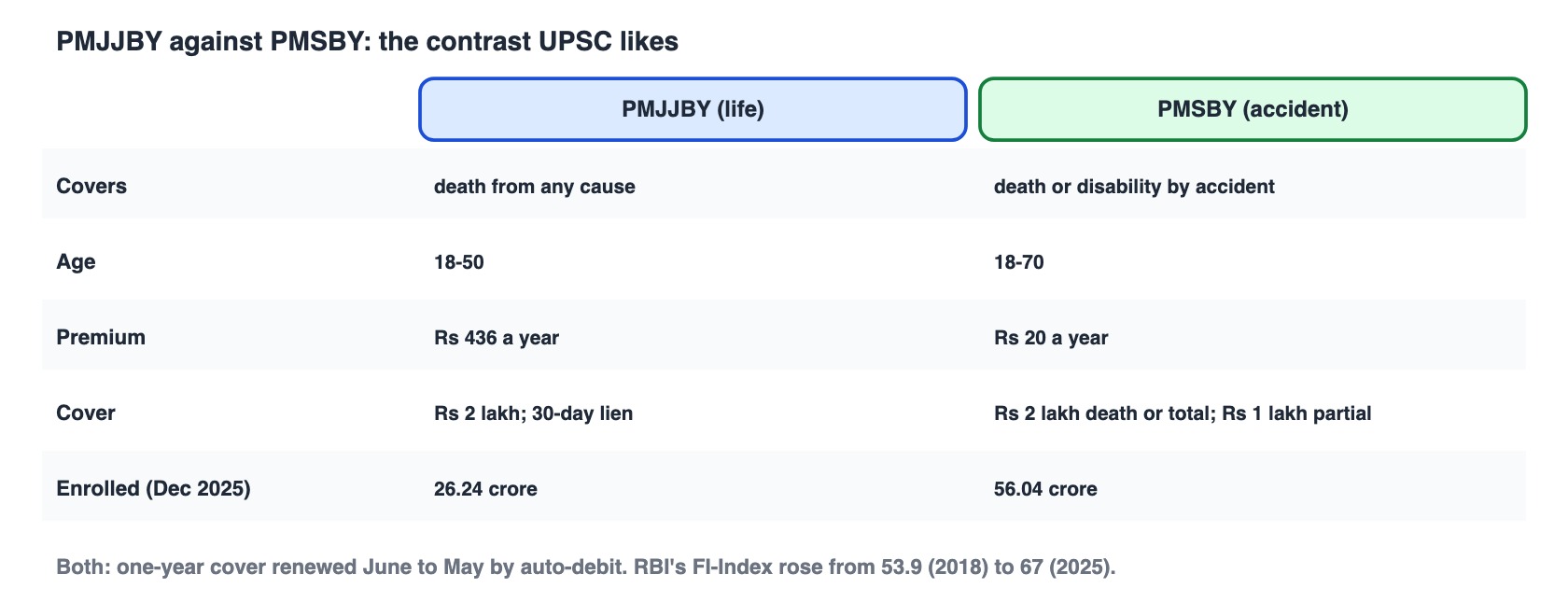
PMJJBY and PMSBY side by side.
Pensions are covered in the social security article: APY for workers aged 18-40, and NPS Vatsalya (launched 18 September 2024), a PFRDA-regulated contributory pension account that guardians open for children under 18.
MUDRA and Stand-Up India
Credit schemes come next, and the categories are a favourite Prelims detail.
PM MUDRA Yojana and Stand-Up India
PM MUDRA Yojana (April 2015) gives collateral-free loans up to Rs 20 lakh for non-corporate, non-farm income-generating activities: manufacturing, trading, services and allied agriculture. The motto is "Funding the Unfunded". Loans come through banks, NBFCs and microfinance institutions, and the Credit Guarantee Fund for Micro Units (CGFMU), run by NCGTC, guarantees them.
Category | Loan size |
Shishu | Up to Rs 50,000 |
Kishor | Above Rs 50,000 to Rs 5 lakh |
Tarun | Above Rs 5 lakh to Rs 10 lakh |
Tarun Plus (from 24 October 2024) | Rs 10 lakh to Rs 20 lakh, only for those who have repaid a Tarun loan |
Over 57 crore loans worth Rs 40.07 lakh crore had been given by April 2026; in 2024-25 about 60% of accounts were women's and 21% went to new entrepreneurs.
Stand-Up India (5 April 2016) promotes entrepreneurship among SC/ST and women. Each bank branch is meant to fund at least two such projects, on average one SC/ST and one woman borrower. Loans are Rs 10 lakh to Rs 1 crore, repayable over up to 7 years, for greenfield (first-time) enterprises in manufacturing, services, trading and allied agriculture. The scheme has a refinance window through SIDBI (initially Rs 10,000 crore) and a credit guarantee through NCGTC. By March 2025, 2.75 lakh accounts had been sanctioned, 2.05 lakh of them to women. On 11 November 2026 the Cabinet continued the scheme for five years to 31 March 2031, targeting at least 2.5 lakh more beneficiaries, with a credit guarantee corpus of Rs 4,111 crore.
PM SVANidhi and PM Vishwakarma
Two newer schemes lend to people who work on the street or with their hands.
PM SVANidhi and PM Vishwakarma
PM SVANidhi (Housing and Urban Affairs) gives street vendors small working-capital loans that grow as they repay: up to Rs 15,000, then Rs 25,000, then Rs 50,000, plus a UPI-linked credit card and cashback for digital payments. The Cabinet extended it on 27 August 2025, with lending until 31 March 2030 and coverage widened to census towns. It has reached over 70 lakh vendors; an ISB study found 95% were borrowing formally for the first time.
PM Vishwakarma (17 September 2023) supports artisans in 18 traditional trades who work with their hands and tools, such as carpenters, blacksmiths, tailors, potters, sculptors and goldsmiths. It gives skill training, a modern toolkit, digital incentives, marketing help and collateral-free loans at a concessional rate. Three ministries run it jointly: MSME, Skill Development and Finance. It reached its target of 30 lakh registrations within two years.
Another recent drive is the October to December 2025 campaign "Your Money, Your Right", which helps people reclaim unclaimed deposits, shares, dividends and insurance money.
How UPSC asks it
The purpose of a scheme, as in "MUDRA is aimed at" (2016), and the agencies behind it, such as SIDBI refinance for Stand-Up India (2016).
Limits and ages: MUDRA categories, PMJJBY vs PMSBY, the Jan Dhan overdraft and insurance cover.
Indices: the three sub-indices of the RBI FI-Index (2026).
Mains: the gap between access and use (dormant accounts), credit for women and micro-enterprises, and digital inclusion.
Further Reading
PIB press releases, ministry websites and annual reports, the Gazette of India, MEA and UN documents and the official sources named in each note — the primary sources behind every fact above.
Test Yourself: Practice Questions & PYQs
12 practice questions, then three real UPSC questions on MUDRA, Stand-Up India and the FI-Index.
Practice Questions
Q1. Under PM Jan Dhan Yojana, the accident insurance cover on the RuPay card for accounts opened after August 2018 is
(a) Rs 1 lakh
(b) Rs 5 lakh
(c) Rs 2 lakh
(d) Rs 30,000
Show answer
Answer: (c) — Cover is Rs 2 lakh for accounts opened after August 2018 (Rs 1 lakh earlier). NPCI pays the premium.
Q2. Consider the following statements:
1. A PMJDY account must maintain a minimum balance of Rs 500.
2. The PMJDY overdraft of up to Rs 10,000 is available to one account holder per household.
3. There is no upper age limit for opening a PMJDY account.
Which of the statements given above are correct?
(a) 1 and 2 only
(b) 2 and 3 only
(c) 1 and 3 only
(d) 1, 2 and 3
Show answer
Answer: (b) — 2 and 3 are correct. There is no minimum balance requirement; the overdraft needs six months of satisfactory operation.
Q3. Which of the following correctly matches PMJJBY and PMSBY?
(a) Both give Rs 5 lakh health cover
(b) Both are pension schemes regulated by PFRDA
(c) PMJJBY: life cover for ages 18-50 at Rs 436 a year; PMSBY: accident cover for ages 18-70 at Rs 20 a year
(d) PMJJBY: accident cover for ages 18-70; PMSBY: life cover for ages 18-50
Show answer
Answer: (c) — PMJJBY pays Rs 2 lakh on death from any cause; PMSBY pays Rs 2 lakh for accidental death or total disability and Rs 1 lakh for partial disability.
Q4. Under PM MUDRA Yojana, the 'Tarun Plus' category
(a) gives Rs 10-20 lakh only to borrowers who have repaid a Tarun loan
(b) gives loans up to Rs 50,000 to new borrowers
(c) is for women borrowers only
(d) is for farm loans to tenant farmers
Show answer
Answer: (a) — Tarun Plus took effect on 24 October 2024, raising the MUDRA ceiling to Rs 20 lakh for borrowers who have repaid a Tarun loan.
Q5. Which of the following is the correct sequence of MUDRA loan categories by increasing size?
(a) Shishu, Tarun, Kishor, Tarun Plus
(b) Shishu, Kishor, Tarun, Tarun Plus
(c) Kishor, Shishu, Tarun, Tarun Plus
(d) Tarun, Kishor, Shishu, Tarun Plus
Show answer
Answer: (b) — Shishu up to Rs 50,000; Kishor up to Rs 5 lakh; Tarun up to Rs 10 lakh; Tarun Plus up to Rs 20 lakh.
Q6. MUDRA loans are guaranteed by the Credit Guarantee Fund for Micro Units, which is administered by
(a) NABARD
(b) the Reserve Bank of India
(c) the Life Insurance Corporation
(d) the National Credit Guarantee Trustee Company
Show answer
Answer: (d) — CGFMU is administered by NCGTC, which also runs the Stand-Up India guarantee.
Q7. Loans under Stand-Up India are given for
(a) farm loans to small and marginal farmers
(b) expansion of existing MSMEs of any owner
(c) greenfield enterprises of SC/ST and women entrepreneurs, Rs 10 lakh to Rs 1 crore
(d) education loans for SC/ST students
Show answer
Answer: (c) — Stand-Up India funds first-time (greenfield) ventures of SC/ST and women, repayable over up to 7 years.
Q8. NPS Vatsalya, launched in September 2024, is
(a) an insurance scheme for newborns
(b) a contributory pension account for minors operated by guardians
(c) a savings scheme for senior citizens
(d) a scholarship for girl students
Show answer
Answer: (b) — NPS Vatsalya is a PFRDA-regulated pension account for children under 18, operated by their guardians.
Q9. Under PM SVANidhi, loans to street vendors are given
(a) as a single Rs 1 lakh loan
(b) only through cooperative banks
(c) in three rising tranches of up to Rs 15,000, Rs 25,000 and Rs 50,000
(d) only to vendors in metropolitan cities
Show answer
Answer: (c) — Each loan, repaid on time, unlocks a bigger one. The scheme now runs to 31 March 2030 and covers census towns too.
Q10. PM Vishwakarma covers artisans in how many traditional trades?
(a) 25
(b) 8
(c) 12
(d) 18
Show answer
Answer: (d) — The scheme, launched on 17 September 2023, covers 18 trades of people who work with their hands and tools.
Q11. Which ministries jointly implement PM Vishwakarma?
(a) Rural Development and Panchayati Raj
(b) Textiles and Culture
(c) Social Justice and Tribal Affairs
(d) MSME, Skill Development and Entrepreneurship, and Finance
Show answer
Answer: (d) — All three ministries share its work: training, toolkits and concessional credit.
Q12. The premium for the accident insurance on a PMJDY RuPay card is paid by
(a) the Reserve Bank of India
(b) the National Payments Corporation of India
(c) the State Government
(d) the account holder
Show answer
Answer: (b) — NPCI pays it; the account holder pays nothing.
UPSC Previous Year Questions (PYQs)
Real UPSC Prelims questions, checked against the official papers and answer keys.
Q1. Pradhan Mantri MUDRA Yojana is aimed at (UPSC CSE 2016)
(a) bringing the small entrepreneurs into formal financial system
(b) providing loans to poor farmers for cultivating particular crops
(c) providing pensions to old and destitute persons
(d) funding the voluntary organizations involved in the promotion of skill development and employment generation
Show answer
Answer: (a) — MUDRA gives collateral-free loans to small and micro enterprises in non-farm activities, bringing them into formal credit.
Q2. With reference to 'Stand Up India Scheme', which of the following statements is/are correct?
1. Its purpose is to promote entrepreneurship among SC/ST and women entrepreneurs.
2. It provides for refinance through SIDBI.
Select the correct answer using the code given below. (UPSC CSE 2016)
(a) 1 only
(b) 2 only
(c) Both 1 and 2
(d) Neither 1 nor 2
Show answer
Answer: (c) — Both. Stand-Up India promotes SC/ST and women entrepreneurs, and has a refinance window through SIDBI (initially Rs 10,000 crore) with a credit guarantee through NCGTC.
Q3. Which one of the following correctly represents the three key sub-indices of the Financial Inclusion Index (FI-Index) of the Reserve Bank of India (RBI)? (UPSC CSE 2026)
(a) Credit access, Insurance depth, and Pension coverage
(b) Banking access, GDP contribution, and Financial literacy
(c) Access, Usage, and Quality
(d) Access, Affordability, and Transparency
Show answer
Answer: (c) — The FI-Index has three sub-indices: Access, Usage and Quality. It stood at 67 in 2025.
Mains Practice Questions
Use these to frame full-length answers. You don't have to answer one exactly — they show the angles UPSC tests, so let them guide which points you cover.
Jan Dhan has opened bank accounts for almost every household. Why is access alone not financial inclusion, and what does the FI-Index's 'Usage' and 'Quality' add?
Examine the role of collateral-free credit schemes such as MUDRA, Stand-Up India and PM SVANidhi in women's and micro-entrepreneurship.
Discuss how the JAM trinity has changed the delivery of welfare benefits, with its limits.