Social Security Schemes for UPSC: Atal Pension Yojana vs PM-SYM, NSAP, the four Labour Codes, e-Shram, EPFO and ESIC
Three Layers of Social Security
🎯 Exam priority: Important. UPSC has asked the Atal Pension Yojana (2016) and PM Shram Yogi Maan-dhan (2024) statement by statement, and the 2025 Labour Codes and gig-worker cover are the next obvious target. Learn the eligibility numbers exactly.
India's social security has three layers. Learn which scheme sits in which layer and who pays for it.
Layer | Who pays | Main schemes |
Social assistance (non-contributory) | Government alone | NSAP, renamed PM Samajik Sahayata Yojana in 2026: old-age, widow and disability pensions, family benefit |
Contributory schemes for the unorganised sector | Worker, with a Government guarantee or matching share | Atal Pension Yojana, PM Shram Yogi Maan-dhan, PMJJBY and PMSBY insurance |
Formal-sector social insurance | Employer and employee | EPFO (provident fund, EPS-95 pension), ESIC (health and cash benefits) |
The constitutional anchor is Article 41, a Directive Principle: the State shall, within its economic capacity, give public assistance in unemployment, old age, sickness and disablement. The Labour Ministry says social protection coverage rose from 19% in 2015 to 64.3% in 2025, second in the world after China, and India won the ISSA Award 2025 for outstanding achievement in social security. A PIB backgrounder of October 2026 put coverage at 68.4% in 2026; the EPFO wage ceiling for mandatory coverage was raised from Rs 15,000 to Rs 25,000 in September 2026.
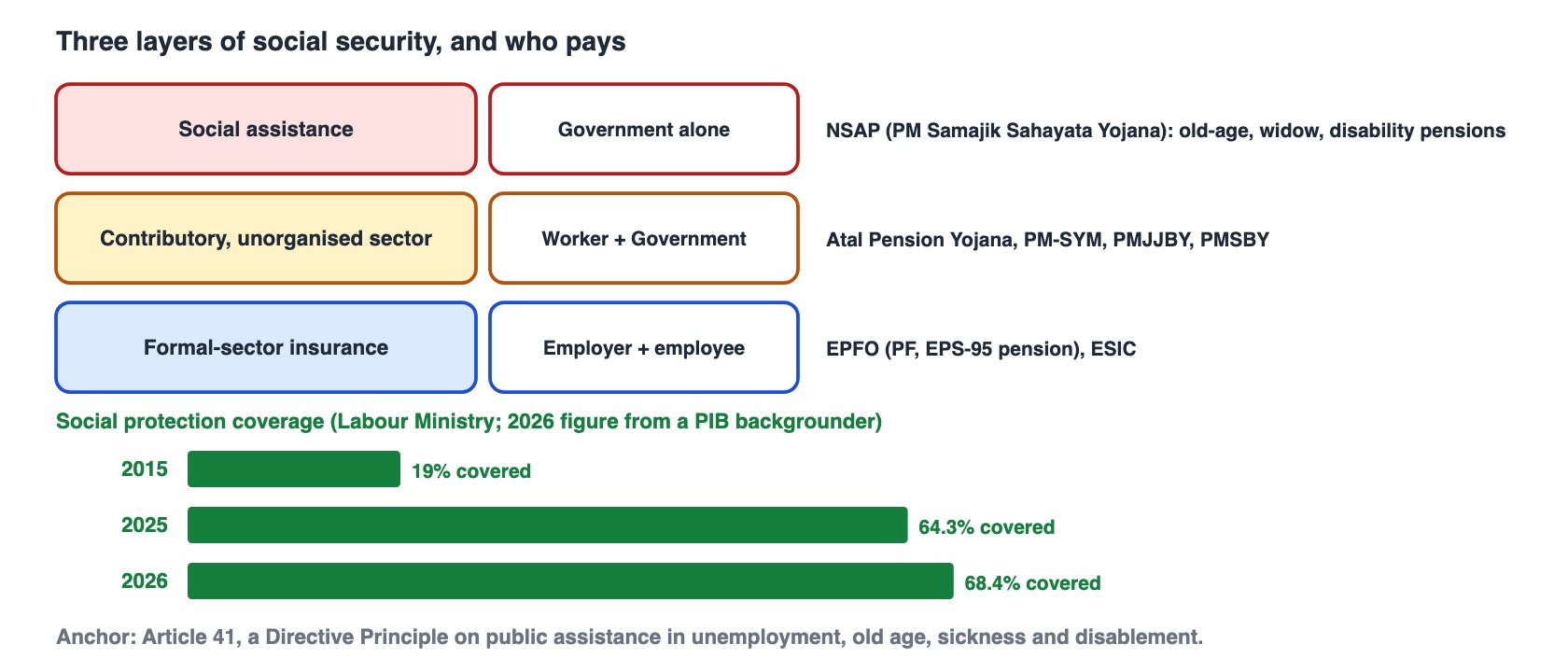
Three layers of social security, who pays for each, and coverage since 2015.
Atal Pension Yojana and PM-SYM
The two contributory pensions for informal workers are the pair UPSC confuses on purpose.
Atal Pension Yojana and PM Shram Yogi Maan-dhan
Feature | Atal Pension Yojana (APY) | PM Shram Yogi Maan-dhan (PM-SYM) |
Launched | 9 May 2015 | 2019 |
Run by | PFRDA, on the NPS architecture (Finance Ministry) | Labour Ministry; LIC is fund manager, CSCs enrol |
Entry age | 18-40 | 18-40 |
Income condition | Not and never an income-tax payer (from 1 October 2022) | Monthly income Rs 15,000 or less; not an income-tax payer; not in EPFO, ESIC or Government-funded NPS |
Pension at 60 | Guaranteed Rs 1,000 to Rs 5,000 a month (slabs of Rs 1,000) | Assured Rs 3,000 a month |
Who contributes | Subscriber; contribution depends on age and pension slab | Worker and Centre 50:50 (worker pays Rs 55 to Rs 200 a month by entry age) |
After death | Same pension to the spouse for life; then the corpus to the nominee | Spouse gets 50% as family pension; family pension is for the spouse only |
Scale | Over 9 crore gross enrolments (21 April 2026); about 48% women | Over 54 lakh enrolled (July 2026); 53.1% women |
APY in numbers: a person joining at 18 pays Rs 42 to Rs 210 a month; at 40, Rs 291 to Rs 1,454, because the minimum contribution period is 20 years. The pension amount is guaranteed: the subscriber chooses the slab and pays the matching contribution.
PM-SYM payouts cannot start before February 2039, since the earliest joiners reach 60 only then. Dormant accounts can now be revived within three years instead of one.
Both schemes are voluntary. Neither limits membership to one person per family.
National Social Assistance Programme
Social assistance is the oldest layer and needs no contribution at all.
NSAP, now the PM Samajik Sahayata Yojana
The National Social Assistance Programme (NSAP) began on 15 August 1995 to give effect to Article 41. It is a centrally sponsored scheme with 100% central assistance, for households below the poverty line in rural and urban areas, run by the Rural Development Ministry. On 14 October 2026 the Cabinet continued it for 2026-27 to 2030-31 (outlay Rs 53,428 crore, about 3.20 crore beneficiaries) and renamed it the Pradhan Mantri Samajik Sahayata Yojana, with new names for each sub-scheme:
Old name | New name (2026) | Central assistance | Who |
Indira Gandhi National Old Age Pension Scheme | PM Vridhavastha Pension Yojana | Rs 200 a month (Rs 500 at 80+) | BPL persons aged 60 and above |
Indira Gandhi National Widow Pension Scheme | PM Vidhawa Pension Yojana | Rs 300 a month (Rs 500 at 80+) | BPL widows aged 40 and above |
Indira Gandhi National Disability Pension Scheme | PM Divyangjan Pension Yojana | Revised: Rs 375 a month (Rs 625 at 80+) | BPL persons with 40% (benchmark) disability, from birth |
National Family Benefit Scheme | PM Parivar Labh Yojana | Rs 20,000 one time | BPL family on the death of the main breadwinner aged 18-59 |
What changed in 2026: only the disability pension. It used to need 80% disability (the "severe disability" of the National Trust Act, 1999) and a minimum age of 18. It now uses the 40% benchmark disability of the Rights of Persons with Disabilities Act, 2016, has no minimum age, and pays more. Its beneficiaries rise from 8.33 lakh to 27.48 lakh.
Annapurna (10 kg of foodgrains a month for BPL elderly not getting the old-age pension) was listed with NFBS as a demand-based scheme in the Ministry's 2025 review.
States add their own top-up, from Rs 50 to Rs 5,700 a month, so most pensioners get around Rs 1,100 a month in all; the central rate is only the floor.
The Four Labour Codes
The biggest change of 2025 was legal, not a new scheme.
The four Labour Codes (in force from 21 November 2025)
Four Codes replaced 29 central labour laws. Common features: uniform definitions; Inspector-cum-Facilitators and web-based inspection; compounding of offences and civil fines instead of jail for first-time offences; a single licence, registration and return; no discrimination by gender, including against transgender persons; and women allowed to work in all sectors, night shifts included, with consent and safety measures.
Code | Headline changes |
Code on Wages, 2019 | Minimum wage a statutory right for every employee, organised or unorganised; a national floor wage set by the Centre, below which States cannot go; overtime at least twice the normal rate |
Industrial Relations Code, 2020 | Fixed-term employment with equal benefits; a re-skilling fund (15 days' wages per retrenched worker); a negotiating union or council; two-member industrial tribunals |
Code on Social Security, 2020 | Defines gig worker, platform worker and aggregator; a Social Security Fund for unorganised, gig and platform workers; ESIC nationwide; gratuity for fixed-term staff after one year; commuting accidents count as employment injuries |
Occupational Safety, Health and Working Conditions Code, 2020 | Applies to establishments with 10+ workers, or even one in hazardous work; appointment letters for all; free annual health check-up; wider definition of inter-State migrant worker; one National OSH Advisory Board |
The uniform wage definition (basic pay plus dearness allowance plus retaining allowance) matters because benefits such as gratuity and maternity benefit are calculated on it.
Gig and platform workers in practice (2026): on 30 October 2026 the Government notified the National Social Security Board for Unorganised Workers and Gig & Platform Workers under the Code on Social Security, chaired by the Union Labour Minister. Aggregators (app-based platforms) must contribute 1-2% of annual turnover, capped at 5% of what they pay gig and platform workers, towards their social security.
e-Shram, EPFO, ESIC and Job Schemes
The Codes run through a set of databases and institutions that UPSC also names in options.
e-Shram, EPFO, ESIC and job schemes
e-Shram (26 August 2021): the National Database of Unorganised Workers, seeded with Aadhaar, registration by self-declaration. It passed 31.42 crore workers in December 2025, works in 22 languages through Bhashini, and links to the National Career Service, Maandhan, myScheme, Skill India Digital and the Jan Suraksha portal for PMJJBY and PMSBY.
Shram Suvidha Portal (16 October 2014) gives each employer a Labour Identification Number (LIN) for online registration, returns and risk-based inspection.
EPFO: 8.25% interest for 2024-25; members can withdraw up to 75% of their balance after 12 months of service; the Centralised Pension Payment System lets EPS pensioners draw pension from any bank branch from January 2025. An India-UK Double Contribution Convention spares short-term deputed workers from paying into both systems.
ESIC now covers 713 districts (up from 668). Its Atal Beemit Vyakti Kalyan Yojana pays an unemployment allowance to insured persons who lose their jobs.
PM Viksit Bharat Rozgar Yojana (launched 15 August 2025, outlay Rs 99,446 crore): first-time employees get one month's wage up to Rs 15,000 (Part A), and employers get incentives for added jobs (Part B), for jobs created from 1 August 2025 to 31 July 2027; the target is over 3.5 crore jobs.
National Career Service (ncs.gov.in) is the digital job exchange; it has mobilised 7.03 crore vacancies since it began.
How UPSC asks it
Entry age, income limits, pension amounts and family pension rules of APY and PM-SYM: the two real questions turn on exactly these.
Which law or Code covers gig and platform workers; what a floor wage is; who administers NSAP.
Mains: universal social security for informal workers, the Labour Codes debate, and the gig economy.
Further Reading
PIB press releases, ministry websites and annual reports, the Gazette of India, MEA and UN documents and the official sources named in each note — the primary sources behind every fact above.
For Your Mains Answer
For your Mains answer
✍️ Sketch to draw (30 seconds): three layers of social security with who pays for each: assistance (Government), contributory schemes (worker plus Government), formal insurance (employer and employee).
Use in your answer
Kind | Item to quote |
Constitution | Article 41: public assistance in unemployment, old age, sickness and disablement, within economic capacity |
Data | Social protection coverage rose from 19% (2015) to 64.3% (2025), second in the world after China; 68.4% in 2026 (PIB) |
Scheme | NSAP, renamed PM Samajik Sahayata Yojana in 2026: old-age, widow and disability pensions |
Scheme | Atal Pension Yojana and PM Shram Yogi Maan-dhan for unorganised workers |
Institution | EPFO (provident fund, EPS-95) and ESIC for the formal sector; EPFO wage ceiling raised from Rs 15,000 to Rs 25,000 |
An opening for a question on social security for the unorganised sector
Article 41 asks the State to provide public assistance in old age, sickness and unemployment within its means; India's coverage has risen from 19% in 2015 to 64.3% in 2025 through a mix of tax-funded pensions and contributory schemes.
A way-forward line
Raise the adequacy of pensions, not only coverage, bring gig and platform workers in through the Social Security Code, and simplify enrolment so that schemes reach those who need them.
Method, model answers and a self-check rubric: the Mains Answer Writing playlist.
Test Yourself: Practice Questions & PYQs
16 practice questions, then two real UPSC questions on APY and PM-SYM.
Practice Questions
Q1. The National Social Assistance Programme is administered by the
(a) Ministry of Rural Development
(b) Ministry of Labour and Employment
(c) Ministry of Finance
(d) Ministry of Social Justice and Empowerment
Show answer
Answer: (a) — NSAP, begun on 15 August 1995, is run by the Rural Development Ministry with 100% central assistance. In October 2026 it was renamed the PM Samajik Sahayata Yojana.
Q2. Under the October 2026 revision of the National Social Assistance Programme (now the PM Samajik Sahayata Yojana), the disability pension
(a) uses the 40% benchmark disability of the RPwD Act, 2016 and has no minimum age
(b) was merged into the old age pension
(c) still requires 80% disability and age 18
(d) became a contributory scheme
Show answer
Answer: (a) — It is now the PM Divyangjan Pension Yojana: 40% benchmark disability instead of 80%, eligibility from birth, and Rs 375 a month (Rs 625 at 80+).
Q3. Under the National Family Benefit Scheme, a BPL household receives
(a) Rs 20,000 one time on the death of the primary breadwinner aged 18-59
(b) Rs 3,000 a month after 60
(c) free health insurance up to Rs 5 lakh
(d) 10 kg of foodgrains a month
Show answer
Answer: (a) — NFBS is a one-time Rs 20,000 to the surviving head of a BPL family when the main breadwinner aged 18-59 dies.
Q4. The Atal Pension Yojana is administered by
(a) NABARD
(b) the Employees' Provident Fund Organisation
(c) the Pension Fund Regulatory and Development Authority
(d) the Life Insurance Corporation of India
Show answer
Answer: (c) — APY is administered by PFRDA and managed under the NPS architecture.
Q5. Consider the following statements:
1. Since 1 October 2022, a person who is or has been an income-tax payer cannot join the Atal Pension Yojana.
2. APY offers pension slabs from Rs 1,000 to Rs 5,000 a month.
3. The minimum contribution period under APY is 10 years.
Which of the statements given above are correct?
(a) 1 and 2 only
(b) 2 and 3 only
(c) 1 and 3 only
(d) 1, 2 and 3
Show answer
Answer: (a) — 1 and 2 are correct. The minimum contribution period is 20 years, which is why the entry age stops at 40.
Q6. Under PM Shram Yogi Maan-dhan, the worker's monthly contribution is matched by
(a) the employer
(b) no one; the scheme is fully self-funded
(c) the State Government
(d) an equal contribution from the Central Government
Show answer
Answer: (d) — PM-SYM is voluntary and contributory on a 50:50 basis: the worker pays an age-specific amount (Rs 55 to Rs 200) and the Centre matches it.
Q7. Which of the following persons is eligible to join PM-SYM?
(a) A 45-year-old street vendor earning Rs 10,000 a month
(b) A 35-year-old construction worker earning Rs 12,000 a month and not in EPFO
(c) A 25-year-old income-tax-paying freelancer
(d) A 30-year-old factory worker who is an ESIC member
Show answer
Answer: (b) — PM-SYM needs entry age 18-40, monthly income Rs 15,000 or less, no EPFO, ESIC or Government-funded NPS membership, and no income tax.
Q8. The four Labour Codes came into force on 21 November 2025 and replaced how many central labour laws?
(a) 44
(b) 4
(c) 12
(d) 29
Show answer
Answer: (d) — The Code on Wages, the Industrial Relations Code, the Code on Social Security and the OSH Code rationalised 29 existing labour laws.
Q9. 'Gig worker', 'platform worker' and 'aggregator' are defined in the
(a) Industrial Relations Code, 2020
(b) Information Technology Act, 2000
(c) Code on Wages, 2019
(d) Code on Social Security, 2020
Show answer
Answer: (d) — The Code on Social Security introduced these definitions and a Social Security Fund for unorganised, gig and platform workers.
Q16. Under the Code on Social Security, 2020, aggregators must contribute towards the social security of gig and platform workers
(a) 10% of profits
(b) a flat Rs 1,000 per worker per year
(c) nothing; contributions are voluntary
(d) 1-2% of annual turnover, capped at 5% of their payments to such workers
Show answer
Answer: (d) — The National Social Security Board for gig and platform workers was notified on 30 October 2026; aggregators pay 1-2% of turnover, capped at 5% of payouts.
Q10. Under the Code on Wages, 2019, the 'floor wage' is
(a) fixed by the Central Government, and no State may set a minimum wage below it
(b) fixed by each State for its own workers
(c) the wage paid to fixed-term employees
(d) the average wage of the organised sector
Show answer
Answer: (a) — The Centre fixes the floor wage; State minimum wages cannot go below it. Minimum wages now apply to every employee, organised or unorganised.
Q11. Under the Code on Social Security, 2020, a fixed-term employee becomes eligible for gratuity after
(a) ten years of service
(b) one year of continuous service
(c) five years of continuous service
(d) no minimum period
Show answer
Answer: (b) — Fixed-term employees get gratuity after one year, against five years for regular employees.
Q12. The e-Shram portal was launched in 2021 to create
(a) a job portal for overseas workers
(b) a single licence for employers
(c) a National Database of Unorganised Workers seeded with Aadhaar
(d) a portal for EPFO withdrawals
Show answer
Answer: (c) — e-Shram is the National Database of Unorganised Workers; registration is on self-declaration and it crossed 31.42 crore workers in December 2025.
Q13. The Atal Beemit Vyakti Kalyan Yojana of ESIC provides
(a) life insurance for gig workers
(b) a pension at 60
(c) an unemployment allowance to insured persons who lose their jobs
(d) free medical college seats
Show answer
Answer: (c) — It pays an unemployment allowance while an ESIC-insured person looks for new work.
Q14. Under the PM Viksit Bharat Rozgar Yojana, first-time employees get
(a) one month's wage up to Rs 15,000
(b) free skill training only
(c) Rs 3,000 a month for two years
(d) an interest-free loan of Rs 50,000
Show answer
Answer: (a) — Part A gives first-timers one month's wage up to Rs 15,000; Part B pays employers for additional jobs. It covers jobs created from 1 August 2025 to 31 July 2027.
Q15. The constitutional provision that directs the State to give public assistance in old age, sickness and disablement is
(a) Article 47
(b) Article 41
(c) Article 39A
(d) Article 21
Show answer
Answer: (b) — Article 41, a Directive Principle, covers the right to work, education and public assistance in unemployment, old age, sickness and disablement. NSAP was set up in this direction.
UPSC Previous Year Questions (PYQs)
Real UPSC Prelims questions, checked against the official papers and answer keys.
Q1. Regarding 'Atal Pension Yojana', which of the following statements is/are correct?
1. It is minimum guaranteed pension scheme mainly targeted at unorganized sector workers.
2. Only one member of a family can join the scheme.
3. Same amount of pension is guaranteed for the spouse for life after subscriber's death.
Select the correct answer using the code given below. (UPSC CSE 2016)
(a) 1 only
(b) 2 and 3 only
(c) 1 and 3 only
(d) 1, 2 and 3
Show answer
Answer: (c) — 1 and 3. APY guarantees a minimum pension of Rs 1,000-5,000 and is aimed at unorganised workers; the same pension continues to the spouse for life. Any eligible citizen aged 18-40 can join; there is no one-per-family rule.
Q2. With reference to the Pradhan Mantri Shram Yogi Maan-dhan (PM-SYM) Yojana, consider the following statements:
1. The entry age group for enrolment in the scheme is 21 to 40 years.
2. Age specific contribution shall be made by the beneficiary.
3. Each subscriber under the scheme shall receive a minimum pension of Rs 3,000 per month after attaining the age of 60 years.
4. Family pension is applicable to the spouse and unmarried daughters.
Which of the statements given above is/are correct? (UPSC CSE 2024)
(a) 1, 3 and 4
(b) 2 and 3 only
(c) 2 only
(d) 1, 2 and 4
Show answer
Answer: (b) — 2 and 3. Entry age is 18-40, not 21-40. The worker pays an age-specific amount matched by the Centre, and the assured pension at 60 is Rs 3,000. Family pension (50%) goes only to the spouse.
Mains Practice Questions
Use these to frame full-length answers. You don't have to answer one exactly — they show the angles UPSC tests, so let them guide which points you cover.
India's social protection coverage is reported to have risen from 19% to 64.3% in a decade. What does the figure count, and what gaps remain for informal workers?
Discuss how the Code on Social Security, 2020 seeks to cover gig and platform workers, and the practical difficulties in doing so.
Compare contributory schemes such as APY and PM-SYM with non-contributory assistance under NSAP as tools of old-age security.