Gastrointestinal Drugs for NEET PG Pharmacology: PPIs, H. pylori, ICMR GI Bleed Protocol, Antiemetics, Laxatives, IBD
Start Here
🎯 Exam priority: High. Expect: an upper GI bleed vignette, PPI adverse effects, H. pylori regimen, the antiemetic for chemotherapy, metoclopramide's boxed warning, lactulose in hepatic encephalopathy, and sulfasalazine in a young man.
CBME mapping: PH 6.1–6.5. Indian protocols: ICMR Acute GI Bleed (July 2020) and Constipation (July 2022) workflows.
Gut Drugs at a Glance
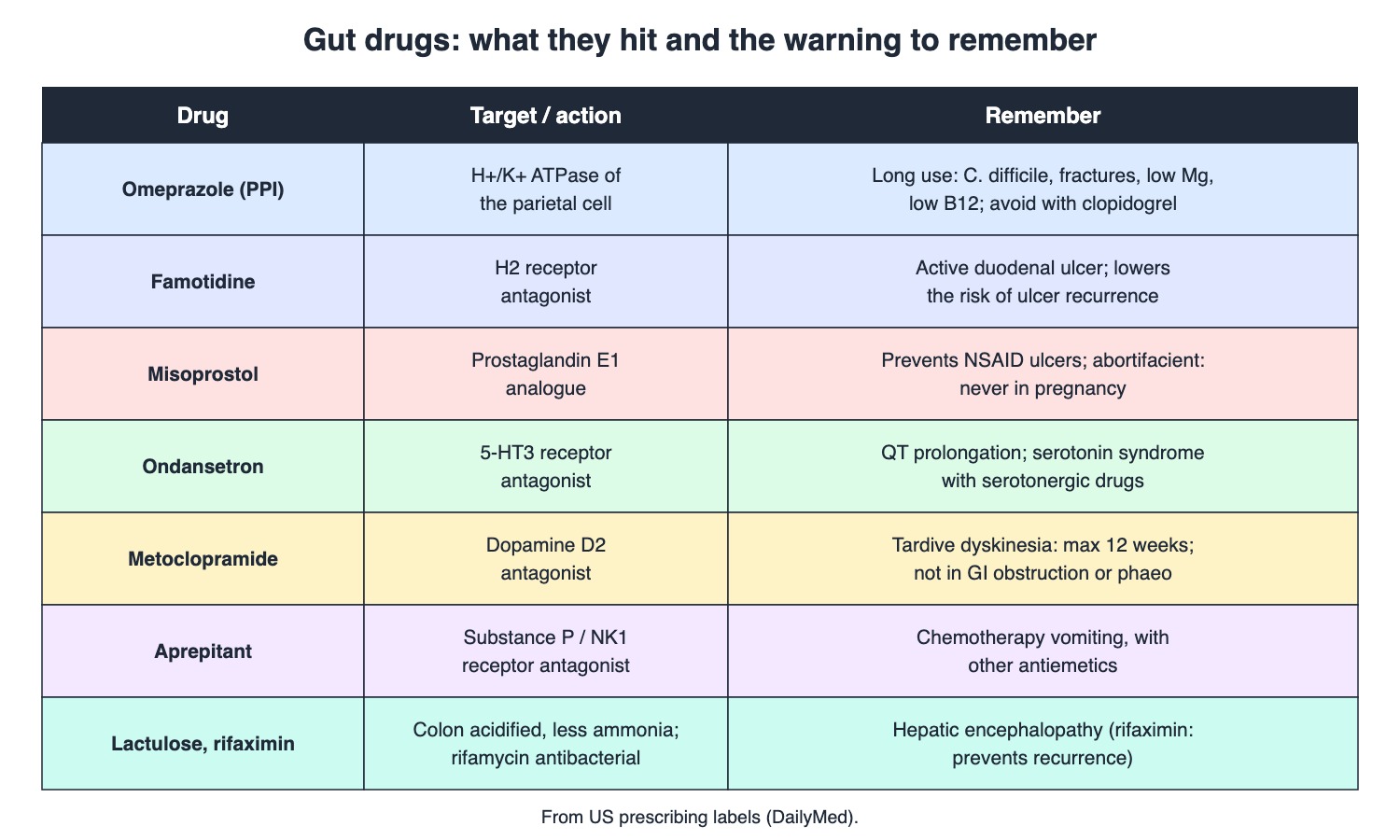
GI drugs: target and the key warning for each, from the drugs' prescribing labels. Drawn by TrackNation.
Acid and Ulcers
PPIs (omeprazole, pantoprazole) block the H+/K+ ATPase of the parietal cell; acid secretion returns over 3–5 days after stopping. Long-term risks: C. difficile diarrhoea (especially in hospital), osteoporotic fractures, low magnesium (after ≥ 3 months), low B12 (after years). Avoid omeprazole with clopidogrel.
H. pylori triple therapy (label): omeprazole 20 mg + amoxicillin 1 g + clarithromycin 500 mg, each twice daily for 10 days.
Famotidine: H2 blocker. Misoprostol: prostaglandin E1 analogue that prevents NSAID ulcers but causes abortion and birth defects — never in pregnancy.
Upper GI Bleed (ICMR)
Step (ICMR acute GI bleed, 2020) | Drug and dose |
All patients (until a variceal bleed is proven) | IV pantoprazole or esomeprazole 80 mg stat, then 40 mg 12-hourly |
Suspected variceal bleed | Terlipressin 2 mg IV, then 1 mg 6-hourly × 3–5 days (avoid in heart or peripheral vascular disease), or somatostatin 250 µg then 250 µg/h, or octreotide 50 µg then 50 µg/h |
Antibiotic prophylaxis (variceal) | Ceftriaxone 1 g IV 12-hourly × 3–5 days (or cefotaxime) |
Transfusion | Packed cells if Hb < 7 g/dL (< 9 with heart disease) |
Endoscopy | Within 24 hours of stabilisation; ulcer: adrenaline 1:10,000 injection ± clips or thermal; varices: band ligation |
After ulcer bleed | PPI infusion 72 h; then pantoprazole/omeprazole 40 mg twice daily for 4 weeks; test for H. pylori |
After variceal bleed | Propranolol 20 mg 12-hourly, increased to a heart rate of 60/min; repeat band ligation |
Nausea, Bowels and the Liver
Ondansetron (5-HT3 antagonist): dose-dependent QT prolongation; serotonin syndrome with serotonergic drugs.
Metoclopramide (D2 antagonist): boxed tardive dyskinesia — avoid more than 12 weeks; raises prolactin; not in GI bleeding, obstruction or perforation, or phaeochromocytoma.
Aprepitant (NK1 antagonist): chemotherapy vomiting, with other antiemetics.
Constipation (ICMR): fewer than three proper stools a week; laxatives include sodium picosulfate, bisacodyl, polyethylene glycol, lactulose and senna. Red flags include delayed passage of meconium (> 48 hours); if a rectal biopsy shows absent ganglion cells, the treatment is surgical (pull-through).
Loperamide: boxed warning — torsades and sudden death at higher-than-recommended doses (misuse).
Hepatic encephalopathy: lactulose is broken down by colonic bacteria, acidifying the colon and lowering blood ammonia; rifaximin (a rifamycin) reduces recurrence.
Inflammatory Bowel Disease
Sulfasalazine splits into 5-ASA and sulfapyridine; it can cause oligospermia and infertility in men (reversible on stopping).
Mesalamine (5-ASA): check kidney function at the start and during treatment.
Infliximab (anti-TNF): boxed serious infections (test for latent TB first) and malignancy, including fatal hepatosplenic T-cell lymphoma, mostly with azathioprine or 6-mercaptopurine.
Traps the Examiner Sets
Give a PPI to every upper GI bleed until varices are confirmed; add terlipressin/octreotide and ceftriaxone if variceal.
Endoscopy within 24 hours of stabilisation.
Metoclopramide: no more than 12 weeks (tardive dyskinesia).
Misoprostol is an abortifacient.
Screen for latent TB before infliximab.
Memory Hooks & Shortcuts
Shortcuts to lock in this article's numbers and lists. Each one only re-packages facts proven above.
🧠 Bleed? PPI first, Pressor for varices, Prophylactic ceftriaxone — the ICMR upper GI bleed triad
🧠 PPI's long road: C-D-M-B — C. difficile, Density loss (fractures), Magnesium, B12
🧠 Metoclopramide: Twelve weeks, Then Trouble (TD) — tardive dyskinesia beyond 12 weeks
🧠 Miso Must not Mothers — misoprostol is contraindicated in pregnancy
🧠 Infliximab: Investigate Infection (TB) first — latent TB test before anti-TNF
🧠 Sulfa-Salazine Slows Sperm — oligospermia
🧠 No ganglia, go Pull-through — absent ganglion cells on rectal biopsy → surgery
Rapid-Revision Cards
UGI bleed: all patients (ICMR)
IV pantoprazole 80 mg, then 40 mg 12-hourly.
Variceal bleed (ICMR)
Terlipressin 2 mg then 1 mg 6-hourly (or somatostatin/octreotide) 3–5 d + ceftriaxone.
Terlipressin don't
Heart or peripheral vascular disease.
Endoscopy timing
Within 24 h of stabilisation.
Transfuse in GI bleed
Hb < 7 (< 9 with heart disease).
After ulcer bleed
PPI infusion 72 h, then 40 mg BD 4 weeks; test H. pylori.
After variceal bleed
Propranolol 20 mg BD to HR 60; repeat banding.
PPI action
H+/K+ ATPase; recovery 3–5 days.
PPI long-term
C. difficile, fractures, low Mg, low B12.
PPI + clopidogrel
Avoid omeprazole.
H. pylori triple
Omeprazole 20 + amoxicillin 1 g + clarithromycin 500, BD × 10 d.
Misoprostol
PGE1 analogue; NSAID ulcers; abortifacient.
Ondansetron
5-HT3; QT; serotonin syndrome.
Metoclopramide
D2; tardive dyskinesia > 12 wk; prolactin ↑.
Metoclopramide don't
GI obstruction/bleed/perforation, phaeo.
Aprepitant
NK1 (substance P) blocker; CINV.
Loperamide
Boxed torsades at high doses.
Lactulose
Colon acidified, ammonia ↓.
Rifaximin
Prevents overt HE recurrence.
Sulfasalazine
5-ASA + sulfapyridine; oligospermia.
Infliximab
Anti-TNF; TB test; HSTCL.
ICMR laxatives
Picosulfate, bisacodyl, PEG, lactulose, senna.
Sources
Facts in this article were checked against these documents.
Standard Treatment Workflows: Acute Gastrointestinal Bleed in Adults, Parts A and B — Indian Council of Medical Research / Department of Health Research, MoHFW, July 2020
Standard Treatment Workflow: Constipation — Indian Council of Medical Research / Department of Health Research, MoHFW, July 2022
Prescribing labels: omeprazole, famotidine, Cytotec, ondansetron injection, Reglan, Emend, loperamide, Enulose, Xifaxan, Lialda, Azulfidine EN, Remicade, Sandostatin, Terlivaz — DailyMed, US National Library of Medicine, current labels, accessed November 2026 (link)
Competency Based Undergraduate Curriculum, Pharmacology (PH 6.1–6.5) — National Medical Commission, 2024
Test Yourself: Practice Questions
Twenty-four questions in NEET PG style, most of them clinical vignettes.
Practice Questions (NEET PG pattern)
Original questions written in the style of the exam: +4 for a correct answer, −1 for a wrong one. Every answer was checked against the sources listed above. NEET PG papers are not published by NBEMS, so these are not past-paper questions.
Q1. A 50-year-old with melena, pulse 110 and BP 88/60 arrives at a district hospital. Per ICMR, besides resuscitation, every such patient gets
(a) oral famotidine
(b) IV vitamin K
(c) IV metoclopramide
(d) IV pantoprazole 80 mg, then 40 mg 12-hourly
Show answer
Answer: (d) — All patients: IV PPI until a variceal bleed is documented.
Q2. A man with alcoholic cirrhosis, ascites and large-volume haematemesis is suspected to have a variceal bleed. ICMR adds
(a) terlipressin (or somatostatin/octreotide) plus IV ceftriaxone
(b) aspirin
(c) oral metoclopramide
(d) IV heparin
Show answer
Answer: (a) — Vasoconstrictor for 3–5 days plus ceftriaxone 1 g 12-hourly for 3–5 days.
Q3. Terlipressin should be avoided in a variceal bleed patient who has
(a) cirrhosis
(b) ascites
(c) jaundice
(d) coronary or peripheral vascular disease
Show answer
Answer: (d) — ICMR: avoid in suspected heart disease or peripheral vascular disease; watch for ischaemia.
Q4. After stabilisation, ICMR says every acute GI bleed patient should have
(a) a CT scan only
(b) endoscopy after 2 weeks
(c) endoscopy within 24 hours
(d) barium meal
Show answer
Answer: (c) — Earlier if there is active ongoing bleeding.
Q5. After band ligation for varices, the patient is discharged on
(a) omeprazole alone for life
(b) nifedipine
(c) propranolol 20 mg 12-hourly, increased to a heart rate of 60/min
(d) aspirin
Show answer
Answer: (c) — ICMR GI bleed Part B.
Q6. An elderly woman on omeprazole for 4 years has low magnesium and anaemia with low B12. The label explains
(a) omeprazole causes hypercalcaemia
(b) this is unrelated
(c) omeprazole causes iron overload
(d) long-term PPIs can cause hypomagnesaemia and B12 deficiency
Show answer
Answer: (d) — Hypomagnesaemia after ≥ 3 months; B12 deficiency with daily use over about 3 years.
Q7. A hospitalised patient on IV pantoprazole develops profuse watery diarrhoea. A PPI-linked cause to consider is
(a) lactose intolerance
(b) Clostridioides difficile infection
(c) hyperthyroidism
(d) laxative abuse
Show answer
Answer: (b) — PPIs may raise the risk of C. difficile diarrhoea, especially in hospital.
Q8. PPIs reduce acid by inhibiting
(a) the H+/K+ ATPase of the parietal cell
(b) gastrin release
(c) muscarinic M3 receptors
(d) H2 receptors
Show answer
Answer: (a) — Acid secretion returns gradually over 3–5 days after stopping.
Q9. A man with a duodenal ulcer tests positive for H. pylori. The omeprazole label's triple therapy is
(a) metronidazole alone for 3 days
(b) famotidine + sucralfate
(c) omeprazole alone for 8 weeks
(d) omeprazole 20 mg + amoxicillin 1 g + clarithromycin 500 mg, twice daily for 10 days
Show answer
Answer: (d) — Label regimen (2.1).
Q10. A woman with arthritis on NSAIDs is offered misoprostol. She must be told it
(a) can cause abortion and birth defects, so it is not for pregnancy
(b) is an H2 blocker
(c) causes constipation only
(d) raises gastric acid
Show answer
Answer: (a) — Prostaglandin E1 analogue; boxed warning in pregnancy.
Q11. A patient on cisplatin is given high-dose IV ondansetron and an SSRI. Two risks to watch are
(a) hypoglycaemia and hyperkalaemia
(b) ototoxicity and nephrotoxicity
(c) QT prolongation and serotonin syndrome
(d) tardive dyskinesia and gynaecomastia
Show answer
Answer: (c) — Ondansetron label.
Q12. A diabetic woman on metoclopramide for gastroparesis for 8 months develops involuntary movements of the face and tongue. This is
(a) a seizure from hyponatraemia
(b) tardive dyskinesia (avoid > 12 weeks)
(c) a hypoglycaemic attack
(d) serotonin syndrome
Show answer
Answer: (b) — Boxed warning; potentially irreversible.
Q13. Metoclopramide is contraindicated in a patient with
(a) diabetic gastroparesis
(b) GERD
(c) phaeochromocytoma or GI obstruction
(d) nausea after surgery
Show answer
Answer: (c) — Also GI haemorrhage or perforation; it may cause a hypertensive crisis in phaeochromocytoma.
Q14. A man on metoclopramide develops galactorrhoea and impotence. The reason is
(a) anticholinergic effect
(b) H2 blockade
(c) D2 blockade raising prolactin
(d) 5-HT3 blockade
Show answer
Answer: (c) — As with other D2 antagonists, metoclopramide raises prolactin.
Q15. For highly emetogenic chemotherapy, a drug that blocks substance P is
(a) metoclopramide
(b) domperidone
(c) ondansetron
(d) aprepitant
Show answer
Answer: (d) — NK1 antagonist, used with other antiemetics.
Q16. A young man misusing very high doses of loperamide collapses. The label's boxed warning is
(a) aplastic anaemia
(b) torsades de pointes and sudden death
(c) hepatic failure
(d) pancreatitis
Show answer
Answer: (b) — Seen with higher-than-recommended doses.
Q17. In a cirrhotic with hepatic encephalopathy, lactulose works by
(a) killing all gut bacteria
(b) bacterial breakdown acidifying the colon and lowering blood ammonia
(c) blocking dopamine
(d) stimulating the liver
Show answer
Answer: (b) — Enulose label.
Q18. To reduce recurrence of overt hepatic encephalopathy, the label-approved antibiotic is
(a) vancomycin
(b) metronidazole
(c) ciprofloxacin
(d) rifaximin
Show answer
Answer: (d) — Xifaxan, a rifamycin.
Q19. A 4-year-old has had constipation since birth with delayed passage of meconium; rectal biopsy shows absent ganglion cells. Per ICMR, definitive treatment is
(a) thyroxine
(b) lifelong laxatives alone
(c) dietary fibre only
(d) pull-through surgery
Show answer
Answer: (d) — ICMR constipation workflow: absent ganglion cells → definitive pull-through surgery (Duhamel, Boley or Swenson).
Q20. A 25-year-old man with ulcerative colitis on sulfasalazine and his wife cannot conceive. A drug cause is
(a) infliximab
(b) mesalamine-induced azoospermia
(c) no drug cause
(d) sulfasalazine-induced oligospermia (reversible)
Show answer
Answer: (d) — Sulfasalazine label.
Q21. Before starting infliximab for Crohn's disease, the patient must be
(a) given a live vaccine
(b) started on warfarin
(c) tested for latent tuberculosis
(d) given a PPI
Show answer
Answer: (c) — Boxed: serious infections (TB reactivation) and malignancy.
Q22. A young man with Crohn's disease on infliximab plus azathioprine develops a fatal lymphoma. The label names
(a) Hodgkin lymphoma only
(b) MALT lymphoma
(c) Burkitt lymphoma
(d) hepatosplenic T-cell lymphoma
Show answer
Answer: (d) — Almost all such cases had received azathioprine or 6-mercaptopurine.
Q23. Sulfasalazine is split in the colon into
(a) 5-aminosalicylic acid and sulfapyridine
(b) mesalamine and prednisolone
(c) olsalazine
(d) aspirin and sulfa
Show answer
Answer: (a) — Azulfidine label.
Q24. A patient on clopidogrel after a stent needs acid suppression. The omeprazole label advises
(a) no interaction
(b) avoiding omeprazole with clopidogrel
(c) stopping clopidogrel
(d) doubling omeprazole
Show answer
Answer: (b) — Omeprazole inhibits CYP2C19, needed to activate clopidogrel.
Active Recall
From memory: give the ICMR drug protocol for acute upper GI bleeding (ulcer and variceal), the mechanism and long-term risks of PPIs, the H. pylori triple regimen, the key warnings for ondansetron, metoclopramide, misoprostol and loperamide, how lactulose and rifaximin help hepatic encephalopathy, and the warnings for sulfasalazine and infliximab.