Heart Failure and Valvular Heart Disease for NEET PG Medicine: HFrEF vs HFpEF, NYHA, Treatment, Murmurs of MS, MR, AS, AR
Start Here
🎯 Exam priority: High. Expect: HFrEF vs HFpEF cut-offs, NYHA class from a history, Kerley B lines, the drugs that reduce mortality in HFrEF, which inotrope does not raise mortality, pulmonary oedema treatment, and murmur-to-lesion matching with eponymous signs.
CBME mapping: GM 1.1–1.27. Pathology of rheumatic fever and endocarditis is in Pathology article 20; drug details in Pharmacology.
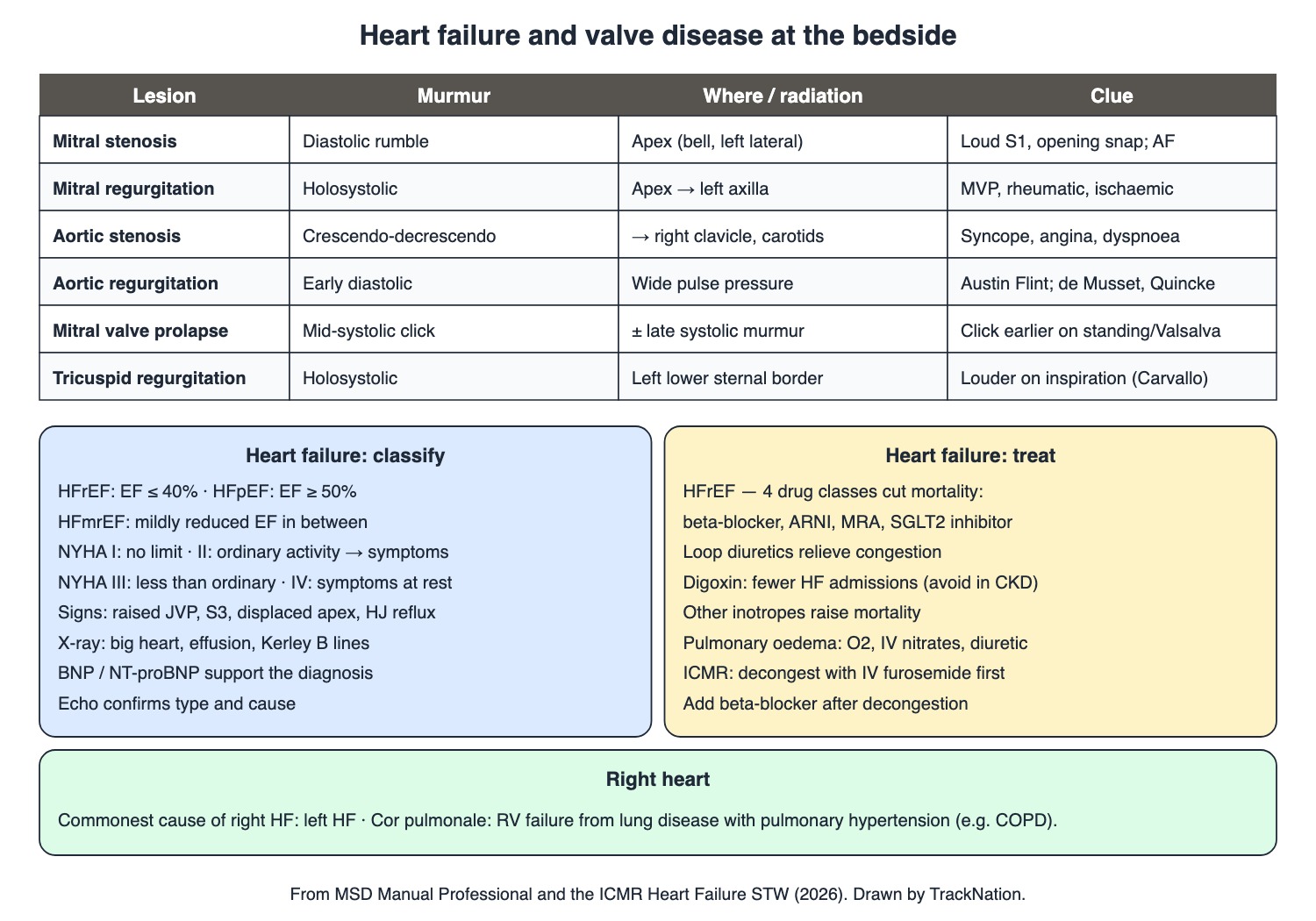
Valve murmurs and heart failure classification and treatment. Drawn by TrackNation.
Heart Failure: Recognise and Classify
By ejection fraction: HFrEF (EF ≤ 40%), HFmrEF (mildly reduced), HFpEF (EF ≥ 50%). Heart failure can occur with a normal EF.
Signs: raised JVP, S3 (or summation gallop), displaced apex from cardiomegaly, hepatojugular reflux; basal crackles and pitting oedema. Severe pulmonary oedema: breathlessness, sweating, wheeze ("cardiac asthma") and sometimes blood-tinged frothy sputum.
Tests: chest X-ray (cardiomegaly, effusion, fluid in the fissure, Kerley B lines), BNP or NT-proBNP, ECG, and echocardiography to confirm type and cause.
Causes in the ICMR workflow: ischaemic cardiomyopathy, diabetic/hypertensive heart disease, rheumatic valve disease, post-viral, peripartum (last trimester or after delivery), idiopathic, post-chemotherapy. Iron deficiency is a common cause of anaemia in HF.
NYHA class | Definition |
I | Ordinary physical activity causes no undue fatigue, breathlessness or palpitations |
II | Comfortable at rest; ordinary activity causes symptoms |
III | Comfortable at rest; less than ordinary activity causes symptoms |
IV | Symptoms at rest; any activity increases discomfort |
Heart Failure: Treatment
Chronic HFrEF: four foundational classes, all shown to reduce mortality — beta-blocker, ARNI, mineralocorticoid receptor antagonist and SGLT2 inhibitor — titrated to the highest tolerated doses. Eplerenone avoids the gynaecomastia of spironolactone.
Loop diuretics control volume overload and symptoms. Digoxin reduces HF admissions in HFrEF but is contraindicated in moderate–severe CKD; among positive inotropes, all except digoxin increase mortality.
Acute HF / pulmonary oedema: decongest with loop diuretics; oxygen, IV nitrates; morphine is now used less (except palliation); inotropes or ventilation if needed.
ICMR STW (2026): decongest with IV furosemide, oxygen if saturation < 90%, start ARNI and spironolactone, beta-blocker after decongestion, SGLT2 inhibitor; pneumococcal and influenza vaccines.
Right heart: the commonest cause of right HF is left HF. Cor pulmonale = RV enlargement and failure from a lung disorder causing pulmonary hypertension (for example COPD).
Valvular Heart Disease
Mitral stenosis: usually rheumatic; complications are pulmonary hypertension, atrial fibrillation and thromboembolism (stroke may be the first sign); haemoptysis and pulmonary oedema, especially in pregnancy.
Mitral regurgitation: primary (MVP, rheumatic) or secondary (LV dilation, infarction). Acute MR: papillary muscle dysfunction/rupture, chordal rupture in endocarditis.
Aortic stenosis: bicuspid valve, degenerative calcification or rheumatic; classic triad syncope, angina, exertional dyspnoea; slow-rising small pulse.
Aortic regurgitation: valve disease or aortic root dilation (bicuspid valve, dissection, rheumatic, endocarditis); wide pulse pressure and peripheral signs.
Tricuspid regurgitation: usually from RV dilation; louder on inspiration (Carvallo sign).
Lesion | Key auscultation | Other clues |
Mitral stenosis | Loud S1, opening snap, low-pitched diastolic rumble at the apex (bell) | Rheumatic; AF, emboli, haemoptysis, worse in pregnancy |
Mitral regurgitation | Holosystolic apical murmur radiating to the left axilla | MVP, rheumatic; acute: papillary muscle or chordal rupture |
Mitral valve prolapse | Mid-systolic click ± late systolic murmur | Click earlier with standing or Valsalva; myxomatous |
Aortic stenosis | Crescendo-decrescendo ejection murmur to right clavicle and carotids | Syncope, angina, dyspnoea; pulsus parvus et tardus |
Aortic regurgitation | Early diastolic murmur; Austin Flint rumble at apex | Wide pulse pressure; de Musset, Quincke signs |
Tricuspid regurgitation | Holosystolic at left lower sternal border, louder on inspiration | Large c-v wave, pulsatile liver; usually RV dilation |
Traps the Examiner Sets
HFrEF ≤ 40%, HFpEF ≥ 50% — the 41–49% band is "mildly reduced".
Diuretics relieve symptoms; the four pillars reduce death.
Only digoxin among inotropes does not raise mortality.
Right-sided murmurs get louder on inspiration (Carvallo in TR).
ICMR: beta-blocker only after decongestion.
Memory Hooks & Shortcuts
Shortcuts to lock in this article's numbers and lists. Each one only re-packages facts proven above.
🧠 40-50: Reduced at 40 or below, Preserved at 50 or above — EF cut-offs
🧠 BAMS for survival: Beta-blocker, ARNI, MRA, SGLT2i — HFrEF pillars
🧠 Aortic stenosis = SAD (Syncope, Angina, Dyspnoea) — AS triad
🧠 Right-sided murmurs Rise with Respiration in (Carvallo) — TR
🧠 Digoxin: the only inotrope that doesn't Doom you — inotropes
🧠 MS = 'Snap, rumble, flutter' (opening snap, rumble, AF) — mitral stenosis
Rapid-Revision Cards
HFrEF / HFpEF
EF ≤ 40% / EF ≥ 50%; mildly reduced in between.
NYHA II
Ordinary activity → symptoms.
NYHA III
Less than ordinary activity → symptoms.
NYHA IV
Symptoms at rest.
HF-specific signs
Raised JVP, S3, displaced apex, HJ reflux.
Kerley B lines
Peripheral horizontal lines; raised LA pressure.
HF biomarker
BNP / NT-proBNP.
HFrEF 4 pillars
Beta-blocker, ARNI, MRA, SGLT2 inhibitor.
Loop diuretic role
Congestion control, not mortality.
Digoxin
Fewer HF admissions; avoid in CKD; only safe inotrope.
Eplerenone
MRA without gynaecomastia.
Pulmonary oedema Rx
O2, IV nitrates, diuretics.
ICMR HF beta-blocker
Only after decongestion.
Right HF commonest cause
Left HF.
Cor pulmonale
RV failure from lung disease + pulmonary HTN.
Mitral stenosis
Loud S1, opening snap, apical diastolic rumble; AF.
Mitral regurgitation
Holosystolic apex → axilla.
MVP
Mid-systolic click; earlier on standing/Valsalva.
Aortic stenosis
Syncope, angina, dyspnoea; ejection murmur → carotids.
Pulsus parvus et tardus
Aortic stenosis.
Aortic regurgitation
Wide pulse pressure; early diastolic murmur.
Austin Flint
Apical diastolic rumble in AR.
Quincke / de Musset
Nail-bed pulsation / head bobbing (AR).
Carvallo sign
TR murmur louder on inspiration.
Sources
Facts in this article were checked against these documents.
MSD Manual Professional: Overview of Heart Failure; Heart Failure; Chronic Heart Failure; Acute Heart Failure; Medications for Heart Failure; Pulmonary Edema; Cor Pulmonale — Merck & Co. (MSD Manuals), reviewed 2025–26 (link)
MSD Manual Professional: Mitral Stenosis; Mitral Regurgitation; Mitral Valve Prolapse; Aortic Stenosis; Aortic Regurgitation; Tricuspid Regurgitation — Merck & Co. (MSD Manuals), reviewed 2024–26 (link)
Standard Treatment Workflow: Heart Failure — A Breathless Patient — ICMR / Department of Health Research, MoHFW, January 2026
Competency Based Undergraduate Curriculum, General Medicine (GM 1) — National Medical Commission, 2024
Test Yourself: Practice Questions
Thirty questions in NEET PG style, most of them clinical vignettes.
Practice Questions (NEET PG pattern)
Original questions written in the style of the exam: +4 for a correct answer, −1 for a wrong one. Every answer was checked against the sources listed above. NEET PG papers are not published by NBEMS, so these are not past-paper questions.
Q1. Echocardiography in a breathless patient shows an ejection fraction of 35%. The heart failure is classified as
(a) HFpEF
(b) HFrEF (EF ≤ 40%)
(c) HFmrEF
(d) normal systolic function
Show answer
Answer: (b) — HFpEF is EF ≥ 50%; mildly reduced lies between.
Q2. A patient with heart failure is comfortable at rest but gets breathless with less than ordinary activity such as dressing. The NYHA class is
(a) III
(b) IV
(c) II
(d) I
Show answer
Answer: (a) — Class IV has symptoms at rest.
Q3. Chest X-ray of a patient with chronic raised left atrial pressure shows short horizontal lines at the periphery of the lower lung fields. These are
(a) honeycombing
(b) Hampton hump
(c) Kerley B lines
(d) air bronchograms
Show answer
Answer: (c) — From thickened interlobular septa.
Q4. Which bedside finding is specific to heart failure?
(a) a third heart sound (S3)
(b) wide fixed splitting of S2
(c) an ejection click
(d) a pericardial knock always
Show answer
Answer: (a) — Also raised JVP, displaced apex, hepatojugular reflux.
Q5. A blood test that supports a diagnosis of heart failure in a breathless patient is
(a) BNP or NT-proBNP
(b) procalcitonin
(c) troponin alone
(d) D-dimer
Show answer
Answer: (a) — Echocardiography confirms.
Q6. In chronic HFrEF, which group of drugs has each been shown to reduce mortality?
(a) CCB, alpha-blocker, statin, aspirin
(b) dobutamine, milrinone, dopamine, digoxin
(c) loop diuretic, digoxin, nitrate, thiazide
(d) beta-blocker, ARNI, MRA, SGLT2 inhibitor
Show answer
Answer: (d) — The four foundational classes.
Q7. Loop diuretics in heart failure mainly
(a) reverse remodelling
(b) increase contractility
(c) reduce mortality on their own
(d) control volume overload and congestion
Show answer
Answer: (d) — Mortality benefit comes from the four pillars.
Q8. Among positive inotropes used in heart failure, the one that does not increase mortality is
(a) dopamine
(b) dobutamine
(c) digoxin
(d) milrinone
Show answer
Answer: (c) — Digoxin reduces HF admissions in HFrEF.
Q9. Digoxin should be avoided in a heart failure patient with
(a) atrial fibrillation
(b) moderate to severe chronic kidney disease
(c) HFrEF
(d) hypertension
Show answer
Answer: (b) — Risk of toxicity.
Q10. A man on spironolactone for HFrEF develops painful breast enlargement. A substitute MRA without this effect is
(a) furosemide
(b) eplerenone
(c) digoxin
(d) hydrochlorothiazide
Show answer
Answer: (b) — Eplerenone does not cause gynaecomastia.
Q11. A patient presents with severe breathlessness, sweating, wheeze and blood-tinged frothy sputum. Initial treatment includes
(a) salbutamol alone
(b) beta-blocker infusion
(c) IV fluids bolus
(d) oxygen, IV nitrates and diuretics
Show answer
Answer: (d) — Acute pulmonary oedema from LV failure.
Q12. Per the ICMR heart failure workflow, beta-blockers in an acutely congested patient should be
(a) never used
(b) considered after decongestion
(c) replaced by digoxin
(d) given as IV bolus first
Show answer
Answer: (b) — Decongest first with IV furosemide.
Q13. A woman develops heart failure in the last trimester of pregnancy without prior heart disease. The ICMR workflow lists this as
(a) pericarditis
(b) rheumatic mitral stenosis
(c) hypertrophic cardiomyopathy
(d) peripartum cardiomyopathy
Show answer
Answer: (d) — Onset in the last trimester or after delivery.
Q14. The commonest cause of right heart failure is
(a) pulmonary embolism
(b) COPD
(c) left heart failure
(d) tricuspid stenosis
Show answer
Answer: (c) — Cor pulmonale is RV failure from lung disease.
Q15. A long-standing COPD patient develops raised JVP, hepatomegaly and pedal oedema. The likely diagnosis is
(a) constrictive pericarditis
(b) mitral stenosis
(c) HFrEF
(d) cor pulmonale
Show answer
Answer: (d) — RV failure secondary to lung disease with pulmonary hypertension.
Q16. A young woman with a history of rheumatic fever has a loud S1, an opening snap and a low-pitched diastolic rumble at the apex. The lesion is
(a) mitral stenosis
(b) aortic stenosis
(c) aortic regurgitation
(d) mitral valve prolapse
Show answer
Answer: (a) — Heard best with the bell at the apex.
Q17. A patient with mitral stenosis suddenly develops a stroke. The likely mechanism is
(a) thromboembolism, often with atrial fibrillation
(b) intracranial haemorrhage always
(c) air embolism
(d) vasculitis
Show answer
Answer: (a) — Stroke may be the first manifestation.
Q18. A pregnant woman with undiagnosed mitral stenosis is most at risk of
(a) pulmonary oedema and haemoptysis
(b) aortic dissection
(c) pericarditis
(d) complete heart block
Show answer
Answer: (a) — Blood volume rises in pregnancy.
Q19. A holosystolic apical murmur radiating to the left axilla indicates
(a) aortic stenosis
(b) mitral regurgitation
(c) VSD always
(d) tricuspid regurgitation
Show answer
Answer: (b) — Primary causes: MVP, rheumatic.
Q20. Soon after an MI, a patient develops sudden pulmonary oedema and a new loud apical holosystolic murmur. The likely cause is
(a) papillary muscle dysfunction or rupture
(b) pericarditis
(c) aortic dissection
(d) mitral stenosis
Show answer
Answer: (a) — Acute MR.
Q21. A crisp mid-systolic click followed by a late systolic murmur suggests
(a) aortic stenosis
(b) hypertrophic cardiomyopathy
(c) mitral stenosis
(d) mitral valve prolapse
Show answer
Answer: (d) — Usually idiopathic myxomatous degeneration.
Q22. In mitral valve prolapse, standing or a Valsalva manoeuvre makes the click
(a) move later toward S2
(b) move closer to S1
(c) disappear
(d) unchanged
Show answer
Answer: (b) — Smaller LV size brings prolapse earlier.
Q23. An elderly man has exertional syncope, angina and breathlessness; carotid pulses are small and slow-rising. The murmur expected is
(a) holosystolic murmur to the axilla
(b) crescendo-decrescendo ejection murmur radiating to the carotids
(c) continuous machinery murmur
(d) early diastolic decrescendo murmur
Show answer
Answer: (b) — Aortic stenosis: pulsus parvus et tardus.
Q24. The causes of aortic stenosis include all EXCEPT
(a) rheumatic fever
(b) degenerative calcification
(c) mitral valve prolapse
(d) congenital bicuspid valve
Show answer
Answer: (c) — Bicuspid, degenerative, rheumatic.
Q25. A man with aortic root dilation has a wide pulse pressure, head bobbing and an early diastolic murmur. The lesion is
(a) pulmonary stenosis
(b) mitral stenosis
(c) aortic stenosis
(d) aortic regurgitation
Show answer
Answer: (d) — de Musset sign.
Q26. In severe aortic regurgitation, a mid-to-late diastolic rumble at the apex without mitral stenosis is the
(a) Carey Coombs murmur
(b) Graham Steell murmur
(c) Gibson murmur
(d) Austin Flint murmur
Show answer
Answer: (d) — Regurgitant flow vibrates the mitral leaflet.
Q27. Visible pulsation of the fingernail capillaries in aortic regurgitation is
(a) Osler sign
(b) de Musset sign
(c) Kussmaul sign
(d) Quincke sign
Show answer
Answer: (d) — de Musset = head bobbing.
Q28. A holosystolic murmur at the left lower sternal border that becomes louder on inspiration is due to
(a) tricuspid regurgitation (Carvallo sign)
(b) aortic stenosis
(c) VSD always
(d) mitral regurgitation
Show answer
Answer: (a) — Usually from RV dilation.
Q29. Jugular venous pulse in severe tricuspid regurgitation shows
(a) cannon a waves
(b) a prominent merged c-v wave with steep y descent
(c) absent x descent only
(d) Kussmaul sign only
Show answer
Answer: (b) — Systolic hepatic pulsation may be felt.
Q30. Which vaccines does the ICMR heart failure workflow recommend?
(a) BCG and polio
(b) rabies and typhoid
(c) HPV and hepatitis A
(d) pneumococcal and influenza
Show answer
Answer: (d) — Part of tertiary-level optimisation.
Active Recall
From memory: classify heart failure by ejection fraction and NYHA class; list its specific signs and X-ray findings; name the four mortality-reducing drug classes and the role of diuretics and digoxin; outline pulmonary oedema treatment and the ICMR pathway; define cor pulmonale; and give the murmur and key signs of MS, MR, MVP, AS, AR and TR.