ECG and Arrhythmias for NEET PG Medicine: AF, Flutter, SVT, WPW, VT, Torsades, Heart Block, Bundle Branch Block, QT
Start Here
🎯 Exam priority: High. Expect: identify a rhythm strip (AF, flutter, Mobitz I vs II, complete block, VT, torsades, WPW), electrolyte effects on QT and T waves, RBBB vs LBBB, adenosine for SVT, what not to give in AF with WPW, and magnesium for torsades.
CBME mapping: ECG competencies within GM 1–2. Infarct ECGs are in article 2; antiarrhythmic drug pharmacology in Pharmacology.
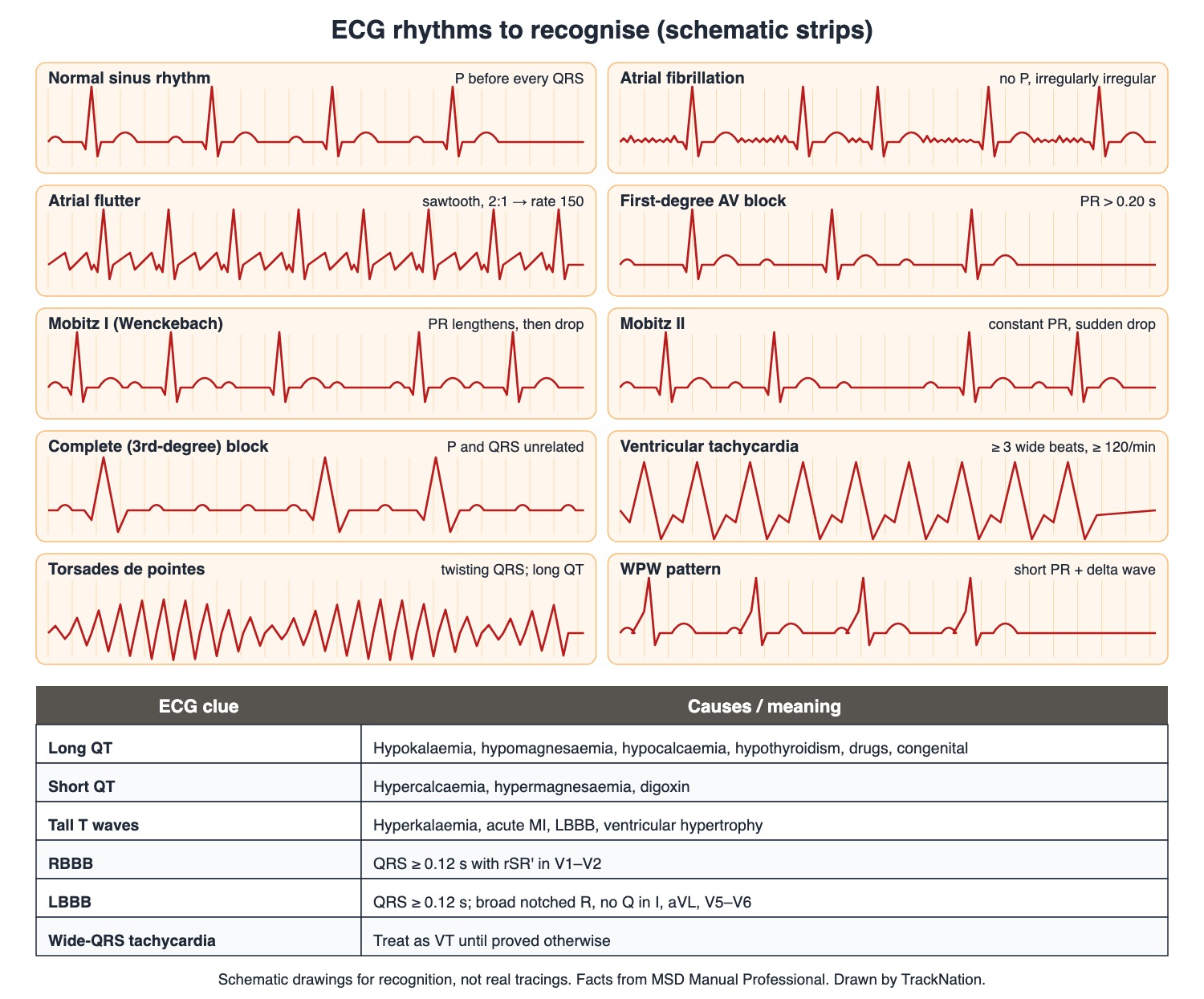
Schematic rhythm strips and ECG clues. Drawn by TrackNation — teaching schematics, not real tracings.
Reading the ECG
QTc is normally 350–450 ms in men and 360–460 ms in women. Long QT: hypokalaemia, hypomagnesaemia, hypocalcaemia, hypothyroidism, MI, myocarditis, intracranial bleeds, drugs, congenital — and it predisposes to torsades. Short QT: hypercalcaemia, hypermagnesaemia, Graves disease, digoxin.
Tall T waves: hyperkalaemia, acute MI, LBBB, stroke, ventricular hypertrophy. Absent P waves: AF, sinus arrest, severe hyperkalaemia.
RBBB: QRS ≥ 0.12 s with rsR′/rSR′ in V1–V2. LBBB: QRS ≥ 0.12 s, broad notched or slurred R and no Q waves in I, aVL, V5–V6.
Tachyarrhythmias
Atrial fibrillation: rapid, irregularly irregular, no P waves, fibrillatory waves. Atrial thrombi → embolic stroke; risk higher with age, moderate–severe mitral stenosis, mechanical valve, hyperthyroidism, hypertension, diabetes, LV dysfunction, prior embolism. Treatment: rate control, anticoagulation, sometimes rhythm conversion. Amiodarone if beta-blockers, non-DHP CCBs and digoxin fail.
Atrial flutter: sawtooth waves in II, III, aVF; atria ~300/min with 2:1 block → regular ventricular rate 150.
Reentrant SVT: starts and stops suddenly; AVNRT is the commonest. Vagal manoeuvres first, then IV adenosine or a non-dihydropyridine CCB. WPW: short PR and delta wave (pre-excitation) with paroxysmal tachycardia; AVRT is the usual tachycardia in WPW.
AF with WPW: digoxin, adenosine, verapamil and diltiazem are dangerous; cardiovert, or use IV procainamide or ibutilide.
Ventricular tachycardia: ≥ 3 consecutive ventricular beats at ≥ 120/min; sustained if ≥ 30 s. Any wide-QRS tachycardia is VT until proved otherwise. Cardioversion or antiarrhythmics; ICD long term.
Torsades de pointes: polymorphic VT twisting around the baseline on a long QT; risks include female sex, age, hypokalaemia, hypomagnesaemia, slow heart rate. Give IV magnesium. VF: immediate syncope; CPR with immediate defibrillation.
Rhythm | ECG | First treatment |
AF | No P, irregular f waves, irregularly irregular | Rate control (beta-blocker, non-DHP CCB, digoxin) + anticoagulation |
Atrial flutter | Sawtooth in II, III, aVF; atria ~300, 2:1 → 150 | Rate control, cardioversion |
Reentrant SVT | Regular narrow QRS; sudden start and stop | Vagal manoeuvres → IV adenosine or non-DHP CCB |
AF with WPW | Fast, irregular, wide/varied QRS | Cardioversion or IV procainamide/ibutilide; avoid digoxin, adenosine, verapamil, diltiazem |
VT | ≥ 3 wide beats ≥ 120/min | Cardioversion or antiarrhythmics; ICD long term |
Torsades | Twisting QRS on long QT | IV magnesium; defibrillate if VF |
VF | Chaotic, no output | CPR with immediate defibrillation |
Bradyarrhythmias and Blocks
Complete heart block shows AV dissociation: cannon a waves, fluctuating BP, variable S1. In adults 18–60 with new Mobitz II or complete block and no obvious heart disease, up to a third have cardiac sarcoidosis.
ICMR bradyarrhythmia workflow: look for reversible causes — beta-blockers, calcium channel blockers, digoxin, electrolytes, thyroid; permanent pacing for complete heart block and advanced AV block, and for symptomatic sinus node dysfunction.
Antiarrhythmics are grouped into four Vaughan Williams classes (details in Pharmacology).
AV block | ECG | Note |
First degree | Every P conducted; PR > 0.20 s | Usually benign |
Mobitz I (Wenckebach) | PR lengthens until a QRS drops; next PR shortest | Can be physiological in young athletes |
Mobitz II | Constant PR; sudden dropped QRS (e.g. 3:1, 4:1) | Infranodal; risk of progression |
Third degree (complete) | No P waves conducted; P rate > QRS rate; AV dissociation | Cannon a waves, variable S1; pacing |
Traps the Examiner Sets
Mobitz I: PR grows then drops; Mobitz II: PR fixed then drops.
Regular narrow tachycardia at exactly 150 → think flutter with 2:1 block.
AF + WPW: no AV-nodal blockers.
Hypercalcaemia shortens QT; hypocalcaemia lengthens it.
Torsades: magnesium, not amiodarone.
Memory Hooks & Shortcuts
Shortcuts to lock in this article's numbers and lists. Each one only re-packages facts proven above.
🧠 Mobitz I = 'longer, longer, longer, drop — now you've got Wenckebach' — Mobitz I
🧠 Flutter at 150 — '300 halved' — flutter
🧠 WPW + AF: no ABCD (Adenosine, Beta-blocker/CCB, Digoxin) — AF with WPW
🧠 Torsades → Mg first ('twist the magnesium cap') — torsades
🧠 Calcium high → QT short (Ca up, QT down) — QT and calcium
🧠 RBBB = Rabbit ears (rSR′) in V1 — RBBB
Rapid-Revision Cards
AF ECG
No P, f waves, irregularly irregular.
AF main risk
Embolic stroke.
AF rate control
Beta-blocker, non-DHP CCB, digoxin; then amiodarone.
Flutter
Sawtooth II, III, aVF; atria ~300; 2:1 → 150.
Commonest PSVT
AVNRT.
SVT treatment
Vagal → IV adenosine / non-DHP CCB.
WPW
Short PR + delta wave; AVRT.
AF + WPW avoid
Digoxin, adenosine, verapamil, diltiazem.
AF + WPW give
Cardioversion or IV procainamide/ibutilide.
VT definition
≥ 3 beats ≥ 120/min; sustained ≥ 30 s.
Wide-QRS tachycardia
VT until proved otherwise.
VF
CPR + immediate defibrillation.
Torsades
Twisting QRS, long QT; IV magnesium.
Long QT causes
Low K, Mg, Ca; hypothyroid; drugs; congenital.
Short QT causes
High Ca, high Mg, digoxin.
Tall T waves
Hyperkalaemia, acute MI, LBBB.
RBBB
rSR′ in V1–V2; QRS ≥ 0.12.
LBBB
Broad notched R, no Q in I, aVL, V5–V6.
1st-degree block
PR > 0.20 s.
Mobitz I
PR lengthens → drop.
Mobitz II
Fixed PR → drop.
Complete block
AV dissociation; cannon a waves.
New CHB age 18–60
Think cardiac sarcoidosis.
Sources
Facts in this article were checked against these documents.
MSD Manual Professional: Electrocardiography; Overview of Arrhythmias; Atrial Fibrillation; Atrial Fibrillation and WPW; Atrial Flutter; Reentrant PSVT; Ventricular Tachycardia; Ventricular Fibrillation; Long QT and Torsades; AV Block; Bundle Branch Block; Medications for Arrhythmias — Merck & Co. (MSD Manuals), reviewed 2024–26 (link)
Standard Treatment Workflow: Bradyarrhythmias in Symptomatic Patients — ICMR / Department of Health Research, MoHFW, 2022–26
Competency Based Undergraduate Curriculum, General Medicine (GM 1–2) — National Medical Commission, 2024
Test Yourself: Practice Questions
Thirty questions in NEET PG style, most of them clinical vignettes and ECG descriptions.
Practice Questions (NEET PG pattern)
Original questions written in the style of the exam: +4 for a correct answer, −1 for a wrong one. Every answer was checked against the sources listed above. NEET PG papers are not published by NBEMS, so these are not past-paper questions.
Q1. A 70-year-old has palpitations; ECG shows no P waves, a wavy baseline and an irregularly irregular ventricular rhythm. The main risk to prevent is
(a) embolic stroke
(b) complete heart block
(c) pericarditis
(d) torsades de pointes
Show answer
Answer: (a) — Atrial fibrillation; anticoagulate by risk.
Q2. Which condition raises stroke risk in atrial fibrillation most among these?
(a) low BMI
(b) young age
(c) moderate to severe mitral stenosis
(d) normal LV function
Show answer
Answer: (c) — Also mechanical valves, hyperthyroidism, hypertension, diabetes, LV dysfunction.
Q3. First-line drugs for long-term rate control in atrial fibrillation include
(a) beta-blockers, non-dihydropyridine CCBs or digoxin
(b) adenosine
(c) atropine
(d) lidocaine
Show answer
Answer: (a) — Amiodarone if these fail.
Q4. A regular narrow-complex tachycardia at exactly 150/min with sawtooth waves in II, III and aVF is
(a) sinus tachycardia
(b) AVNRT
(c) atrial flutter with 2:1 block
(d) VT
Show answer
Answer: (c) — Atria ~300/min; half conducted.
Q5. A young woman has palpitations that start and stop suddenly; ECG shows a regular narrow-complex tachycardia at 190/min. Vagal manoeuvres fail. Next drug is
(a) IV digoxin
(b) IV adenosine
(c) IV amiodarone
(d) oral warfarin
Show answer
Answer: (b) — Or a non-dihydropyridine CCB.
Q6. The commonest type of paroxysmal supraventricular tachycardia is
(a) junctional ectopic tachycardia
(b) AV reentrant via an accessory pathway
(c) AV nodal re-entry
(d) atrial flutter
Show answer
Answer: (c) — AVRT is the usual tachycardia in WPW.
Q7. A resting ECG shows a short PR interval and a slurred upstroke of the QRS in a patient with episodes of tachycardia. The diagnosis is
(a) hyperkalaemia
(b) Wolff-Parkinson-White syndrome
(c) LBBB
(d) first-degree AV block
Show answer
Answer: (b) — Short PR + delta wave = pre-excitation.
Q8. A patient with known WPW develops a fast irregular broad-complex tachycardia (AF with pre-excitation). Which drug must be avoided?
(a) ibutilide
(b) none — cardioversion is contraindicated
(c) procainamide
(d) verapamil
Show answer
Answer: (d) — Also avoid digoxin, adenosine, diltiazem.
Q9. In AF with WPW where cardioversion cannot be done, the preferred drug is
(a) IV digoxin
(b) IV procainamide or ibutilide
(c) IV adenosine
(d) IV diltiazem
Show answer
Answer: (b) — They prolong the accessory pathway refractory period.
Q10. Ventricular tachycardia is defined as
(a) ≥ 3 consecutive ventricular beats at ≥ 120/min
(b) a narrow-complex tachycardia
(c) any wide QRS beat
(d) ≥ 10 beats at ≥ 200/min
Show answer
Answer: (a) — Sustained if ≥ 30 seconds.
Q11. A haemodynamically stable patient has a regular wide-QRS tachycardia (QRS 0.16 s). It should be treated as
(a) atrial flutter
(b) ventricular tachycardia until proved otherwise
(c) sinus tachycardia
(d) SVT with aberrancy
Show answer
Answer: (b) — A classic safety rule.
Q12. VT lasting 20 seconds that stops by itself without collapse is classed as
(a) torsades
(b) sustained VT
(c) non-sustained VT
(d) VF
Show answer
Answer: (c) — Sustained = ≥ 30 s or collapse.
Q13. A collapsed patient has a chaotic ECG with no identifiable QRS complexes and no pulse. The key immediate treatment is
(a) synchronised cardioversion at low energy
(b) CPR with immediate defibrillation
(c) atropine
(d) IV adenosine
Show answer
Answer: (b) — Ventricular fibrillation.
Q14. A woman on a QT-prolonging drug with low potassium develops a polymorphic VT whose QRS axis twists around the baseline. First-line drug is
(a) IV magnesium
(b) IV digoxin
(c) IV procainamide
(d) IV amiodarone
Show answer
Answer: (a) — Torsades de pointes; defibrillate if VF follows.
Q15. Which electrolyte abnormality shortens the QT interval?
(a) hypocalcaemia
(b) hypokalaemia
(c) hypercalcaemia
(d) hypomagnesaemia
Show answer
Answer: (c) — Also hypermagnesaemia and digoxin.
Q16. A patient's ECG shows tall T waves without chest pain. The electrolyte cause to check first is
(a) hyperkalaemia
(b) hypercalcaemia
(c) hypokalaemia
(d) hypothermia
Show answer
Answer: (a) — Also acute MI, LBBB, ventricular hypertrophy.
Q17. Normal QTc in adult women is about
(a) 360–460 ms
(b) 200–300 ms
(c) 120–200 ms
(d) 500–600 ms
Show answer
Answer: (a) — Men 350–450 ms.
Q18. ECG shows QRS 0.14 s with an rSR′ pattern in V1. This is
(a) right bundle branch block
(b) left bundle branch block
(c) WPW
(d) hyperkalaemia
Show answer
Answer: (a) — LBBB has broad notched R in I, aVL, V5–V6.
Q19. Broad notched R waves with absent Q waves in I, aVL, V5 and V6 and QRS ≥ 0.12 s indicate
(a) right bundle branch block
(b) left bundle branch block
(c) WPW
(d) left anterior fascicular block
Show answer
Answer: (b) — RBBB shows rSR′ in V1.
Q20. Every P wave is followed by a QRS, but the PR interval is 0.28 s. This is
(a) complete heart block
(b) Mobitz II
(c) Mobitz I
(d) first-degree AV block
Show answer
Answer: (d) — PR > 0.20 s.
Q21. A rhythm strip shows the PR interval getting longer each beat until a QRS is dropped, then the cycle repeats. This is
(a) third-degree block
(b) Mobitz type I (Wenckebach)
(c) Mobitz type II
(d) sinus arrhythmia
Show answer
Answer: (b) — Can be physiological in young athletes.
Q22. Constant PR intervals with sudden dropped QRS complexes in a 3:1 pattern indicate
(a) atrial flutter
(b) Mobitz type I block
(c) first-degree block
(d) Mobitz type II block
Show answer
Answer: (d) — Infranodal and more dangerous.
Q23. A dizzy elderly man has a slow pulse, cannon a waves in the neck and varying loudness of S1. ECG would show
(a) AF
(b) complete AV dissociation (third-degree block)
(c) sinus tachycardia
(d) first-degree block
Show answer
Answer: (b) — No P waves are conducted.
Q24. A 40-year-old without known heart disease develops new complete heart block. A cause to search for, found in up to a third of such patients, is
(a) cardiac sarcoidosis
(b) hypercalcaemia
(c) WPW
(d) rheumatic fever
Show answer
Answer: (a) — Lyme carditis is a reversible cause.
Q25. Mobitz type I block in a healthy young athlete is
(a) caused by hyperkalaemia always
(b) always an indication for pacing
(c) a sign of acute MI
(d) often physiological
Show answer
Answer: (d) — Narrow QRS → usually in the AV node.
Q26. Before pacing a patient with symptomatic bradycardia, the ICMR workflow asks you to exclude
(a) drugs such as beta-blockers, calcium channel blockers or digoxin
(b) asthma
(c) migraine
(d) hypercholesterolaemia
Show answer
Answer: (a) — Also check electrolytes and thyroid.
Q27. Torsades de pointes is promoted by all EXCEPT
(a) slow heart rate
(b) hypokalaemia
(c) hypomagnesaemia
(d) hypercalcaemia
Show answer
Answer: (d) — Hypercalcaemia shortens QT.
Q28. In atrial flutter, the atrial rate is typically about
(a) 60/min
(b) 300/min
(c) 600/min
(d) 150/min
Show answer
Answer: (b) — Range 250–350.
Q29. Which drug classification groups antiarrhythmics into four main classes by cellular effect?
(a) NYHA
(b) CHA2DS2-VASc
(c) Vaughan Williams
(d) Killip
Show answer
Answer: (c) — Class I–IV.
Q30. Absent P waves can be seen in all EXCEPT
(a) first-degree AV block
(b) atrial fibrillation
(c) sinus arrest
(d) severe hyperkalaemia
Show answer
Answer: (a) — First-degree block has P waves with long PR.
Active Recall
From memory: describe the ECG of AF, flutter, SVT, WPW, VT, torsades and VF with first treatment; list what lengthens and shortens the QT and what causes tall T waves; contrast RBBB and LBBB; and describe each degree of AV block with its significance.