Ischaemic Heart Disease for NEET PG Medicine: Angina, Unstable Angina, NSTEMI, STEMI ECG, Reperfusion, Complications of MI
Start Here
🎯 Exam priority: High. Expect: ECG localisation of an infarct, STEMI criteria, why NSTEMI is not thrombolysed, right ventricular infarction management, troponin timing, the ICMR loading doses and PCI window, and post-MI complications by clue.
CBME mapping: GM 2.1–2.24. Atherosclerosis and infarct histology are in Pathology article 20; the full ECG and arrhythmias are in Medicine article 3.
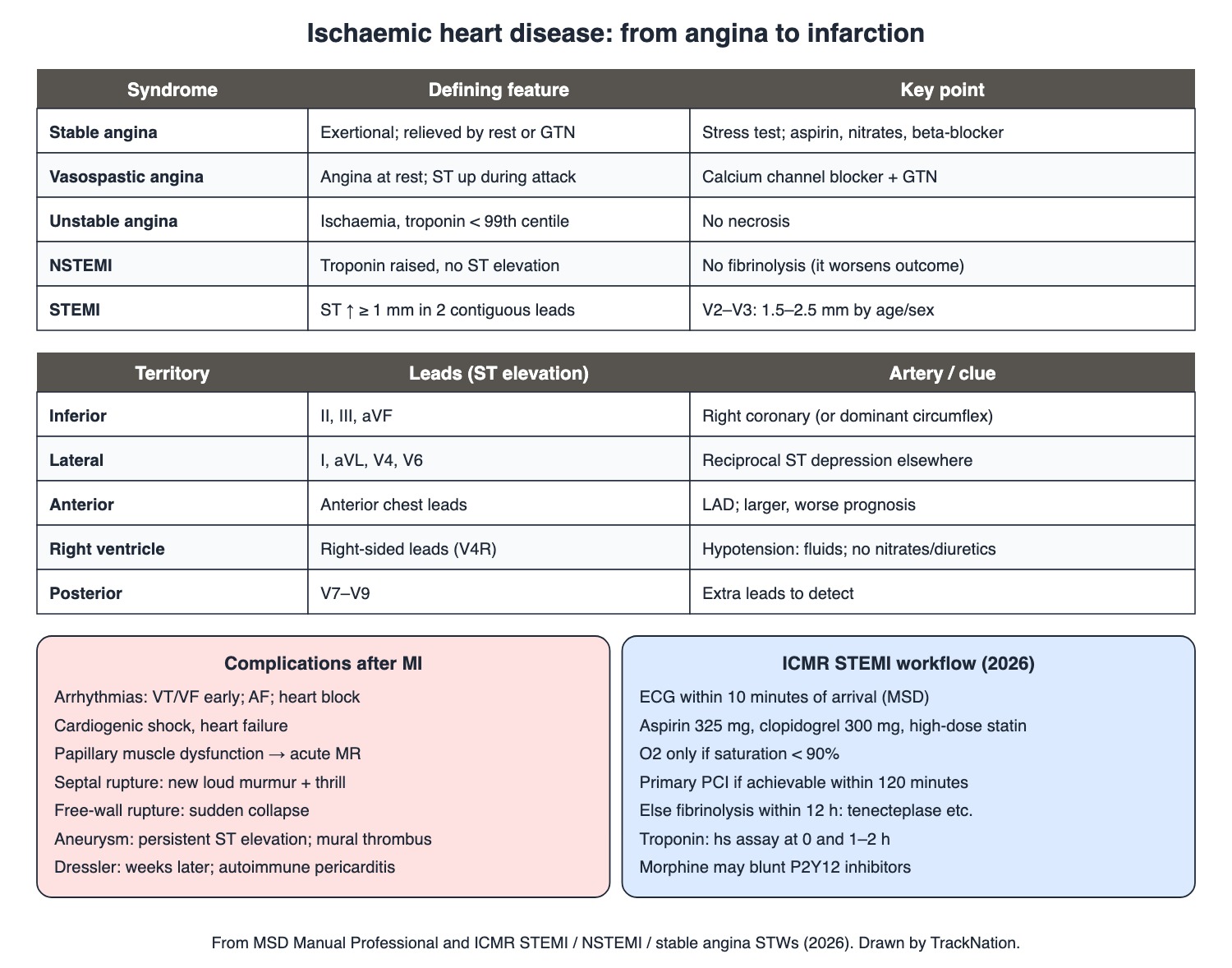
ACS spectrum, infarct territories, complications and the ICMR STEMI pathway. Drawn by TrackNation.
Angina
Angina pectoris: precordial discomfort from transient ischaemia without infarction. Stable angina is brought on by exertion or stress and relieved by rest or sublingual nitroglycerin. Tests: ECG, stress testing (ECG or imaging), CT angiography.
Vasospastic angina: coronary spasm; angina at rest, ST elevation during an attack; provocation with ergonovine or acetylcholine; treat with calcium channel blockers and nitroglycerin.
ICMR stable angina STW: aspirin 75 mg daily (clopidogrel if intolerant), anti-ischaemic drugs, revascularise if anatomy suits; prefer CABG over PCI in diabetics with multivessel disease.
Acute Coronary Syndromes
Unstable angina: ischaemia without necrosis (troponin below the 99th centile). NSTEMI: troponin rise without ST elevation. STEMI: ST elevation ≥ 1 mm in two contiguous leads (1.5–2.5 mm in V2–V3 by age and sex). A new LBBB alone is not a STEMI equivalent.
ECG within 10 minutes of presentation; high-sensitivity troponin at presentation and 1–2 hours later (0 and 3–6 hours with standard assays). Pathological Q waves mark established infarction.
Territories: inferior (II, III, aVF — right coronary or dominant circumflex), lateral (I, aVL, V4, V6), anterior (LAD; larger infarcts, worse prognosis). Extra leads: V4R for the right ventricle, V7–V9 for the posterior wall.
Right ventricular infarction usually accompanies an inferior infarct (proximal right coronary). Hypotension: give IV saline (1–2 L); avoid nitrates and diuretics, which drop preload and cause severe hypotension.
Treatment
Prehospital: oxygen (if hypoxic), aspirin, nitrates and transfer to the right centre. In hospital: aspirin plus a P2Y12 inhibitor (clopidogrel, prasugrel, ticagrelor), anticoagulation (heparin), nitroglycerin, beta-blocker, statin, ACE inhibitor or ARB.
Nitroglycerin is preferred to morphine or fentanyl, which can blunt some P2Y12 inhibitors.
Reperfusion: STEMI → primary PCI, or fibrinolysis (tenecteplase, alteplase, reteplase, streptokinase) when timely PCI is not available. Fibrinolytics worsen outcome in unstable angina and NSTEMI.
Step (ICMR STW 2026) | STEMI | Unstable angina / NSTEMI |
Loading | Aspirin 325 mg, clopidogrel 300 mg, atorvastatin 80 mg (or rosuvastatin 20–40 mg) | Dual antiplatelets (ticagrelor or prasugrel if PCI planned) |
Oxygen | Only if saturation < 90% | As needed |
Reperfusion | Primary PCI if possible within 120 minutes; otherwise fibrinolysis within 12 hours (fibrin-specific agent preferred) | Revascularise within 24 h (high risk) or 72 h (intermediate risk); no fibrinolysis |
After PCI | Dual antiplatelets | Dual antiplatelets for at least 12 months |
Complications
Electrical: VT/VF (often within 24 hours), atrial arrhythmias, sinus node and conduction disturbances.
Mechanical: hypotension, cardiogenic shock, heart failure; papillary muscle dysfunction (acute MR); septal rupture — sudden loud systolic murmur and thrill at the left sternal border; free-wall rupture (1% of MIs, 15% of in-hospital deaths) — sudden collapse; ventricular aneurysm — persistent ST elevation and a bulging cardiac shadow, with mural thrombus and emboli.
Inflammatory: early peri-infarction pericarditis; Dressler (post-MI) syndrome days to months later — autoimmune; fever, pericarditis, effusions, pleuritis, joint pain. Anticoagulants are contraindicated in Dressler syndrome but not in early pericarditis.
Traps the Examiner Sets
Inferior STEMI + hypotension → right-sided leads, fluids; no nitrates.
NSTEMI is never thrombolysed.
New LBBB alone is not automatically STEMI.
Persistent ST elevation weeks after MI = ventricular aneurysm.
ICMR: PCI if within 120 minutes, else lyse within 12 hours.
Memory Hooks & Shortcuts
Shortcuts to lock in this article's numbers and lists. Each one only re-packages facts proven above.
🧠 Inferior = II, III, aVF — 'two, three, and a Very Fat RCA' — inferior MI
🧠 RV infarct: Fill it, don't Nitrate it — RV infarction
🧠 NSTEMI: No STEMI, No Streptokinase — fibrinolysis
🧠 120 to PCI, 12 to lyse — ICMR reperfusion
🧠 Persistent ST = Pouch (aneurysm) — LV aneurysm
🧠 Dressler = Delayed, Defensive (autoimmune), Don't anticoagulate — Dressler
Rapid-Revision Cards
Stable angina
Exertion; relieved by rest/GTN; no infarction.
Vasospastic angina
Rest pain, ST ↑ in attack; CCB + GTN.
Unstable angina
Troponin < 99th centile.
NSTEMI
Troponin ↑, no ST ↑; no fibrinolysis.
STEMI criterion
ST ↑ ≥ 1 mm in 2 contiguous leads (V2–V3: 1.5–2.5 mm).
ECG timing
Within 10 min of presentation.
hs-troponin timing
0 and 1–2 h.
Inferior MI
II, III, aVF; RCA or dominant LCx.
Lateral MI
I, aVL, V4, V6.
Anterior MI
LAD; larger, worse prognosis.
RV infarct
With inferior MI; V4R; fluids, no nitrates.
Posterior MI
V7–V9.
New LBBB
Not a STEMI equivalent alone.
ICMR STEMI loading
Aspirin 325, clopidogrel 300, atorvastatin 80.
ICMR PCI window
Within 120 min, else lyse within 12 h.
ICMR NSTEMI revasc
High risk < 24 h; intermediate < 72 h.
DAPT after PCI (NSTEMI)
≥ 12 months.
Morphine in ACS
Blunts some P2Y12 inhibitors; GTN preferred.
Septal rupture
New loud murmur + thrill, left sternal border.
Free-wall rupture
Sudden collapse; 1% of MIs.
LV aneurysm
Persistent ST ↑; mural thrombus.
Dressler syndrome
Autoimmune; weeks later; no anticoagulants.
Sources
Facts in this article were checked against these documents.
MSD Manual Professional: Angina Pectoris; Vasospastic Angina; Overview of Acute Coronary Syndromes; Acute Myocardial Infarction; Medications for Acute Coronary Syndromes; Complications of Acute Coronary Syndromes — Merck & Co. (MSD Manuals), reviewed 2025–26 (link)
Standard Treatment Workflows: STEMI; Unstable Angina/NSTEMI; Stable Angina — ICMR / Department of Health Research, MoHFW, January 2026
Competency Based Undergraduate Curriculum, General Medicine (GM 2) — National Medical Commission, 2024
Test Yourself: Practice Questions
Thirty questions in NEET PG style, most of them clinical vignettes.
Practice Questions (NEET PG pattern)
Original questions written in the style of the exam: +4 for a correct answer, −1 for a wrong one. Every answer was checked against the sources listed above. NEET PG papers are not published by NBEMS, so these are not past-paper questions.
Q1. A man gets chest pressure when climbing stairs that settles within minutes of rest or sublingual nitroglycerin. This is
(a) pericarditis
(b) NSTEMI
(c) stable angina
(d) unstable angina
Show answer
Answer: (c) — Transient ischaemia without infarction.
Q2. A patient has recurrent chest pain at rest; ECG during pain shows ST elevation that resolves afterwards. Treatment of choice is
(a) urgent CABG
(b) fibrinolysis
(c) a beta-blocker alone
(d) a calcium channel blocker with nitroglycerin
Show answer
Answer: (d) — Vasospastic angina; provocation with ergonovine or acetylcholine.
Q3. A patient with prolonged rest chest pain has no ST elevation and troponin below the 99th percentile on repeat testing. The diagnosis is
(a) STEMI
(b) stable angina
(c) unstable angina
(d) NSTEMI
Show answer
Answer: (c) — No myocardial necrosis.
Q4. STEMI on ECG (outside V2–V3) requires ST elevation of at least
(a) 0.5 mm in one lead
(b) 1 mm in two or more contiguous leads
(c) 3 mm in all leads
(d) 1 mm in any single lead
Show answer
Answer: (b) — V2–V3 need 1.5–2.5 mm depending on age and sex.
Q5. How soon should an ECG be recorded in a patient with suspected ACS?
(a) within 1 hour
(b) within 10 minutes of presentation
(c) after troponin returns
(d) within 24 hours
Show answer
Answer: (b) — It drives the decision for emergency catheterisation.
Q6. ECG shows ST elevation in II, III and aVF with reciprocal depression elsewhere. The usual culprit artery is
(a) first diagonal
(b) left main
(c) left anterior descending
(d) right coronary (or dominant circumflex)
Show answer
Answer: (d) — Inferior (inferoposterior) infarction.
Q7. Which infarcts tend to be largest with the worst prognosis?
(a) posterior infarcts
(b) anterior infarcts from LAD occlusion
(c) inferior infarcts
(d) isolated right ventricular infarcts
Show answer
Answer: (b) — Usually left anterior descending.
Q8. Hyperacute ST elevation in I, aVL, V4 and V6 indicates infarction of the
(a) inferior wall
(b) lateral wall
(c) septum only
(d) right ventricle
Show answer
Answer: (b) — Reciprocal depression appears in other leads.
Q9. A patient with inferior STEMI becomes hypotensive with high right-sided filling pressure. After right-sided leads confirm the cause, the first treatment is
(a) morphine
(b) IV normal saline 1–2 L
(c) IV furosemide
(d) IV nitroglycerin
Show answer
Answer: (b) — Right ventricular infarction; nitrates and diuretics drop preload.
Q10. Extra ECG leads V7–V9 are recorded to detect
(a) posterior infarction
(b) pericarditis
(c) LBBB
(d) right ventricular infarction
Show answer
Answer: (a) — V4R detects RV infarction.
Q11. With a high-sensitivity troponin assay, a suspected ACS patient should be tested
(a) after 12 hours only
(b) on presentation and again 1–2 hours later
(c) only once at 24 hours
(d) only if ECG is normal
Show answer
Answer: (b) — Standard assays: 0 and 3–6 hours.
Q12. A patient with NSTEMI is in a hospital without a catheter lab. Fibrinolysis should
(a) be given with half dose
(b) be given within 12 hours
(c) be given if troponin is high
(d) not be given — it worsens outcome in NSTEMI
Show answer
Answer: (d) — Fibrinolysis is for STEMI only.
Q13. For chest pain in ACS, nitroglycerin is preferred to morphine because opioids
(a) cause hypertension
(b) dissolve clots
(c) can reduce the activity of some P2Y12 inhibitors
(d) raise troponin
Show answer
Answer: (c) — Use opioids judiciously.
Q14. The ICMR STEMI workflow loading doses are
(a) heparin only
(b) clopidogrel 75 mg, simvastatin 10 mg
(c) aspirin 75 mg alone
(d) aspirin 325 mg, clopidogrel 300 mg, atorvastatin 80 mg
Show answer
Answer: (d) — Rosuvastatin 20–40 mg is an alternative statin.
Q15. Per the ICMR STEMI workflow, a patient at a non-PCI centre should be transferred for primary PCI if it can be done within
(a) 120 minutes
(b) 30 minutes only
(c) 6 hours
(d) 24 hours
Show answer
Answer: (a) — Otherwise thrombolyse (within 12 hours of symptom onset).
Q16. Oxygen in STEMI (ICMR) is indicated when
(a) always at 15 L/min
(b) only during PCI
(c) never
(d) oxygen saturation is below 90%
Show answer
Answer: (d) — Routine oxygen is not required.
Q17. A fibrinolytic preferred by the ICMR STEMI workflow is
(a) heparin
(b) urokinase only
(c) aspirin
(d) a fibrin-specific agent such as tenecteplase
Show answer
Answer: (d) — Streptokinase if fibrin-specific agents are unavailable.
Q18. Per ICMR, a high-risk NSTEMI patient should be revascularised within
(a) 1 month
(b) 72 hours
(c) 7 days
(d) 24 hours
Show answer
Answer: (d) — Intermediate risk: within 72 hours.
Q19. After PCI for NSTEMI, the ICMR workflow advises dual antiplatelet therapy for at least
(a) 1 month
(b) 12 months
(c) lifelong double therapy always
(d) 1 week
Show answer
Answer: (b) — Then single antiplatelet long term.
Q20. A diabetic with stable angina has multivessel coronary disease suitable for revascularisation. The ICMR workflow prefers
(a) PCI over CABG
(b) medical therapy only
(c) CABG over PCI
(d) fibrinolysis
Show answer
Answer: (c) — Aspirin 75 mg daily continues.
Q21. After an MI, a patient suddenly develops a new loud systolic murmur with a thrill at the left sternal border. The likely complication is
(a) free-wall rupture
(b) Dressler syndrome
(c) ventricular septal rupture
(d) pericarditis
Show answer
Answer: (c) — Acute MR from papillary muscle rupture is the main alternative.
Q22. A patient recovering from MI suddenly collapses with loss of blood pressure while the ECG still shows rhythm. The likely cause is
(a) Dressler syndrome
(b) septal rupture
(c) mural thrombus
(d) free-wall rupture
Show answer
Answer: (d) — 1% of MIs, 15% of in-hospital deaths.
Q23. After a large MI, the ECG still shows persistent ST elevation and the chest X-ray shows a bulge of the cardiac border. This suggests
(a) re-infarction
(b) pericarditis
(c) left ventricular aneurysm
(d) Dressler syndrome
Show answer
Answer: (c) — Echo confirms; mural thrombus and emboli can follow.
Q24. Three weeks after an MI, a patient has fever, pericardial rub, pleural effusion and joint pains. The mechanism is
(a) bacterial pericarditis
(b) drug allergy to aspirin
(c) re-infarction
(d) an autoimmune reaction to necrotic myocyte material
Show answer
Answer: (d) — Dressler (post-MI) syndrome.
Q25. In Dressler syndrome, anticoagulation is
(a) contraindicated
(b) the first-line treatment
(c) irrelevant
(d) mandatory
Show answer
Answer: (a) — It is not contraindicated in early peri-infarction pericarditis.
Q26. Ventricular tachycardia or fibrillation after PCI for STEMI most often occurs
(a) only with LBBB
(b) after 1 month
(c) after 6 months
(d) within 24 hours
Show answer
Answer: (d) — Beta-blockers help prevent arrhythmias in the first weeks.
Q27. In isolation, a new left bundle branch block on ECG
(a) is always STEMI
(b) is not considered a STEMI equivalent
(c) means posterior MI
(d) excludes MI
Show answer
Answer: (b) — Clinical context and other criteria matter.
Q28. Which pair of drugs is used as dual antiplatelet therapy in ACS?
(a) aspirin and a P2Y12 inhibitor such as ticagrelor
(b) aspirin and digoxin
(c) clopidogrel and statin
(d) heparin and warfarin
Show answer
Answer: (a) — P2Y12 inhibitors: clopidogrel, prasugrel, ticagrelor, cangrelor.
Q29. Fibrinolytics such as tenecteplase and streptokinase work by
(a) blocking GP IIb/IIIa
(b) blocking P2Y12
(c) activating plasminogen
(d) inhibiting thrombin directly
Show answer
Answer: (c) — All are IV plasminogen activators.
Q30. Right ventricular infarction usually occurs together with
(a) an inferior left ventricular infarction
(b) aortic dissection
(c) a lateral infarction
(d) an anterior infarction
Show answer
Answer: (a) — Proximal right coronary occlusion.
Active Recall
From memory: define stable, vasospastic and unstable angina, NSTEMI and STEMI; give the STEMI ECG criterion and lead territories; explain right ventricular infarction management; outline ACS drugs, the ICMR loading doses and the PCI-or-lysis rule; and list MI complications with their clues.