Hypertension for NEET PG Medicine: ICMR 2026 Grades and Targets, Drugs, Secondary Causes, Retinopathy, Urgency vs Emergency
Start Here
🎯 Exam priority: High. Expect: classify a BP reading, when one reading is enough, targets for diabetics and the elderly, which drug to avoid in pregnancy, gout or asthma, why not ACEi + ARB, the commonest secondary cause, retinopathy grade 4, and the urgency-vs-emergency step.
CBME mapping: GM 8.1–8.19. Phaeochromocytoma and Conn syndrome pathology are in Pathology article 26; NP-NCD screening in Community Medicine.
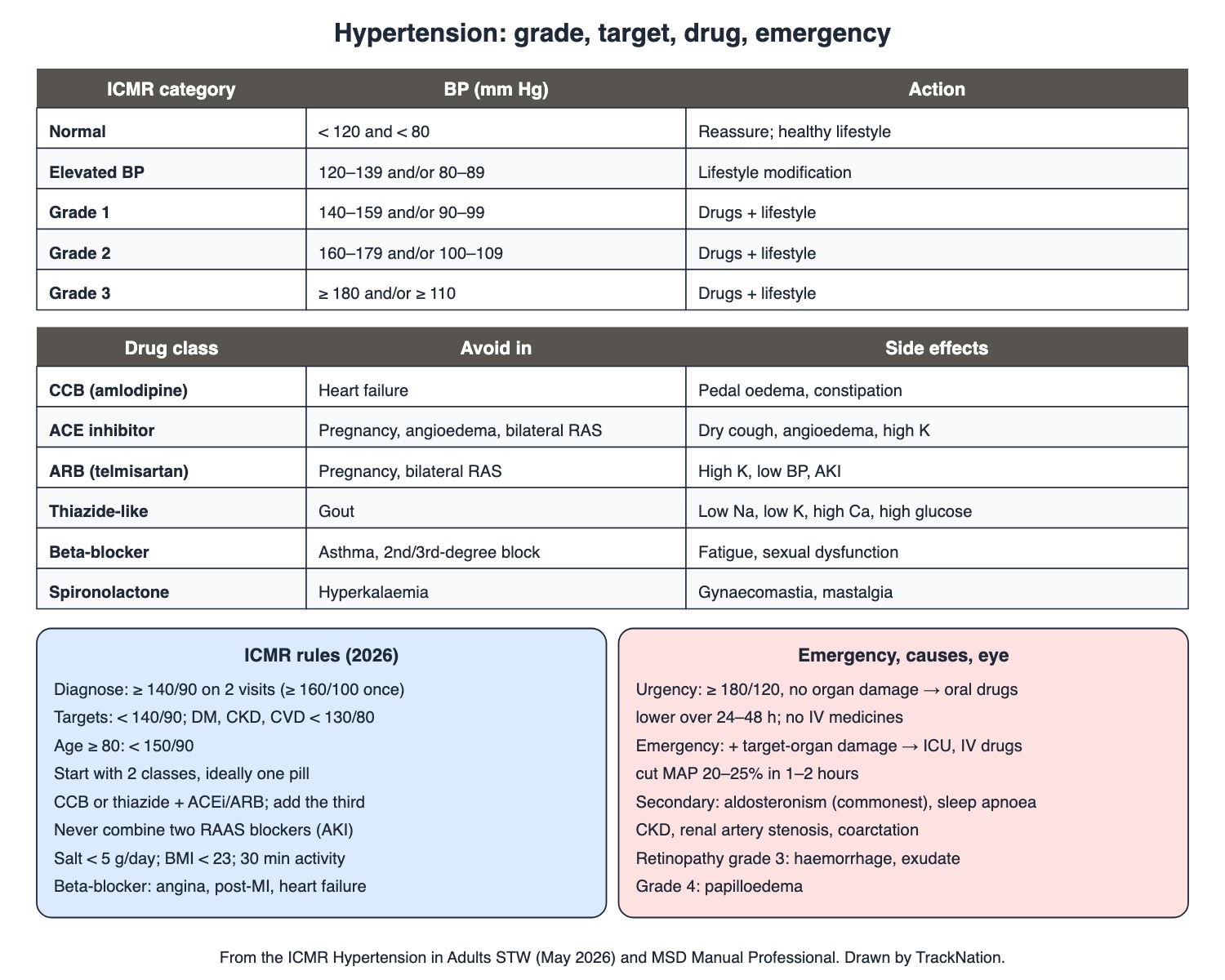
ICMR grades, targets, drugs, urgency vs emergency, causes and retinopathy. Drawn by TrackNation.
Diagnose and Classify (ICMR 2026)
"A silent killer": most patients are asymptomatic, so every adult ≥ 18 should have BP measured at every clinic visit.
Diagnosis: ≥ 140/90 mm Hg on two different visits; a single visit is enough if ≥ 160/100. Use the higher category if only one value is high. Check orthostatic BP in adults ≥ 65.
Targets: all adults < 140/90; diabetes, CKD or established CVD < 130/80 (if tolerated); age ≥ 80 < 150/90.
White-coat hypertension: high in the clinic, normal out of the clinic.
ICMR category | Systolic (mm Hg) | Diastolic (mm Hg) | Action |
Normal | < 120 | < 80 | Reassure |
Elevated BP | 120–139 | 80–89 | Lifestyle |
Grade 1 | 140–159 | 90–99 | Drugs + lifestyle |
Grade 2 | 160–179 | 100–109 | Drugs + lifestyle |
Grade 3 | ≥ 180 | ≥ 110 | Drugs + lifestyle |
Causes and Target Organs
Primary hypertension is about 85%. Secondary is usually due to primary aldosteronism; others: obstructive sleep apnoea, chronic kidney disease, renal artery stenosis, coarctation (legs lower than arms), phaeochromocytoma, Cushing syndrome, thyroid and parathyroid disease, drugs (steroids, stimulants, cocaine); liquorice worsens control.
Renovascular: about 80% atherosclerotic, 20% fibromuscular dysplasia; a renal bruit in fewer than half.
Retinopathy (Keith-Wagener-Barker): 1 arteriolar narrowing; 2 narrowing + sclerosis; 3 haemorrhages and exudates; 4 papilloedema.
Treatment
Lifestyle (ICMR): no tobacco or alcohol, salt < 5 g/day, more fruit and vegetables, 30 minutes of activity daily, BMI < 23 kg/m², waist < 90 cm (men) and < 80 cm (women).
Start with two classes, preferably as a single-pill combination; monotherapy only for low-risk grade 1, age ≥ 80 or the frail. Use a CCB or thiazide-like diuretic with an ACE inhibitor or ARB; add the third class if needed; then spironolactone. Never combine two RAAS blockers (AKI risk). ICMR stepwise protocols start with amlodipine 5 mg and step up every 4 weeks.
Beta-blockers are not first-line, but suit angina, post-MI and heart failure. ACE inhibitors/ARBs are preferred in diabetes; ACE inhibitors are contraindicated in pregnancy; dry cough is their commonest and angioedema their most serious adverse effect. Methyldopa can cause Coombs-positive haemolytic anaemia.
Class (ICMR examples) | Avoid in | Watch for |
CCB — amlodipine | Heart failure | Pedal oedema, constipation |
ACE inhibitor — enalapril, ramipril | Pregnancy or planning it, prior angioedema, hyperkalaemia, bilateral renal artery stenosis | Dry cough, angioedema, high K, creatinine rise |
ARB — losartan, telmisartan, olmesartan | Pregnancy, bilateral renal artery stenosis | High K, hypotension, AKI |
Thiazide-like — chlorthalidone, HCTZ | Gout (and pregnancy per ICMR table) | Low Na, low K, high Ca, glucose intolerance |
Beta-blocker — metoprolol, carvedilol, labetalol | Asthma, severe bradycardia, 2nd/3rd-degree AV block | Fatigue, depression, sexual dysfunction |
MRA — spironolactone | Hyperkalaemia | Gynaecomastia, mastalgia |
Urgency vs Emergency
Urgency: ≥ 180/120 without acute target-organ damage — start oral drugs, lower BP gradually over 24–48 hours, no IV medicines, review within a week. Anxiety is the commonest cause.
Emergency: the same levels plus target-organ damage — encephalopathy, retinopathy, pre-eclampsia/eclampsia, acute LV failure with pulmonary oedema, myocardial ischaemia, aortic dissection, renal failure. Short-acting IV drugs (labetalol, clevidipine, esmolol) then ICU titration; aim for a 20–25% fall in MAP over 1–2 hours.
Traps the Examiner Sets
One reading ≥ 160/100 is enough to diagnose (ICMR).
Severe BP without organ damage = urgency → oral, slow.
ACEi + ARB together: never.
Thiazide in gout, beta-blocker in asthma, ACEi in pregnancy — all avoid.
Commonest secondary cause: primary aldosteronism.
Memory Hooks & Shortcuts
Shortcuts to lock in this article's numbers and lists. Each one only re-packages facts proven above.
🧠 120 – 140 – 160 – 180: Normal, Grade 1, Grade 2, Grade 3 steps of 20 — BP grades
🧠 'A + C or D': ACEi/ARB with CCB or Diuretic — drug pairing
🧠 Never double the RAAS — 'two rams butt heads (AKI)' — no ACEi + ARB
🧠 Urgency = Unhurried oral; Emergency = IV in the ER — urgency vs emergency
🧠 Retinopathy 4 = Four-letter 'disc' swells (papilloedema) — KWB grade 4
🧠 Aldo is the Usual secondary suspect — secondary hypertension
Rapid-Revision Cards
ICMR normal BP
< 120/80.
ICMR elevated BP
120–139 / 80–89: lifestyle.
ICMR grade 1/2/3
140–159/90–99; 160–179/100–109; ≥ 180/≥ 110.
Diagnosis
≥ 140/90 on 2 visits; ≥ 160/100 once.
Targets
< 140/90; DM/CKD/CVD < 130/80; ≥ 80 y < 150/90.
Initial therapy (ICMR)
Two classes, single pill.
Best pairing
CCB or thiazide + ACEi/ARB.
Never
ACEi + ARB.
Resistant HTN add-on
Spironolactone (MRA).
ACEi in pregnancy
Contraindicated.
ACEi side effects
Cough (commonest), angioedema (most serious).
Thiazide avoid
Gout.
Beta-blocker avoid
Asthma, severe bradycardia, AV block.
CCB side effects
Pedal oedema, constipation.
Lifestyle (ICMR)
Salt < 5 g; BMI < 23; waist < 90/80 cm; 30 min.
Commonest secondary cause
Primary aldosteronism.
Coarctation clue
Legs BP lower than arms.
Renovascular
80% atherosclerosis, 20% FMD.
Retinopathy grade 4
Papilloedema.
Urgency
≥ 180/120, no organ damage: oral, 24–48 h.
Emergency
+ organ damage: IV, MAP ↓ 20–25% in 1–2 h.
Sources
Facts in this article were checked against these documents.
Standard Treatment Workflow: Hypertension in Adults — ICMR / Department of Health Research, MoHFW, May 2026 (link)
MSD Manual Professional: Hypertension; Medications for Hypertension; Hypertensive Emergencies; Renovascular Hypertension — Merck & Co. (MSD Manuals), reviewed 2025–26 (link)
Competency Based Undergraduate Curriculum, General Medicine (GM 8) — National Medical Commission, 2024
Test Yourself: Practice Questions
Thirty questions in NEET PG style, most of them clinical vignettes.
Practice Questions (NEET PG pattern)
Original questions written in the style of the exam: +4 for a correct answer, −1 for a wrong one. Every answer was checked against the sources listed above. NEET PG papers are not published by NBEMS, so these are not past-paper questions.
Q1. A 45-year-old has BP 152/94 mm Hg on two separate clinic visits. By the ICMR 2026 workflow this is
(a) grade 2 hypertension
(b) grade 1 hypertension
(c) elevated BP
(d) normal
Show answer
Answer: (b) — Grade 1: 140–159 and/or 90–99.
Q2. A reading of 166/104 mm Hg at one visit. Per ICMR, the diagnosis of hypertension
(a) needs ambulatory monitoring always
(b) needs three more visits
(c) cannot be made
(d) can be made at this single visit
Show answer
Answer: (d) — One visit suffices at ≥ 160/100.
Q3. BP 132/86 mm Hg is classified by ICMR as
(a) grade 2
(b) grade 1 hypertension
(c) normal
(d) elevated BP — lifestyle modification
Show answer
Answer: (d) — 120–139 and/or 80–89.
Q4. The ICMR BP target for a hypertensive patient with diabetes is
(a) < 130/80 mm Hg if tolerated
(b) < 160/100
(c) < 150/90
(d) < 120/70 always
Show answer
Answer: (a) — General adults < 140/90; age ≥ 80 < 150/90.
Q5. The ICMR target for an 84-year-old with hypertension is
(a) no target
(b) < 130/80
(c) < 120/80
(d) < 150/90 mm Hg
Show answer
Answer: (d) — Check orthostatic BP in those ≥ 65.
Q6. The ICMR default initial drug treatment for most adults with hypertension is
(a) lifestyle only for 1 year
(b) a beta-blocker alone
(c) two drugs from different classes, preferably a single pill
(d) a diuretic alone
Show answer
Answer: (c) — Monotherapy only for low-risk grade 1, ≥ 80 years or frail.
Q7. Which combination does the ICMR workflow forbid?
(a) chlorthalidone with an ACE inhibitor
(b) an ACE inhibitor with an ARB
(c) amlodipine with chlorthalidone
(d) amlodipine with telmisartan
Show answer
Answer: (b) — Two RAAS blockers raise AKI risk.
Q8. If BP stays uncontrolled on a CCB, ACE inhibitor/ARB and thiazide-like diuretic, the ICMR workflow suggests adding
(a) a loop diuretic in all
(b) a second ACE inhibitor
(c) digoxin
(d) a mineralocorticoid receptor antagonist such as spironolactone
Show answer
Answer: (d) — Resistant hypertension step.
Q9. A pregnant woman with chronic hypertension should NOT receive
(a) lifestyle advice
(b) labetalol
(c) BP monitoring
(d) an ACE inhibitor
Show answer
Answer: (d) — ACE inhibitors (and ARBs) are contraindicated in pregnancy; labetalol is used in pregnancy.
Q10. A patient on enalapril develops a persistent dry cough. This is
(a) caused by hyperkalaemia
(b) a sign of heart failure always
(c) the commonest adverse effect of ACE inhibitors
(d) an allergy to all antihypertensives
Show answer
Answer: (c) — Angioedema is the most serious.
Q11. A hypertensive man with recurrent gout should avoid
(a) telmisartan
(b) thiazide-like diuretics
(c) losartan
(d) amlodipine
Show answer
Answer: (b) — Thiazides raise urate.
Q12. Ankle swelling after starting amlodipine is
(a) a sign of renal failure
(b) a recognised side effect of CCBs
(c) heart failure in all cases
(d) drug allergy
Show answer
Answer: (b) — Constipation is another.
Q13. A hypertensive asthmatic should not be given
(a) chlorthalidone
(b) amlodipine
(c) telmisartan
(d) a beta-blocker
Show answer
Answer: (d) — Also avoid with severe bradycardia or 2nd/3rd-degree block.
Q14. Beta-blockers as antihypertensives are best reserved for patients who also have
(a) pregnancy-planning only
(b) asthma
(c) angina, previous MI or heart failure
(d) gout
Show answer
Answer: (c) — They are not first-line otherwise.
Q15. The ICMR salt limit for hypertensive patients is
(a) no limit
(b) < 2 g/day of sodium chloride only for kidney disease
(c) < 10 g/day
(d) < 5 g/day
Show answer
Answer: (d) — With activity 30 min/day and BMI < 23.
Q16. The ICMR waist circumference targets are
(a) < 102 cm men, < 88 cm women
(b) < 90 cm for men and < 80 cm for women
(c) < 80 cm men, < 70 cm women
(d) none
Show answer
Answer: (b) — BMI target < 23 kg/m².
Q17. The commonest identifiable cause of secondary hypertension is
(a) primary aldosteronism
(b) Cushing syndrome
(c) coarctation of the aorta
(d) phaeochromocytoma
Show answer
Answer: (a) — Sleep apnoea, CKD and renal artery stenosis follow.
Q18. A young man has arm hypertension with much lower BP in the legs and delayed femoral pulses. The likely cause is
(a) coarctation of the aorta
(b) white-coat hypertension
(c) renal artery stenosis
(d) primary aldosteronism
Show answer
Answer: (a) — A vascular cause of secondary hypertension.
Q19. A young woman's renovascular hypertension is due to fibromuscular dysplasia. Of all renovascular hypertension, this cause accounts for about
(a) 20%
(b) 50%
(c) 5%
(d) 80%
Show answer
Answer: (a) — Atherosclerosis causes about 80%.
Q20. Fundoscopy in a severely hypertensive patient shows papilloedema. The Keith-Wagener-Barker grade is
(a) 1
(b) 2
(c) 4
(d) 3
Show answer
Answer: (c) — Grade 3 = haemorrhages and exudates.
Q21. Haemorrhages and exudates with arteriolar changes but no papilloedema correspond to hypertensive retinopathy grade
(a) 4
(b) 3
(c) 1
(d) 2
Show answer
Answer: (b) — Grade 4 adds papilloedema.
Q22. A patient's BP is 186/122 mm Hg; he is asymptomatic with no target-organ damage. Per ICMR, management is
(a) sublingual nifedipine to normal within 1 hour
(b) oral antihypertensives with gradual lowering over 24–48 hours
(c) IV labetalol infusion in ICU
(d) IV nitroprusside
Show answer
Answer: (b) — Hypertensive urgency; no IV medicines.
Q23. A hypertensive emergency differs from urgency by the presence of
(a) headache alone
(b) age over 60
(c) acute target-organ damage
(d) a higher systolic number only
Show answer
Answer: (c) — Brain, heart, kidneys, aorta, retina, pregnancy.
Q24. In a hypertensive emergency (excluding special cases), the initial goal is to lower mean arterial pressure by
(a) 10% over 24 hours
(b) to normal within 30 minutes
(c) 50% within 10 minutes
(d) 20–25% over 1–2 hours
Show answer
Answer: (d) — Short-acting IV drugs, then ICU titration.
Q25. Which is a target-organ complication defining a hypertensive emergency?
(a) palpitations alone
(b) white-coat effect
(c) isolated headache with anxiety
(d) acute aortic dissection
Show answer
Answer: (d) — Also encephalopathy, pulmonary oedema, MI, eclampsia, renal failure.
Q26. The commonest cause of hypertensive urgency is
(a) phaeochromocytoma
(b) aortic dissection
(c) renal artery stenosis
(d) anxiety
Show answer
Answer: (d) — Treat the anxiety; acute complications are unlikely.
Q27. A patient's BP is high in clinic but normal on home and ambulatory readings. This is
(a) grade 2 hypertension
(b) resistant hypertension
(c) masked hypertension
(d) white-coat hypertension
Show answer
Answer: (d) — Out-of-office readings settle the diagnosis.
Q28. In patients with diabetes and hypertension, the antihypertensive class of choice is
(a) ACE inhibitor or ARB
(b) alpha-blocker
(c) beta-blocker
(d) loop diuretic
Show answer
Answer: (a) — Unless pregnant.
Q29. Primary (essential) hypertension accounts for about
(a) 99%
(b) 50%
(c) 15%
(d) 85% of cases
Show answer
Answer: (d) — Secondary: 5–15%.
Q30. An antihypertensive that can cause Coombs-positive haemolytic anaemia is
(a) chlorthalidone
(b) telmisartan
(c) methyldopa
(d) amlodipine
Show answer
Answer: (c) — A centrally acting drug.
Active Recall
From memory: give the ICMR BP categories, diagnostic rule and targets; describe the ICMR drug strategy and forbidden combination; list contraindications and side effects of each class; name secondary causes and retinopathy grades; and contrast urgency with emergency management.