Asthma, COPD and Respiratory Failure for NEET PG Medicine: Spirometry, ICMR Inhaler Steps, Exacerbations, Oxygen Targets
Start Here
🎯 Exam priority: High. Expect: asthma vs COPD from history, the spirometric definition of COPD, methacholine challenge, step-up inhalers (ICMR), danger signs in acute asthma (rising PaCO2), COPD exacerbation features, oxygen target 88–92% in COPD, and type 1 vs type 2 respiratory failure.
CBME mapping: GM 28.1–28.26. Lung pathology (emphysema, asthma) is in Pathology article 19; bronchodilator pharmacology in Pharmacology.
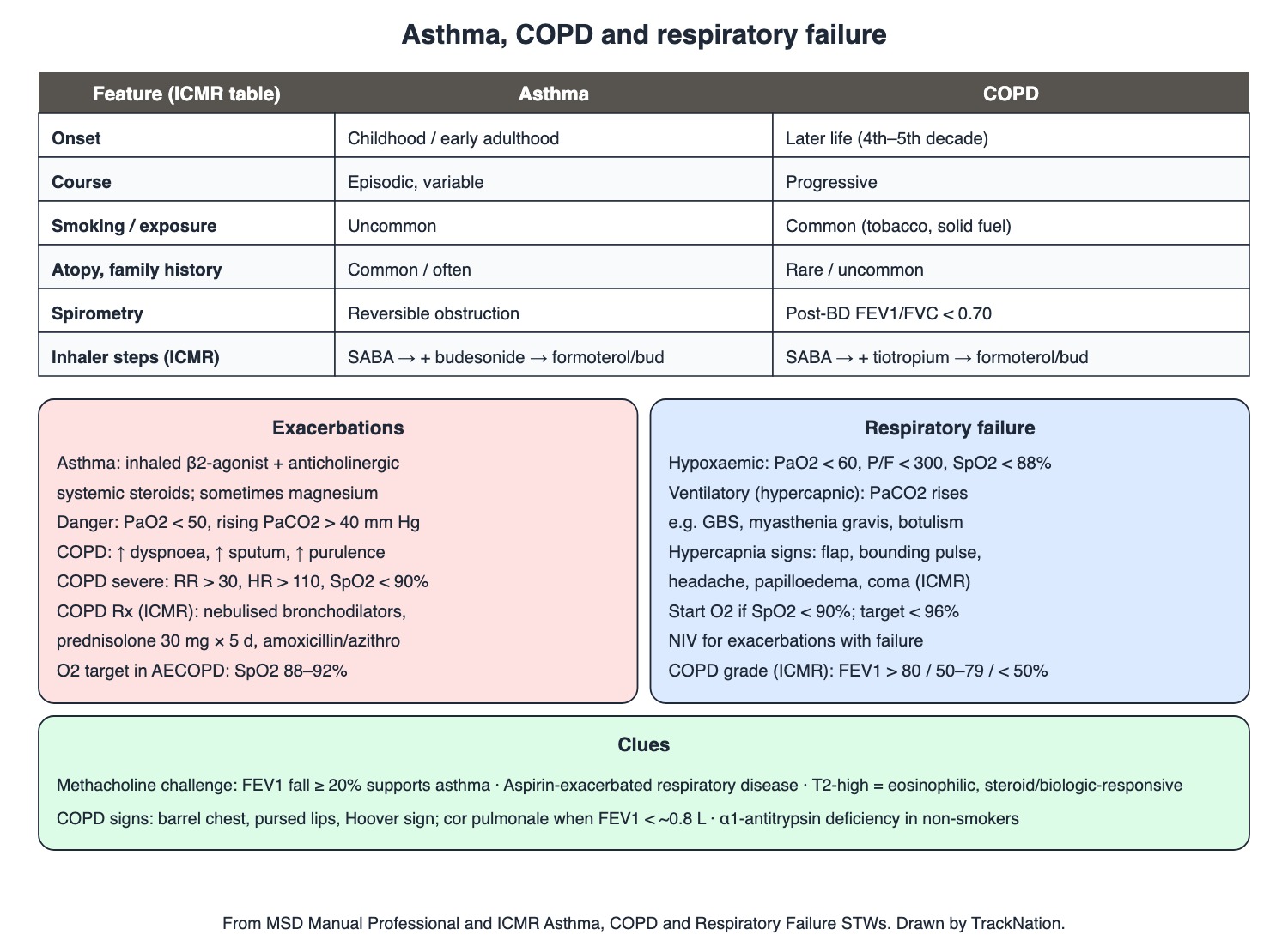
Asthma vs COPD, inhaler steps, exacerbations and respiratory failure. Drawn by TrackNation.
Asthma
Definition: diffuse airway inflammation from triggers causing partially or completely reversible bronchoconstriction — with airway oedema, hyperreactivity and remodelling. T2-high (eosinophilic) asthma responds to steroids and biologics. Aspirin-exacerbated respiratory disease is a recognised subtype.
Diagnosis: clinical, with reversible obstruction on spirometry. If spirometry is normal, provocation with methacholine (or histamine, adenosine, exercise): an FEV1 fall of ≥ 20% (> 12% in children) supports asthma.
Control (ICMR, over 4 weeks): daytime symptoms or reliever use ≤ 2 a week, no night symptoms, no limitation, FEV1 or PEF > 80% = good control.
Drugs: inhaled drugs are the mainstay. LABAs are never used alone. Montelukast (leukotriene antagonist) is less effective than inhaled steroids. Biologics (omalizumab, dupilumab, mepolizumab) are add-ons for severe eosinophilic asthma.
Acute asthma: inhaled beta-2 agonist plus anticholinergic, systemic steroids, sometimes magnesium. Danger: PaO2 < 50 mm Hg or a PaCO2 rising above 40 mm Hg (tiring patient) → impending respiratory failure.
ICMR step | Asthma | COPD |
1 | Levosalbutamol 50 µg or salbutamol 100 µg as needed | Mild: levosalbutamol as needed |
2 | + budesonide 100 µg twice daily | Moderate: + tiotropium 9 µg once daily |
3 | Formoterol/budesonide 6/200 µg single inhaler, twice daily and as needed | Severe: formoterol/budesonide 6/200 µg twice daily |
4 | + tiotropium and low-dose oral methylxanthine | + tiotropium and/or low-dose methylxanthine |
5 | + low-dose oral corticosteroid; refer | Refer if uncontrolled or complications |
COPD
Definition: post-bronchodilator FEV1/FVC < 0.70. Causes: tobacco, solid-fuel cooking smoke, occupational dust; in non-smokers think alpha-1 antitrypsin deficiency (protease-driven emphysema). Only about 15% of smokers develop clinical COPD. Rule out TB with sputum AFB if cough lasts > 2 weeks.
Signs: barrel chest, hyper-resonance, reduced breath sounds, forced expiratory time > 6 s, pursed-lip breathing, Hoover sign; cor pulmonale (loud P2, raised JVP, oedema) in advanced disease — risk rises when FEV1 falls below about 0.8 L.
Severity: by FEV1 (table), breathlessness (mMRC scale), exacerbations and complications (respiratory failure, cor pulmonale, secondary polycythaemia).
Exacerbation: increased breathlessness, sputum volume and purulence. Severe: cyanosis, RR > 30, HR > 110, SBP < 90, SpO2 < 90%. Treat with oxygen, nebulised bronchodilators, systemic steroids (ICMR: prednisolone 30 mg for 5 days), antibiotics (amoxicillin, azithromycin or doxycycline), and non-invasive ventilation if needed. Target SpO2 88–92%.
COPD severity (post-bronchodilator FEV1, MSD/GOLD) | Value |
Mild | ≥ 80% predicted |
Moderate | 50–79% |
Severe | 30–49% |
Very severe | < 30% |
Respiratory Failure
Hypoxaemic (type 1): inadequate oxygenation — PaO2 < 60 mm Hg, PaO2/FiO2 < 300 or SpO2 < 88%. Ventilatory (hypercapnic, type 2): inadequate CO2 removal — as in COPD exacerbations or respiratory muscle weakness (Guillain-Barré, myasthenia gravis, botulism).
Clues to hypercapnia (ICMR): headache, bounding pulse, flapping tremor, papilloedema, drowsiness to coma.
Oxygen (ICMR): start when SpO2 < 90%, titrate to SpO2 < 96% — but 88–92% in COPD exacerbation.
Traps the Examiner Sets
A "normal" PaCO2 in severe asthma is a danger sign.
COPD = post-bronchodilator FEV1/FVC < 0.70.
LABA never alone in asthma.
COPD exacerbation: aim for 88–92%, not 100%.
Young non-smoker with emphysema → alpha-1 antitrypsin.
Memory Hooks & Shortcuts
Shortcuts to lock in this article's numbers and lists. Each one only re-packages facts proven above.
🧠 Asthma Reverses, COPD Remains (post-BD FEV1/FVC < 0.70) — asthma vs COPD
🧠 88–92: COPD's Goldilocks oxygen — oxygen target
🧠 Normal CO2 in asthma = Not normal (tiring) — acute asthma
🧠 Three Ds of AECOPD: Dyspnoea, Dirty sputum, Dumping more sputum — exacerbation
🧠 CO2 retainer: Flap, Full pulse, Fuzzy head — hypercapnia
🧠 LABA Lonely = Lethal (never alone) — LABA
Rapid-Revision Cards
Asthma
Reversible bronchoconstriction; inflammation, hyperreactivity.
Methacholine test
FEV1 fall ≥ 20% (12% children).
T2-high asthma
Eosinophilic; steroid/biologic responsive.
ICMR asthma steps
SABA → + budesonide → formoterol/bud → + tiotropium → oral steroid.
LABA rule
Never monotherapy in asthma.
Montelukast
Less effective than ICS.
Acute asthma Rx
SABA + SAMA, systemic steroid, ± magnesium.
Asthma danger
PaO2 < 50; PaCO2 > 40 rising.
COPD definition
Post-BD FEV1/FVC < 0.70.
COPD severity
≥ 80 mild, 50–79 moderate, 30–49 severe, < 30 very severe.
COPD risks (ICMR)
Tobacco, solid fuel, occupation; age > 35.
Non-smoker emphysema
Alpha-1 antitrypsin deficiency.
COPD signs
Barrel chest, FET > 6 s, Hoover, pursed lips.
COPD exacerbation
↑ dyspnoea, ↑ sputum, ↑ purulence.
Severe AECOPD
RR > 30, HR > 110, SpO2 < 90%, SBP < 90.
ICMR AECOPD steroid
Prednisolone 30 mg × 5 days.
AECOPD O2 target
88–92%.
Type 1 failure
PaO2 < 60, P/F < 300.
Type 2 failure
Hypercapnia; COPD, GBS, myasthenia.
Hypercapnia signs
Headache, bounding pulse, flap, papilloedema.
ICMR O2 start
SpO2 < 90%; target < 96%.
Sources
Facts in this article were checked against these documents.
MSD Manual Professional: Asthma; Pharmacologic Treatment of Asthma; Treatment of Acute Asthma Exacerbations; COPD; Treatment of Acute COPD Exacerbation; Alpha-1 Antitrypsin Deficiency — Merck & Co. (MSD Manuals), reviewed 2025–26 (link)
MSD Manual Professional: Overview of Respiratory Failure; Ventilatory Failure; Acute Hypoxemic Respiratory Failure — Merck & Co. (MSD Manuals), reviewed 2026 (link)
Standard Treatment Workflows: Asthma; Chronic Obstructive Pulmonary Disease; Respiratory Failure — ICMR / Department of Health Research, MoHFW, 2019–22 (link)
Competency Based Undergraduate Curriculum, General Medicine (GM 28) — National Medical Commission, 2024
Test Yourself: Practice Questions
Thirty questions in NEET PG style, most of them clinical vignettes.
Practice Questions (NEET PG pattern)
Original questions written in the style of the exam: +4 for a correct answer, −1 for a wrong one. Every answer was checked against the sources listed above. NEET PG papers are not published by NBEMS, so these are not past-paper questions.
Q1. A 19-year-old with eczema and allergic rhinitis has episodic wheeze and night cough; spirometry shows obstruction that improves markedly after salbutamol. The diagnosis is
(a) interstitial lung disease
(b) COPD
(c) asthma
(d) bronchiectasis
Show answer
Answer: (c) — Reversible bronchoconstriction.
Q2. A patient with suspected asthma has normal spirometry. On methacholine challenge, the finding that supports asthma is a fall in FEV1 of at least
(a) 20% (12% in children)
(b) 2%
(c) 5%
(d) 50%
Show answer
Answer: (a) — Alternatives: histamine, adenosine, exercise.
Q3. A 60-year-old ex-smoker has progressive breathlessness and daily cough. Post-bronchodilator FEV1/FVC is 0.62. This confirms
(a) restrictive lung disease
(b) normal lungs
(c) COPD
(d) asthma
Show answer
Answer: (c) — COPD is defined by post-bronchodilator FEV1/FVC < 0.70.
Q4. A COPD patient's post-bronchodilator FEV1 is 42% of predicted. Airflow limitation is
(a) moderate
(b) very severe
(c) mild
(d) severe
Show answer
Answer: (d) — Severe = 30–49%.
Q5. A 32-year-old non-smoker has emphysema and abnormal liver tests. The likely cause is
(a) chronic asthma
(b) alpha-1 antitrypsin deficiency
(c) silicosis
(d) sarcoidosis
Show answer
Answer: (b) — Unopposed proteases destroy lung tissue.
Q6. In rural Indian women who have never smoked, an important COPD risk factor listed by ICMR is
(a) solid-fuel cooking smoke
(b) high-protein diet
(c) contact lenses
(d) air travel
Show answer
Answer: (a) — Also tobacco and occupational exposure.
Q7. Which bedside finding supports COPD per the ICMR workflow?
(a) clubbing always
(b) pericardial rub
(c) forced expiratory time > 6 seconds
(d) stony dull percussion
Show answer
Answer: (c) — Also barrel chest, hyper-resonance, reduced breath sounds.
Q8. Paradoxical inward movement of the lower rib cage during inspiration in severe COPD is the
(a) Kussmaul sign
(b) Hamman sign
(c) Hoover sign
(d) Trousseau sign
Show answer
Answer: (c) — With pursed-lip breathing and accessory muscle use.
Q9. COPD patients become at risk of hypoxaemia, hypercapnia and cor pulmonale when FEV1 falls below about
(a) 0.8 L
(b) 3 L
(c) 2 L
(d) 0.1 L
Show answer
Answer: (a) — Advanced disease.
Q10. The three cardinal symptoms of a COPD exacerbation are increased
(a) weight, appetite and sleep
(b) fever, rash and joint pain
(c) chest pain, palpitations and syncope
(d) breathlessness, sputum volume and sputum purulence
Show answer
Answer: (d) — Anthonisen-type features.
Q11. A COPD patient in exacerbation is given oxygen. The SpO2 target recommended by the ICMR respiratory failure workflow is
(a) 80–84%
(b) 98–100%
(c) 88–92%
(d) any value above 95%
Show answer
Answer: (c) — Higher targets risk worsening hypercapnia.
Q12. The ICMR oral steroid regimen for a COPD exacerbation is
(a) dexamethasone 20 mg single dose
(b) prednisolone 60 mg for 6 weeks
(c) prednisolone 30 mg daily for 5 days
(d) no steroids
Show answer
Answer: (c) — With bronchodilators and antibiotics.
Q13. Features of a severe COPD exacerbation (ICMR) include
(a) respiratory rate > 30/min and heart rate > 110/min
(b) normal sensorium and RR 18
(c) mild cough only
(d) SpO2 97% at rest
Show answer
Answer: (a) — Also cyanosis, SBP < 90, SpO2 < 90%.
Q14. Complications that place COPD in the severe ICMR category include
(a) respiratory failure, cor pulmonale and secondary polycythaemia
(b) allergic rhinitis
(c) eczema
(d) anaemia only
Show answer
Answer: (a) — The worst category decides severity.
Q15. In the ICMR asthma workflow, an uncontrolled patient on as-needed reliever alone should be stepped up by adding
(a) an oral antihistamine
(b) oral antibiotics
(c) inhaled budesonide (a corticosteroid)
(d) oral theophylline only
Show answer
Answer: (c) — Inhaled drugs are the mainstay.
Q16. A long-acting beta-agonist in asthma should
(a) be used only in children
(b) replace inhaled steroids
(c) be used only orally
(d) never be used as monotherapy
Show answer
Answer: (d) — Combine with an inhaled steroid.
Q17. Montelukast compared with inhaled steroids for persistent asthma is
(a) more effective
(b) identical
(c) less effective
(d) contraindicated
Show answer
Answer: (c) — A leukotriene receptor antagonist.
Q18. A severe asthmatic with high blood eosinophils despite maximal inhaled therapy may receive add-on
(a) dupilumab or another biologic
(b) aspirin
(c) atenolol
(d) propranolol
Show answer
Answer: (a) — Omalizumab, mepolizumab are others.
Q19. A patient in acute severe asthma becomes drowsy; ABG shows PaO2 48 mm Hg and PaCO2 46 mm Hg. This indicates
(a) improvement
(b) hyperventilation from anxiety
(c) metabolic alkalosis
(d) progression to respiratory failure
Show answer
Answer: (d) — A rising PaCO2 in asthma is ominous.
Q20. Standard treatment of an acute asthma exacerbation includes
(a) inhaled beta-2 agonist with anticholinergic plus systemic steroids
(b) antitussives
(c) oral montelukast alone
(d) beta-blockers
Show answer
Answer: (a) — Sometimes magnesium.
Q21. Asthma is well controlled (ICMR) when, over the past 4 weeks, FEV1 or PEF is
(a) below 50%
(b) below 80%
(c) above 80% of predicted or personal best
(d) irrelevant
Show answer
Answer: (c) — With minimal symptoms and reliever use.
Q22. Asthma that worsens after aspirin intake belongs to
(a) aspirin-exacerbated respiratory disease
(b) Churg-Strauss only
(c) allergic bronchopulmonary aspergillosis
(d) COPD
Show answer
Answer: (a) — Dysregulated arachidonic acid metabolism.
Q23. The ICMR asthma vs COPD table says asthma typically begins
(a) only after smoking
(b) only in the elderly
(c) in childhood or early adulthood
(d) in the 5th decade
Show answer
Answer: (c) — COPD usually starts in the 4th–5th decade.
Q24. Acute hypoxaemic respiratory failure is defined by
(a) SpO2 < 95%
(b) PaCO2 > 45 only
(c) PaO2 < 60 mm Hg, P/F < 300 or SpO2 < 88%
(d) pH > 7.45
Show answer
Answer: (c) — Type 1 failure.
Q25. A patient with Guillain-Barré syndrome develops rising PaCO2. This is
(a) normal
(b) hypoxaemic failure from pneumonia only
(c) ventilatory (hypercapnic) respiratory failure from muscle weakness
(d) metabolic acidosis
Show answer
Answer: (c) — Also myasthenia gravis and botulism.
Q26. Per ICMR, oxygen therapy should be started when SpO2 falls below
(a) 98%
(b) 90%
(c) 95% in all
(d) 80%
Show answer
Answer: (b) — Titrate to < 96% (88–92% in COPD).
Q27. A drowsy COPD patient has headache, bounding pulse and a flapping tremor. The likely abnormality is
(a) hypoglycaemia
(b) hyponatraemia
(c) hypercapnia
(d) hypocalcaemia
Show answer
Answer: (c) — CO2 retention; papilloedema and coma may follow.
Q28. Only about what share of smokers develop clinically apparent COPD?
(a) 15%
(b) 90%
(c) 50%
(d) 1%
Show answer
Answer: (a) — Smoking is still the main risk factor.
Q29. In the ICMR COPD workflow, a moderate COPD patient is treated with
(a) theophylline alone
(b) oral prednisolone daily
(c) no inhaler
(d) tiotropium once daily plus as-needed levosalbutamol
Show answer
Answer: (d) — Severe adds formoterol/budesonide.
Q30. Treatment of an acute COPD exacerbation typically includes all EXCEPT
(a) bronchodilators
(b) antibiotics when indicated
(c) long-term oral steroids for months
(d) oxygen
Show answer
Answer: (c) — Systemic steroids are short courses; NIV if failure.
Active Recall
From memory: define asthma and describe its diagnosis and ICMR stepwise therapy; list acute asthma treatment and danger signs; define COPD, its causes, signs and severity grades; describe exacerbation recognition, treatment and oxygen target; and contrast hypoxaemic and ventilatory respiratory failure.