Pneumonia for NEET PG Medicine: Organisms, CURB-65, ICMR Antibiotics, Hospital and Aspiration Pneumonia, Legionella, Influenza
Start Here
🎯 Exam priority: High. Expect: commonest organism, CURB-65 components and cut-offs, Indian first-line antibiotic, why fluoroquinolones are avoided in India, HAP/VAP timing and organisms, aspiration site, Legionella clues and PCP in advanced HIV.
CBME mapping: GM 3.1–3.22. Lung pathology is in Pathology article 19; antibiotics in Pharmacology; TB in Medicine article 7.
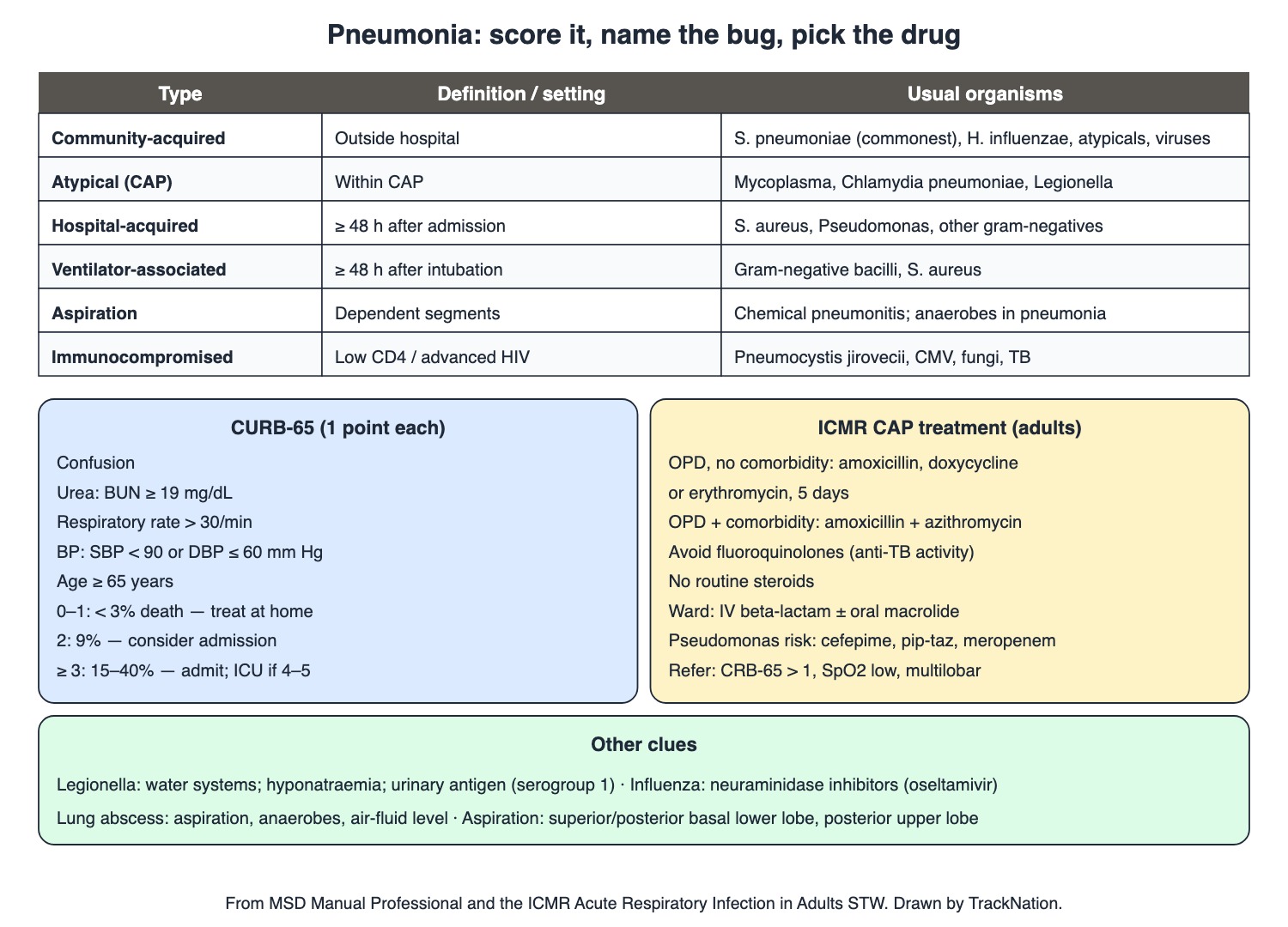
Pneumonia types and organisms, CURB-65 and ICMR treatment. Drawn by TrackNation.
Community-Acquired Pneumonia
Organisms: S. pneumoniae is the commonest in all ages and settings; also H. influenzae, atypicals (Mycoplasma, Chlamydia pneumoniae, Legionella) and viruses. S. aureus (including MRSA) and Pseudomonas need specific risk factors. Psittacosis follows exposure to parrots and related birds.
Signs: fever, tachypnoea, tachycardia, crackles, bronchial breath sounds, egophony. In the elderly: confusion.
Tests (admitted patients): blood cultures, sputum Gram stain and culture, urinary pneumococcal and Legionella antigens, HIV screening; chest X-ray.
Severity: CURB-65 (CRB-65 without urea in primary care).
CURB-65 point | Criterion |
C | Confusion |
U | Urea: BUN ≥ 19 mg/dL (6.8 mmol/L) |
R | Respiratory rate > 30/min |
B | SBP < 90 or DBP ≤ 60 mm Hg |
65 | Age ≥ 65 |
Score 0–1 | Death risk < 3% — outpatient |
Score 2 | 9% — consider admission |
Score ≥ 3 | 15–40% — admit; ICU at 4–5 |
Treatment: the ICMR Workflow
Upper respiratory infection and acute bronchitis: symptomatic care; antibiotics only for clear indications (amoxicillin for acute follicular tonsillitis; purulent sputum with leukocytosis in bronchitis).
In India, fluoroquinolones are not used for CAP because their anti-tubercular activity can mask tuberculosis.
Non-invasive ventilation may help CAP with respiratory failure. Discharge when eating, afebrile and stable for at least 48 hours.
Setting (ICMR ARI STW) | Treatment |
Outpatient CAP, no comorbidity | Amoxicillin 500 mg TDS, or erythromycin, or doxycycline — 5 days |
Outpatient CAP with comorbidity | Amoxicillin 500 mg TDS + azithromycin 500 mg OD; 7–10 days if slow response |
Do not give | Fluoroquinolones (anti-TB activity, can mask TB); steroids unless otherwise indicated |
Ward (non-ICU) | IV beta-lactam; add oral macrolide for atypicals, comorbidity or recent antibiotics |
Suspected Pseudomonas | Cefepime, ceftazidime, piperacillin–tazobactam or meropenem (± amikacin) |
Refer if | CRB-65 > 1, low SpO2, multilobar shadows, confusion, hypothermia, frank haemoptysis |
Other Pneumonias
Hospital-acquired: ≥ 48 hours after admission — S. aureus, Pseudomonas and other gram-negatives; resistance is a concern. Ventilator-associated: ≥ 48 hours after intubation — gram-negative bacilli and S. aureus.
Aspiration: chemical pneumonitis from sterile gastric contents; aspiration pneumonia and lung abscess from oral secretions with anaerobes. Shadows sit in dependent segments — superior or posterior basal segments of a lower lobe, posterior segment of an upper lobe.
Immunocompromised: in advanced HIV (low CD4) — Pneumocystis jirovecii, Toxoplasma, CMV, fungi, mycobacteria.
Legionella: lives in fresh water and building water systems; labs show hyponatraemia, hypophosphataemia and raised transaminases; urinary antigen detects serogroup 1 only.
Influenza: incubation 1–4 days (average 48 hours); antigenic drift causes yearly variants; complications include primary viral and secondary bacterial pneumonia; neuraminidase inhibitors (oseltamivir, zanamivir, peramivir) or baloxavir.
Traps the Examiner Sets
Commonest CAP bug everywhere: pneumococcus.
CURB-65: urea ≥ 19 mg/dL BUN, RR > 30, SBP < 90 or DBP ≤ 60, age ≥ 65.
India: no fluoroquinolone for CAP (masks TB).
HAP/VAP = after 48 hours.
Pneumonia + low sodium + water-system exposure → Legionella.
Memory Hooks & Shortcuts
Shortcuts to lock in this article's numbers and lists. Each one only re-packages facts proven above.
🧠 CURB-65 = Confused Urea Rises, Breathing fast, BP drops, 65 — CURB-65
🧠 0-1 home, 2 hospital, 3+ high (ICU at 4-5) — CURB-65 action
🧠 In India 'No FQ for CAP' — Fluoroquinolones Quieten TB — fluoroquinolones
🧠 HAP/VAP: 48 hours = 2 days in → hospital bugs (Staph, Pseudomonas) — HAP/VAP
🧠 Legionella: Low sodium, Loves water, Lab urine antigen — Legionella
🧠 Aspiration falls Down and Back (dependent segments) — aspiration
Rapid-Revision Cards
Commonest CAP organism
S. pneumoniae.
Atypicals
Mycoplasma, Chlamydia pneumoniae, Legionella.
CURB-65
Confusion, BUN ≥ 19, RR > 30, SBP < 90/DBP ≤ 60, age ≥ 65.
CURB-65 0–1
< 3% death; outpatient.
CURB-65 2
9%; consider admission.
CURB-65 ≥ 3
15–40%; admit; ICU at 4–5.
Primary-care score
CRB-65.
ICMR OPD CAP
Amoxicillin (or erythromycin/doxycycline), 5 days.
ICMR OPD CAP + comorbidity
Amoxicillin + azithromycin.
No fluoroquinolones (India)
Anti-TB activity masks TB.
Pseudomonas cover
Cefepime, ceftazidime, pip-taz, meropenem.
ICMR referral
CRB-65 > 1, SpO2 ≤ 92% (≤ 50 y), multilobar, confusion.
HAP
≥ 48 h after admission; S. aureus, Pseudomonas.
VAP
≥ 48 h after intubation; GNB, S. aureus.
Aspiration sites
Superior/posterior basal lower lobe; posterior upper lobe.
Lung abscess
Aspiration; anaerobes.
Advanced HIV pneumonia
Pneumocystis jirovecii.
Legionella
Water systems; hyponatraemia; urinary Ag serogroup 1.
Influenza drugs
Neuraminidase inhibitors; baloxavir.
Psittacosis
Birds; Chlamydia psittaci.
Sources
Facts in this article were checked against these documents.
MSD Manual Professional: Overview of Pneumonia; Community-Acquired Pneumonia; Hospital-Acquired Pneumonia; Ventilator-Associated Pneumonia; Aspiration Pneumonitis and Pneumonia; Pneumonia in Immunocompromised Patients; Lung Abscess — Merck & Co. (MSD Manuals), reviewed 2025–26 (link)
MSD Manual Professional: Legionella Infections; Influenza — Merck & Co. (MSD Manuals), reviewed 2026 (link)
Standard Treatment Workflow: Acute Respiratory Infection in Adults — ICMR / Department of Health Research, MoHFW, 2019 (link)
Competency Based Undergraduate Curriculum, General Medicine (GM 3) — National Medical Commission, 2024
Test Yourself: Practice Questions
Thirty questions in NEET PG style, most of them clinical vignettes.
Practice Questions (NEET PG pattern)
Original questions written in the style of the exam: +4 for a correct answer, −1 for a wrong one. Every answer was checked against the sources listed above. NEET PG papers are not published by NBEMS, so these are not past-paper questions.
Q1. The commonest organism causing community-acquired pneumonia in all age groups is
(a) Klebsiella pneumoniae
(b) Staphylococcus aureus
(c) Mycoplasma pneumoniae
(d) Streptococcus pneumoniae
Show answer
Answer: (d) — Atypicals and viruses are also common.
Q2. Which group lists the atypical causes of community-acquired pneumonia?
(a) Mycoplasma, Chlamydia pneumoniae, Legionella
(b) Pneumococcus, Haemophilus, Moraxella
(c) S. aureus, MRSA, Streptococcus pyogenes
(d) Pseudomonas, Klebsiella, E. coli
Show answer
Answer: (a) — Plus viruses.
Q3. A 72-year-old with pneumonia is confused, BUN 25 mg/dL, respiratory rate 32/min, BP 100/70 mm Hg. Her CURB-65 score is
(a) 2
(b) 3
(c) 4
(d) 5
Show answer
Answer: (c) — Confusion, urea, respiratory rate, age — BP does not score.
Q4. A CURB-65 score of 1 indicates
(a) death risk < 3% — outpatient treatment is usually appropriate
(b) need for mechanical ventilation
(c) risk of death 40%
(d) ICU admission
Show answer
Answer: (a) — Score 2 → consider admission.
Q5. With a CURB-65 score of 3 or more, mortality risk is about
(a) > 80%
(b) < 3%
(c) 9%
(d) 15–40%
Show answer
Answer: (d) — Admit; consider ICU with 4–5.
Q6. In primary care without blood tests, the ICMR workflow scores pneumonia severity using
(a) APACHE II
(b) CRB-65
(c) SOFA
(d) PSI
Show answer
Answer: (b) — CURB-65 without urea.
Q7. A 30-year-old with no comorbidity has mild CAP (CRB-65 = 0). Per ICMR, the first-line antibiotic is
(a) IV meropenem
(b) levofloxacin
(c) oral ciprofloxacin
(d) oral amoxicillin 500 mg three times a day
Show answer
Answer: (d) — Erythromycin or doxycycline are alternatives; 5 days.
Q8. A diabetic outpatient with CAP should, per ICMR, receive
(a) moxifloxacin
(b) amoxicillin alone for 3 days
(c) IV amikacin
(d) amoxicillin plus azithromycin
Show answer
Answer: (d) — Comorbidities change the regimen.
Q9. Why does the ICMR workflow advise against fluoroquinolones for CAP?
(a) they are too expensive
(b) they are inactive against pneumococcus
(c) they cause hypokalaemia
(d) their anti-tubercular activity can mask TB
Show answer
Answer: (d) — TB is common in India.
Q10. Per ICMR, corticosteroids in non-severe CAP are
(a) not given unless another medical indication exists
(b) first-line
(c) routine
(d) given to all inpatients
Show answer
Answer: (a) — Not recommended in non-severe CAP.
Q11. A hospitalised CAP patient with bronchiectasis and chronic steroid use needs cover for Pseudomonas. A suitable ICMR choice is
(a) erythromycin
(b) doxycycline
(c) piperacillin–tazobactam
(d) oral amoxicillin
Show answer
Answer: (c) — Also cefepime, ceftazidime, meropenem.
Q12. Which feature is an ICMR criterion to refer a CAP patient to a higher centre?
(a) multilobar consolidation on chest X-ray
(b) temperature 38 °C alone
(c) mild sore throat
(d) cough for 3 days
Show answer
Answer: (a) — Also CRB-65 > 1, low SpO2, confusion, hypothermia.
Q13. In a patient aged under 50 with CAP, the ICMR SpO2 threshold for referral is
(a) ≤ 98%
(b) ≤ 70%
(c) ≤ 80%
(d) ≤ 92%
Show answer
Answer: (d) — < 90% in those over 50.
Q14. Pneumonia developing 4 days after admission for a hip fracture is
(a) aspiration pneumonitis by definition
(b) community-acquired pneumonia
(c) hospital-acquired pneumonia
(d) ventilator-associated pneumonia
Show answer
Answer: (c) — HAP = at least 48 hours after admission.
Q15. The commonest organisms in hospital-acquired pneumonia are
(a) S. aureus and Pseudomonas with other gram-negatives
(b) Mycoplasma and Chlamydia
(c) Pneumocystis and CMV
(d) pneumococcus and Haemophilus
Show answer
Answer: (a) — Resistance is a major concern.
Q16. Ventilator-associated pneumonia is defined as pneumonia arising
(a) only in children
(b) within 6 hours of intubation
(c) at least 48 hours after endotracheal intubation
(d) after discharge
Show answer
Answer: (c) — Gram-negative bacilli and S. aureus dominate.
Q17. A patient with a decreased level of consciousness aspirates and develops pneumonia. The usual sites are
(a) the apices only
(b) the lingula only
(c) the anterior segments
(d) superior or posterior basal segments of a lower lobe, or posterior segment of an upper lobe
Show answer
Answer: (d) — Aspiration.
Q18. Inhaling a large volume of sterile gastric contents causes
(a) Pneumocystis pneumonia
(b) chemical pneumonitis
(c) lung abscess immediately
(d) Legionella pneumonia
Show answer
Answer: (b) — Bacterial aspiration pneumonia differs.
Q19. The commonest organisms in a lung abscess after aspiration are
(a) Pneumocystis
(b) influenza virus
(c) anaerobic bacteria
(d) Mycoplasma
Show answer
Answer: (c) — From oral secretions.
Q20. A patient with advanced HIV (very low CD4 count) has bilateral pneumonia. A classic opportunistic cause is
(a) Mycoplasma
(b) Legionella only
(c) Pneumocystis jirovecii
(d) Streptococcus pneumoniae only
Show answer
Answer: (c) — Also Toxoplasma, CMV, fungi, mycobacteria.
Q21. A pneumonia cluster is traced to a contaminated building water system; patients have low sodium, low phosphate and raised transaminases. The organism is
(a) Klebsiella
(b) Legionella
(c) Mycoplasma
(d) pneumococcus
Show answer
Answer: (b) — Lives in fresh water and building plumbing.
Q22. The Legionella urinary antigen test detects
(a) all Legionella species
(b) L. pneumophila serogroup 1 only
(c) pneumococcus
(d) Mycoplasma
Show answer
Answer: (b) — A negative test does not exclude other serogroups.
Q23. Oseltamivir acts on influenza by
(a) blocking DNA polymerase
(b) inhibiting neuraminidase
(c) inhibiting endonuclease
(d) inhibiting reverse transcriptase
Show answer
Answer: (b) — Baloxavir is the endonuclease inhibitor.
Q24. The average incubation period of influenza is
(a) 48 hours (range 1–4 days)
(b) 2 weeks
(c) 6 hours
(d) 1 month
Show answer
Answer: (a) — Mild cases resemble a cold.
Q25. Minor progressive mutations of influenza haemagglutinin and neuraminidase producing yearly variants are called
(a) phase variation
(b) antigenic shift
(c) antigenic drift
(d) reassortment pandemics
Show answer
Answer: (c) — Shift is a major change.
Q26. A bird keeper develops pneumonia. The organism to consider is
(a) Chlamydia psittaci
(b) Coxiella only
(c) Legionella
(d) Pneumocystis
Show answer
Answer: (a) — Psittacosis is rare.
Q27. An elderly patient with pneumonia may present mainly with
(a) diarrhoea only
(b) confusion
(c) joint swelling
(d) rash
Show answer
Answer: (b) — Delirium carries higher mortality.
Q28. A patient with suspected CAP also has frank haemoptysis. The ICMR workflow says this may suggest
(a) pulmonary TB or malignancy
(b) bronchitis
(c) viral URI
(d) asthma
Show answer
Answer: (a) — Frank haemoptysis is also a referral criterion.
Q29. Which test is part of the work-up for a patient admitted with CAP?
(a) urinary VMA
(b) urinary pneumococcal and Legionella antigens
(c) D-dimer
(d) serum amylase
Show answer
Answer: (b) — Also blood and sputum cultures and HIV screening.
Q30. Per ICMR, a CAP inpatient can be discharged when
(a) CRP is normal
(b) after 14 days of IV antibiotics
(c) eating, afebrile and haemodynamically stable for at least 48 hours
(d) the chest X-ray is completely clear
Show answer
Answer: (c) — X-ray clearing lags behind recovery.
Active Recall
From memory: list CAP organisms; give the CURB-65 components and what each score means; state the ICMR outpatient and inpatient regimens, why fluoroquinolones are avoided and the referral criteria; define HAP and VAP with organisms; describe aspiration, lung abscess, PCP, Legionella and influenza features.