Cholera, Campylobacter, H. pylori and Food Poisoning for NEET PG Microbiology: Diarrhoea vs Dysentery, Toxins and ICMR Management
Start Here
🎯 Exam priority: High. Expect: incubation-period clues for food poisoning, B. cereus and rice, cholera serogroups, stool appearance, TCBS and risk factors, single-dose doxycycline, Campylobacter → Guillain–Barré, V. vulnificus in liver disease, Yersinia mimicking appendicitis, H. pylori tests, ulcer site and cancers, C. difficile triggers, and ICMR ORS/zinc doses.
CBME mapping: MI4.1–4.6. Fact-checked against the MSD Manual, OpenStax Microbiology and the ICMR acute diarrhoea workflow (2019).
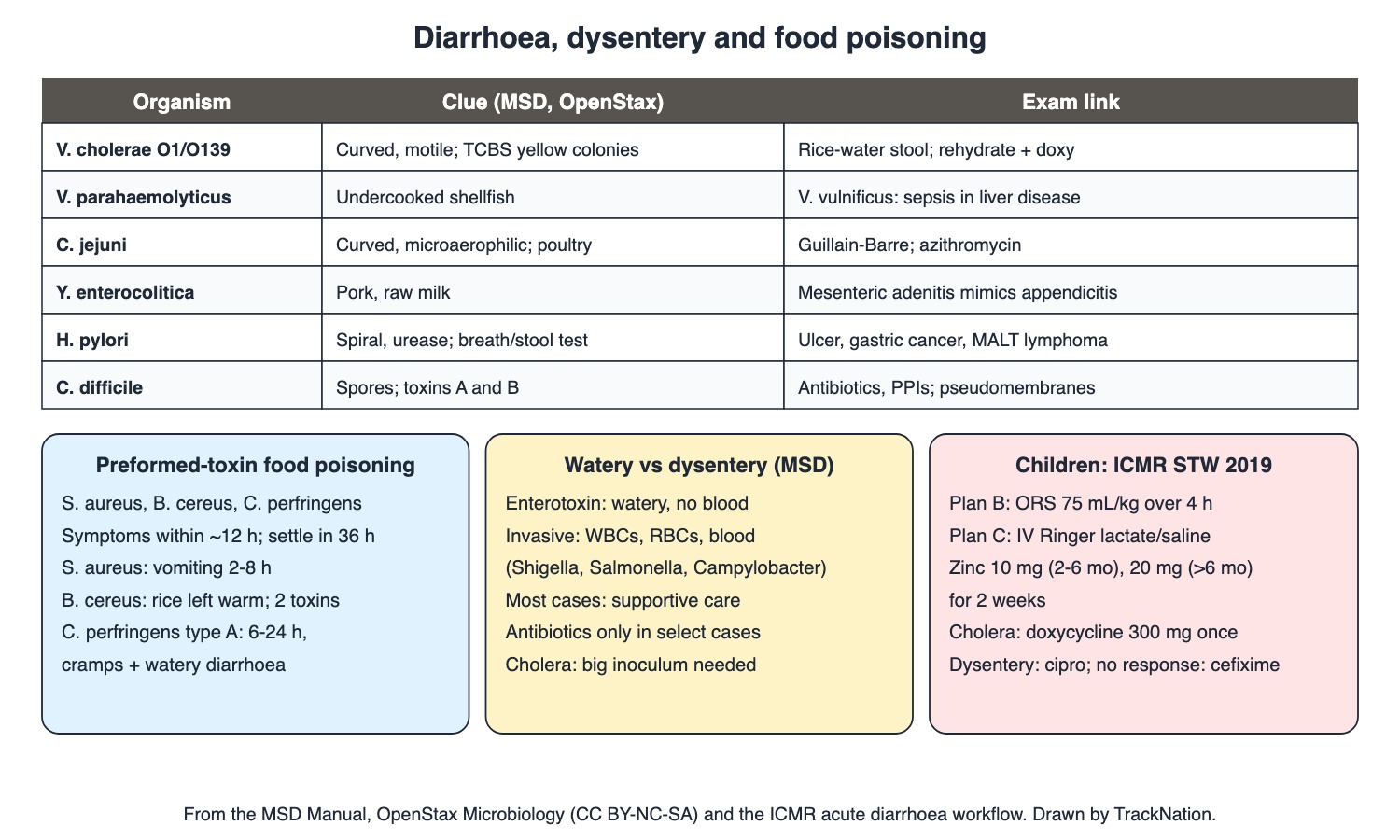
Diarrhoeal pathogens, food poisoning and ICMR management. Drawn by TrackNation.
Diarrhoea, Dysentery and Food Poisoning (MSD, OpenStax)
Enterotoxin diarrhoea is watery; invasive organisms (Shigella, Salmonella, Campylobacter) cause dysentery — WBCs and RBCs in stool, sometimes gross blood. Most gastroenteritis needs only supportive care and rehydration; antibiotics only in select cases.
Preformed-toxin food poisoning (S. aureus, B. cereus, C. perfringens): nausea, vomiting and diarrhoea within ~12 hours, settling within 36 hours. S. aureus: vomiting at 2–8 h (article 07).
Bacillus cereus: spores survive cooking; illness after rice or other food left at room temperature; two toxins — one emetic, one diarrhoeal. C. perfringens type A: spores survive cooking of meat; cramps and watery diarrhoea 6–24 h later, gone within a day.
C. difficile: spore-forming gram-positive rod; overgrowth after antibiotics (and with PPIs); toxins A and B → pseudomembranous colitis (more in article 13).
Cholera and Other Vibrios (MSD, OpenStax)
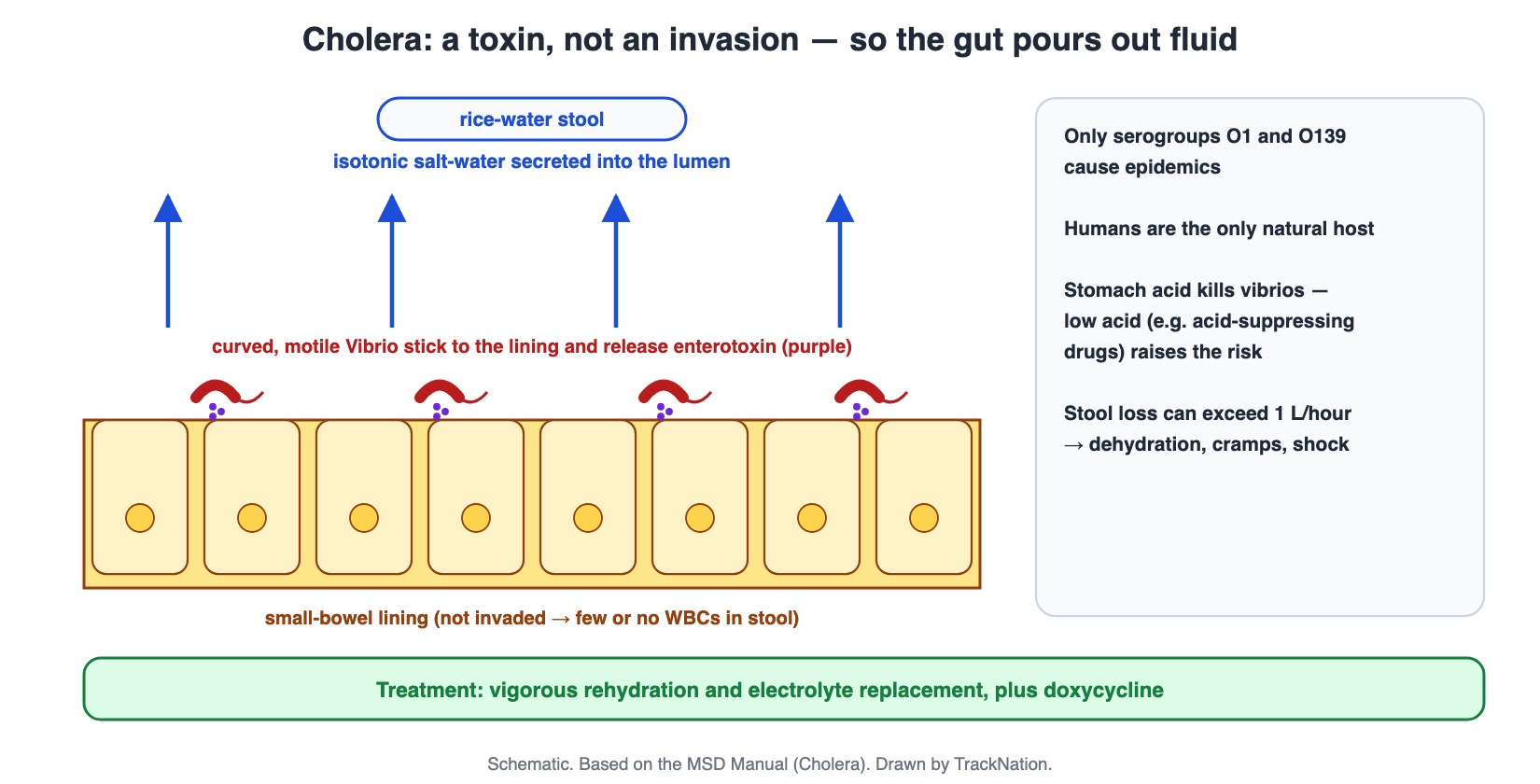
How cholera toxin drains the gut without invading it. Drawn by TrackNation.
V. cholerae: short, curved, motile gram-negative bacillus; humans are the only natural host. Epidemic disease from serogroups O1 and O139; the El Tor biotype now predominates (more mild/asymptomatic infection).
Spread by contaminated water or shellfish; a large inoculum is needed (person-to-person spread uncommon). Higher risk with blood group O and hypo/achlorhydria (including acid-suppressing drugs). Incubation 1–3 days.
Painless profuse watery rice-water stool and vomiting → severe dehydration, cramps, hypokalaemia, acidosis. Stool on TCBS gives yellow colonies; hanging-drop microscopy is used in suspected cases (ICMR).
Treatment: rapid rehydration (ORS; IV isotonic fluid if severe) plus a single dose of doxycycline 300 mg (or azithromycin). Oral cholera vaccines exist.
V. parahaemolyticus: undercooked shellfish → diarrhoea. V. vulnificus: septicaemia with high mortality, especially in chronic liver disease; also severe wound infection from warm seawater.
Campylobacter, Yersinia and H. pylori (MSD, OpenStax)
Campylobacter jejuni: curved, microaerophilic; undercooked poultry, raw milk, water; peak at ages 1–5. Complications: Guillain–Barré syndrome (antibodies cross-react with gangliosides; 20–50% of GBS follows C. jejuni), reactive arthritis. Treat, when needed, with azithromycin.
Yersinia enterocolitica: raw/undercooked pork, unpasteurised milk; mesenteric adenitis that mimics appendicitis. Its cousin Y. pestis (plague) is spread by rat fleas, shows safety-pin bipolar staining; pneumonic plague is highly contagious; streptomycin or gentamicin.
H. pylori: spiral, gram-negative, urease-producing (ammonia neutralises acid); acquired in childhood in low- and middle-income countries. Antral infection → high gastrin and acid → duodenal ulcer; body infection → atrophy, gastric ulcer and adenocarcinoma; also MALT lymphoma.
Tests: urea breath test, stool antigen, biopsy (rapid urease test, histology); culture is of limited use. Treatment: PPI + 2 antibiotics ± bismuth; bismuth quadruple therapy for 14 days where clarithromycin resistance exceeds 15%.
Children with Diarrhoea: ICMR Workflow (2019)
Plan B (some dehydration): ORS 75 mL/kg over 4 hours in the clinic. Plan C (severe): urgent IV fluids — Ringer lactate or normal saline.
Zinc for 2 weeks: 10 mg/day at 2–6 months, 20 mg/day above 6 months; continue breastfeeding.
Suspected cholera: stool hanging drop; where cholera is prevalent, doxycycline 300 mg single dose (tetracycline, or erythromycin in young children).
Dysentery: ciprofloxacin 15 mg/kg twice daily, reassess after 2 days; if no improvement, cefixime 10 mg/kg/day. Amoebiasis or giardiasis on stool microscopy → metronidazole.
Traps the Examiner Sets
Vomiting within hours = preformed toxin (S. aureus, B. cereus emetic); 6–24 h with cramps = C. perfringens.
Cholera diarrhoea is painless and watery — not dysentery.
Guillain–Barré after a diarrhoeal illness → think Campylobacter.
Antral H. pylori gives duodenal ulcer; body-predominant gives gastric ulcer and cancer.
V. vulnificus causes no enteritis but deadly septicaemia (bullae, DIC) in liver disease, and severe wound infection from seawater.
Memory Hooks & Shortcuts
Shortcuts to lock in this article's numbers and lists. Each one only re-packages facts proven above.
🧠 Food-poisoning clock: 'Staph and cereus in a Snap (2–8 h); Perfringens Patiently (6–24 h)' — food poisoning
🧠 Cholera 'O1, O139 — One Big Rice-water flood'; treat with 'Doxy once' — cholera
🧠 'Chicken → Campylobacter → Can't walk (GBS)' — Campylobacter
🧠 'Pork → Pseudo-appendicitis' (Yersinia) — Yersinia
🧠 H. pylori: 'Antrum → Acid → Duodenal; Body → Bad (cancer)' — H. pylori
Rapid-Revision Cards
Dysentery
WBC + RBC; invasive organisms.
Preformed toxin
Within 12 h; gone in 36 h.
B. cereus
Rice left warm; emetic + diarrhoeal toxins.
C. perfringens
Type A; meat; 6–24 h.
Cholera serogroups
O1, O139; El Tor.
Cholera incubation
1–3 days.
Cholera stool
Painless rice-water.
Cholera risk
Blood group O; achlorhydria.
TCBS
Yellow Vibrio colonies.
Cholera drug
Doxycycline 300 mg once.
V. vulnificus
Sepsis in liver disease.
Campylobacter
Microaerophilic; poultry; azithro.
Campylobacter → GBS
20–50% of GBS cases.
Yersinia enterocolitica
Pork; pseudoappendicitis.
Plague
Rat flea; safety-pin; streptomycin.
H. pylori
Spiral, urease; childhood.
Antral vs body
Duodenal ulcer vs gastric ulcer/cancer.
H. pylori tests
Breath, stool antigen, RUT.
C. difficile
Antibiotics, PPIs; pseudomembranes.
ICMR Plan B
ORS 75 mL/kg over 4 h.
ICMR zinc
10 mg (2–6 mo), 20 mg (>6 mo) × 2 wk.
Sources
Facts in this article were checked against these documents.
MSD Manual Professional: Overview of Gastroenteritis; Cholera; Noncholera Vibrio; Campylobacter; Plague and Other Yersinia; H. pylori; C. perfringens Food Poisoning — Merck & Co. (MSD Manuals), 2024–26 (link)
Microbiology (section 24.3) — Parker N, Schneegurt M, Thi Tu A-H, Lister P, Forster BM (OpenStax), 2016 (link)
Standard Treatment Workflow: Management of Acute Diarrhea (paediatrics) — Indian Council of Medical Research / Department of Health Research, 2019
Competency Based Undergraduate Curriculum, Vol I: Microbiology (MI4.1–4.6) — National Medical Commission, 2024
Test Yourself: Practice Questions
Thirty questions in NEET PG style, most of them clinical vignettes.
Practice Questions (NEET PG pattern)
Original questions written in the style of the exam: +4 for a correct answer, −1 for a wrong one. Every answer was checked against the sources listed above. NEET PG papers are not published by NBEMS, so these are not past-paper questions.
Q1. Diarrhoea with pus cells and red cells in the stool indicates
(a) an enterotoxin-only process
(b) viral gastroenteritis
(c) an invasive (dysenteric) process
(d) lactose intolerance
Show answer
Answer: (c) — Shigella, Salmonella, Campylobacter.
Q2. Food poisoning from preformed toxins typically causes symptoms within
(a) a month
(b) 3–5 days
(c) 12 hours, settling within 36 hours
(d) 1–2 weeks
Show answer
Answer: (c) — S. aureus, B. cereus, C. perfringens.
Q3. Vomiting a few hours after eating rice left at room temperature for many hours suggests
(a) Bacillus cereus emetic toxin
(b) Clostridium botulinum
(c) Shigella
(d) Vibrio cholerae
Show answer
Answer: (a) — Spores survive cooking.
Q4. Abdominal cramps and watery diarrhoea 6–24 hours after eating meat cooked in bulk and left warm point to
(a) S. aureus
(b) Clostridium perfringens type A
(c) V. parahaemolyticus
(d) B. cereus emetic toxin
Show answer
Answer: (b) — MSD.
Q5. Epidemic cholera is caused by V. cholerae serogroups
(a) O157 and H7
(b) O1 and O139
(c) K1 and K2
(d) O2 and O3
Show answer
Answer: (b) — El Tor biotype predominates.
Q6. The incubation period of cholera is
(a) 1–3 days
(b) 2–8 hours
(c) 1–2 weeks
(d) 3–4 weeks
Show answer
Answer: (a) — MSD.
Q7. Painless, profuse, watery stools looking like rice water suggest
(a) amoebic dysentery
(b) ulcerative colitis
(c) shigellosis
(d) cholera
Show answer
Answer: (d) — No blood.
Q8. People at higher risk of cholera include those with
(a) blood group O or achlorhydria
(b) sickle cell trait
(c) high gastric acid
(d) blood group AB
Show answer
Answer: (a) — Vibrios are acid-sensitive.
Q9. On TCBS agar, V. cholerae forms
(a) no growth
(b) pink colonies
(c) black colonies
(d) yellow colonies
Show answer
Answer: (d) — Selective and differential.
Q10. Person-to-person spread of cholera is uncommon because
(a) it spreads only by mosquitoes
(b) humans are not hosts
(c) the organism dies in stool
(d) a large inoculum is needed
Show answer
Answer: (d) — MSD.
Q11. The antibiotic regimen for cholera in an adult is
(a) a single dose of doxycycline 300 mg (with rehydration)
(b) IV ceftriaxone for 7 days
(c) ciprofloxacin for 14 days
(d) metronidazole
Show answer
Answer: (a) — Rehydration is the mainstay.
Q12. A patient with chronic liver disease develops septicaemia with bullous skin lesions after ingesting seafood. The likely organism is
(a) Shigella
(b) Vibrio vulnificus
(c) V. cholerae O1
(d) Campylobacter
Show answer
Answer: (b) — High fatality.
Q13. Campylobacter jejuni is best described as
(a) gram-negative diplococcus
(b) acid-fast bacillus
(c) curved, microaerophilic gram-negative rod
(d) spore-forming gram-positive rod
Show answer
Answer: (c) — MSD.
Q14. Ascending flaccid paralysis some weeks after a diarrhoeal illness from undercooked chicken suggests prior infection with
(a) Rotavirus
(b) Campylobacter jejuni
(c) Vibrio cholerae
(d) Shigella
Show answer
Answer: (b) — Ganglioside cross-reaction.
Q15. Campylobacter enteritis, when it needs treatment, is treated with
(a) vancomycin
(b) metronidazole
(c) penicillin
(d) azithromycin
Show answer
Answer: (d) — MSD.
Q16. Right iliac fossa pain mimicking appendicitis after eating undercooked pork suggests
(a) Vibrio parahaemolyticus
(b) C. perfringens
(c) Shigella
(d) Yersinia enterocolitica (mesenteric adenitis)
Show answer
Answer: (d) — MSD.
Q17. Plague is transmitted to humans mainly by
(a) the bite of an infected rat flea
(b) ticks
(c) sandfly
(d) Anopheles mosquito
Show answer
Answer: (a) — Pneumonic form spreads person to person.
Q18. Yersinia pestis on Giemsa stain shows
(a) spores
(b) acid-fast beading
(c) metachromatic granules
(d) bipolar 'safety-pin' staining
Show answer
Answer: (d) — MSD.
Q19. H. pylori survives gastric acid mainly by producing
(a) lipase
(b) urease, which generates ammonia
(c) catalase
(d) coagulase
Show answer
Answer: (b) — OpenStax.
Q20. Antral-predominant H. pylori infection predisposes to
(a) achlorhydria
(b) pernicious anaemia
(c) duodenal ulcer through increased gastrin and acid
(d) gastric atrophy
Show answer
Answer: (c) — Body-predominant → gastric ulcer, cancer.
Q21. A low-grade gastric B-cell tumour linked to H. pylori is
(a) Burkitt lymphoma
(b) GIST
(c) MALT lymphoma
(d) carcinoid
Show answer
Answer: (c) — MSD.
Q22. Non-invasive tests for H. pylori include
(a) urea breath test and stool antigen
(b) serum gastrin only
(c) Widal
(d) culture of gastric juice
Show answer
Answer: (a) — Biopsy for RUT if endoscopy.
Q23. Where clarithromycin resistance exceeds 15%, H. pylori is treated with
(a) clarithromycin triple therapy for 3 days
(b) bismuth quadruple therapy for 14 days
(c) amoxicillin alone
(d) PPI alone
Show answer
Answer: (b) — MSD.
Q24. C. difficile overgrowth is promoted by antibiotics and by
(a) probiotics
(b) high-fibre diet
(c) proton pump inhibitors
(d) vitamin C
Show answer
Answer: (c) — OpenStax.
Q25. C. difficile colitis can progress to
(a) pseudomembranous colitis
(b) coeliac disease
(c) ulcerative colitis
(d) Crohn disease
Show answer
Answer: (a) — Toxins A and B.
Q26. ETEC causes watery diarrhoea through
(a) a heat-stable enterotoxin similar to cholera toxin
(b) mucosal invasion
(c) Shiga toxin
(d) neurotoxin
Show answer
Answer: (a) — OpenStax.
Q27. Under the ICMR workflow, a child with some dehydration (Plan B) receives
(a) ORS 10 mL/kg once
(b) no fluids
(c) ORS 75 mL/kg over 4 hours
(d) IV Ringer lactate immediately
Show answer
Answer: (c) — Plan C = IV.
Q28. Zinc dose for a 9-month-old with acute diarrhoea (ICMR) is
(a) 20 mg/day for 2 weeks
(b) 50 mg/day for 5 days
(c) 20 mg once
(d) 10 mg/day for 2 weeks
Show answer
Answer: (a) — 10 mg at 2–6 months.
Q29. In a cholera-prevalent area, the ICMR workflow gives an older child or adult
(a) metronidazole
(b) cefixime for 5 days
(c) doxycycline 300 mg single dose
(d) ciprofloxacin for 7 days
Show answer
Answer: (c) — Erythromycin in young children.
Q30. Per the ICMR workflow, a child with dysentery starts on
(a) metronidazole first
(b) ciprofloxacin 15 mg/kg twice daily, switching to cefixime if no improvement in 2 days
(c) no antibiotic
(d) IV vancomycin
Show answer
Answer: (b) — Reassess at 2 days.
Active Recall
From memory: distinguish watery and invasive diarrhoea, give the timing and food clues for toxin food poisoning, describe cholera from serogroup to treatment, name the non-cholera vibrios, describe Campylobacter, Yersinia and plague, explain H. pylori disease, tests and treatment, outline C. difficile triggers, and state the ICMR paediatric diarrhoea plan.