Enterobacterales, Pseudomonas, Enteric Fever and UTI for NEET PG Microbiology: E. coli, STEC, Klebsiella, Shigella, Typhoid and ICMR Treatment
Start Here
🎯 Exam priority: Very high. Expect: culture timing in typhoid (blood vs stool vs marrow), Widal pitfalls, carriers, Indian quinolone resistance and first-line drugs, STEC and HUS (no antibiotics), Shigella inoculum, Proteus stones, Klebsiella pneumonia, Pseudomonas settings, UTI organisms, colony-count thresholds, who to treat for asymptomatic bacteriuria, and ICMR first-line UTI drugs.
CBME mapping: MI3.6–3.8, MI8.1. Fact-checked against the MSD Manual, the ICMR Treatment Guidelines for Antimicrobial Use (2019), the ICMR Standard Treatment Workflow for UTI (July 2026) and the WHO AWaRe antibiotic book.
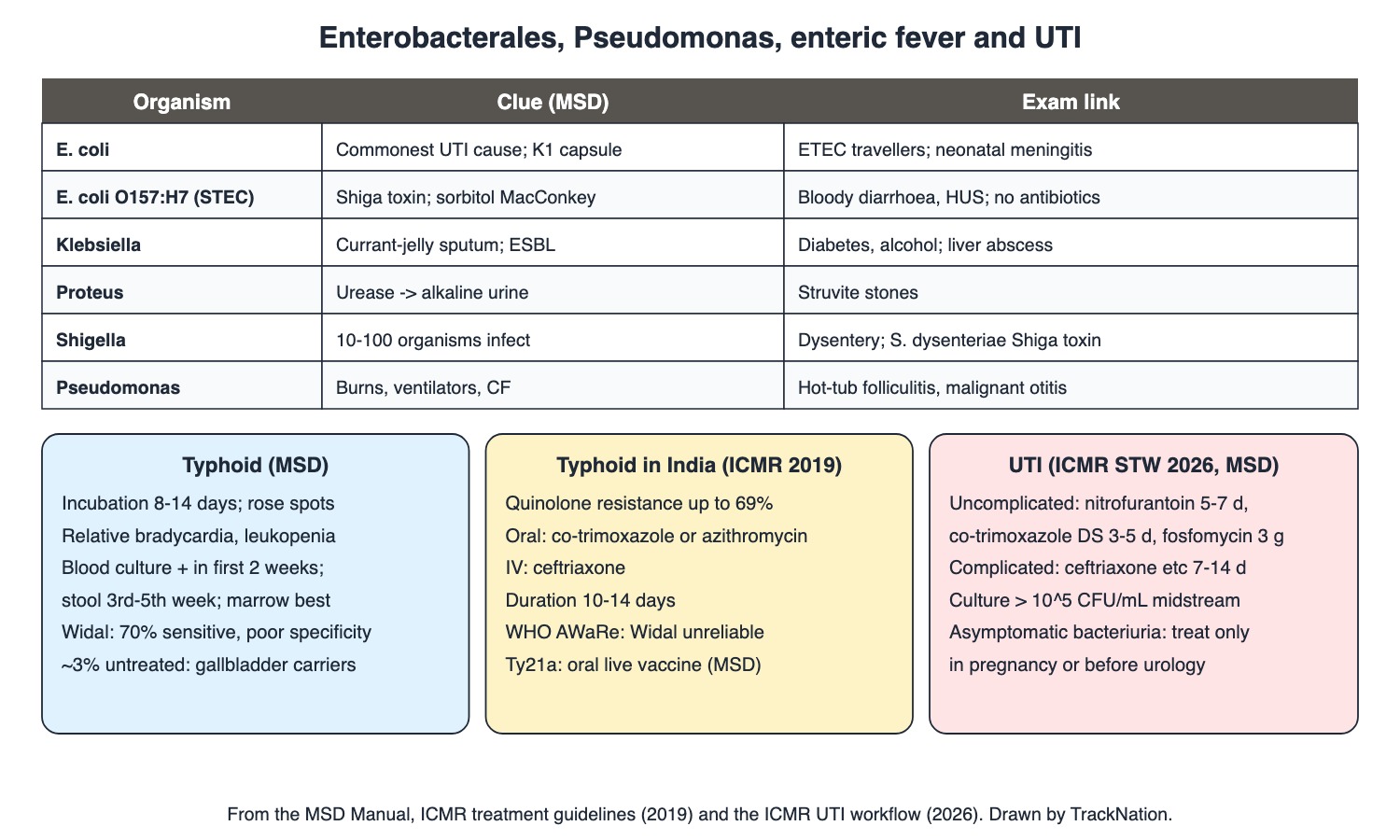
Enterobacterales, Pseudomonas, typhoid and UTI. Drawn by TrackNation.
E. coli, Klebsiella, Proteus, Shigella (MSD)
E. coli: the commonest cause of UTI (ascending from the perineum). Diarrhoeal pathotypes: ETEC — watery diarrhoea in infants and travellers; EIEC — inflammatory diarrhoea; EPEC — infant watery diarrhoea. K1 capsule strains cause neonatal meningitis.
STEC / EHEC (O157:H7), also called VTEC: Shiga toxin; undercooked ground beef or raw milk; bloody diarrhoea without much fever → haemolytic-uraemic syndrome. Screen on sorbitol MacConkey. Treatment supportive — antibiotics are not recommended (fluoroquinolones may raise HUS risk).
Klebsiella pneumonia: severe, currant-jelly sputum, lung abscess, empyema — in diabetes and alcohol use; also community-acquired liver abscess; ESBL producers common (ICMR: third-generation cephalosporin resistance up to 75% in E. coli/Klebsiella).
Proteus: urease → alkaline urine → struvite (magnesium ammonium phosphate) stones.
Shigella: just 10–100 organisms cause disease; subgroups A S. dysenteriae, B flexneri, C boydii, D sonnei; bloody diarrhoea (dysentery); S. dysenteriae type 1 makes Shiga toxin (HUS). Antibiotics (ciprofloxacin, azithromycin, ceftriaxone) for moderate–severe or high-risk cases.
Salmonella and Enteric Fever (MSD, ICMR, WHO)
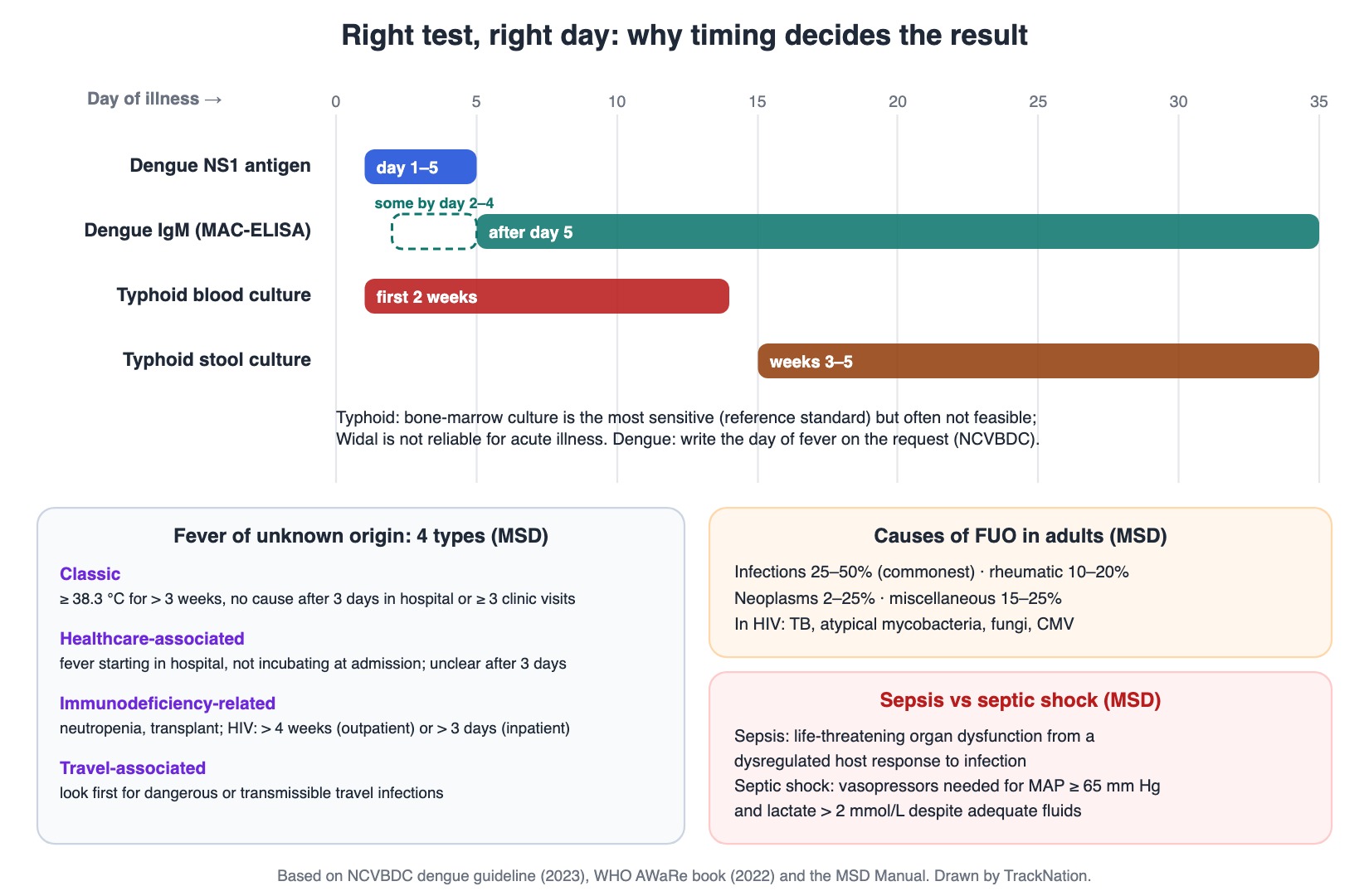
Which typhoid culture in which week (and dengue NS1 vs IgM). Drawn by TrackNation.
S. Typhi causes 70–80% of enteric fever (WHO); Paratyphi A, B, C the rest. Faecal–oral spread. Incubation 8–14 days (shorter with bigger doses). Gradual fever, relative bradycardia, rose spots on chest and abdomen in the second week (5–30%), splenomegaly, leukopenia; complications include intestinal haemorrhage and perforation.
Culture timing: blood culture positive mainly in the first 2 weeks; stool culture in weeks 3–5; bone marrow culture is highly sensitive (the reference standard, WHO). Widal (O and H antibodies; 4-fold rise in paired sera) is only ~70% sensitive, cross-reacts and is not reliable for acute diagnosis.
Chronic carriers: about 3% of untreated patients carry S. Typhi in the gallbladder for >1 year.
India (ICMR 2019): quinolone resistance up to 69% (Typhi) and 23% (Paratyphi A); low resistance to co-trimoxazole, chloramphenicol and third-generation cephalosporins. Oral: co-trimoxazole or azithromycin; parenteral: ceftriaxone (slower defervescence); 10–14 days. Always test susceptibility; the nalidixic-acid screen does not predict ciprofloxacin response (MSD). Ty21a is a live oral vaccine.
Nontyphoidal Salmonella: meat, poultry, eggs, raw milk, pet reptiles; higher risk with sickle cell disease, achlorhydria, HIV — recurrent Salmonella bacteraemia should prompt HIV testing.
Pseudomonas (MSD)
Opportunist of hospitals: burns (infection under the eschar → bacteraemia), ventilators, neutropenia; community infection in cystic fibrosis and advanced HIV. Greenish pus.
Classic links: hot-tub folliculitis, swimmer's ear, malignant external otitis in diabetes (cranial nerve palsies), ecthyma gangrenosum in neutropenia, puncture wounds of the foot.
Relatives: Burkholderia pseudomallei → melioidosis; B. cepacia; Stenotrophomonas.
Urinary Tract Infection (MSD, ICMR STW 2026)
Organisms: E. coli and other enteric gram-negatives lead; S. saprophyticus ~10–15%; Proteus, Klebsiella, Pseudomonas, enterococci. The main defence is complete bladder emptying; obstruction, stones, VUR, catheters and pregnancy raise risk.
Tests: nitrite (fresh urine) is specific but insensitive; leukocyte esterase marks >10 WBC. Culture: >105 CFU/mL in midstream urine (MSD and ICMR); >102 CFU/mL in a catheter specimen.
Asymptomatic bacteriuria: do not screen or treat, except in pregnancy (screen at 12–16 weeks) or before an invasive urological procedure.
ICMR STW (July 2026) — uncomplicated cystitis: nitrofurantoin 100 mg BD for 5–7 days, co-trimoxazole DS BD 3–5 days, or fosfomycin 3 g once; no urine culture needed for uncomplicated UTI. Complicated UTI/pyelonephritis: culture first, then e.g. ceftriaxone 1–2 g IV daily, cefoperazone-sulbactam or piperacillin-tazobactam for 7–14 days.
CAUTI: a biofilm forms on the catheter; remove or replace catheters early.
Traps the Examiner Sets
Typhoid week 1 → blood culture; weeks 3–5 → stool; negative but suspicious → bone marrow.
A single raised Widal titre in an endemic area does not diagnose typhoid.
Bloody diarrhoea without fever + HUS → STEC; avoid antibiotics.
Asymptomatic bacteriuria in a catheterised or elderly patient: no treatment; in pregnancy: treat.
In India, ciprofloxacin is a poor empirical choice for typhoid because of resistance.
Memory Hooks & Shortcuts
Shortcuts to lock in this article's numbers and lists. Each one only re-packages facts proven above.
🧠 Typhoid cultures 'BASU': Blood (week 1), Antibodies/Widal (week 2, unreliable), Stool and Urine (weeks 3–5) — Marrow anytime — typhoid
🧠 'Shigella is Stingy' — just 10–100 bugs; 'A-B-C-D: Dysenteriae, Flexneri, Boydii, Sonnei' — Shigella
🧠 'Proteus Pees Pure Stones' — urease, alkaline urine, struvite — Proteus
🧠 'STEC: Stop The Expensive Cipro' — antibiotics raise HUS risk — STEC
🧠 'Pseudomonas loves wet places': hot tubs, swimmer's ear, burns, ventilators — Pseudomonas
Rapid-Revision Cards
UTI commonest
E. coli.
ETEC
Traveller's watery diarrhoea.
STEC O157:H7
Bloody, little fever, HUS; sorbitol MacConkey.
STEC treatment
Supportive; avoid antibiotics.
Klebsiella
Currant-jelly sputum; diabetes, alcohol.
Proteus
Urease → struvite stones.
Shigella dose
10–100 organisms.
Shigella groups
A dysenteriae, B flexneri, C boydii, D sonnei.
Typhoid incubation
8–14 days.
Typhoid signs
Relative bradycardia, rose spots, leukopenia.
Typhoid cultures
Blood wk 1–2; stool wk 3–5; marrow best.
Widal
~70% sensitive; unreliable acutely.
Carrier
Gallbladder; ~3% untreated.
India typhoid
Quinolone R up to 69%; co-trimoxazole/azithro; ceftriaxone.
Ty21a
Live oral vaccine.
NTS + HIV
Recurrent bacteraemia → HIV test.
Pseudomonas
Burns, CF, hot tub, malignant otitis.
Melioidosis
Burkholderia pseudomallei.
Bacteriuria
>10^5 midstream; >10^2 catheter.
Treat ASB
Pregnancy; before urology.
ICMR cystitis
Nitrofurantoin 5–7 d; DS 3–5 d; fosfomycin 3 g.
Sources
Facts in this article were checked against these documents.
MSD Manual Professional: E. coli; EHEC; Klebsiella, Enterobacter, Serratia; Proteeae; Typhoid Fever; Nontyphoidal Salmonella; Shigellosis; Pseudomonas; Bacterial UTIs; CAUTI — Merck & Co. (MSD Manuals), 2024–26 (link)
Treatment Guidelines for Antimicrobial Use in Common Syndromes (2nd ed.) — Indian Council of Medical Research, 2019
Standard Treatment Workflow: Urinary Tract Infections — Indian Council of Medical Research / Department of Health Research, 2026
The WHO AWaRe (Access, Watch, Reserve) antibiotic book — World Health Organization, 2022
Competency Based Undergraduate Curriculum, Vol I: Microbiology (MI3.6–3.8, MI8.1) — National Medical Commission, 2024
Test Yourself: Practice Questions
Thirty questions in NEET PG style, most of them clinical vignettes.
Practice Questions (NEET PG pattern)
Original questions written in the style of the exam: +4 for a correct answer, −1 for a wrong one. Every answer was checked against the sources listed above. NEET PG papers are not published by NBEMS, so these are not past-paper questions.
Q1. The commonest cause of urinary tract infection is
(a) S. saprophyticus
(b) E. coli
(c) Proteus
(d) Enterococcus
Show answer
Answer: (b) — Ascending infection.
Q2. A traveller develops watery diarrhoea abroad. The usual E. coli pathotype is
(a) uropathogenic
(b) enteroinvasive (EIEC)
(c) enterotoxigenic (ETEC)
(d) enterohaemorrhagic (EHEC)
Show answer
Answer: (c) — Traveller's diarrhoea.
Q3. A patient has bloody diarrhoea without significant fever after eating undercooked ground beef, then develops haemolytic-uraemic syndrome. The organism is
(a) E. coli O157:H7 (STEC)
(b) Vibrio cholerae
(c) Campylobacter
(d) Salmonella Typhi
Show answer
Answer: (a) — HUS.
Q4. E. coli O157:H7 is screened for on
(a) TCBS
(b) XLD only
(c) Bordet–Gengou
(d) sorbitol MacConkey agar
Show answer
Answer: (d) — MSD.
Q5. In STEC infection, antibiotics are
(a) given as ciprofloxacin routinely
(b) not recommended; fluoroquinolones may increase HUS risk
(c) essential
(d) given only as metronidazole
Show answer
Answer: (b) — Supportive care.
Q6. Severe pneumonia with currant-jelly sputum and lung abscess in a man with alcohol use disorder suggests
(a) Klebsiella pneumoniae
(b) Streptococcus pneumoniae
(c) Legionella
(d) Mycoplasma
Show answer
Answer: (a) — Also diabetes; liver abscess.
Q7. Struvite stones with alkaline urine are linked with
(a) Enterococcus
(b) Proteus (urease)
(c) S. saprophyticus
(d) E. coli
Show answer
Answer: (b) — Magnesium ammonium phosphate.
Q8. Shigella causes disease after ingestion of as few as
(a) 10–100 organisms
(b) one million organisms
(c) 10^8 organisms
(d) 10^5 organisms
Show answer
Answer: (a) — Low inoculum.
Q9. The Shigella subgroup A is
(a) S. sonnei
(b) S. dysenteriae
(c) S. boydii
(d) S. flexneri
Show answer
Answer: (b) — B flexneri, C boydii, D sonnei.
Q10. The incubation period of typhoid fever is usually
(a) 6–24 hours
(b) 4–6 weeks
(c) 1–3 days
(d) 8–14 days
Show answer
Answer: (d) — Inverse to dose.
Q11. In the second week of a gradual high fever, a patient has a pulse slow for the degree of fever and pink blanching spots on the abdomen. The likely diagnosis is
(a) dengue
(b) malaria
(c) meningococcaemia
(d) typhoid fever
Show answer
Answer: (d) — Relative bradycardia, rose spots.
Q12. In the first week of suspected typhoid, the most useful culture is
(a) Widal
(b) stool culture
(c) urine culture
(d) blood culture
Show answer
Answer: (d) — Stool in weeks 3–5.
Q13. Stool culture in typhoid is usually positive in
(a) the third to fifth weeks
(b) never
(c) the first 3 days
(d) the incubation period
Show answer
Answer: (a) — MSD.
Q14. When blood and stool cultures are negative but typhoid is strongly suspected, the most sensitive test is
(a) bone marrow culture
(b) stool microscopy
(c) repeat urine culture
(d) Widal
Show answer
Answer: (a) — Reference standard (WHO).
Q15. The main limitation of the Widal test is
(a) it detects only Paratyphi
(b) it is too expensive
(c) it needs bone marrow
(d) moderate sensitivity and poor specificity, so it cannot diagnose acute illness reliably
Show answer
Answer: (d) — Cross-reactions.
Q16. Chronic typhoid carriers harbour the organism mainly in the
(a) bone marrow
(b) kidney
(c) spleen
(d) gallbladder
Show answer
Answer: (d) — About 3% of untreated.
Q17. According to ICMR (2019), quinolone resistance in Salmonella Typhi in India is as high as
(a) 20%
(b) 5%
(c) 69%
(d) 100%
Show answer
Answer: (c) — Paratyphi A 23%.
Q18. ICMR's oral options for typhoid fever are
(a) ciprofloxacin alone
(b) co-trimoxazole or azithromycin
(c) doxycycline
(d) amoxicillin alone
Show answer
Answer: (b) — Parenteral ceftriaxone.
Q19. The live oral typhoid vaccine strain is
(a) Ty21a
(b) Vi polysaccharide only
(c) BCG
(d) Sabin
Show answer
Answer: (a) — MSD.
Q20. Recurrent nontyphoidal Salmonella bacteraemia in an otherwise healthy adult should prompt testing for
(a) lupus
(b) HIV
(c) diabetes
(d) thyroid disease
Show answer
Answer: (b) — MSD.
Q21. Children with sickle cell disease are prone to osteomyelitis caused by
(a) Pseudomonas
(b) Salmonella
(c) Klebsiella
(d) Proteus
Show answer
Answer: (b) — Haemolytic conditions.
Q22. An itchy pustular rash around hair follicles after using a hot tub is due to
(a) Malassezia
(b) Candida
(c) Pseudomonas aeruginosa
(d) S. aureus
Show answer
Answer: (c) — Self-limiting.
Q23. A patient with diabetes has severe ear pain with a cranial nerve palsy. The likely infection is
(a) malignant external otitis due to Pseudomonas
(b) Aspergillus otomycosis
(c) acute otitis media due to pneumococcus
(d) herpes zoster oticus only
Show answer
Answer: (a) — Parenteral therapy.
Q24. Ecthyma gangrenosum is seen in
(a) children with impetigo
(b) syphilis
(c) neutropenic patients with Pseudomonas bacteraemia
(d) leprosy
Show answer
Answer: (c) — MSD.
Q25. Melioidosis is caused by
(a) Stenotrophomonas
(b) Burkholderia pseudomallei
(c) Pseudomonas aeruginosa
(d) Brucella
Show answer
Answer: (b) — Previously Pseudomonas pseudomallei.
Q26. The coagulase-negative staphylococcus causing about 10–15% of bacterial UTIs is
(a) S. hominis
(b) S. lugdunensis
(c) S. saprophyticus
(d) S. epidermidis
Show answer
Answer: (c) — MSD.
Q27. Significant bacteriuria in a midstream clean-catch urine is usually
(a) any growth
(b) more than 10^8 CFU/mL
(c) more than 10^2 CFU/mL
(d) more than 10^5 CFU/mL
Show answer
Answer: (d) — Catheter specimen >10^2.
Q28. Asymptomatic bacteriuria should be treated
(a) in pregnancy or before an invasive urological procedure
(b) in all catheterised patients
(c) in diabetics
(d) in all elderly patients
Show answer
Answer: (a) — MSD; ICMR.
Q29. Per the ICMR UTI workflow (2026), a first-line option for uncomplicated cystitis is
(a) ceftriaxone for 14 days
(b) IV meropenem
(c) nitrofurantoin 100 mg BD for 5–7 days
(d) vancomycin
Show answer
Answer: (c) — Or co-trimoxazole DS, fosfomycin 3 g.
Q30. Bacteria in catheter-associated UTI are hard to eradicate mainly because of
(a) capsule
(b) biofilm on the catheter
(c) spore formation
(d) intracellular survival
Show answer
Answer: (b) — Remove or change the catheter.
Active Recall
From memory: list the E. coli pathotypes and the features and management of STEC, give clues for Klebsiella, Proteus and Shigella, describe typhoid course, culture timing, Widal limits, carriers and Indian treatment, list Pseudomonas settings, and outline UTI organisms, culture thresholds, asymptomatic bacteriuria rules and ICMR first-line treatment.