Diphtheria, Meningococcus, Haemophilus and Pertussis for NEET PG Microbiology: Toxins, Lab Clues, Meningitis Causes and India's UIP
Start Here
🎯 Exam priority: High. Expect: diphtheria toxin genetics and complications, Elek test and media, meningococcal rash and adrenal haemorrhage, complement-deficiency risk, chemoprophylaxis, Haemophilus growth factors, pertussis stages and blood picture, Listeria clues, which organism causes meningitis at which age, CSF pattern, and the UIP schedule for DPT-containing vaccines.
CBME mapping: MI6.1, MI6.3, MI7.1–7.2. Fact-checked against the MSD Manual, OpenStax Microbiology and the MoHFW UIP (2026).
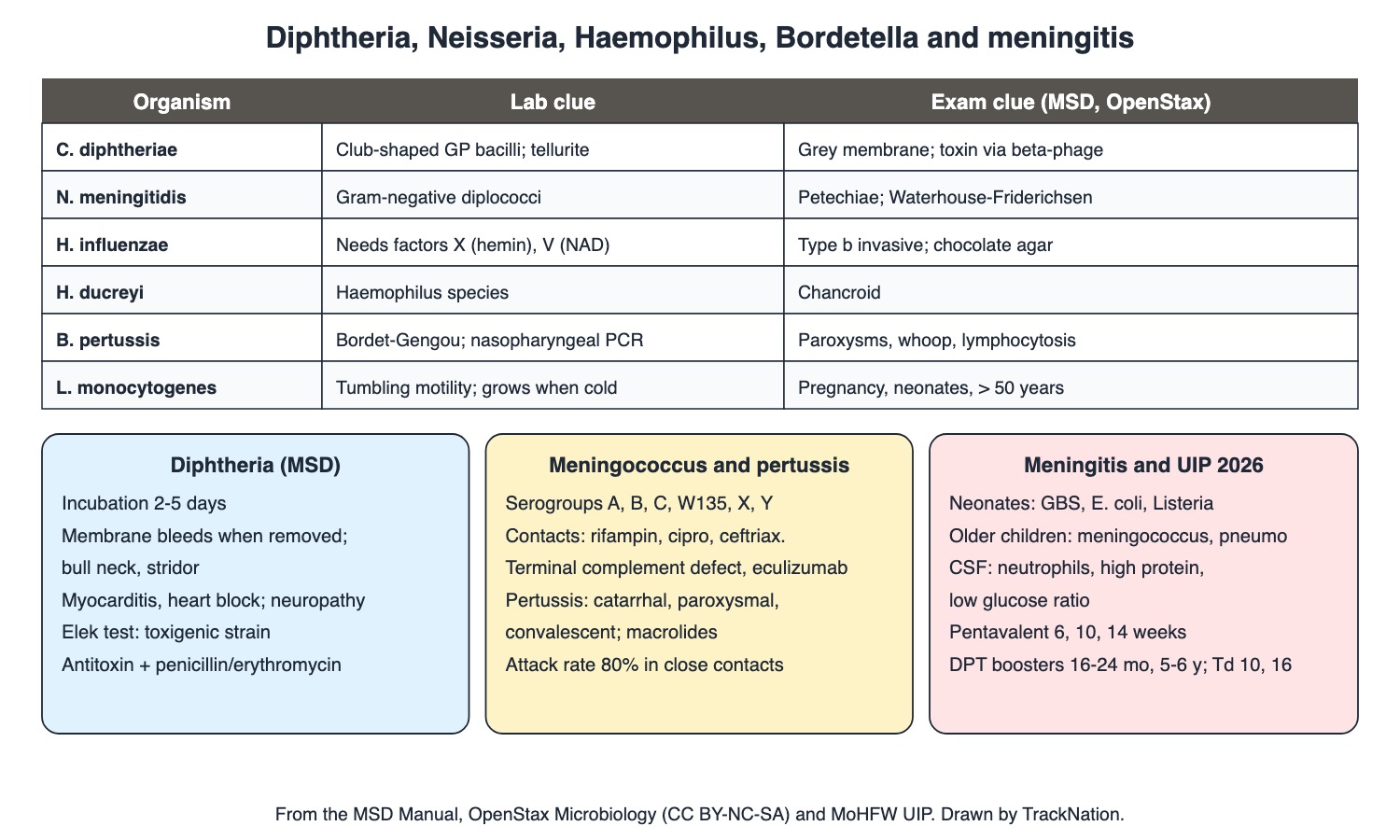
Diphtheria, Neisseria, Haemophilus, Bordetella, Listeria and meningitis. Drawn by TrackNation.
Diphtheria (MSD)
Corynebacterium diphtheriae: club-shaped gram-positive bacillus. Only strains carrying the tox gene on a lysogenic beta-phage make toxin (lysogenic conversion). Carriers exist.
Pharyngeal disease after 2–5 days incubation: a dirty grey, adherent pseudomembrane that bleeds when removed; may spread to larynx and trachea; bull neck, stridor. Cutaneous diphtheria rarely causes toxin complications (poor skin absorption).
Toxin complications: myocarditis and heart block (often as the throat improves); demyelinating neuropathy — early loss of ocular accommodation and bulbar palsy (nasal regurgitation), peripheral neuropathy later.
Lab: tellurite media (Loeffler, Tinsdale); modified Elek immunodiffusion or PCR shows a toxigenic strain. Treatment: antitoxin plus penicillin, erythromycin or azithromycin; repeat cultures to confirm cure.
Meningococcus and Haemophilus (MSD, OpenStax)
N. meningitidis: gram-negative diplococci colonising the nasopharynx; serogroups A, B, C, W135, X, Y cause most disease. Meningitis and meningococcaemia with an early haemorrhagic petechial rash; fulminant Waterhouse–Friderichsen syndrome (shock, purpura, adrenal haemorrhage), DIC.
High-risk groups: asplenia, complement deficiency (C3, C5–C9, properdin, factor H/D), patients on eculizumab/ravulizumab, HIV, Hajj and African-meningitis-belt travellers, dormitory and military settings. Immunity is serogroup-specific. Carriage is eliminated with ceftriaxone, ciprofloxacin or rifampin.
H. influenzae needs factor X (haemin) and factor V (NAD) — grows on chocolate agar. Before Hib conjugate vaccine, type b caused most invasive disease: meningitis, bacteraemia, septic arthritis, pneumonia, otitis media, cellulitis, epiglottitis. Non-typeable strains are non-encapsulated. H. ducreyi causes chancroid.
Pertussis and Listeria (MSD, OpenStax)
Bordetella pertussis (gram-negative, humans only): pertussis toxin (A-B; raises cAMP). Incubation 7–10 days; three stages over 6–10 weeks — catarrhal (highly infectious, as is the early paroxysmal stage), paroxysmal (spasmodic cough ending in a whoop), convalescent. Attack rate ≥80% of close contacts; one attack does not give lifelong immunity.
Lab: WBC 15,000–20,000 with 60–80% lymphocytes (marked lymphocytosis in infants <6 months = poor prognosis); nasopharyngeal culture on Bordet–Gengou, PCR, serology. Treat with macrolides. Infants <6 months have the highest incidence. "a" in DTaP = acellular.
Listeria monocytogenes: gram-positive bacilli with tumbling motility; grows at refrigerator temperatures (ready-to-eat chilled foods); dangerous in pregnancy (fetal death); attack rates highest in neonates, adults ≥65 and the immunocompromised. Treat with ampicillin/penicillin (± aminoglycoside) or co-trimoxazole.
Bacterial Meningitis and the UIP (MSD, OpenStax, MoHFW)
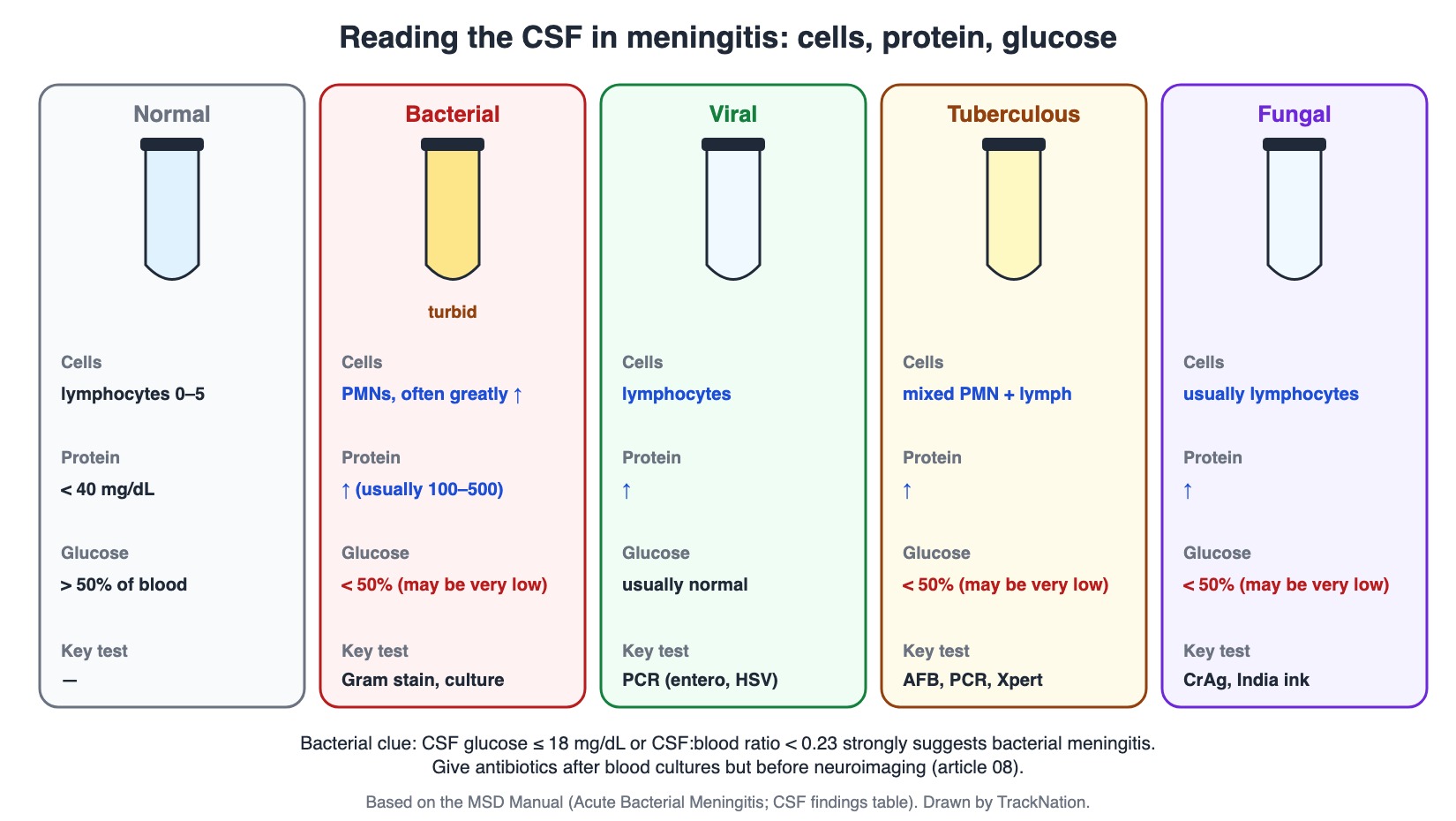
CSF cells, protein and glucose in bacterial, viral, TB and fungal meningitis. Drawn by TrackNation.
Causes by age: neonates — group B streptococcus, E. coli, Listeria; older infants, children, young adults — meningococcus, pneumococcus; >50 years — pneumococcus, Listeria, S. aureus, gram-negatives (so ampicillin is added).
CSF: raised pressure, turbid, neutrophils, high protein, low CSF:blood glucose (OpenStax thresholds: >10 PMNs/mm³, glucose <45 mg/dL, protein >45 mg/dL). Rapid latex agglutination tests on CSF exist for N. meningitidis.
If imaging delays lumbar puncture, give antibiotics and steroids after blood cultures but before the scan; dexamethasone is best established in pneumococcal meningitis.
UIP 2026: Pentavalent at 6, 10 and 14 weeks; DPT boosters at 16–24 months and 5–6 years; Td at 10 and 16 years and in pregnancy.
Traps the Examiner Sets
Only phage-carrying C. diphtheriae make toxin — prove toxigenicity with the Elek test.
Recurrent Neisseria infection → check terminal complement (C5–C9).
Pertussis gives lymphocytosis, not neutrophilia.
Listeria grows in the fridge; MSD meningitis regimens add ampicillin to cover it in adults >50 years.
Memory Hooks & Shortcuts
Shortcuts to lock in this article's numbers and lists. Each one only re-packages facts proven above.
🧠 'Phage Makes the Diphtheria Monster' — no beta-phage, no toxin — diphtheria
🧠 Diphtheria damage 'Heart then Head': myocarditis, then cranial nerve palsies — complications
🧠 'Haemophilus needs X and V — the Roman numerals of 10 and 5' — Haemophilus
🧠 'Membrane Attack Missing = Meningococcus' — C5–C9 deficiency — complement
🧠 Neonatal meningitis 'B-E-L': GBS, E. coli, Listeria — meningitis
Rapid-Revision Cards
Diphtheria toxin
tox gene on beta-phage.
Diphtheria membrane
Grey, adherent, bleeds; bull neck.
Diphtheria complications
Myocarditis; bulbar palsy.
Elek test
Toxigenic C. diphtheriae.
Diphtheria media
Tellurite: Loeffler, Tinsdale.
Diphtheria treatment
Antitoxin + penicillin/macrolide.
Meningococcus
GN diplococci; A B C W135 X Y.
Waterhouse–Friderichsen
Purpura, shock, adrenal haemorrhage.
Recurrent Neisseria
C5–C9 deficiency; eculizumab.
Carriage eradication
Rifampin, cipro, ceftriaxone.
H. influenzae
Factors X + V; chocolate agar.
Hib disease
Meningitis, epiglottitis.
H. ducreyi
Chancroid.
Pertussis toxin
A-B; ↑cAMP.
Pertussis stages
Catarrhal, paroxysmal, convalescent.
Pertussis blood
60–80% lymphocytes.
Pertussis lab
NP swab; Bordet–Gengou; PCR.
Listeria
Tumbling; grows cold; ampicillin.
Neonatal meningitis
GBS, E. coli, Listeria.
Bacterial CSF
PMNs, ↑protein, ↓glucose.
UIP
Penta 6/10/14 wk; DPT B 16–24 mo, 5–6 y; Td 10, 16.
Sources
Facts in this article were checked against these documents.
MSD Manual Professional: Diphtheria; Meningococcal Diseases; Haemophilus Infections; Pertussis; Listeriosis; Acute Bacterial Meningitis — Merck & Co. (MSD Manuals), 2024–26 (link)
Microbiology (sections 22.2, 26.2) — Parker N, Schneegurt M, Thi Tu A-H, Lister P, Forster BM (OpenStax), 2016 (link)
Universal Immunization Programme: National Immunization Schedule — Ministry of Health and Family Welfare, Government of India, 2026
Competency Based Undergraduate Curriculum, Vol I: Microbiology (MI6.1, MI6.3, MI7.1–7.2) — National Medical Commission, 2024
Test Yourself: Practice Questions
Thirty questions in NEET PG style, most of them clinical vignettes.
Practice Questions (NEET PG pattern)
Original questions written in the style of the exam: +4 for a correct answer, −1 for a wrong one. Every answer was checked against the sources listed above. NEET PG papers are not published by NBEMS, so these are not past-paper questions.
Q1. C. diphtheriae produces toxin only when it carries
(a) an R plasmid
(b) a transposon from Streptococcus
(c) a capsule
(d) a lysogenic beta-phage with the tox gene
Show answer
Answer: (d) — Lysogenic conversion.
Q2. An unvaccinated child has a grey membrane on the tonsils that bleeds when scraped, with a swollen neck. The diagnosis is
(a) Vincent angina
(b) streptococcal pharyngitis
(c) diphtheria
(d) infectious mononucleosis
Show answer
Answer: (c) — Bull neck.
Q3. The incubation period of pharyngeal diphtheria is usually
(a) 1–2 hours
(b) 2–3 weeks
(c) 2–5 days
(d) 3 months
Show answer
Answer: (c) — Range 1–10 days.
Q4. A child recovering from diphtheria develops nasal regurgitation of fluids. This is due to
(a) secondary streptococcal infection
(b) membrane obstruction
(c) toxin-induced bulbar palsy
(d) steroid side effect
Show answer
Answer: (c) — Demyelinating neuropathy.
Q5. The cardiac complication of diphtheria is
(a) myocarditis with heart block
(b) infective endocarditis
(c) pericardial effusion only
(d) rheumatic valvulitis
Show answer
Answer: (a) — Often as throat improves.
Q6. Toxigenicity of a C. diphtheriae isolate is shown by the
(a) modified Elek immunodiffusion test
(b) Schick test only
(c) CAMP test
(d) Widal test
Show answer
Answer: (a) — Or PCR.
Q7. Selective media for C. diphtheriae contain
(a) charcoal
(b) thiosulfate and citrate
(c) tellurite (Loeffler or Tinsdale)
(d) bile salts
Show answer
Answer: (c) — MSD.
Q8. Specific treatment of diphtheria is
(a) antibiotics alone
(b) IVIG
(c) antitoxin plus penicillin or a macrolide
(d) steroids alone
Show answer
Answer: (c) — MSD.
Q9. Toxin complications are rare in cutaneous diphtheria because
(a) toxin is poorly absorbed from the skin
(b) it is always treated early
(c) antibodies are higher in skin
(d) skin strains never make toxin
Show answer
Answer: (a) — MSD.
Q10. A patient with fever, shock and purpura is found to have adrenal haemorrhage. This is
(a) Rocky Mountain spotted fever
(b) Waterhouse–Friderichsen syndrome from meningococcaemia
(c) dengue shock
(d) toxic shock syndrome
Show answer
Answer: (b) — MSD.
Q11. Recurrent meningococcal infections suggest a deficiency of
(a) IgE
(b) terminal complement components (C5–C9)
(c) neutrophil elastase
(d) T cells only
Show answer
Answer: (b) — Also properdin, factor H/D, C3.
Q12. A patient on eculizumab is at particular risk of
(a) candidiasis
(b) meningococcal disease
(c) tuberculosis
(d) pneumocystis pneumonia
Show answer
Answer: (b) — Terminal complement blocker.
Q13. Drugs used to eliminate nasopharyngeal carriage of N. meningitidis in contacts include
(a) rifampin, ciprofloxacin or ceftriaxone
(b) vancomycin
(c) metronidazole
(d) penicillin V
Show answer
Answer: (a) — MSD.
Q14. The meningococcal serogroups causing most human disease are
(a) O1 and O139
(b) A, B, C, W135, X and Y
(c) 1–6
(d) types a–f
Show answer
Answer: (b) — 13 serogroups in all.
Q15. Haemophilus influenzae requires
(a) cysteine and tellurite
(b) high salt
(c) anaerobic conditions
(d) factor X (haemin) and factor V (NAD)
Show answer
Answer: (d) — Chocolate agar.
Q16. Before Hib vaccination, most invasive H. influenzae disease, including epiglottitis and meningitis, was due to
(a) H. parainfluenzae
(b) type f
(c) non-typeable strains
(d) capsular type b
Show answer
Answer: (d) — MSD.
Q17. Chancroid is caused by
(a) Treponema pallidum
(b) Haemophilus ducreyi
(c) Klebsiella granulomatis
(d) Chlamydia trachomatis L1–L3
Show answer
Answer: (b) — MSD.
Q18. Pertussis toxin acts by
(a) blocking acetylcholine release
(b) raising cyclic AMP in host cells
(c) cleaving IgA
(d) inhibiting protein synthesis via EF-2
Show answer
Answer: (b) — A-B toxin.
Q19. An infant has bouts of coughing ending in a high-pitched inspiratory whoop. Blood count shows
(a) neutrophilia
(b) eosinophilia
(c) pancytopenia
(d) leucocytosis with 60–80% lymphocytes
Show answer
Answer: (d) — MSD.
Q20. The specimen and medium for culturing B. pertussis are
(a) throat swab on blood agar
(b) sputum on MacConkey
(c) nasopharyngeal swab on Bordet–Gengou medium
(d) blood on Lowenstein–Jensen
Show answer
Answer: (c) — Transport fast.
Q21. Pertussis is treated with
(a) macrolides
(b) vancomycin
(c) penicillin G
(d) aminoglycosides
Show answer
Answer: (a) — MSD.
Q22. The attack rate of pertussis among close contacts is about
(a) 10%
(b) 30%
(c) below 5%
(d) 80% or more
Show answer
Answer: (d) — Highly contagious.
Q23. Marked lymphocytosis in pertussis carries a poor prognosis in
(a) adolescents
(b) adults over 60
(c) infants under 6 months
(d) pregnant women
Show answer
Answer: (c) — MSD.
Q24. A pregnant woman develops a febrile illness after eating chilled ready-to-eat meat. The organism able to grow at refrigerator temperature is
(a) Clostridium botulinum
(b) Salmonella
(c) Staphylococcus aureus
(d) Listeria monocytogenes
Show answer
Answer: (d) — Tumbling motility.
Q25. Listeriosis is treated with
(a) vancomycin alone
(b) ampicillin (often with an aminoglycoside)
(c) metronidazole
(d) ceftriaxone alone
Show answer
Answer: (b) — Or co-trimoxazole.
Q26. The most common causes of bacterial meningitis in neonates are
(a) M. tuberculosis
(b) meningococcus and pneumococcus
(c) group B streptococcus, E. coli and Listeria
(d) Hib and S. aureus
Show answer
Answer: (c) — MSD.
Q27. In adults over 50 with meningitis, empirical therapy adds ampicillin to cover
(a) Listeria monocytogenes
(b) H. influenzae
(c) Cryptococcus
(d) N. meningitidis
Show answer
Answer: (a) — MSD.
Q28. Typical CSF in acute bacterial meningitis shows
(a) neutrophils, raised protein and low glucose ratio
(b) eosinophils
(c) lymphocytes with normal glucose
(d) normal cells and protein
Show answer
Answer: (a) — MSD.
Q29. If CT must precede lumbar puncture in suspected bacterial meningitis, you should
(a) wait for CT before any treatment
(b) give antibiotics only after LP
(c) give steroids only
(d) take blood cultures and start antibiotics and steroids before the scan
Show answer
Answer: (d) — Do not delay.
Q30. Under India's UIP (2026), pentavalent vaccine is given at
(a) 5 and 10 years
(b) birth only
(c) 9 and 16 months
(d) 6, 10 and 14 weeks
Show answer
Answer: (d) — DPT boosters 16–24 months and 5–6 years.
Active Recall
From memory: explain how diphtheria toxin is acquired and what it does, give the lab tests and treatment, describe meningococcal disease, risk groups and carriage eradication, Haemophilus growth needs and diseases, pertussis stages, lab and treatment, Listeria clues, the age-wise causes of meningitis with CSF findings, and the UIP schedule for DPT-containing vaccines.