Metabolic Response to Injury and Shock for NEET PG Surgery: Ebb and Flow, Types of Shock, Fluids, Haemorrhage Control and Vasopressors
Start Here
🎯 Exam priority: High. Expect: ebb vs flow phase, which hormones rise, acute-phase proteins up and down, the four shock types and their causes, warm vs cold shock, lactate and urine thresholds, 30 mL/kg crystalloid, 1:1:1 blood, permissive hypotension and its head-injury exception, which fluid when, and first steps for tension pneumothorax and tamponade.
CBME mapping: SU1.1–1.3 (metabolic response to injury, perioperative care basics) and SU2.1–2.3 (shock and its resuscitation). Blood products and nutrition follow in article 2.
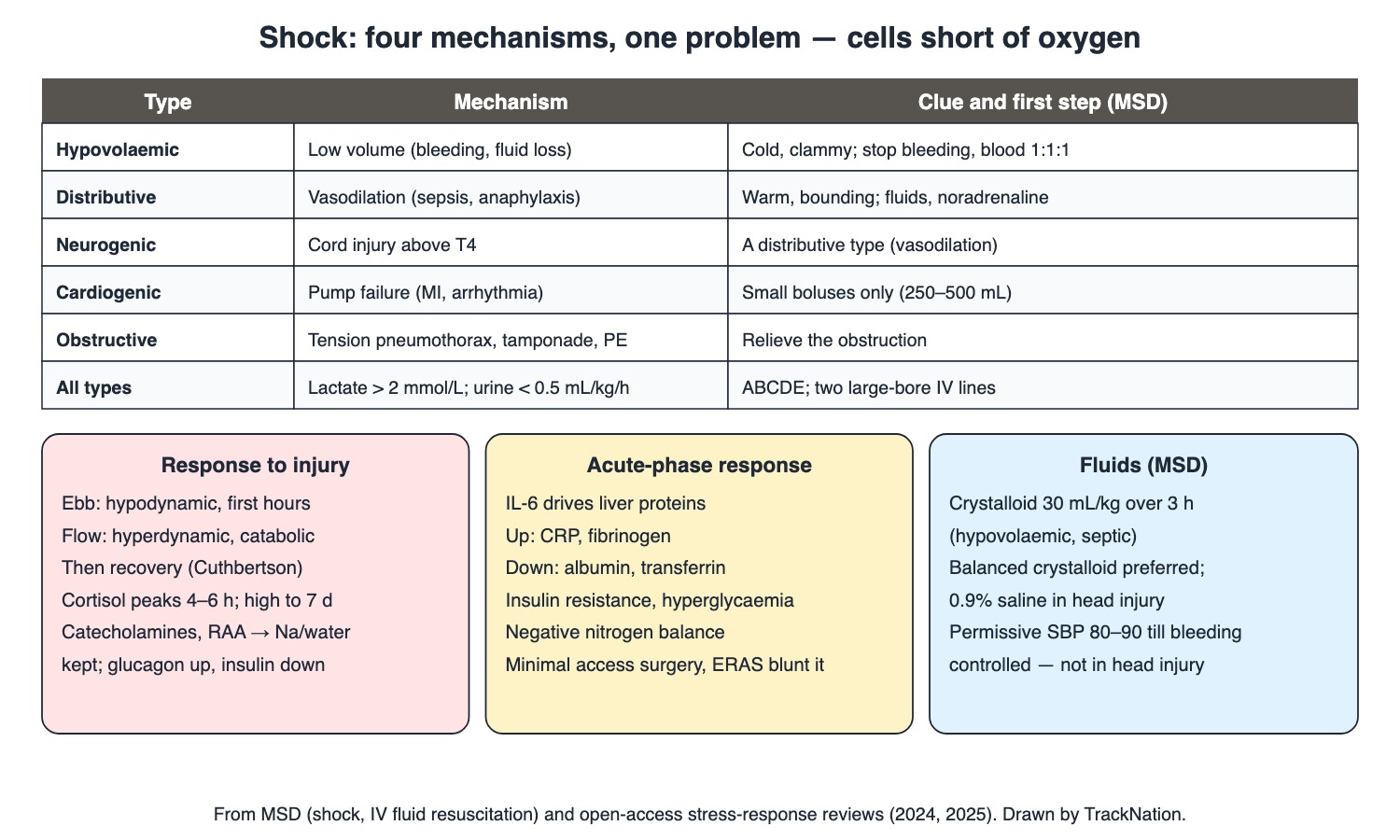
Shock types with mechanisms and first steps; ebb and flow phases; acute-phase response; fluid resuscitation. Drawn by TrackNation.
Metabolic Response to Injury
Phases: ebb — hypodynamic, the first hours, holding homeostasis; flow — hyperdynamic, hypercatabolic; then recovery. Cuthbertson first noted muscle-breakdown products in post-operative urine. Size depends on the magnitude, invasiveness and duration of surgery.
Sympatho-adrenomedullary axis: noradrenaline and adrenaline → tachycardia, hypertension, blood diverted from kidney and gut → renin–angiotensin–aldosterone activation → fluid retention and oliguria; glucagon rises, insulin falls → raised glucose. HPA axis: cortisol peaks at 4–6 hours; ACTH normal by 24 h but cortisol may stay high up to 7 days after major surgery.
Acute-phase response (driven mainly by IL-6): CRP, fibrinogen and α2-macroglobulin rise; albumin and transferrin fall. Immune shift Th2 > Th1 weakens cell-mediated immunity.
Metabolic result: insulin resistance, gluconeogenesis, lipolysis, proteolysis → negative nitrogen balance and muscle loss. Blunted by minimal-access surgery and enhanced-recovery care; volatile anaesthetics suppress cortisol, ACTH and catecholamines more than IV agents; etomidate blocks 11-β-hydroxylase (cortisol).
Shock: Definition and Types (MSD)
Shock = tissue hypoperfusion from circulatory failure with inadequate oxygen delivery → anaerobic metabolism, cell damage. Markers: lactate > 2 mmol/L, urine < 0.5 mL/kg/h, capillary refill > 2 s, altered mentation. Hypotension (SBP < 90 or MAP < 65) is common but not required. Compensation shunts blood to heart and brain away from the gut. Reperfusion adds injury; MODS = progressive failure of ≥ 2 organs, most often after sepsis, lungs first.
Hypovolaemic — bleeding (trauma, surgery, ulcer, varices, ruptured aneurysm) or fluid loss. Distributive — vasodilation with normal blood volume: sepsis, anaphylaxis, neurogenic (cord injury above T4), drugs. Cardiogenic — pump failure (MI, arrhythmia, acute valve lesions). Obstructive — tension pneumothorax, tamponade, massive PE.
Bedside: cold, clammy, slow capillary refill in hypovolaemic, cardiogenic and obstructive shock; warm, flushed skin and bounding pulse may occur in distributive (septic) shock. CVP < 5 mm Hg suggests hypovolaemia. Finding the cause matters more than naming the type.
Septic shock = sepsis needing vasopressors for MAP ≥ 65 with lactate > 2 mmol/L despite adequate fluids.
Resuscitation (MSD)
ABCDE; oxygen if SpO₂ < 94%; keep warm; nothing by mouth; two large-bore (14–16 G) peripheral lines (central or intraosseous if veins fail). Give drugs IV (IM absorption unreliable).
Hypovolaemic or distributive: 30 mL/kg balanced crystalloid over 3 h; only 250–500 mL boluses with raised right-sided pressure or acute MI; no fluid challenge with pulmonary oedema. Fluids are usually contraindicated in cardiogenic and obstructive shock.
Haemorrhagic shock: stop the bleeding first — fluids accompany, not precede, surgery. Massive transfusion: RBC : FFP : platelets 1:1:1. Permissive hypotension (SBP 80–90, MAP 55–60) until control — not in traumatic brain injury. O-negative blood if cross-match cannot wait; warm blood when giving more than 1–2 units.
Fluids: only 15–25% of isotonic crystalloid stays intravascular; never hypotonic fluid (0.45% saline, D5W) for resuscitation; balanced crystalloid preferred (less hyperchloraemic acidosis) but 0.9% saline in head injury; colloids no better, starch harms kidneys, albumin worse in TBI. End point: urine > 0.5–1 mL/kg/h; lactate lags for hours.
Vasopressors: noradrenaline (or vasopressin) for MAP ≥ 65 in septic shock after fluids; anaphylaxis → IV adrenaline. Tension pneumothorax → needle in the 5th intercostal space, midaxillary line, then chest drain; tamponade → pericardiocentesis (surgical repair if traumatic).
Traps the Examiner Sets
Normal BP does not exclude shock.
Albumin and transferrin fall in the acute-phase response.
Permissive hypotension is wrong in head injury.
Warm peripheries can be shock (septic).
Memory Hooks & Shortcuts
Shortcuts to lock in this article's numbers and lists. Each one only re-packages facts proven above.
🧠 'Ebb ebbs, flow flows': ebb = low, flow = high catabolism — phases
🧠 Acute phase: 'CRP and fibrinogen climb; albumin and transferrin decline' — proteins
🧠 Shock types 'HDCO': Hypovolaemic, Distributive, Cardiogenic, Obstructive — types
🧠 'Stop the tap before you fill the tank' — bleeding control first — haemorrhage
🧠 'Head injury hates hypotension' — permissive hypotension
Rapid-Revision Cards
Ebb phase
Hypodynamic, first hours.
Flow phase
Hyperdynamic, catabolic.
Cortisol
Peak 4–6 h; high up to 7 d.
Oliguria
RAA activation.
Hyperglycaemia
Glucagon up, insulin down.
Acute phase up
CRP, fibrinogen.
Acute phase down
Albumin, transferrin.
Main cytokine
IL-6.
Etomidate
Blocks 11-β-hydroxylase.
Shock markers
Lactate > 2; urine < 0.5 mL/kg/h.
Normal BP?
Shock still possible.
Warm shock
Distributive/septic.
Neurogenic
Cord injury above T4.
Obstructive
Tension PTX, tamponade, PE.
Access
Two 14–16 G lines; IO.
First fluid
30 mL/kg crystalloid over 3 h.
Haemorrhage
Control bleeding first; 1:1:1.
Permissive hypotension
SBP 80–90; not in TBI.
TBI fluid
0.9% saline.
Never
Hypotonic fluid.
Septic shock
Vasopressor for MAP ≥ 65 + lactate > 2.
Sources
Facts in this article were checked against these documents.
MSD Manual Professional: Shock; Intravenous Fluid Resuscitation; Sepsis and Septic Shock; Tension Pneumothorax — Merck & Co. (MSD Manuals), 2026 (link)
The Surgical Stress Response and Anesthesia: A Narrative Review — Journal of Clinical Medicine (MDPI, CC BY), 2024 (link)
Surgical Stress Response: A Physiological Review of the Endocrine, Immune, and Metabolic Changes — Cureus (CC BY 4.0), 2025 (link)
Competency Based Undergraduate Curriculum, Vol III: General Surgery (SU1, SU2) — National Medical Commission, 2024
Test Yourself: Practice Questions
Thirty questions in NEET PG style, most of them clinical vignettes.
Practice Questions (NEET PG pattern)
Original questions written in the style of the exam: +4 for a correct answer, −1 for a wrong one. Every answer was checked against the sources listed above. NEET PG papers are not published by NBEMS, so these are not past-paper questions.
Q1. In the first hours after major trauma, the hypodynamic phase in which the body struggles to maintain homeostasis is the
(a) recovery phase
(b) ebb phase
(c) flow phase
(d) anabolic phase
Show answer
Answer: (b) — Flow = hyperdynamic, catabolic.
Q2. The hyperdynamic, hypercatabolic phase of the response to injury is the
(a) flow phase
(b) plateau phase
(c) lag phase
(d) ebb phase
Show answer
Answer: (a) — Then recovery.
Q3. After major surgery, plasma cortisol typically peaks at about
(a) 3 days
(b) 2 weeks
(c) 30 minutes
(d) 4–6 hours
Show answer
Answer: (d) — Can stay high up to 7 days.
Q4. Oliguria and fluid retention after surgery are explained mainly by
(a) insulin excess
(b) thyroxine surge
(c) activation of the renin–angiotensin–aldosterone system
(d) low cortisol
Show answer
Answer: (c) — Gut and kidney flow fall.
Q5. Post-operative hyperglycaemia in a non-diabetic results from
(a) raised glucagon and lowered insulin with insulin resistance
(b) low cortisol
(c) increased insulin secretion
(d) reduced gluconeogenesis
Show answer
Answer: (a) — Stress hormones.
Q6. Which plasma protein FALLS during the acute-phase response after surgery?
(a) fibrinogen
(b) albumin
(c) C-reactive protein
(d) α2-macroglobulin
Show answer
Answer: (b) — Transferrin also falls.
Q7. The cytokine mainly responsible for the hepatic acute-phase response is
(a) interferon-γ
(b) interleukin-6
(c) interleukin-10
(d) interleukin-2
Show answer
Answer: (b) — Drives CRP.
Q8. An induction agent that suppresses cortisol by inhibiting 11-β-hydroxylase is
(a) thiopentone
(b) ketamine
(c) etomidate
(d) propofol
Show answer
Answer: (c) — Adrenal suppression.
Q9. A septic patient has a normal blood pressure, cool peripheries, confusion and lactate of 4 mmol/L. Regarding shock
(a) it can be present without hypotension
(b) lactate is irrelevant
(c) shock is excluded by normal BP
(d) only BP defines shock
Show answer
Answer: (a) — Hypoperfusion defines shock.
Q10. Urine output suggesting renal hypoperfusion in shock is below
(a) 5 mL/kg/hour
(b) 0.5 mL/kg/hour
(c) 2 mL/kg/hour
(d) 100 mL/hour
Show answer
Answer: (b) — Target 0.5–1 mL/kg/h.
Q11. A febrile patient with pneumonia is hypotensive with warm, flushed skin and a bounding pulse. The shock type is
(a) cardiogenic
(b) hypovolaemic
(c) distributive (septic)
(d) obstructive
Show answer
Answer: (c) — Vasodilation.
Q12. After a cervical spinal cord injury, a hypotensive patient has warm skin. The shock is
(a) obstructive
(b) cardiogenic
(c) haemorrhagic only
(d) neurogenic, a form of distributive shock
Show answer
Answer: (d) — Cord injury above T4.
Q13. Tension pneumothorax and cardiac tamponade cause which type of shock?
(a) obstructive
(b) hypovolaemic
(c) distributive
(d) cardiogenic
Show answer
Answer: (a) — Impaired filling.
Q14. Massive pulmonary embolism produces shock by
(a) fluid loss
(b) vasodilation
(c) pump failure from MI
(d) interfering with ventricular emptying (obstructive)
Show answer
Answer: (d) — Obstructive.
Q15. Multiple organ dysfunction syndrome is defined as progressive dysfunction of at least
(a) 2 organs
(b) 1 organ
(c) all organs
(d) 4 organs
Show answer
Answer: (a) — Commonest after sepsis.
Q16. In septic shock, the organ most frequently affected first by MODS is the
(a) spleen
(b) lung
(c) skin
(d) brain
Show answer
Answer: (b) — ALI/ARDS.
Q17. Initial venous access in a shocked adult should be
(a) a central line before anything else
(b) two large-bore (14–16 G) peripheral cannulae
(c) oral fluids
(d) one 22 G cannula
Show answer
Answer: (b) — IO if veins fail.
Q18. In a shocked patient whose peripheral veins cannot be cannulated quickly, an alternative is
(a) subcutaneous fluids
(b) intramuscular drugs
(c) intraosseous access
(d) oral rehydration
Show answer
Answer: (c) — Or central line.
Q19. Initial fluid for hypovolaemic or septic shock per MSD is
(a) 0.45% saline
(b) 5% dextrose 1 L stat
(c) 30 mL/kg balanced crystalloid over 3 hours
(d) albumin 20% only
Show answer
Answer: (c) — Then reassess.
Q20. A patient with shock after acute MI and distended neck veins should receive fluid as
(a) small boluses of 250–500 mL
(b) no monitoring
(c) hypotonic saline
(d) 30 mL/kg rapidly
Show answer
Answer: (a) — Avoid overload.
Q21. A man with a stab wound and haemorrhagic shock is being given fluids. The first priority is
(a) normalising BP with crystalloid before surgery
(b) vasopressors
(c) waiting for cross-match
(d) surgical control of the bleeding
Show answer
Answer: (d) — Fluids accompany surgery.
Q22. For a patient needing massive transfusion, the ratio of RBC : FFP : platelets is
(a) red cells only
(b) 4:1:1
(c) 1:2:4
(d) 1:1:1
Show answer
Answer: (d) — Start early.
Q23. Permissive hypotension aims for a systolic BP of about
(a) 80–90 mm Hg until bleeding is controlled
(b) 120 mm Hg
(c) 60 mm Hg always
(d) 140 mm Hg
Show answer
Answer: (a) — MAP 55–60.
Q24. A trauma patient in haemorrhagic shock also has a severe head injury. Regarding permissive hypotension
(a) it is preferred
(b) it is contraindicated
(c) target SBP 60
(d) it protects the brain
Show answer
Answer: (b) — Cerebral perfusion.
Q25. Which fluid should NOT be used for resuscitation in shock?
(a) 0.9% saline
(b) packed red cells
(c) 5% dextrose (hypotonic)
(d) Ringer's lactate
Show answer
Answer: (c) — Little stays intravascular.
Q26. For resuscitating a patient with traumatic brain injury, the preferred crystalloid is
(a) 5% dextrose
(b) Ringer's lactate
(c) 0.9% saline
(d) 0.45% saline
Show answer
Answer: (c) — Albumin worse in TBI.
Q27. Compared with crystalloids for resuscitation, colloids
(a) never affect coagulation
(b) offer no major advantage, and starch may harm the kidney
(c) are first-line in all shock
(d) are clearly superior
Show answer
Answer: (b) — MSD.
Q28. Blood needed immediately before cross-match in an exsanguinating patient should be
(a) O Rh-negative
(b) any available group
(c) whole blood from a relative
(d) AB positive
Show answer
Answer: (a) — Warm if > 1–2 units.
Q29. Septic shock is defined as sepsis requiring vasopressors to keep MAP at least
(a) 50 mm Hg
(b) 100 mm Hg
(c) 65 mm Hg with lactate > 2 mmol/L despite fluids
(d) 90 mm Hg
Show answer
Answer: (c) — Sepsis-3 style.
Q30. A trauma patient becomes hypotensive with absent breath sounds on one side and a shifted trachea. Immediate management is
(a) needle decompression in the 5th intercostal space, midaxillary line, then a chest drain
(b) fluid bolus only
(c) pericardiocentesis
(d) chest X-ray first
Show answer
Answer: (a) — Obstructive shock.
Active Recall
From memory: describe the phases and hormonal changes of the metabolic response to injury and the acute-phase proteins, define shock and its markers, list the four types with causes and bedside clues, and outline resuscitation including haemorrhage control, fluid choice, permissive hypotension and vasopressors.