Perioperative Care for NEET PG Surgery: Pre-op Assessment, Fasting, Anticoagulants, Diabetes, Malignant Hyperthermia, Post-op Fever and Laparoscopy
Start Here
🎯 Exam priority: High. Expect: which pre-op tests are justified, ASA fasting times, when to stop aspirin and warfarin and the INR target, steroid stress cover, diabetic dosing on the day of surgery, the 6 Ws of post-op fever, malignant hyperthermia triggers, first sign and dantrolene, and laparoscopy contraindications.
CBME mapping: SU10–SU11 (perioperative management, anaesthesia and pain), SU16 (minimally invasive surgery), with safety parts of SU7–SU8. Day-care criteria and audit methods are not covered here for want of a checkable source.
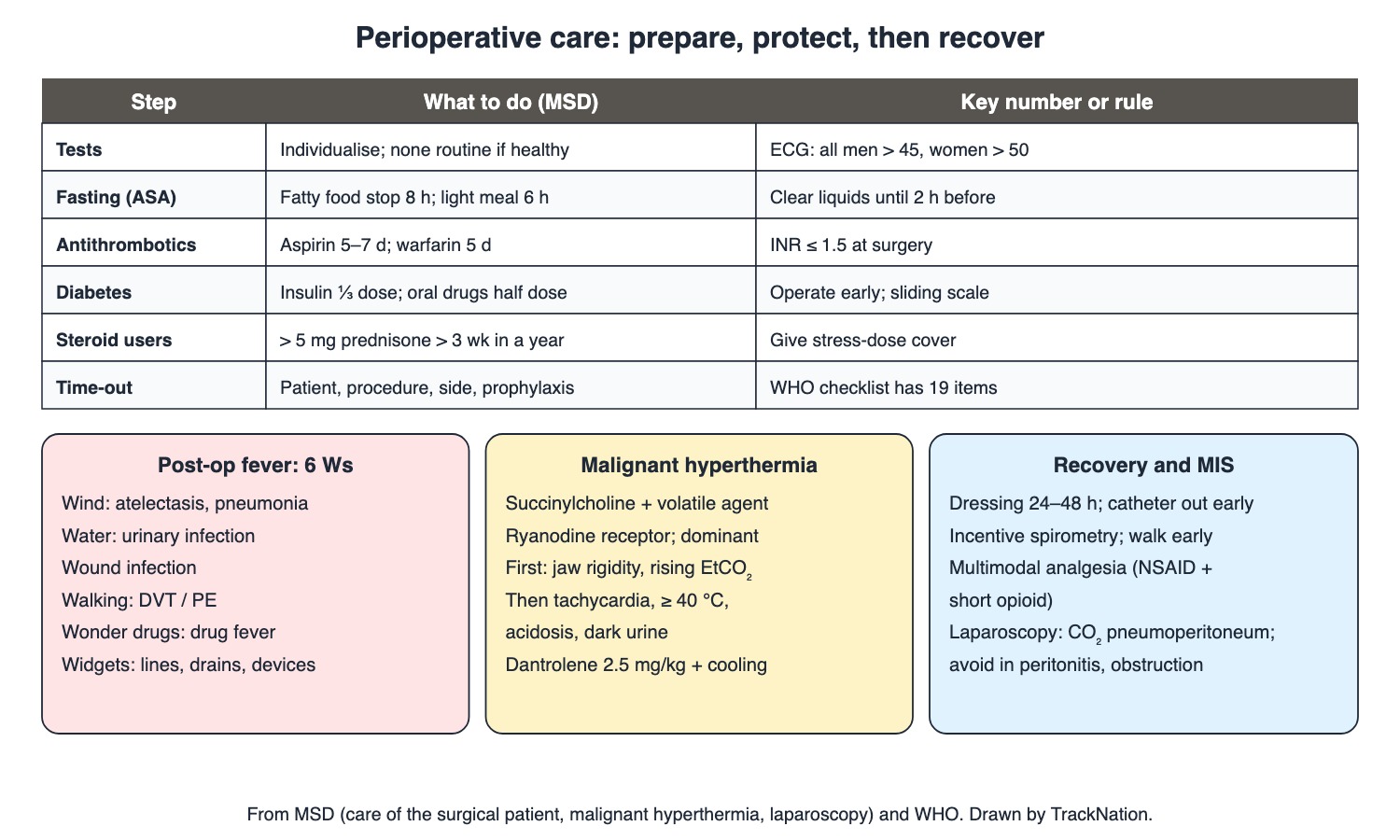
Preoperative tests, fasting, drugs, diabetes, steroids, time-out; post-op fever; malignant hyperthermia; recovery and laparoscopy. Drawn by TrackNation.
Before Surgery (MSD)
Aim: find and optimise risk — delay elective surgery to control hypertension, diabetes or blood disorders. History: cardiopulmonary symptoms, bleeding and clot risks, past anaesthetic problems, allergies (drugs, latex), drugs and supplements, smoking and alcohol, sleep apnoea. Examine the spine if spinal anaesthesia is planned; note pre-existing cognitive problems.
No routine tests in healthy patients. Pregnancy test in women of reproductive age. CBC if > 65 or major blood loss expected; coagulation tests only with a bleeding history; ECG in all men > 45 and women > 50 (and at-risk patients); chest X-ray only with cardiopulmonary symptoms or risk.
Highest-risk operations: heart, lung, liver resection, long or bloody abdominal operations, major orthopaedics. Emergency surgery carries more risk than the same operation done electively. Cardiac predictors: CAD, heart failure, stroke, insulin-treated diabetes, creatinine > 2; unstable angina sharply raises infarction risk.
Preparing the Patient (MSD)
Antithrombotics: aspirin and other antiplatelets stopped 5–7 days before; warfarin 5 days, INR ≤ 1.5 at surgery; bridge with LMWH only for high clot risk (mechanical valve, prior VTE); DOACs stopped by half-life and kidney function without bridging; dabigatran reversed by idarucizumab. Remove an epidural catheter ≥ 12 h after the last DOAC.
Steroids: stress-dose cover if > 5 mg prednisone daily for > 3 weeks in the past year. Continue antihypertensives with a sip of water. Diabetes: one-third of usual insulin (half of oral drugs) that morning, list early, sliding scale after. Stop smoking weeks before chest or abdominal surgery.
Fasting (ASA): fatty food 8 h, light meal 6 h, clear liquids until 2 h. Clip hair, never shave with a blade; remove urinary catheters within 2 days. Time-out before incision: patient identity, procedure, site and side, equipment, prophylaxis given. The WHO Surgical Safety Checklist has 19 items and reduces deaths and complications.
After Surgery (MSD)
Leave recovery only when the airway is protected. Breathlessness: hypoxic (atelectasis, fluid overload — give oxygen) vs non-hypoxic (pain); oversedation can cause hypoxia without breathlessness, so monitor oximetry. Incentive spirometry and coughing prevent pneumonia.
DVT prophylaxis from theatre; early mobilisation (older adults lose up to 5% of muscle a day in bed). Multimodal analgesia (regular NSAIDs plus the lowest, shortest opioid dose; PCA for severe pain). Morphine accumulates in renal failure.
Delirium (elderly, dementia; opioids, anticholinergics): check oxygen, stop non-essential drugs. Urinary retention: catheterise if distended or no urine for 6–8 h. Keep the theatre dressing 24–48 h; remove drains early.
Fever: early — inflammatory response; later — the 6 Ws: Wind (atelectasis, pneumonia), Water (UTI), Wound, Walking (DVT/PE), Wonder drugs, Widgets (lines, drains, implants).
Malignant Hyperthermia and Laparoscopy (MSD)
Malignant hyperthermia: succinylcholine plus a volatile agent (halothane, isoflurane, sevoflurane, desflurane) in a susceptible patient — autosomal dominant, usually a ryanodine receptor mutation; may need several exposures. First sign often jaw (masseter) rigidity; rising end-tidal CO₂ is early; then tachycardia, acidosis, temperature ≥ 40 °C, rhabdomyolysis. Treat with dantrolene 2.5 mg/kg IV repeated, plus cooling; avoid verapamil and diltiazem.
Laparoscopy: a needle creates a CO₂ pneumoperitoneum, then ports for the scope and instruments. Absolute contraindications: bleeding disorder, poor cooperation, peritonitis, intestinal obstruction, abdominal wall infection. Relative: severe heart or lung disease, large hernias, many previous operations, tense ascites.
Traps the Examiner Sets
No routine chest X-ray or coagulation tests in a healthy patient.
Clear fluids are allowed until 2 hours before.
Malignant hyperthermia: rising EtCO₂ before fever.
Do not bridge DOACs.
Memory Hooks & Shortcuts
Shortcuts to lock in this article's numbers and lists. Each one only re-packages facts proven above.
🧠 Fasting '8-6-2': fat 8, meal 6, clear 2 — fasting
🧠 'Five days for warfarin, five to seven for aspirin' — antithrombotics
🧠 Post-op fever: 'Wind, Water, Wound, Walking, Wonder drugs, Widgets' — fever
🧠 MH: 'Sux plus gas — jaw tight, CO₂ climbing, dantrolene fast' — malignant hyperthermia
🧠 Insulin morning: 'one-third, first on the list' — diabetes
Rapid-Revision Cards
Routine tests
None if healthy.
ECG
Men > 45, women > 50.
Coag tests
Only with bleeding history.
Emergency surgery
Higher risk.
Aspirin
Stop 5–7 days.
Warfarin
Stop 5 days; INR ≤ 1.5.
Bridge
Mechanical valve, prior VTE.
DOACs
No bridging.
Dabigatran reversal
Idarucizumab.
Steroid cover
> 5 mg > 3 weeks in a year.
Insulin morning
⅓ dose; list early.
Fasting
Fat 8 h, meal 6 h, clear 2 h.
Hair
Clip, don't shave.
Time-out
Patient, procedure, side.
WHO checklist
19 items.
Hypoxic post-op
Atelectasis → O₂, spirometry.
Retention
Catheter if no urine 6–8 h.
6 Ws
Wind, Water, Wound, Walking, Wonder drugs, Widgets.
MH trigger
Succinylcholine + volatile.
MH first signs
Jaw rigidity, rising EtCO₂.
MH drug
Dantrolene.
Sources
Facts in this article were checked against these documents.
MSD Manual Professional: Preoperative Evaluation; Perioperative Management; Postoperative Care; Malignant Hyperthermia; Treatment of Pain; Atelectasis; Laparoscopy — Merck & Co. (MSD Manuals), 2025–26 (link)
Safe surgery: tools and resources (WHO Surgical Safety Checklist) — World Health Organization, accessed 2026 (link)
Competency Based Undergraduate Curriculum, Vol III: General Surgery (SU7–SU11, SU16) — National Medical Commission, 2024
Test Yourself: Practice Questions
Thirty questions in NEET PG style, most of them clinical vignettes.
Practice Questions (NEET PG pattern)
Original questions written in the style of the exam: +4 for a correct answer, −1 for a wrong one. Every answer was checked against the sources listed above. NEET PG papers are not published by NBEMS, so these are not past-paper questions.
Q1. A fit 28-year-old is listed for an elective hernia repair. Routine pre-operative chest X-ray and coagulation tests are
(a) not indicated
(b) needed only for men
(c) needed for all general anaesthetics
(d) mandatory
Show answer
Answer: (a) — Individualise testing.
Q2. A pre-operative ECG is recommended for
(a) only cardiac surgery
(b) no one
(c) everyone over 18
(d) all men over 45 and women over 50
Show answer
Answer: (d) — Plus at-risk patients.
Q3. Which pre-operative test is typically done in women of reproductive age?
(a) pregnancy test
(b) thyroid scan
(c) bone densitometry
(d) mammography
Show answer
Answer: (a) — β-hCG.
Q4. Compared with the same operation done electively, emergency surgery has
(a) the same risk
(b) higher morbidity and mortality
(c) lower risk
(d) less bleeding
Show answer
Answer: (b) — Less time to optimise.
Q5. A patient on aspirin is scheduled for elective major surgery. Aspirin is usually stopped
(a) 1 month before
(b) 5–7 days before
(c) never
(d) the morning of surgery
Show answer
Answer: (b) — Unless stents dictate otherwise.
Q6. Warfarin is stopped before elective surgery so that the INR on the day is
(a) irrelevant
(b) exactly 2.5
(c) ≤ 3.0
(d) ≤ 1.5 (stop about 5 days before)
Show answer
Answer: (d) — Bridge only if high risk.
Q7. Bridging anticoagulation with LMWH after stopping warfarin should be considered for
(a) no one
(b) every patient on warfarin
(c) a patient with a mechanical heart valve
(d) patients on DOACs
Show answer
Answer: (c) — Also prior VTE.
Q8. A patient on dabigatran needs emergency surgery. Its specific reversal agent is
(a) vitamin K
(b) andexanet only
(c) idarucizumab
(d) protamine
Show answer
Answer: (c) — Monoclonal antibody fragment.
Q9. A patient took prednisolone 10 mg daily for 2 months last year. Before major surgery she should receive
(a) insulin
(b) perioperative stress-dose steroid cover
(c) no steroid
(d) fludrocortisone only
Show answer
Answer: (b) — > 5 mg for > 3 weeks in a year.
Q10. On the morning of surgery, a patient on insulin usually receives
(a) double insulin
(b) the full insulin dose
(c) no glucose monitoring
(d) one-third of the usual insulin dose, and is listed early
Show answer
Answer: (d) — Oral drugs: half dose.
Q11. A hypertensive patient asks about her morning amlodipine on the day of surgery. Advice is to
(a) take it after surgery only
(b) double it
(c) omit it
(d) take it with a sip of water
Show answer
Answer: (d) — Continue cardiovascular drugs.
Q12. According to ASA fasting advice, clear liquids may be taken until
(a) midnight before
(b) 6 hours before
(c) 8 hours before
(d) 2 hours before surgery
Show answer
Answer: (d) — Light meal 6 h; fatty food 8 h.
Q13. A patient had fried food. ASA advice is to stop such food at least
(a) 2 hours before
(b) 24 hours before
(c) 1 hour before
(d) 8 hours before surgery
Show answer
Answer: (d) — Fatty or meat.
Q14. Hair at the operative site, if it must be removed, is removed by
(a) waxing
(b) razor in theatre
(c) razor shave the night before
(d) clippers or depilatory cream, not a razor
Show answer
Answer: (d) — Blade causes nicks.
Q15. During the pre-incision time-out, the team confirms
(a) only the surgeon's name
(b) the post-op ward
(c) patient identity, procedure, operative site and side, equipment and prophylaxis
(d) only consent
Show answer
Answer: (c) — Wrong-site prevention.
Q16. The WHO Surgical Safety Checklist contains
(a) 50 items
(b) 5 items
(c) 19 items
(d) 100 items
Show answer
Answer: (c) — Reduces morbidity and mortality.
Q17. A day after abdominal surgery, a patient is breathless and hypoxic; imaging shows collapsed lung at both bases. The likely cause and first treatment are
(a) pneumothorax — chest drain
(b) atelectasis — oxygen, deep breathing and coughing
(c) anxiety — sedatives
(d) pulmonary oedema — furosemide
Show answer
Answer: (b) — Incentive spirometry.
Q18. An oversedated post-operative patient may be hypoxic without breathlessness. Monitoring should include
(a) nothing
(b) pulse oximetry or capnometry
(c) only respiratory rate
(d) daily chest X-ray
Show answer
Answer: (b) — Sedation blunts dyspnoea.
Q19. A post-operative patient has not passed urine for 8 hours and has a painful distended bladder. Management is
(a) wait 24 hours
(b) straight (in-out) catheterisation
(c) fluid restriction
(d) IV furosemide
Show answer
Answer: (b) — Opioids and anticholinergics cause retention.
Q20. An elderly woman becomes confused on day 2 after surgery. The first steps are to
(a) restrain her
(b) check oxygenation and stop non-essential drugs
(c) start antipsychotics routinely
(d) add a benzodiazepine
Show answer
Answer: (b) — Delirium.
Q21. Of the '6 Ws' of post-operative fever, 'Walking' refers to
(a) drug fever
(b) wound infection
(c) urinary infection
(d) deep vein thrombosis
Show answer
Answer: (d) — Mobilise early.
Q22. 'Wind' as a cause of post-operative fever refers to
(a) drug reaction
(b) atelectasis or pneumonia
(c) wound dehiscence
(d) flatus
Show answer
Answer: (b) — Incentive spirometry.
Q23. The theatre dressing over a clean incision is usually left undisturbed for
(a) 24–48 hours
(b) 7 days
(c) 1 hour
(d) until suture removal
Show answer
Answer: (a) — Unless signs of infection.
Q24. During anaesthesia with sevoflurane and succinylcholine, a patient develops masseter rigidity and a rising end-tidal CO₂. The diagnosis is
(a) thyroid storm
(b) light anaesthesia
(c) anaphylaxis
(d) malignant hyperthermia
Show answer
Answer: (d) — Fever comes later.
Q25. The specific drug for malignant hyperthermia is
(a) paracetamol
(b) verapamil
(c) succinylcholine
(d) dantrolene
Show answer
Answer: (d) — 2.5 mg/kg IV, repeat.
Q26. Malignant hyperthermia susceptibility is inherited as
(a) mitochondrial
(b) X-linked recessive
(c) autosomal recessive
(d) autosomal dominant, usually a ryanodine receptor mutation
Show answer
Answer: (d) — Variable penetrance.
Q27. In malignant hyperthermia, which drugs should be avoided for arrhythmias?
(a) lidocaine
(b) amiodarone
(c) beta-blockers
(d) verapamil and diltiazem
Show answer
Answer: (d) — Non-dihydropyridine CCBs.
Q28. A post-operative patient with chronic kidney disease becomes drowsy with myoclonus on morphine. The reason is
(a) accumulation of active morphine metabolites
(b) morphine allergy
(c) naloxone deficiency
(d) hypoglycaemia
Show answer
Answer: (a) — Choose another opioid.
Q29. The gas used to create a pneumoperitoneum for laparoscopy is
(a) air
(b) nitrous oxide
(c) carbon dioxide
(d) oxygen
Show answer
Answer: (c) — Expelled at the end.
Q30. An absolute contraindication to laparoscopy listed by MSD is
(a) obesity
(b) intestinal obstruction
(c) previous single appendicectomy
(d) age over 60
Show answer
Answer: (b) — Also peritonitis, bleeding disorder.
Active Recall
From memory: list what the pre-operative history and tests should cover, state fasting times and how to handle antiplatelets, warfarin, DOACs, steroids and diabetes, describe the time-out, explain post-operative hypoxia, retention, delirium and the 6 Ws of fever, and describe malignant hyperthermia and laparoscopy contraindications.