Trauma for NEET PG Surgery: Primary Survey, Head Injury and GCS, Chest Injuries, Abdominal and Splenic Trauma, Spinal Injury
Start Here
🎯 Exam priority: Very high. Expect: ABCDE order, GCS scoring and severity bands, CT and surgery thresholds in head injury, epidural vs subdural on CT, basal skull fracture signs, Cushing triad, the six immediate chest killers and their first steps, massive haemothorax and thoracotomy numbers, E-FAST vs CT, the commonest injured abdominal organ, splenic conservation and vaccines, and spinal immobilisation.
CBME mapping: SU17.1–17.10 (first aid, triage, primary survey, head, chest and abdominal injuries). Haemorrhagic shock was article 1.
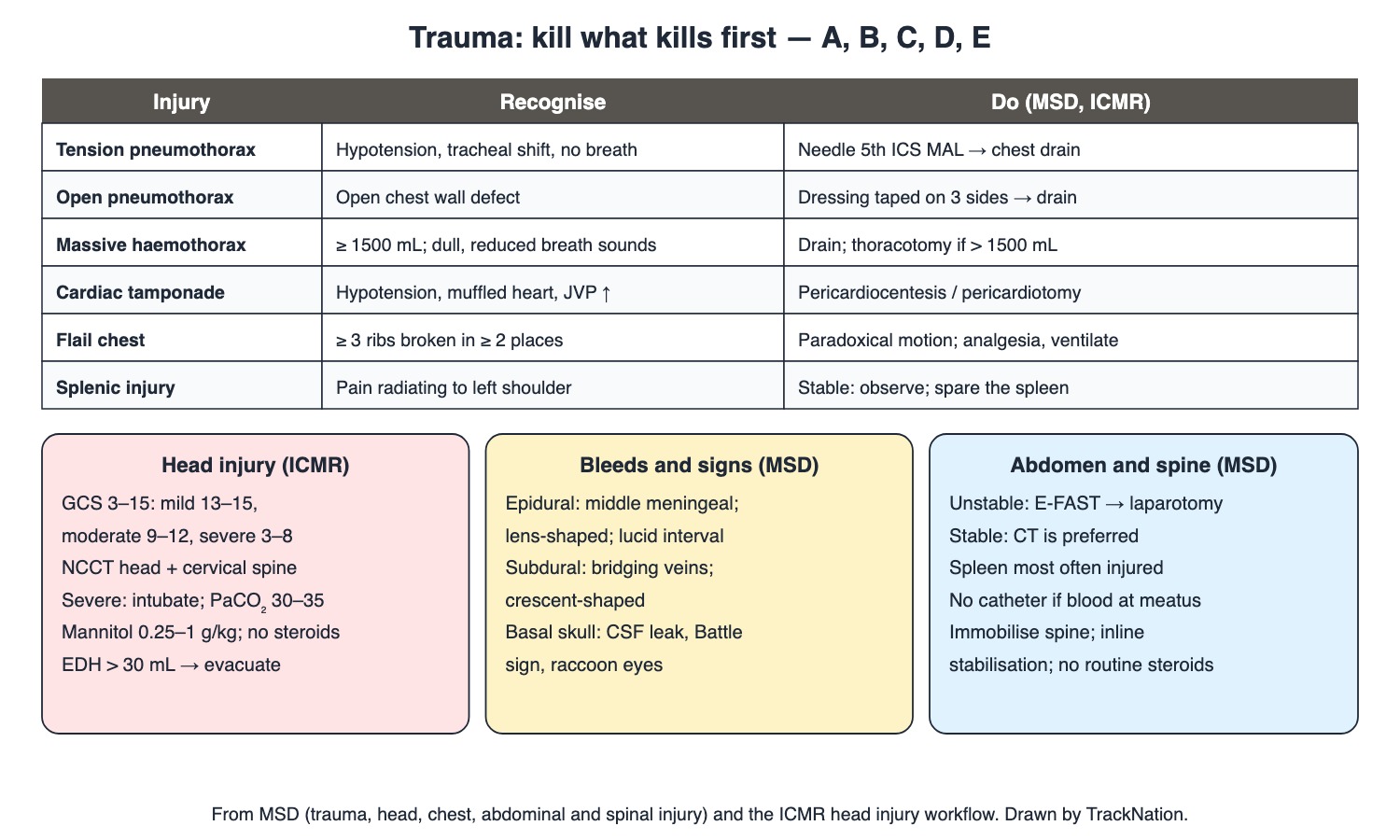
Life-threatening chest injuries and splenic injury; head injury; intracranial bleeds; abdominal and spinal trauma. Drawn by TrackNation.
Primary and Secondary Survey (MSD)
Primary survey: A, B, C, D, E — Airway (with cervical spine protection), Breathing, Circulation, Disability (neurology), Exposure/environment — evaluating and treating together, the most lethal first. Treating a dramatic but non-lethal injury first can be a fatal mistake. In pregnancy, stabilising the mother is the best care for the fetus.
Breathing: look for paradoxical chest motion (flail chest), feel for rib fractures and surgical emphysema.
Secondary survey once stable: AMPLE history (Allergies, Medications, Past history, Last meal, Events), head-to-toe examination. No urethral catheter if there is blood at the meatus or perineal bruising. Imaging: E-FAST for the unstable patient (free fluid, pericardial fluid, pneumothorax); CT for the stable patient.
Head Injury (ICMR, MSD)
GCS = Eyes 4 + Verbal 5 + Motor 6 (3–15); decorticate flexion = M3, decerebrate extension = M2. Mild 13–15, moderate 9–12, severe 3–8. Red flags (unconscious, unequal pupils, irregular breathing) → 20% mannitol if SBP > 90 and transfer once ABC is stable.
NCCT head with cervical spine as soon as possible; definite indications include GCS < 15, loss of consciousness, suspected skull fracture, post-traumatic seizure, focal deficit, persistent vomiting, amnesia. Severe injury: intubate (rapid sequence, not nasal), sedate, head up, PaCO₂ 30–35, mannitol 0.25–1 g/kg or 3% saline for high ICP, phenytoin or levetiracetam for seizures; steroids are not useful.
Operate for extradural haematoma > 30 mL or subdural > 10 mm with midline shift > 5 mm and deterioration; decompressive craniectomy is the commonest operation. Watch for falling GCS, new deficit, bradycardia with hypertension.
Extradural: middle meningeal artery torn by a temporal fracture; lucid interval; CT lens-shaped (lenticular). Acute subdural: torn bridging veins; CT crescent. Basal skull fracture: CSF rhinorrhoea or otorrhoea, haemotympanum, Battle sign, raccoon eyes. Cushing triad: hypertension, bradycardia, irregular breathing. Herniation: dilated pupil on the side of the lesion, hemiplegia on the opposite side.
Chest Injuries (MSD)
Tension pneumothorax: one-way valve; hypotension, tracheal deviation, distended neck veins, hyperresonance, absent breath sounds — a clinical diagnosis: needle decompression immediately, then chest drain. Open pneumothorax (defect ≥ ⅔ tracheal diameter): occlusive dressing taped on three sides, then drain.
Haemothorax: lung, intercostal or internal mammary bleeding; dull, reduced breath sounds; drain in the 5th–6th space, midaxillary line. Massive = ≥ 1500 mL; urgent thoracotomy if > 1500 mL initially or > 200 mL/h for 2–4 h.
Cardiac tamponade (usually penetrating wounds medial to the nipples): as little as 150 mL acutely; Beck's triad — hypotension, muffled heart sounds, raised JVP — is unreliable; pulsus paradoxus > 10 mm Hg; treat with pericardiocentesis or pericardiotomy.
Flail chest: ≥ 3 adjacent ribs each broken in ≥ 2 places → paradoxical movement (in on inspiration); a marker of underlying lung contusion; analgesia, ventilation if needed.
Abdominal and Spinal Injury (MSD)
Blunt trauma: spleen is the commonest organ injured, then liver, then small bowel. Gunshots injure more than stabs. Chest wounds below the 4th intercostal space (nipple line) may enter the abdomen. Abdominal distension means 2–3 L of blood. FAST misses solid-organ detail and perforations; chest X-ray shows free gas under the diaphragm. Unstable patients go to laparotomy; most stable ones are observed or embolised.
Spleen: pain may radiate to the left shoulder; 5 grades; most are managed non-operatively when stable; avoid splenectomy because of overwhelming post-splenectomy sepsis (pneumococcus, also Neisseria, Haemophilus) — vaccinate if the spleen is removed. Infectious mononucleosis spleens rupture easily.
Spine: immobilise immediately; manual inline stabilisation during intubation; firm board. Central cord syndrome after hyperextension of a narrow cervical canal — arms weaker than legs. Corticosteroids are not routinely recommended.
Traps the Examiner Sets
Do not wait for an X-ray to decompress a tension pneumothorax.
Lens-shaped = extradural; crescent = subdural.
No steroids in head or spinal injury.
Blood at the meatus: no catheter.
Memory Hooks & Shortcuts
Shortcuts to lock in this article's numbers and lists. Each one only re-packages facts proven above.
🧠 GCS '4-5-6': eyes 4, voice 5, motor 6 — GCS
🧠 'Lens = Lucid = Leaking artery' (extradural); 'Crescent = Cortical veins' (subdural) — bleeds
🧠 'Treat tension, don't X-ray it' — tension pneumothorax
🧠 Thoracotomy '1500 at once, 200 an hour' — haemothorax
🧠 'Blood at the tip — don't pass the tube' — urethra
Rapid-Revision Cards
Primary survey
A, B, C, D, E.
Biggest error
Dramatic before deadly.
AMPLE
Allergies, Meds, Past, Last meal, Events.
Blood at meatus
No catheter.
Unstable abdomen
E-FAST; stable → CT.
GCS
E4 V5 M6 = 3–15.
Severity
Mild 13–15; moderate 9–12; severe 3–8.
Decerebrate
M2; decorticate M3.
Head CT
NCCT head + C-spine.
Severe HI
Intubate; PaCO₂ 30–35; mannitol.
Steroids in HI
Not useful.
Operate EDH
> 30 mL.
Operate SDH
> 10 mm + shift > 5 mm.
Extradural
Middle meningeal; lens; lucid interval.
Subdural
Bridging veins; crescent.
Basal skull
Battle, raccoon eyes, CSF leak.
Tension PTX
Needle 5th ICS MAL, then drain.
Open PTX
Dressing taped on 3 sides.
Thoracotomy
> 1500 mL or > 200 mL/h for 2–4 h.
Tamponade
Beck's triad; 150 mL enough.
Commonest organ
Spleen (blunt).
Sources
Facts in this article were checked against these documents.
MSD Manual Professional: Approach to the Trauma Patient; Traumatic Brain Injury; Tension and Open Pneumothorax; Hemothorax; Cardiac Tamponade; Flail Chest; Abdominal Trauma; Splenic Injury; Spinal Trauma — Merck & Co. (MSD Manuals), 2025–26 (link)
Standard Treatment Workflow: Head Injury (Neurosurgery) — Indian Council of Medical Research, DHR, 2022 (link)
Competency Based Undergraduate Curriculum, Vol III: General Surgery (SU17) — National Medical Commission, 2024
Test Yourself: Practice Questions
Thirty questions in NEET PG style, most of them clinical vignettes.
Practice Questions (NEET PG pattern)
Original questions written in the style of the exam: +4 for a correct answer, −1 for a wrong one. Every answer was checked against the sources listed above. NEET PG papers are not published by NBEMS, so these are not past-paper questions.
Q1. A road-traffic victim has an obvious open tibial fracture and is breathing noisily. The first priority is
(a) the airway (with cervical spine protection)
(b) splinting the fracture
(c) tetanus toxoid
(d) X-ray of the leg
Show answer
Answer: (a) — ABCDE.
Q2. In the AMPLE history, 'L' stands for
(a) lab results
(b) last meal
(c) loss of consciousness
(d) limb injuries
Show answer
Answer: (b) — Allergies, Medications, Past history, Last meal, Events.
Q3. A pelvic-trauma patient has blood at the urethral meatus. Before urethral catheterisation you should
(a) insert a large catheter
(b) catheterise and clamp
(c) avoid catheterisation and suspect urethral injury
(d) give antibiotics and catheterise
Show answer
Answer: (c) — Also perineal bruising.
Q4. A haemodynamically unstable patient after blunt abdominal trauma should first have
(a) MRI
(b) barium study
(c) CT abdomen in radiology
(d) bedside E-FAST
Show answer
Answer: (d) — CT for stable patients.
Q5. A patient opens eyes to pain, makes incomprehensible sounds and localises pain. The GCS is
(a) 9 (E2 V2 M5)
(b) 11
(c) 7
(d) 13
Show answer
Answer: (a) — Moderate injury.
Q6. Decerebrate (extensor) posturing scores how many points on the GCS motor scale?
(a) 2
(b) 4
(c) 1
(d) 3
Show answer
Answer: (a) — Decorticate = 3.
Q7. Per ICMR, a head injury with GCS 10 is classified as
(a) moderate
(b) minor
(c) severe
(d) mild
Show answer
Answer: (a) — Moderate 9–12.
Q8. A head-injured patient with GCS 7 should be managed by
(a) intubation, sedation and resuscitation
(b) oral analgesics only
(c) skull X-ray only
(d) discharge with advice
Show answer
Answer: (a) — Severe = 3–8.
Q9. In head injury, the CT to request as soon as possible is
(a) non-contrast CT head with cervical spine
(b) skull X-ray only
(c) contrast CT abdomen
(d) MRI brain first
Show answer
Answer: (a) — ICMR.
Q10. Which drug is NOT useful in head injury per ICMR?
(a) mannitol
(b) levetiracetam
(c) corticosteroids
(d) phenytoin
Show answer
Answer: (c) — Also not in spinal injury routinely.
Q11. An extradural haematoma is an indication for surgery when its volume exceeds
(a) 100 mL
(b) 5 mL
(c) 300 mL
(d) 30 mL
Show answer
Answer: (d) — Neurosurgeon.
Q12. A subdural haematoma needs surgery when it is thicker than 10 mm with midline shift greater than
(a) 1 mm
(b) 50 mm
(c) 20 mm
(d) 5 mm
Show answer
Answer: (d) — With deterioration.
Q13. A young man is briefly unconscious after a blow to the temple, recovers, then deteriorates hours later. CT shows a lens-shaped hyperdensity. The vessel injured is the
(a) middle meningeal artery
(b) bridging veins
(c) superior sagittal sinus
(d) anterior cerebral artery
Show answer
Answer: (a) — Extradural; lucid interval.
Q14. A crescent-shaped hyperdensity over the hemisphere on CT after a fall indicates
(a) acute subdural haematoma from torn bridging veins
(b) subarachnoid haemorrhage only
(c) concussion
(d) extradural haematoma
Show answer
Answer: (a) — Lens = extradural.
Q15. Bruising behind the ear after head trauma (Battle sign) suggests
(a) concussion only
(b) orbital fracture only
(c) basal skull fracture
(d) mandible fracture
Show answer
Answer: (c) — Also raccoon eyes, CSF leak.
Q16. Cushing triad of raised intracranial pressure consists of
(a) hypertension, tachycardia, tachypnoea
(b) hypotension, tachycardia, fever
(c) hypotension, bradycardia, rash
(d) hypertension, bradycardia and respiratory depression
Show answer
Answer: (d) — Late sign.
Q17. For a head-injured patient needing intubation, nasotracheal intubation is avoided because
(a) it needs paralysis
(b) coughing and gagging raise intracranial pressure
(c) it lowers ICP too much
(d) it is too fast
Show answer
Answer: (b) — Use rapid sequence oral intubation.
Q18. A stabbed patient is hypotensive with a deviated trachea, distended neck veins and absent breath sounds on one side. The next step is
(a) CT chest
(b) pericardiocentesis
(c) chest X-ray
(d) immediate needle decompression, then a chest drain
Show answer
Answer: (d) — Clinical diagnosis.
Q19. A large open chest wound has air moving in and out of it with each breath. Immediate management is
(a) immediate thoracotomy
(b) leave open
(c) a sterile occlusive dressing taped on three sides
(d) a dressing taped on all four sides
Show answer
Answer: (c) — Then chest drain.
Q20. A chest drain placed for haemothorax drains 1,600 mL immediately. The next step is
(a) urgent thoracotomy
(b) give diuretics
(c) remove the drain
(d) observe for 24 h
Show answer
Answer: (a) — > 1500 mL initially.
Q21. Continued chest-drain bleeding that indicates thoracotomy is
(a) > 50 mL/day
(b) any blood
(c) > 200 mL/hour for 2–4 hours with compromise
(d) > 20 mL/hour for 1 hour
Show answer
Answer: (c) — Or repeated transfusion.
Q22. A chest drain for traumatic haemothorax is inserted in the
(a) 5th or 6th intercostal space, midaxillary line
(b) 8th space posteriorly
(c) subxiphoid
(d) 2nd space midclavicular line
Show answer
Answer: (a) — Safe triangle area.
Q23. After a stab wound medial to the left nipple, a patient has hypotension, muffled heart sounds and raised JVP. The diagnosis is
(a) tension pneumothorax
(b) cardiac tamponade
(c) massive haemothorax
(d) flail chest
Show answer
Answer: (b) — Beck's triad.
Q24. In acute traumatic tamponade, the volume of pericardial blood that can cause tamponade may be as little as
(a) 2 L
(b) 1 L
(c) 50 mL only in children
(d) 150 mL
Show answer
Answer: (d) — Slow effusions stretch to 2 L.
Q25. Pulsus paradoxus is a fall in systolic pressure on inspiration of more than
(a) 10 mm Hg
(b) 2 mm Hg
(c) 100 mm Hg
(d) 40 mm Hg
Show answer
Answer: (a) — Suggests tamponade.
Q26. Flail chest is defined as
(a) sternum fracture
(b) any rib fracture
(c) one rib fractured twice
(d) ≥ 3 adjacent ribs each fractured in ≥ 2 places with paradoxical movement
Show answer
Answer: (d) — Lung contusion marker.
Q27. The intra-abdominal organ most often injured in blunt trauma is the
(a) spleen
(b) liver
(c) kidney
(d) pancreas
Show answer
Answer: (a) — Then liver, small bowel.
Q28. After a bicycle fall, a patient with abdominal pain radiating to the left shoulder is haemodynamically stable; CT shows a grade 2 splenic laceration. Management is
(a) laparoscopy for all
(b) discharge home
(c) non-operative observation with serial examinations and haemoglobin
(d) immediate splenectomy
Show answer
Answer: (c) — Spare the spleen.
Q29. After splenectomy, the commonest cause of overwhelming sepsis is
(a) Escherichia coli
(b) Staphylococcus aureus
(c) Streptococcus pneumoniae
(d) Candida
Show answer
Answer: (c) — Vaccinate.
Q30. An elderly man falls forward hitting his chin; afterwards his arms are much weaker than his legs. The likely spinal syndrome is
(a) anterior cord syndrome
(b) central cord syndrome
(c) cauda equina syndrome
(d) Brown-Séquard syndrome
Show answer
Answer: (b) — Hyperextension, narrow canal.
Active Recall
From memory: list the primary survey steps, score GCS and grade head injury, give the ICMR CT and surgery thresholds, contrast extradural and subdural haematoma, name basal skull fracture signs and the Cushing triad, and give the recognition and first step for tension and open pneumothorax, haemothorax, tamponade, flail chest, splenic and spinal injury.