Wounds, Surgical Infections, Asepsis and Sutures for NEET PG: Healing, Closure, Suture Removal, Tetanus, Fasciitis, Sterilisation and Biomedical Waste
Start Here
🎯 Exam priority: High. Expect: healing timeline and tensile strength, keloid vs hypertrophic scar, when to close and when to leave open, suture removal days, lidocaine maximum doses, tetanus prophylaxis by vaccine history, necrotising fasciitis and gas gangrene, timing of antibiotic prophylaxis, autoclave settings, and biomedical waste colours.
CBME mapping: SU5 (wound healing and care), SU6 (surgical infections), SU14 (asepsis, sterilisation, sutures) and SU15 (biohazard disposal).
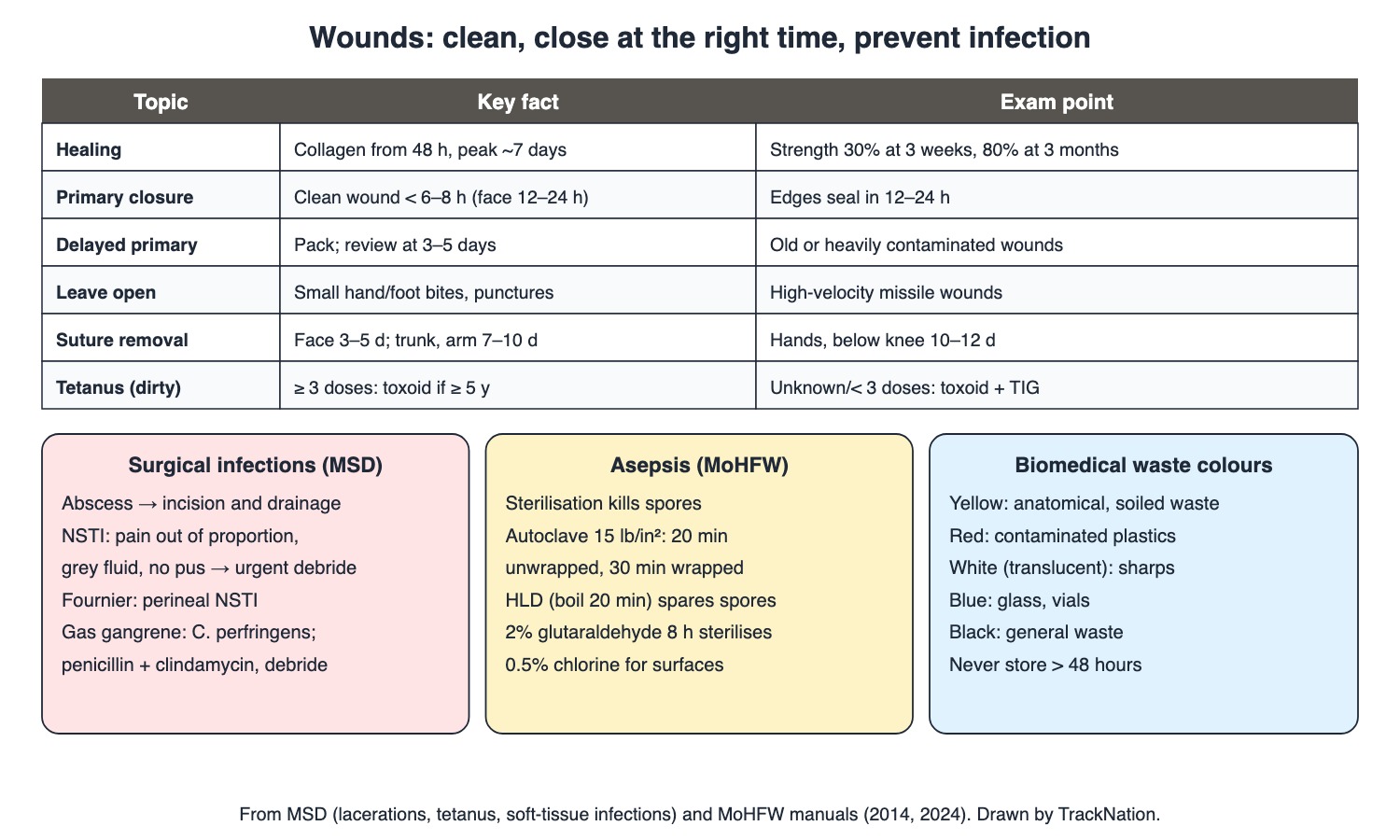
Wound healing, closure timing, suture removal, tetanus; surgical infections; sterilisation; biomedical waste colours. Drawn by TrackNation.
How Wounds Heal (MSD)
Sequence: haemostasis (vasoconstriction, platelets) → inflammation (neutrophils, macrophages clear debris) → fibroblasts lay down collagen from 48 h, peaking ~7 days, deposition complete in a month → remodelling. Tensile strength is only ~30% at 3 weeks and ~80% at 3 months and never reaches normal.
Primary intention: the epithelium seals the wound in 12–24 h and looks normal by 5 days. Secondary intention (left open): epithelialisation takes longer in proportion to the defect.
Scars are red for ~8 weeks then fade. Hypertrophic scar stays raised within the wound; a keloid extends beyond the original wound (commoner in dark skin; earlobes, shoulders, upper arms, chest). Wounds across tension lines widen.
Impaired healing: mainly ischaemia and infection — diabetes, arterial disease, crush, tight sutures, haematoma, foreign bodies, delay, contamination (bites), steroids and immunosuppressants, malnutrition and vitamin C deficiency, collagen disorders. Legs heal worst; face and scalp best.
Wound Care, Closure and Sutures (MSD)
Treat life threats first; stop bleeding with pressure; test sensation before local anaesthetic; look for vessel, nerve and tendon injury (a complete tendon cut gives a resting deformity) and foreign bodies — missing these is a major error.
Clip hair (never shave; never trim eyebrows); irrigate with saline under pressure, ≥ 100–300 mL; avoid full-strength antiseptics inside the wound. Lidocaine maximum 3–5 mg/kg (7 mg/kg with adrenaline); adrenaline in fingers or nose is now considered safe; "allergy" is often to the preservative methylparaben.
Primary closure for clean wounds < 6–8 h old (< 12–24 h on face and scalp). Delayed primary closure for older or dirty wounds: pack with saline gauze, close at 3–5 days if clean. Do not close small hand or foot bites, punctures or high-velocity missile wounds. No staples on the face.
Sutures: nylon, polypropylene (non-absorbable skin sutures); silk — good knots but high tissue reaction; absorbables for deep layers — polydioxanone (absorbed ~180 days), chromic gut (~1 week). Face 5-0/6-0. Removal: face 3–5 days; trunk and arms 7–10; hands and below the knee 10–12.
Systemic antibiotics only for bites on limbs, human bites, wounds into tendon, bone or joint, and heavy contamination. Tetanus: fully immunised (≥ 3 doses) → toxoid if ≥ 10 years (clean) or ≥ 5 years (dirty); unknown or < 3 doses with a dirty wound → toxoid plus TIG.
Surgical Infections (MSD)
Abscess (furuncle = one hair follicle, carbuncle = several) → incision and drainage.
Necrotising soft-tissue infection: often polymicrobial; pain out of proportion to signs, then bullae, crepitus, gangrene, sepsis; at surgery grey exudate, friable fascia and no pus. Diabetics at risk; no entry wound in ~20%. Perineal form = Fournier gangrene. LRINEC cannot rule it out. Treat by urgent surgical debridement plus broad antibiotics with clindamycin or linezolid to block toxin.
Gas gangrene (clostridial myonecrosis): Clostridium perfringens after crushed, devitalised or contaminated wounds; gas and crepitus, foul discharge, bronze skin → penicillin + clindamycin and debridement.
Tetanus: lockjaw (masseter spasm), risus sardonicus, opisthotonos, spasms with a clear mind; debride the wound, metronidazole, human TIG 500 units IM, then vaccinate.
Antibiotic prophylaxis: not needed for most clean operations unless implants or high-stakes infection; give within 1 hour before incision (2 h for vancomycin, fluoroquinolones); redose cephalosporins after 4 h; stop within 24 h unless infection is found. Cefazolin is standard for cardiac, vascular and joint surgery.
Asepsis and Biomedical Waste (MoHFW)
Sterilisation kills all microbes including spores; high-level disinfection (boiling 20 minutes, or 2% glutaraldehyde 20 minutes) does not reliably kill spores and is used only when sterilisation is impossible. Autoclave at 15 lb/in² for 20 min (unwrapped) or 30 min (wrapped); open hinged instruments; 2% glutaraldehyde for 8 hours sterilises. Store up to 1 week in a closed sterile container. Surfaces and floors: 0.5% chlorine; spills and waste: 1%.
Waste segregation at source: yellow — anatomical waste and soiled swabs; red — contaminated plastics (syringes, gloves, masks, blood and urine bags); white translucent puncture-proof — sharps and needles; blue — glass vials and ampoules; black — general waste. Fill bins only ¾ and never store waste beyond 48 hours.
Traps the Examiner Sets
Keloid crosses the wound margin; hypertrophic scar does not.
Never shave a wound or trim eyebrows.
No pus in necrotising fasciitis.
Boiling is disinfection, not sterilisation.
Memory Hooks & Shortcuts
Shortcuts to lock in this article's numbers and lists. Each one only re-packages facts proven above.
🧠 Strength '30 at 3 weeks, 80 at 3 months' — healing
🧠 Suture removal 'Face five, body ten, leg twelve' — removal
🧠 'Keloid crosses the line' — scars
🧠 Fasciitis: 'Pain beyond the picture, no pus in the picture' — NSTI
🧠 Waste: 'Yellow body, Red plastic, White sharp, Blue glass' — BMW colours
Rapid-Revision Cards
Collagen
From 48 h; peak ~7 days.
Tensile strength
30% at 3 wk; 80% at 3 mo.
Epithelial seal
12–24 h.
Keloid
Beyond wound margin.
Impaired healing
Ischaemia, infection.
Before LA
Test sensation.
Hair
Clip; never shave or trim eyebrows.
Lidocaine max
3–5 mg/kg; 7 with adrenaline.
Primary closure
< 6–8 h; face 12–24 h.
Delayed primary
Pack; close at 3–5 d.
Leave open
Hand/foot bites, punctures, missiles.
Removal
Face 3–5; trunk 7–10; leg 10–12 d.
Silk
High tissue reaction.
PDS
Absorbed ~180 days.
Tetanus, dirty
Booster if ≥ 5 y; TIG if < 3 doses.
NSTI
Pain > signs; no pus; debride.
Gas gangrene
C. perfringens; penicillin + clinda.
Prophylaxis
≤ 1 h before incision.
Autoclave
15 lb/in²: 20 / 30 min.
Glutaraldehyde 2%
8 h sterilises.
Sharps bin
White translucent.
Sources
Facts in this article were checked against these documents.
MSD Manual Professional: Skin Lacerations; Prevention of Surgical Site Infection; Cutaneous Abscess; Necrotizing Soft-Tissue Infection; Clostridial Soft-Tissue Infections; Tetanus — Merck & Co. (MSD Manuals), 2025–26 (link)
Standards and Quality Assurance in Sterilization Services; Female Sterilization Manual — Ministry of Health and Family Welfare, Government of India, 2014
Immunization Handbook / Routine Immunization manual for Medical Officers (biomedical waste segregation table, CPCB 2021) — Ministry of Health and Family Welfare, 2024
Competency Based Undergraduate Curriculum, Vol III: General Surgery (SU5, SU6, SU14, SU15) — National Medical Commission, 2024
Test Yourself: Practice Questions
Thirty questions in NEET PG style, most of them clinical vignettes.
Practice Questions (NEET PG pattern)
Original questions written in the style of the exam: +4 for a correct answer, −1 for a wrong one. Every answer was checked against the sources listed above. NEET PG papers are not published by NBEMS, so these are not past-paper questions.
Q1. Collagen synthesis in a healing wound begins within about
(a) 3 months
(b) 1 hour
(c) 3 weeks
(d) 48 hours, peaking at about 7 days
Show answer
Answer: (d) — Fibroblasts.
Q2. Three weeks after a laparotomy, the scar's tensile strength compared with normal skin is about
(a) 80%
(b) 5%
(c) 100%
(d) 30%
Show answer
Answer: (d) — 80% at 3 months; never 100%.
Q3. A sutured clean incision is sealed against bacteria and water by epithelium within
(a) 3 weeks
(b) 1 hour
(c) 12–24 hours
(d) 7 days
Show answer
Answer: (c) — Normal-looking by 5 days.
Q4. A raised scar that grows beyond the margins of the original wound is a
(a) keloid
(b) Marjolin ulcer
(c) contracture
(d) hypertrophic scar
Show answer
Answer: (a) — Commoner in dark skin.
Q5. The commonest factors impairing wound healing are
(a) early mobilisation
(b) tissue ischaemia and infection
(c) facial location
(d) young age
Show answer
Answer: (b) — Legs worst, face best.
Q6. A nutrient deficiency specifically listed as impairing wound healing is
(a) vitamin C
(b) vitamin D excess
(c) vitamin K excess
(d) vitamin A excess
Show answer
Answer: (a) — Collagen.
Q7. Before injecting local anaesthetic into a hand laceration, you must
(a) test distal sensation
(b) close the wound
(c) apply full-strength povidone-iodine into the wound
(d) shave the area
Show answer
Answer: (a) — Nerve injury.
Q8. Hair around a scalp laceration should be
(a) burned
(b) clipped, not shaved
(c) left and sutured into the wound
(d) shaved with a razor
Show answer
Answer: (b) — Razors cause microtrauma.
Q9. A laceration runs through the eyebrow. The eyebrow should
(a) be shaved
(b) be clipped completely
(c) not be trimmed — it guides alignment
(d) be excised
Show answer
Answer: (c) — Hair-skin border.
Q10. The maximum dose of plain lidocaine for wound infiltration is about
(a) 0.5 mg/kg
(b) 50 mg/kg
(c) 20 mg/kg
(d) 3–5 mg/kg (7 mg/kg with adrenaline)
Show answer
Answer: (d) — Bupivacaine 2.5 mg/kg.
Q11. A clean forearm laceration presents 4 hours after injury. Management is
(a) leave open to heal by secondary intention
(b) amputation
(c) delayed closure at 2 weeks
(d) primary closure after cleaning
Show answer
Answer: (d) — < 6–8 h.
Q12. A heavily soil-contaminated leg wound seen at 20 hours should be
(a) cleaned, debrided, packed and considered for delayed primary closure at 3–5 days
(b) covered with staples
(c) left untreated
(d) sutured tightly at once
Show answer
Answer: (a) — Delayed primary closure.
Q13. Which wound should NOT be closed primarily?
(a) a small dog bite on the hand
(b) a 4-hour clean forearm cut
(c) a clean 2-hour scalp laceration
(d) a clean surgical incision
Show answer
Answer: (a) — Also punctures, missile wounds.
Q14. Skin sutures on the face are usually removed after
(a) 7–10 days
(b) 3–5 days
(c) 10–12 days
(d) 3 weeks
Show answer
Answer: (b) — Avoid cross-hatching.
Q15. Sutures below the knee are usually removed after
(a) 10–12 days
(b) 1 month
(c) 7 days
(d) 3–5 days
Show answer
Answer: (a) — Also hands, extensor elbow and knee.
Q16. A suture with good knot security but high tissue reactivity is
(a) polypropylene
(b) polydioxanone
(c) silk
(d) nylon
Show answer
Answer: (c) — Mostly mouth and lips.
Q17. A long-lasting absorbable suture taking about 180 days to absorb is
(a) chromic gut
(b) polydioxanone
(c) silk
(d) poliglecaprone
Show answer
Answer: (b) — Gut ~1 week.
Q18. A man with a soil-contaminated wound had his last tetanus booster 7 years ago after a full primary course. He needs
(a) TIG only
(b) tetanus toxoid only
(c) nothing
(d) toxoid plus TIG
Show answer
Answer: (b) — Dirty wound: booster if ≥ 5 years.
Q19. A farmer with a dirty wound has never been vaccinated against tetanus. He needs
(a) nothing
(b) toxoid only
(c) antibiotics only
(d) tetanus toxoid plus tetanus immunoglobulin
Show answer
Answer: (d) — Unknown or < 3 doses.
Q20. A man has jaw stiffness, a fixed grin with raised eyebrows and back arching spasms with a clear sensorium after a puncture wound. The diagnosis is
(a) meningitis
(b) tetanus
(c) rabies
(d) strychnine poisoning only
Show answer
Answer: (b) — Risus sardonicus.
Q21. A diabetic has severe thigh pain far greater than the mild redness suggests, then develops bullae and crepitus. At surgery there is grey fluid and no pus. The diagnosis is
(a) simple cellulitis
(b) DVT
(c) necrotising soft-tissue infection
(d) abscess
Show answer
Answer: (c) — Urgent debridement.
Q22. Necrotising infection of the perineum and genitals is called
(a) Marjolin ulcer
(b) Fournier gangrene
(c) Ludwig angina
(d) Meleney ulcer
Show answer
Answer: (b) — After perirectal abscess, surgery.
Q23. The definitive treatment of necrotising fasciitis is
(a) urgent surgical debridement with broad antibiotics
(b) elevation and observation
(c) antibiotics alone
(d) steroids
Show answer
Answer: (a) — Clindamycin to block toxin.
Q24. After a crush injury, a limb develops crepitus, foul discharge and bronze skin within a day. The organism and treatment are
(a) Candida; fluconazole
(b) Clostridium perfringens; penicillin + clindamycin and debridement
(c) Pseudomonas; ceftazidime only
(d) Staph aureus; flucloxacillin only
Show answer
Answer: (b) — Gas gangrene.
Q25. Prophylactic antibiotics for surgery should be given
(a) after skin closure
(b) for 7 days after surgery
(c) the night before
(d) within 1 hour before the incision
Show answer
Answer: (d) — 2 h for vancomycin.
Q26. A cephalosporin prophylaxis dose should be repeated when surgery lasts more than
(a) 12 hours
(b) 24 hours
(c) 4 hours
(d) 30 minutes
Show answer
Answer: (c) — Stop by 24 h unless infected.
Q27. The process that destroys bacterial spores is
(a) alcohol rub
(b) boiling for 20 minutes
(c) sterilisation (e.g. autoclaving)
(d) 0.5% chlorine wipe
Show answer
Answer: (c) — HLD spares spores.
Q28. Per MoHFW standards, wrapped instruments and linen are autoclaved at 15 lb/in² for
(a) 30 minutes
(b) 8 hours
(c) 2 hours
(d) 5 minutes
Show answer
Answer: (a) — 20 min unwrapped.
Q29. A chemical that sterilises instruments if they are soaked for at least 8 hours is
(a) 2% glutaraldehyde
(b) soap solution
(c) 0.5% chlorine
(d) 70% alcohol
Show answer
Answer: (a) — 20 minutes gives HLD only.
Q30. Under Indian biomedical waste segregation, used needles and sharps go into
(a) a yellow bag
(b) a red bag
(c) a black bin
(d) a white translucent puncture-proof container
Show answer
Answer: (d) — Blue for glass.
Active Recall
From memory: describe wound healing and the strength of a scar over time, list factors that impair healing, outline wound cleansing, anaesthesia, closure timing and suture removal, give the tetanus prophylaxis rules, describe necrotising fasciitis and gas gangrene, and state the rules for antibiotic prophylaxis, sterilisation and biomedical waste segregation.