Blood Transfusion and Surgical Nutrition for NEET PG: Components, Transfusion Reactions, Massive Transfusion, Enteral and Parenteral Feeding
Start Here
🎯 Exam priority: High. Expect: which component for which problem, storage temperatures and shelf life, Hb and platelet rise per unit, transfusion thresholds, the commonest reaction, how acute haemolysis presents and is managed, TRALI vs TACO, irradiation for GVHD, IgA deficiency, the massive transfusion definition and lethal triad, and enteral vs parenteral nutrition.
CBME mapping: SU3.1–3.3 (blood and components, counselling) and SU12.1–12.3 (nutrition and fluid therapy). Shock resuscitation was article 1.
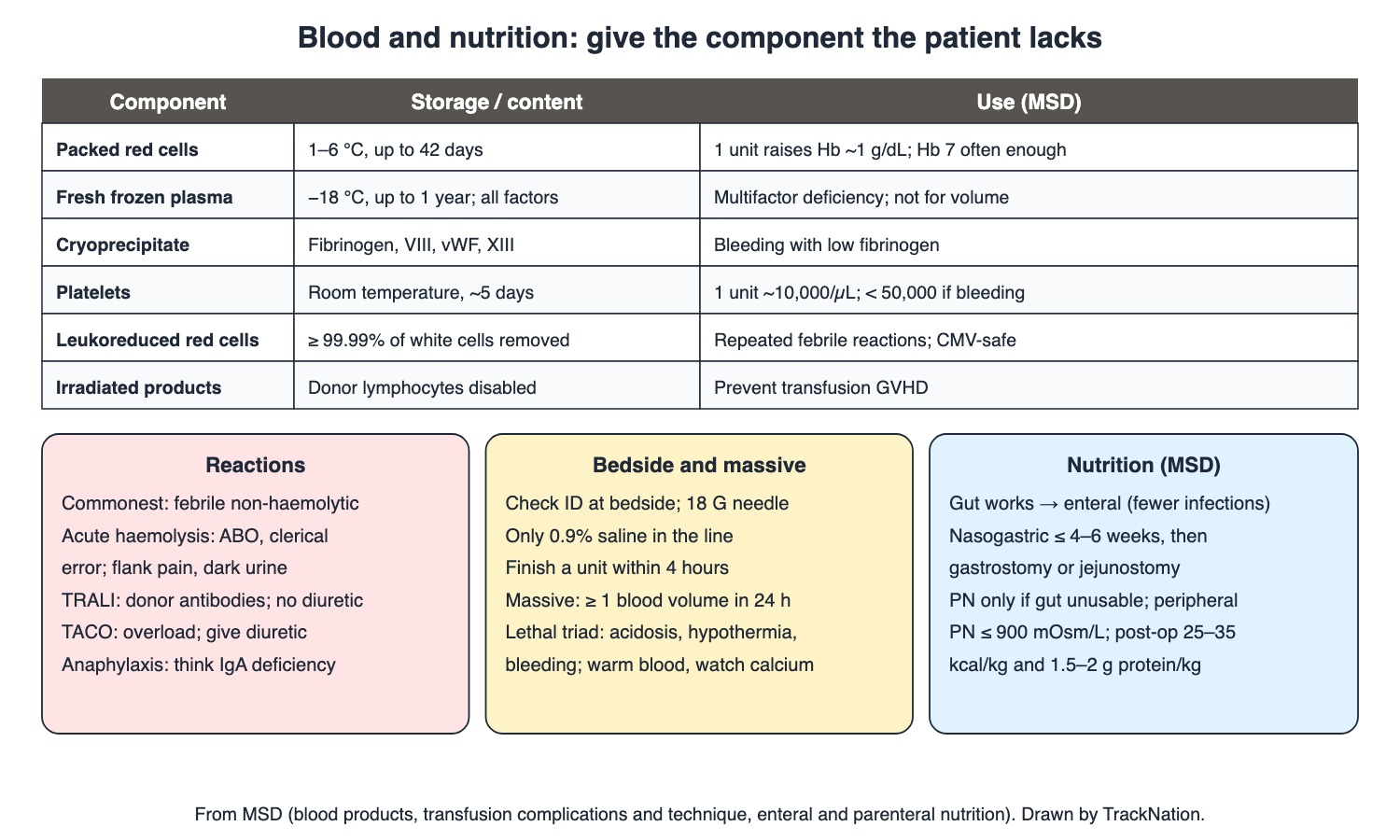
Blood components; transfusion reactions; bedside rules and massive transfusion; enteral and parenteral nutrition. Drawn by TrackNation.
Blood Components (MSD)
Packed red cells: stored at 1–6 °C up to 42 days; one unit raises Hb by ~1 g/dL (Hct ~3%). Hb 7 g/dL is usually adequate in healthy patients; higher in poor cardiopulmonary reserve or ongoing bleeding. Washed cells for severe plasma reactions (IgA); leukoreduced (≥ 99.99% WBC removed) for repeated febrile reactions and when CMV-negative blood is needed.
FFP: all clotting factors, no platelets; −18 °C up to 1 year. For multifactor deficiency — massive transfusion, DIC, liver failure. Not for volume expansion or heparin overdose; for warfarin reversal 4-factor PCC is first choice.
Cryoprecipitate (from FFP): ~80 units factor VIII and vWF, ~250 mg fibrinogen, factor XIII — used for bleeding with low fibrinogen.
Platelets: room temperature (more bacterial risk; ~5 days). One unit raises the count ~10,000/µL; give if < 5,000–10,000 without bleeding, < 50,000 with bleeding or for major surgery. Single-donor plateletpheresis limits exposure. Rh immune globulin 300 µg IM to an Rh-negative mother after delivery or abortion.
Transfusion Reactions (MSD)
Any reaction (except local itching or urticaria): stop the transfusion, keep the line open with saline, send the bag and samples to the blood bank; if blood is urgently needed, use O-negative red cells.
Febrile non-haemolytic — the commonest: temperature rise ≥ 1 °C, chills; but investigate every fever as possible haemolysis. Prevent with leukoreduced blood.
Acute haemolytic — ABO mismatch, usually from mislabelled samples or bedside identification errors; within 1 hour: fever, chills, flushing, loin pain, hypotension, haemoglobinuria, DIC; under anaesthesia only hypotension, oozing or dark urine. Recheck labels; DAT positive, haptoglobin very low. Treat with saline and furosemide to keep urine 100 mL/h; avoid renal-vasoconstricting pressors (low-dose dopamine if needed).
TRALI: donor anti-HLA or anti-granulocyte antibodies → non-cardiogenic pulmonary oedema; supportive, no diuretics. TACO: volume overload in elderly or cardiac/renal patients → slow transfusion, furosemide.
Transfusion GVHD: donor lymphocytes in an immunocompromised recipient (or blood from a first-degree relative) → rash, diarrhoea, pancytopenia; > 90% mortality; prevent by irradiating cellular products. Anaphylaxis → think IgA deficiency; use washed products or IgA-deficient donor plasma. Delayed haemolysis: unexplained Hb drop 1–2 weeks later. Infections: Yersinia in refrigerated red cells; syphilis killed by ≥ 96 h storage at 4–10 °C.
Bedside Safety and Massive Transfusion
Consent; check wristband, unit label and compatibility report at the bedside; ≥ 18 G cannula; standard filter; only 0.9% saline in the line (hypotonic fluids lyse cells, Ringer's calcium clots blood); no drugs mixed with blood; finish each unit within 4 hours; watch closely in the first 15 minutes.
Massive transfusion = ≥ 1 blood volume in 24 h (~10 units in a 70-kg adult). Dilution plus trauma consumption → lethal triad: acidosis, hypothermia, bleeding → give plasma and platelets early (1:1:1 or 1:1:2). Warm with a heat-exchange set — never a microwave. Citrate can cause hypocalcaemia (rarely needs calcium gluconate); potassium rises with old blood in kidney failure. Stored blood loses 2,3-DPG (after 7 days).
Surgical Nutrition (MSD)
If the gut works, use it: enteral feeding preserves gut structure, is cheaper and has fewer infections. Indications include anorexia, coma, stroke dysphagia, head and neck trauma, burns and pre-operative optimisation of the malnourished.
Tubes: nasogastric/nasoenteric for ≤ 4–6 weeks; longer → gastrostomy or jejunostomy. Jejunostomy does not lower aspiration risk. Confirm blind tube position by X-ray; avoid nasal tubes with cribriform plate fractures. Polymeric formulas are standard; hydrolysed (elemental) for malabsorption. Intolerance (diarrhoea, vomiting) in up to 20% (50% in critical illness), more with bolus feeds.
Parenteral nutrition only when the gut cannot be used (obstruction, short bowel, some colitis). Peripheral PN must be ≤ 900 mOsm/L (else thrombophlebitis); stronger solutions need a central line. Post-operative needs: 25–35 kcal/kg and 1.5–2 g protein/kg a day; energy needs rise 12% per °C of fever.
PN complications: line problems in 5–10% (sepsis), hyper- and rebound hypoglycaemia if dextrose stops suddenly, liver dysfunction (cholestasis), volume overload (> 1 kg/day gain), metabolic bone disease after > 3 months.
Traps the Examiner Sets
FFP is not a volume expander.
TRALI: no diuretic; TACO: diuretic.
Steroid or transplant drugs alone are not an indication for irradiated blood.
Jejunostomy does not prevent aspiration.
Memory Hooks & Shortcuts
Shortcuts to lock in this article's numbers and lists. Each one only re-packages facts proven above.
🧠 'Red cold, plasma frozen, platelets warm' — 1–6 °C, −18 °C, room temperature — storage
🧠 'One unit, one gram' — RBC raises Hb ~1 g/dL — dose
🧠 'TRALI: dry the donor, not the patient' (no diuretic); 'TACO: tap the kidneys' (furosemide) — lung reactions
🧠 'Anaphylaxis to blood? Ask about IgA' — allergy
🧠 'If the gut works, use it' — nutrition
Rapid-Revision Cards
Packed RBC
1–6 °C, 42 days; +1 g/dL per unit.
FFP
−18 °C, 1 year; all factors.
Cryoprecipitate
Fibrinogen, VIII, vWF, XIII.
Platelets
Room temp; +10,000 per unit.
Platelet trigger
< 10k prophylaxis; < 50k bleeding.
Warfarin bleed
4-factor PCC.
Commonest reaction
Febrile non-haemolytic.
Acute haemolysis
ABO, clerical; loin pain, dark urine.
First step
Stop; saline; recheck labels.
AHTR treatment
Urine 100 mL/h; saline + furosemide.
TRALI
Donor antibody; no diuretic.
TACO
Overload; furosemide.
Anaphylaxis
IgA deficiency; washed products.
GVHD
Irradiate; relatives' blood.
Delayed haemolysis
Hb falls 1–2 weeks later.
Massive transfusion
≥ 1 blood volume / 24 h.
Lethal triad
Acidosis, hypothermia, bleeding.
Line rules
18 G; 0.9% saline only; 4 h.
Gut works
Feed enterally.
Tube > 4–6 weeks
Gastrostomy/jejunostomy.
Peripheral PN
≤ 900 mOsm/L.
Sources
Facts in this article were checked against these documents.
MSD Manual Professional: Blood Products; Complications of Transfusion; Technique of Transfusion; Enteral Nutrition; Parenteral Nutrition — Merck & Co. (MSD Manuals), 2025–26 (link)
Competency Based Undergraduate Curriculum, Vol III: General Surgery (SU3, SU12) — National Medical Commission, 2024
Test Yourself: Practice Questions
Thirty questions in NEET PG style, most of them clinical vignettes.
Practice Questions (NEET PG pattern)
Original questions written in the style of the exam: +4 for a correct answer, −1 for a wrong one. Every answer was checked against the sources listed above. NEET PG papers are not published by NBEMS, so these are not past-paper questions.
Q1. Packed red cells are stored at
(a) room temperature for 5 days
(b) −18 °C for 1 year
(c) 1–6 °C for up to 42 days
(d) 37 °C for 24 hours
Show answer
Answer: (c) — FFP −18 °C; platelets room temp.
Q2. One unit of packed red cells raises an adult's haemoglobin by about
(a) 5 g/dL
(b) 0.2 g/dL
(c) 1 g/dL
(d) 3 g/dL
Show answer
Answer: (c) — Hct ~3%.
Q3. Fresh frozen plasma is the right choice for
(a) heparin overdose
(b) bleeding with multifactor deficiency such as DIC or massive transfusion
(c) volume expansion
(d) isolated low fibrinogen
Show answer
Answer: (b) — Not for volume.
Q4. A patient on warfarin has a life-threatening bleed. The first-choice reversal product is
(a) platelets
(b) cryoprecipitate
(c) FFP always
(d) 4-factor prothrombin complex concentrate
Show answer
Answer: (d) — FFP only if PCC unavailable.
Q5. A bleeding patient has a low fibrinogen level. The product that supplies concentrated fibrinogen is
(a) albumin
(b) platelets
(c) packed red cells
(d) cryoprecipitate
Show answer
Answer: (d) — ~250 mg per unit.
Q6. A bleeding patient's platelet count is 30,000/µL. Platelet transfusion is
(a) indicated (bleeding with count < 50,000)
(b) never indicated
(c) contraindicated
(d) only below 5,000
Show answer
Answer: (a) — Also for major surgery.
Q7. Why do platelet concentrates carry the highest risk of bacterial contamination?
(a) they are frozen
(b) they contain plasma only
(c) they are irradiated
(d) they are stored at room temperature
Show answer
Answer: (d) — ~5-day limit.
Q8. A woman has had two febrile reactions to transfusion. Future red cells should be
(a) irradiated only
(b) leukoreduced
(c) fresh whole blood
(d) O-negative
Show answer
Answer: (b) — ≥ 99.99% WBC removed.
Q9. The most common complication of blood transfusion is
(a) acute haemolysis
(b) febrile non-haemolytic reaction
(c) TRALI
(d) GVHD
Show answer
Answer: (b) — Still investigate every fever.
Q10. Soon after a unit is started, a patient develops fever, flushing, severe low-back pain and dark urine. The likely cause is
(a) acute haemolytic reaction from ABO incompatibility
(b) allergic urticaria
(c) TACO
(d) febrile non-haemolytic reaction
Show answer
Answer: (a) — Intravascular haemolysis.
Q11. The usual cause of ABO-incompatible transfusion is
(a) old blood
(b) mislabelled samples or failure to check identity at the bedside
(c) donor antibodies
(d) bacterial contamination
Show answer
Answer: (b) — Clerical error.
Q12. The first step when an acute transfusion reaction is suspected is to
(a) stop the transfusion and keep the line open with saline
(b) give antihistamine and continue
(c) slow the drip
(d) restart after 10 minutes
Show answer
Answer: (a) — Recheck labels.
Q13. In acute haemolytic transfusion reaction, management aims to keep urine output at
(a) 100 mL/hour with saline and furosemide
(b) no target
(c) 10 mL/hour
(d) 500 mL/hour with mannitol only
Show answer
Answer: (a) — Avoid renal-vasoconstricting pressors.
Q14. Under general anaesthesia, acute haemolytic reaction may present only as
(a) hyperthermia only
(b) bradycardia only
(c) hypotension, oozing from the wound and dark urine
(d) rash
Show answer
Answer: (c) — Watch the field.
Q15. A laboratory finding in intravascular haemolysis is
(a) low LDH
(b) high haptoglobin
(c) very low haptoglobin with a positive DAT
(d) negative DAT always
Show answer
Answer: (c) — Free Hb in plasma/urine.
Q16. Shortly after a plasma transfusion a patient develops hypoxia with a chest X-ray of non-cardiogenic pulmonary oedema. Management is
(a) high-dose furosemide
(b) restart transfusion
(c) antibiotics only
(d) supportive care; avoid diuretics (TRALI)
Show answer
Answer: (d) — Donor antibodies.
Q17. An elderly woman with heart failure develops signs of heart failure during her second unit. The likely cause and treatment are
(a) TACO — stop and give furosemide
(b) febrile reaction — paracetamol
(c) TRALI — avoid diuretics
(d) anaphylaxis — adrenaline
Show answer
Answer: (a) — Transfuse slowly.
Q18. A patient develops anaphylaxis during transfusion. An underlying condition to suspect is
(a) haemophilia
(b) thalassaemia trait
(c) G6PD deficiency
(d) IgA deficiency
Show answer
Answer: (d) — Use washed products.
Q19. Transfusion-associated GVHD is prevented by
(a) irradiating cellular blood products
(b) leukoreduction alone
(c) warming blood
(d) giving steroids
Show answer
Answer: (a) — > 90% mortality.
Q20. Irradiated blood is required when
(a) the donor is a first-degree relative
(b) the patient is a renal transplant recipient on immunosuppressants only
(c) blood is older than 7 days
(d) the patient takes prednisolone
Show answer
Answer: (a) — Shared HLA haplotype.
Q21. Ten days after transfusion, a patient's haemoglobin falls back to the pre-transfusion level without bleeding. This is
(a) TRALI
(b) GVHD
(c) iron overload
(d) delayed haemolytic transfusion reaction
Show answer
Answer: (d) — Anamnestic antibody.
Q22. A refrigerated red-cell unit can still transmit endotoxin from
(a) Staphylococcus epidermidis only
(b) Yersinia
(c) Treponema after 2 weeks
(d) Plasmodium vivax only
Show answer
Answer: (b) — Cold-loving.
Q23. Massive transfusion is defined as
(a) ≥ 4 units in a week
(b) ≥ 1 blood volume (about 10 units) in 24 hours
(c) any O-negative unit
(d) ≥ 2 units in a day
Show answer
Answer: (b) — 70-kg adult.
Q24. The lethal triad in massive haemorrhage and transfusion is
(a) hypoglycaemia, hypokalaemia, hypocalcaemia
(b) hypoxia, hypercapnia, acidosis
(c) fever, rash, diarrhoea
(d) acidosis, hypothermia and bleeding (coagulopathy)
Show answer
Answer: (d) — Give plasma and platelets early.
Q25. Blood for rapid transfusion should be warmed using
(a) an in-line heat-exchange device
(b) hot water at 60 °C
(c) a microwave oven
(d) nothing
Show answer
Answer: (a) — Microwave haemolyses.
Q26. The only IV fluid that may run in the same line as blood is
(a) Ringer's lactate
(b) 5% dextrose
(c) 0.9% saline
(d) 0.45% saline
Show answer
Answer: (c) — Calcium clots; hypotonic lyses.
Q27. Each unit of blood should be completed within
(a) 4 hours
(b) 30 minutes
(c) 24 hours
(d) 12 hours
Show answer
Answer: (a) — Bacterial growth risk.
Q28. After a stroke a patient cannot swallow but has a working gut; feeding is expected for 3 months. The best route is
(a) nasogastric tube indefinitely
(b) parenteral nutrition
(c) gastrostomy tube feeding
(d) IV dextrose
Show answer
Answer: (c) — > 4–6 weeks.
Q29. Peripheral parenteral nutrition must have an osmolarity no higher than
(a) 2,000 mOsm/L
(b) 300 mOsm/L
(c) 1,500 mOsm/L
(d) 900 mOsm/L
Show answer
Answer: (d) — Else thrombophlebitis.
Q30. A patient's central parenteral nutrition with concentrated dextrose is stopped abruptly. The complication to anticipate is
(a) rebound hypoglycaemia
(b) hyperglycaemia
(c) air embolism
(d) refeeding hyperkalaemia
Show answer
Answer: (a) — Taper dextrose.
Active Recall
From memory: list each blood component with its storage and main use, describe the main transfusion reactions and their management, define massive transfusion and its dangers, give the bedside rules, and compare enteral and parenteral nutrition with requirements and complications.