Burns for NEET PG Surgery: Depth, Rule of Nines, Parkland Formula, Inhalation Injury, Escharotomy, Infection and Electrical Burns
Start Here
🎯 Exam priority: High. Expect: identify depth from a description, rule of nines and the hand method, which burns count in TBSA, the Parkland formula with its timing and fluid, urine targets, airway red flags and CO, escharotomy depth, organisms by day, silver sulfadiazine side effect, referral criteria, and electrical burns.
CBME mapping: SU4.1–4.4 (pathophysiology, assessment, management and counselling in burns). Medicolegal aspects (SU4.3) are not covered here because we have no checkable source for them yet.
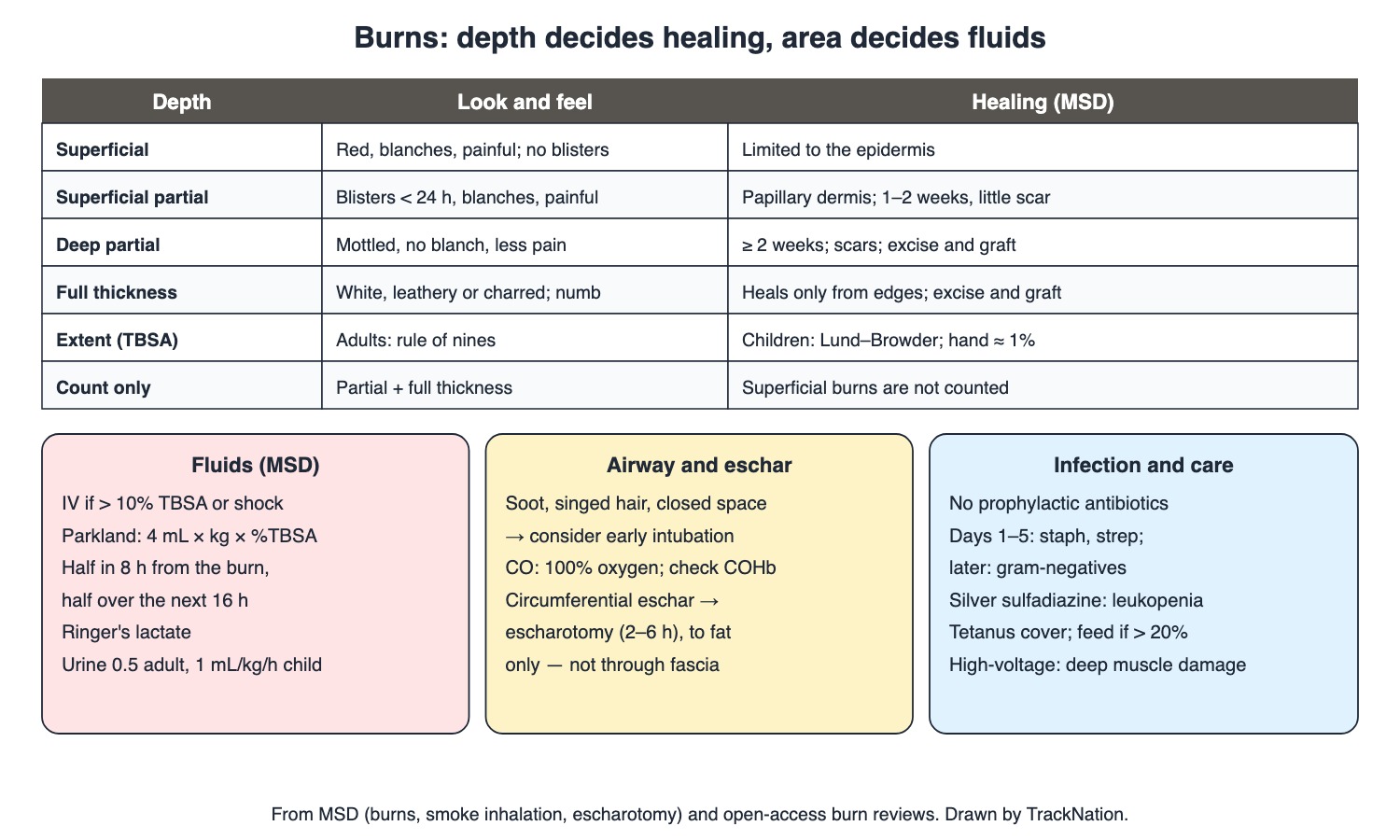
Burn depth with signs and healing; TBSA; Parkland fluids; airway and escharotomy; infection and care. Drawn by TrackNation.
How Burns Injure (MSD, reviews)
Heat denatures protein → coagulative necrosis. Jackson's zones: coagulation (centre), stasis (ischaemic, salvageable), hyperaemia (outer). Lost skin → infection, fluid loss, heat loss; oedema worsens volume loss.
Systemic risk rises with area: ≥ 40% TBSA, age > 60 or < 2, major trauma or smoke inhalation. Commonest systemic problems: hypovolaemia and infection. Also hypoalbuminaemia, low Mg, PO₄ and K, acidosis, ileus, hypothermia; rhabdomyolysis or haemolysis → dark urine → acute tubular necrosis.
Chemical burns (acids, alkalis such as cement) keep burning for hours. High-voltage (> 1000 V) electrical burns destroy muscle, nerve and vessels under little visible skin damage. Think of abuse in young children and the elderly.
Depth and Extent
Superficial (epidermis): red, blanches, painful, no blisters. Superficial partial-thickness (papillary dermis): blisters within 24 h, blanches, painful; heals in 1–2 weeks with little scar. Deep partial-thickness: white/red mottled, does not blanch, less painful (pinprick felt as pressure); ≥ 2 weeks, scars. Full thickness (into fat): white, leathery or charred, painless, hairs pull out easily; heals only from the edges → excise and graft. If unsure between deep partial and full, treat as full thickness.
TBSA counts only partial- and full-thickness burns. Adults: rule of nines — head 9%, each upper limb 9%, each lower limb 18% (front 9, back 9). Children: Lund–Browder chart (a newborn's head is ~18%). Scattered burns: the patient's whole hand with fingers ≈ 1%.
Resuscitation and Airway
ABC first; stop the burning; remove clothing; flush liquid chemicals with water for ≥ 20 minutes (brush powders off first). IV fluids for partial/full burns > 10% TBSA or shock, via 14–16 G cannulas through unburned skin; avoid cut-downs.
Parkland: 4 mL × kg × %TBSA in the first 24 h from the time of the burn; half in the first 8 h, half over the next 16 h; Ringer's lactate (large saline volumes cause hyperchloraemic acidosis). It is only a starting point — titrate to urine 0.5 mL/kg/h in adults, 1 mL/kg/h in children; children also need maintenance fluid (modified Parkland adds 1500 mL/m²). Colloid (albumin) may be added after 12 h in big burns. Watch for overload and compartment syndromes.
Airway red flags: confinement in a fire, carbonaceous sputum, perioral burns, singed nasal hair, stridor → early intubation. Hot smoke burns the pharynx; steam can burn below the cords. No posterior pharyngeal swelling at 2–6 h makes upper airway injury unlikely. CO and cyanide poison cellular respiration: 100% oxygen; hyperbaric oxygen if COHb > 20% or neurological deficit.
Wound Care, Eschar and Infection
Analgesia (IV opioids), clean with soap and room-temperature water, debride ruptured blisters (not small ones on palms, fingers, soles), topical silver sulfadiazine (may cause transient leukopenia) or mafenide, silver dressings; elevate limbs; tetanus booster or immunoglobulin. Deep partial and full thickness → excision and grafting.
Circumferential eschar on a limb, chest or neck → escharotomy, usually within 2–6 h, cut only to subcutaneous fat (not fascia, unlike fasciotomy); signs: absent Doppler flow, distal SpO₂ < 95%, compartment pressure > 30 mm Hg, breathing difficulty. No contraindications.
No prophylactic systemic antibiotics. Early infection: streptococci and staphylococci; after 5–7 days: gram-negatives. Fever and leucocytosis are unreliable; confirm by biopsy (surface swabs unreliable). Feed (by tube if needed) burns > 20% TBSA; parenteral nutrition rarely needed.
Discuss with a burn centre: full thickness > 1%, partial thickness > 5%, burns of hands, face, feet or perineum, age < 2 or > 60. Long term: scars and contractures near joints; keloids (more in darker skin).
Electrical: hand is the usual source, foot the ground; arm-to-arm or arm-to-foot current crosses the heart → arrhythmia; household AC causes tetany (cannot let go); rhabdomyolysis, compartment syndrome; cardiac monitoring 6–12 h when indicated.
Traps the Examiner Sets
Superficial (erythema-only) burns are not counted in TBSA.
Parkland time starts at the burn, not at arrival.
Painless burn = deeper, not milder.
Escharotomy stops at fat.
Memory Hooks & Shortcuts
Shortcuts to lock in this article's numbers and lists. Each one only re-packages facts proven above.
🧠 'Blisters = partial; painless = full' — depth
🧠 Parkland '4-8-16': 4 mL, half in 8 h, rest in 16 h — from the burn — fluids
🧠 Rule of nines: 'Head nine, arm nine, leg eighteen' — TBSA
🧠 'Escharotomy stops at fat; fasciotomy goes through fascia' — eschar
🧠 'Electricity: the iceberg burn' — small skin, deep damage — electrical
Rapid-Revision Cards
Superficial
Red, blanches, no blisters.
Superficial partial
Blisters < 24 h; 1–2 weeks.
Deep partial
Mottled, no blanch; ≥ 2 weeks, scars.
Full thickness
Leathery, painless, hairs pull out.
Jackson zones
Coagulation, stasis, hyperaemia.
TBSA counts
Partial + full thickness only.
Rule of nines
Head 9, arm 9, leg 18.
Hand
≈ 1% TBSA.
Children
Lund–Browder.
IV fluids
> 10% TBSA.
Parkland
4 mL × kg × %TBSA.
Timing
Half in 8 h from burn.
Fluid
Ringer's lactate.
Urine target
0.5 adult; 1 child (mL/kg/h).
Airway clues
Soot, singed hair, closed space.
CO
100% O₂; HBO if COHb > 20%.
Escharotomy
To fat, not fascia; 2–6 h.
Antibiotics
No prophylaxis.
Organisms
Gram-positive early; gram-negative > 5–7 d.
SSD
Transient leukopenia.
Electrical
Small skin, big muscle damage.
Sources
Facts in this article were checked against these documents.
MSD Manual Professional: Burns; Smoke Inhalation; How to Do Burn Escharotomy; Electrical Injuries — Merck & Co. (MSD Manuals), 2025–26 (link)
The evaluation and management of thermal injuries: 2014 update — Clinical and Experimental Emergency Medicine (CC BY-NC), 2014 (link)
Treatment of burns in the first 24 hours: simple and practical guide — World Journal of Emergency Surgery (CC BY), 2012 (link)
Special considerations in paediatric burn patients — Indian Journal of Plastic Surgery (CC BY), 2010 (link)
Competency Based Undergraduate Curriculum, Vol III: General Surgery (SU4) — National Medical Commission, 2024
Test Yourself: Practice Questions
Thirty questions in NEET PG style, most of them clinical vignettes.
Practice Questions (NEET PG pattern)
Original questions written in the style of the exam: +4 for a correct answer, −1 for a wrong one. Every answer was checked against the sources listed above. NEET PG papers are not published by NBEMS, so these are not past-paper questions.
Q1. A cook spills hot oil on his forearm. The area is red, painful, blanches and has blisters by the next day. The depth is
(a) superficial partial-thickness
(b) deep partial-thickness
(c) full thickness
(d) superficial
Show answer
Answer: (a) — Blisters within 24 h.
Q2. A burn is red and painful, blanches easily and never blisters. The depth is
(a) superficial partial
(b) deep partial
(c) superficial (epidermal)
(d) full thickness
Show answer
Answer: (c) — Not counted in TBSA.
Q3. A burn is leathery, painless to pinprick, and hairs pull out easily. The depth is
(a) deep partial only
(b) superficial partial
(c) full thickness
(d) superficial
Show answer
Answer: (c) — Heals from edges only.
Q4. A mottled red-and-white burn does not blanch and is less painful; pinprick feels like pressure. It will
(a) take ≥ 2 weeks and scar — deep partial-thickness
(b) never need grafting
(c) heal without scar in 1 week
(d) heal in 5 days
Show answer
Answer: (a) — Heals only from follicles.
Q5. Full-thickness burns heal
(a) from sweat ducts
(b) from hair follicles in 1 week
(c) only from the wound edges, so most need excision and grafting
(d) without scarring
Show answer
Answer: (c) — Unless very small.
Q6. In Jackson's burn wound model, the potentially salvageable middle zone is the zone of
(a) hyperaemia
(b) stasis
(c) coagulation
(d) necrosis
Show answer
Answer: (b) — Protect perfusion.
Q7. When calculating TBSA for fluids, which burns are counted?
(a) facial burns only
(b) full thickness only
(c) all burns including erythema
(d) partial- and full-thickness only
Show answer
Answer: (d) — Superficial excluded.
Q8. By the rule of nines, one entire lower limb of an adult is
(a) 4.5%
(b) 27%
(c) 9%
(d) 18%
Show answer
Answer: (d) — Front 9, back 9.
Q9. To estimate small scattered burns, the area of the patient's whole hand including fingers equals about
(a) 0.1%
(b) 1% of TBSA
(c) 9%
(d) 5%
Show answer
Answer: (b) — Not just the palm.
Q10. For estimating burn area in a young child, the preferred method is the
(a) Parkland formula
(b) adult rule of nines
(c) Baux score
(d) Lund–Browder chart
Show answer
Answer: (d) — Bigger head, smaller legs.
Q11. IV fluid resuscitation is required for partial- or full-thickness burns greater than
(a) 10% TBSA (or shock)
(b) 40% only
(c) 1%
(d) 60% only
Show answer
Answer: (a) — MSD.
Q12. A 70-kg man has 30% partial- and full-thickness burns. His Parkland volume for the first 24 hours is
(a) 16,800 mL
(b) 4,200 mL
(c) 8,400 mL
(d) 2,100 mL
Show answer
Answer: (c) — 4 × 70 × 30.
Q13. A patient burned at 10 a.m. reaches hospital at 2 p.m. The first half of the Parkland volume should be completed by
(a) 10 p.m. (8 hours from arrival)
(b) 6 p.m. (8 hours from the burn)
(c) the next morning
(d) 2 p.m. tomorrow
Show answer
Answer: (b) — Clock starts at injury.
Q14. The fluid used for Parkland resuscitation is
(a) packed red cells
(b) 5% dextrose
(c) 0.45% saline
(d) Ringer's lactate
Show answer
Answer: (d) — Saline → hyperchloraemic acidosis.
Q15. The target urine output during burn resuscitation in an adult is
(a) 0.1 mL/kg/hour
(b) 5 mL/kg/hour
(c) 2 mL/kg/hour
(d) 0.5 mL/kg/hour
Show answer
Answer: (d) — 1 mL/kg/h in children < 30 kg.
Q16. Children receiving burn resuscitation also need
(a) only colloid
(b) no extra fluid
(c) maintenance fluid added, as they risk hypoglycaemia
(d) fluid restriction
Show answer
Answer: (c) — Modified Parkland.
Q17. A man rescued from a house fire has soot in his sputum, singed nasal hairs and a cough. The priority is
(a) give antibiotics
(b) start oral fluids
(c) wait for chest X-ray
(d) secure the airway early (consider intubation)
Show answer
Answer: (d) — Oedema worsens.
Q18. Which inhaled agent can burn the airway below the vocal cords?
(a) warm air
(b) hot dry smoke
(c) steam
(d) carbon dioxide
Show answer
Answer: (c) — Carries more heat.
Q19. A fire victim is confused with headache; COHb is 25%. Treatment includes
(a) 100% oxygen and consideration of hyperbaric oxygen
(b) methylene blue
(c) room air
(d) sodium bicarbonate
Show answer
Answer: (a) — COHb > 20% absolute HBO indication.
Q20. A circumferential full-thickness burn of the forearm causes absent distal Doppler signals. The treatment is
(a) escharotomy through the eschar to subcutaneous fat
(b) amputation
(c) fasciotomy only
(d) elevation and wait 48 hours
Show answer
Answer: (a) — Not through fascia.
Q21. Escharotomy differs from fasciotomy in that it
(a) always opens muscle compartments
(b) is done after 2 weeks
(c) needs general anaesthesia only
(d) does not breach the deep fascia
Show answer
Answer: (d) — Within 2–6 h.
Q22. A chemical (alkali) splash burn should first be
(a) covered dry
(b) irrigated with copious water for at least 20 minutes
(c) neutralised with acid
(d) treated with oil
Show answer
Answer: (b) — Brush powders off first.
Q23. Regarding antibiotics in an acute burn without infection
(a) give penicillin to all
(b) give broad-spectrum for 7 days
(c) prophylactic systemic antibiotics are not given
(d) give topical only by mouth
Show answer
Answer: (c) — Treat proven infection.
Q24. A burn wound becomes infected on day 9. The likely organisms are
(a) anaerobes only
(b) streptococci only
(c) gram-negative bacteria
(d) fungi only
Show answer
Answer: (c) — Staph/strep early.
Q25. A topical burn agent known to cause transient leukopenia is
(a) honey
(b) silver sulfadiazine
(c) mafenide
(d) bacitracin
Show answer
Answer: (b) — Changed daily.
Q26. Burn wound infection is best confirmed by
(a) white cell count alone
(b) surface swab
(c) tissue biopsy
(d) fever alone
Show answer
Answer: (c) — Fever and WBC unreliable.
Q27. Burn-centre referral is advised for which of these?
(a) a 0.5% superficial partial burn of the thigh
(b) a full-thickness burn of 2% TBSA
(c) superficial sunburn of the back
(d) erythema of one finger
Show answer
Answer: (b) — Full thickness > 1%.
Q28. A linesman touches a high-voltage cable and has small skin wounds but a tense, painful forearm and dark urine. The concern is
(a) superficial burn
(b) anxiety
(c) minor injury only
(d) deep muscle damage with rhabdomyolysis and compartment syndrome
Show answer
Answer: (d) — Skin understates damage.
Q29. Household alternating current is dangerous partly because it
(a) never affects the heart
(b) causes tetanic contraction so the victim cannot let go
(c) is direct current
(d) always throws the victim away
Show answer
Answer: (b) — Prolonged contact.
Q30. Which patient factor most raises the risk of severe complications and death after burns?
(a) age 30
(b) a 2% superficial burn
(c) ≥ 40% TBSA partial/full-thickness burns
(d) female sex
Show answer
Answer: (c) — Also age > 60 or < 2, inhalation.
Active Recall
From memory: describe each burn depth with its signs and healing, explain how to estimate TBSA, give the Parkland formula with timing, fluid and urine targets, list airway red flags and the treatment of carbon monoxide, explain escharotomy, and outline infection control and electrical burns.