Headache and Seizures for NEET PG Medicine: Migraine, Cluster, IIH, Red Flags, Epilepsy Drugs, Status Epilepticus
Start Here
🎯 Exam priority: High. Expect: migraine features and ICMR drugs, triptan contraindications, medication-overuse headache, cluster headache features and oxygen, IIH profile, headache red flags, epilepsy definition and when to treat one seizure, absence and JME, drug adverse effects (phenytoin, carbamazepine, valproate), valproate and folic acid in women, status epilepticus timeline and doses.
CBME mapping: GM 17.1–17.14 (headache) and GM 20.1–20.5 (seizures). SAH is in article 22; meningitis in article 11; antiseizure pharmacology in Pharmacology; febrile seizures in Paediatrics.
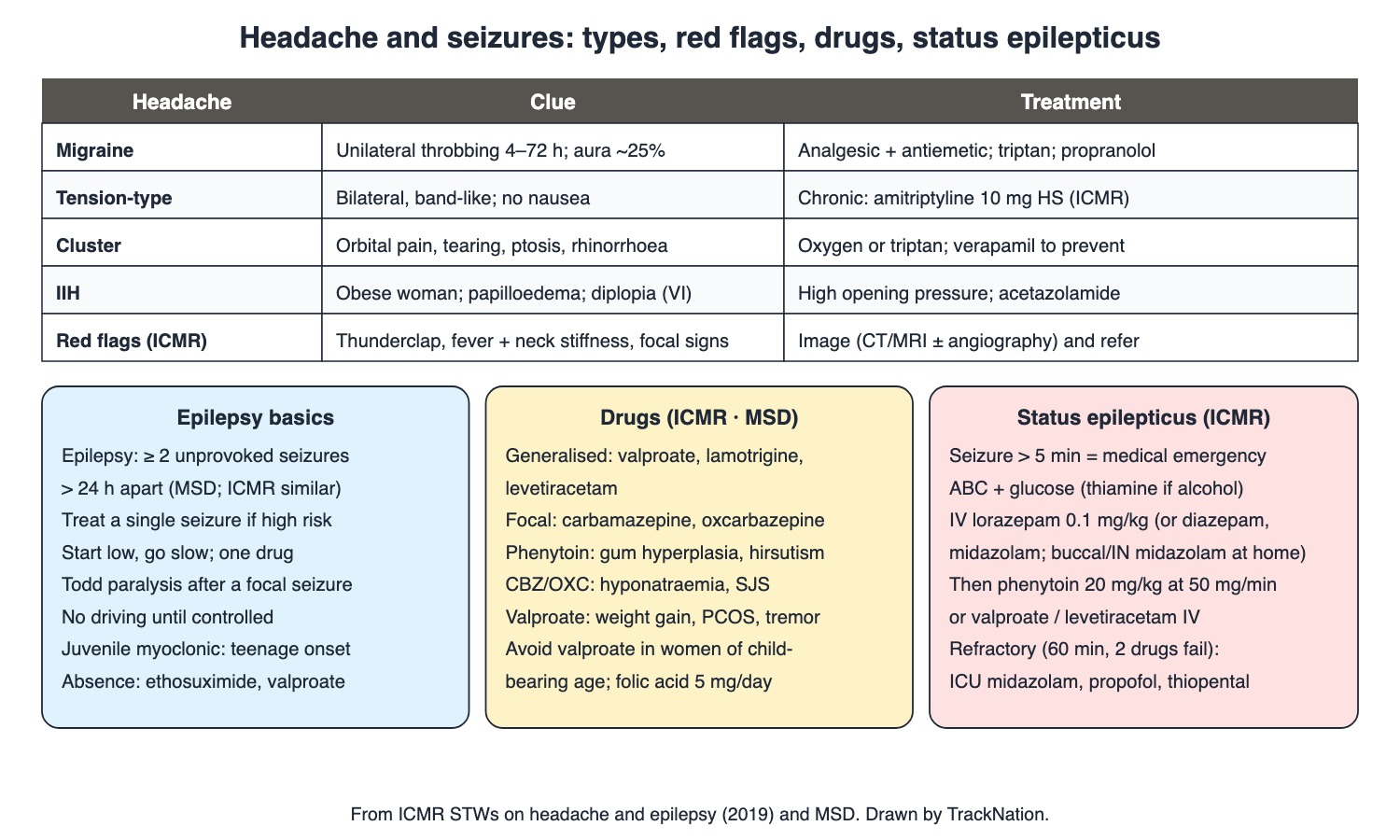
Headache types and red flags, epilepsy drugs and status epilepticus. Drawn by TrackNation.
Headache
Migraine: 4–72 h, often unilateral and throbbing, worse with exertion, with nausea and photophobia; aura in ~25%. ICMR acute: paracetamol 650 mg or indomethacin 50 mg with prochlorperazine 10 mg; prophylaxis if > 2 attacks/month — propranolol 40 mg or flunarizine 10 mg for 2 months; lifestyle (≥ 6 h sleep, avoid triggers). MSD adds triptans, DHE, amitriptyline, topiramate. Triptans/DHE are contraindicated in CAD or uncontrolled hypertension; overuse causes medication-overuse headache.
Tension-type: bilateral, band-like, spreads over the head; no nausea or vomiting. Chronic: amitriptyline 10 mg at night (ICMR).
Cluster headache: periorbital/temporal pain with ipsilateral ptosis, lacrimation, rhinorrhoea; alcohol triggers attacks in a cluster. Acute: oxygen, parenteral triptan or DHE; prevent with verapamil or lithium. ICMR: indomethacin 25 mg TID for other trigeminal autonomic cephalalgias.
IIH: mostly women with obesity; headache, transient visual obscurations, diplopia (VI nerve), pulsatile tinnitus, papilloedema; high opening pressure with normal CSF; acetazolamide or topiramate, weight loss — lost vision rarely returns.
Red flags (ICMR): first or worst headache, thunderclap onset, fever with neck stiffness, focal signs, altered consciousness, headache waking from sleep, new headache in pregnancy/postpartum, cancer or immunosuppression → imaging and referral. CVT is treated with heparin.
Epilepsy and Antiseizure Drugs
Epilepsy: ≥ 2 unprovoked seizures > 24 h apart (a single seizure is not epilepsy). ICMR: treat epilepsy; treat a single seizure if recurrence risk is high (focal seizures, neurological deficit, abnormal EEG or imaging, family history). Start one broad-spectrum drug, low and slow. Differentiate from syncope and psychogenic events.
Generalised seizures: absence, tonic-clonic, others; focal with preserved or impaired awareness. Juvenile myoclonic epilepsy: adolescent onset, myoclonic, tonic-clonic and absence seizures. Absence: ethosuximide, valproate or lamotrigine first-line. Todd paralysis is a transient post-ictal weakness.
Adverse effects (ICMR): valproate — weight gain, tremor, hair loss, PCOS, thrombocytopenia; carbamazepine/oxcarbazepine — hyponatraemia, rash, SJS; phenytoin — gum hyperplasia, coarse facies, hirsutism, osteomalacia.
Women: avoid valproate and polytherapy; folic acid 5 mg/day in all women of child-bearing age. Carbamazepine, phenytoin and valproate carry relatively high teratogenic risk.
Safety: avoid driving, swimming, heights and bathing in a tub until seizures are controlled (often > 6 months).
Status epilepticus (ICMR STW) | Action |
> 5 minutes (impending SE) | ABC, glucose (thiamine + glucose if alcohol use), monitoring; at home: buccal/intranasal midazolam |
Benzodiazepine | IV lorazepam up to 0.1 mg/kg at 2 mg/min (or IV diazepam / midazolam) |
Second-line IV drug | Phenytoin 20 mg/kg at 50 mg/min, or IV valproate 25–40 mg/kg, or levetiracetam 20–30 mg/kg |
Refractory (60 min; benzodiazepine + IV drug failed) | ICU: midazolam infusion, propofol, thiopental (EEG monitoring) |
Traps the Examiner Sets
No triptans in coronary disease or uncontrolled hypertension.
Cluster headache: oxygen; IIH: acetazolamide.
Status epilepticus clock starts at 5 minutes; benzodiazepine first.
Phenytoin IV no faster than 50 mg/min.
Valproate is avoided in women of child-bearing age unless others fail.
Memory Hooks & Shortcuts
Shortcuts to lock in this article's numbers and lists. Each one only re-packages facts proven above.
🧠 Migraine 'POUND': Pulsatile, One-day (4–72 h), Unilateral, Nausea, Disabling — migraine
🧠 Cluster: 'Oxygen for the eye that cries' — cluster headache
🧠 IIH: 'Fat, Fertile female, Fuzzy discs' — IIH
🧠 Status epilepticus '5-30-60': impending, established, refractory — SE timeline
🧠 Phenytoin: 'Twenty per kilo, Fifty per minute' — phenytoin dose
🧠 Valproate in women: 'Avoid unless all else fails' — valproate
Rapid-Revision Cards
Migraine
Unilateral throbbing 4–72 h; aura ~25%.
ICMR migraine acute
Paracetamol 650 / indomethacin + prochlorperazine.
ICMR prophylaxis
> 2/month: propranolol 40 or flunarizine 10 × 2 mo.
Triptan CI
CAD, uncontrolled HTN.
MOH
Overused triptans/analgesics.
Tension-type
Bilateral band; no nausea; amitriptyline 10 mg.
Cluster
Orbital pain + tearing, ptosis; O2, triptan; verapamil.
IIH
Obese women; papilloedema; VI palsy; acetazolamide.
Headache red flags
Thunderclap, fever + neck stiffness, focal signs, pregnancy, immunosuppression.
CVT
Heparin.
Epilepsy
≥ 2 unprovoked seizures > 24 h apart.
Treat single seizure
If high recurrence risk.
JME
Teen; myoclonic + GTC + absence.
Absence drugs
Ethosuximide, valproate, lamotrigine.
Todd paralysis
Post-ictal weakness.
Phenytoin AE
Gum hyperplasia, hirsutism, coarse facies.
CBZ/OXC AE
Hyponatraemia, SJS.
Valproate AE
Weight gain, tremor, PCOS, low platelets.
Women with epilepsy
Avoid valproate/polytherapy; folate 5 mg.
Status epilepticus
> 5 min.
SE step 1
IV lorazepam 0.1 mg/kg (home: buccal/IN midazolam).
SE step 2
Phenytoin 20 mg/kg ≤ 50 mg/min; or valproate/levetiracetam.
Refractory SE
60 min, 2 drugs failed → ICU anaesthetic agents.
Sources
Facts in this article were checked against these documents.
Standard Treatment Workflows: Management of Headache; Management of Epilepsy — Indian Council of Medical Research, DHR, 2019 (link)
MSD Manual Professional: Migraine; Tension-Type Headache; Cluster Headache; Idiopathic Intracranial Hypertension; Seizure Disorders; Antiseizure Medications — Merck & Co. (MSD Manuals), reviewed 2025–26 (link)
Competency Based Undergraduate Curriculum, General Medicine (GM 17, GM 20) — National Medical Commission, 2024
Test Yourself: Practice Questions
Thirty questions in NEET PG style, most of them clinical vignettes.
Practice Questions (NEET PG pattern)
Original questions written in the style of the exam: +4 for a correct answer, −1 for a wrong one. Every answer was checked against the sources listed above. NEET PG papers are not published by NBEMS, so these are not past-paper questions.
Q1. A woman has recurrent unilateral throbbing headaches lasting a day with nausea and photophobia, worse on exertion. The diagnosis is
(a) trigeminal neuralgia
(b) tension-type headache
(c) migraine
(d) cluster headache
Show answer
Answer: (c) — 4–72 hours; aura in ~25%.
Q2. Per ICMR, migraine prophylaxis is started when attacks occur more than
(a) 1 per year
(b) never
(c) 10 per day
(d) 2 per month — propranolol 40 mg or flunarizine 10 mg
Show answer
Answer: (d) — Trial for 2 months.
Q3. ICMR acute treatment of a migraine attack at PHC level is
(a) IV morphine
(b) oral steroids
(c) oxygen
(d) paracetamol 650 mg (or indomethacin) with prochlorperazine 10 mg
Show answer
Answer: (d) — Plus lifestyle changes.
Q4. Triptans are contraindicated in a migraine patient with
(a) hypothyroidism
(b) asthma
(c) iron deficiency
(d) coronary artery disease
Show answer
Answer: (d) — Also uncontrolled hypertension (coronary constriction).
Q5. A patient taking triptans most days develops daily headaches. The likely cause is
(a) medication overuse headache
(b) sinusitis
(c) brain tumour
(d) cluster headache
Show answer
Answer: (a) — Withdraw the overused drug.
Q6. Bilateral band-like headache spreading over the whole head without nausea or vomiting is
(a) IIH
(b) migraine
(c) cluster headache
(d) tension-type headache
Show answer
Answer: (d) — Chronic: amitriptyline 10 mg at night.
Q7. A man has recurrent attacks of severe pain around one eye with ipsilateral tearing, ptosis and rhinorrhoea for weeks. The acute treatment is
(a) oxygen inhalation or a parenteral triptan
(b) paracetamol only
(c) acetazolamide
(d) carbamazepine
Show answer
Answer: (a) — Cluster headache; verapamil prevents.
Q8. During a cluster period, which substance commonly triggers attacks?
(a) alcohol
(b) coffee withdrawal only
(c) sugar
(d) milk
Show answer
Answer: (a) — Not during remission.
Q9. A woman with obesity has daily headache, transient visual obscurations, pulsatile tinnitus and bilateral papilloedema; MRI is normal. The next test and treatment are
(a) EEG; valproate
(b) LP showing high opening pressure with normal CSF; acetazolamide
(c) nothing; reassure
(d) CT angiography; nimodipine
Show answer
Answer: (b) — Idiopathic intracranial hypertension.
Q10. Diplopia in idiopathic intracranial hypertension is due to dysfunction of cranial nerve
(a) VI
(b) IV
(c) III
(d) VII
Show answer
Answer: (a) — A false-localising sign.
Q11. The main danger of untreated IIH is
(a) permanent visual loss
(b) stroke
(c) hearing loss
(d) hydrocephalus
Show answer
Answer: (a) — Lost vision usually does not return.
Q12. Per ICMR, a headache red flag needing urgent imaging is
(a) headache relieved by sleep
(b) known migraine with usual aura
(c) bilateral pressure for years
(d) sudden thunderclap headache
Show answer
Answer: (d) — Also fever with neck stiffness, focal signs.
Q13. Cerebral venous thrombosis presenting with headache is treated with
(a) steroids
(b) thrombolysis always
(c) triptans
(d) heparin (UFH or LMWH)
Show answer
Answer: (d) — ICMR tertiary-care pathway.
Q14. Epilepsy is defined as
(a) seizures with hypoglycaemia
(b) two seizures from fever
(c) ≥ 2 unprovoked seizures occurring more than 24 hours apart
(d) any single seizure
Show answer
Answer: (c) — A single seizure is not epilepsy.
Q15. Per ICMR, after a single unprovoked seizure, antiseizure medication is started if
(a) always
(b) never
(c) recurrence risk is high (focal seizure, deficit, abnormal EEG or imaging, family history)
(d) only if aged over 60
Show answer
Answer: (c) — Otherwise treat when epilepsy is established.
Q16. A 15-year-old has myoclonic jerks, occasional tonic-clonic seizures and absences. The syndrome is
(a) West syndrome
(b) Lennox–Gastaut syndrome
(c) juvenile myoclonic epilepsy
(d) temporal lobe epilepsy
Show answer
Answer: (c) — Appears in adolescence.
Q17. First-line monotherapy for typical absence seizures includes
(a) carbamazepine
(b) oxcarbazepine
(c) ethosuximide, valproate or lamotrigine
(d) phenytoin
Show answer
Answer: (c) — Carbamazepine can worsen seizures in some situations (ICMR).
Q18. After a focal motor seizure of the right arm, the arm stays weak for some hours and recovers. This is
(a) functional weakness
(b) Todd paralysis
(c) stroke
(d) myasthenia
Show answer
Answer: (b) — Contralateral to the focus.
Q19. Gum hyperplasia, coarse facial features and hirsutism are adverse effects of
(a) lamotrigine
(b) phenytoin
(c) levetiracetam
(d) ethosuximide
Show answer
Answer: (b) — Also osteomalacia.
Q20. A patient on carbamazepine for focal epilepsy becomes confused with Na 122 mmol/L. The cause is
(a) status epilepticus
(b) carbamazepine-induced hyponatraemia
(c) valproate toxicity
(d) SIADH from tumour only
Show answer
Answer: (b) — Also with oxcarbazepine.
Q21. Weight gain, tremor, hair loss and polycystic ovaries are adverse effects of
(a) phenytoin
(b) sodium valproate
(c) carbamazepine
(d) levetiracetam
Show answer
Answer: (b) — Also thrombocytopenia.
Q22. Per ICMR, in a 24-year-old woman with generalised epilepsy, valproate should be
(a) given only in pregnancy
(b) avoided unless other drugs fail
(c) combined with two other drugs
(d) first choice
Show answer
Answer: (b) — Teratogenic; avoid polytherapy.
Q23. All women of child-bearing age on antiseizure drugs should take
(a) iron 200 mg/day
(b) folic acid 5 mg/day
(c) vitamin K daily
(d) nothing extra
Show answer
Answer: (b) — Reduces neural tube defect risk.
Q24. A tonic-clonic seizure lasting more than how long is treated as status epilepticus (impending) per ICMR?
(a) 5 minutes
(b) 24 hours
(c) 60 minutes
(d) 30 seconds
Show answer
Answer: (a) — Medical emergency.
Q25. The first drug in the emergency department for status epilepticus per ICMR is
(a) propofol infusion
(b) oral valproate
(c) IV phenytoin
(d) IV lorazepam up to 0.1 mg/kg at 2 mg/min
Show answer
Answer: (d) — Or IV diazepam/midazolam.
Q26. A child is having a prolonged seizure at home with no IV access. The ICMR option is
(a) wait for the seizure to stop
(b) oral phenytoin
(c) IM phenobarbitone only
(d) buccal or intranasal midazolam
Show answer
Answer: (d) — Out-of-hospital.
Q27. After a benzodiazepine, phenytoin for status epilepticus is given as
(a) 20 mg/kg IV at no more than 50 mg/min
(b) 1 g IM
(c) 100 mg orally
(d) 5 mg/kg as rapid bolus
Show answer
Answer: (a) — Alternatives: IV valproate or levetiracetam.
Q28. Refractory status epilepticus in the ICMR workflow means
(a) any seizure > 5 min
(b) two seizures in a day
(c) seizures continuing at 60 minutes after a benzodiazepine and an IV antiseizure drug fail
(d) seizure with fever
Show answer
Answer: (c) — ICU: midazolam, propofol, thiopental.
Q29. A known alcohol user arrives in status epilepticus. Along with benzodiazepines, give
(a) thiamine and glucose
(b) insulin
(c) naloxone
(d) flumazenil
Show answer
Answer: (a) — Check glucose in all.
Q30. A patient with newly diagnosed epilepsy asks about driving and swimming. Advice is
(a) never again for life
(b) no restrictions
(c) only avoid swimming
(d) avoid them until seizures are controlled (often > 6 months)
Show answer
Answer: (d) — Also heights, power tools, tub baths.
Active Recall
From memory: describe migraine and its ICMR acute and preventive treatment, triptan cautions, tension-type and cluster headache, IIH and headache red flags, define epilepsy and when to treat a first seizure, list adverse effects of phenytoin, carbamazepine and valproate, advice for women, and the ICMR status epilepticus steps with doses.