Opioids, Cannabis, Stimulants and Tobacco for NEET PG Psychiatry: Overdose and Naloxone, Opioid Withdrawal, Buprenorphine, Cocaine, Varenicline
Start Here
🎯 Exam priority: High. Expect: pupils in opioid toxicity vs withdrawal, naloxone dose and why patients re-sedate, the four specific opioid withdrawal signs, buprenorphine as a partial agonist, methadone and QT, naltrexone timing, cannabis red eyes and hyperemesis, no beta-blockers in cocaine chest pain, amphetamine hyperthermia, and the best drug to quit smoking.
CBME mapping: PS 3.1. Toxidromes are also in Medicine (poisoning) and Pharmacology.
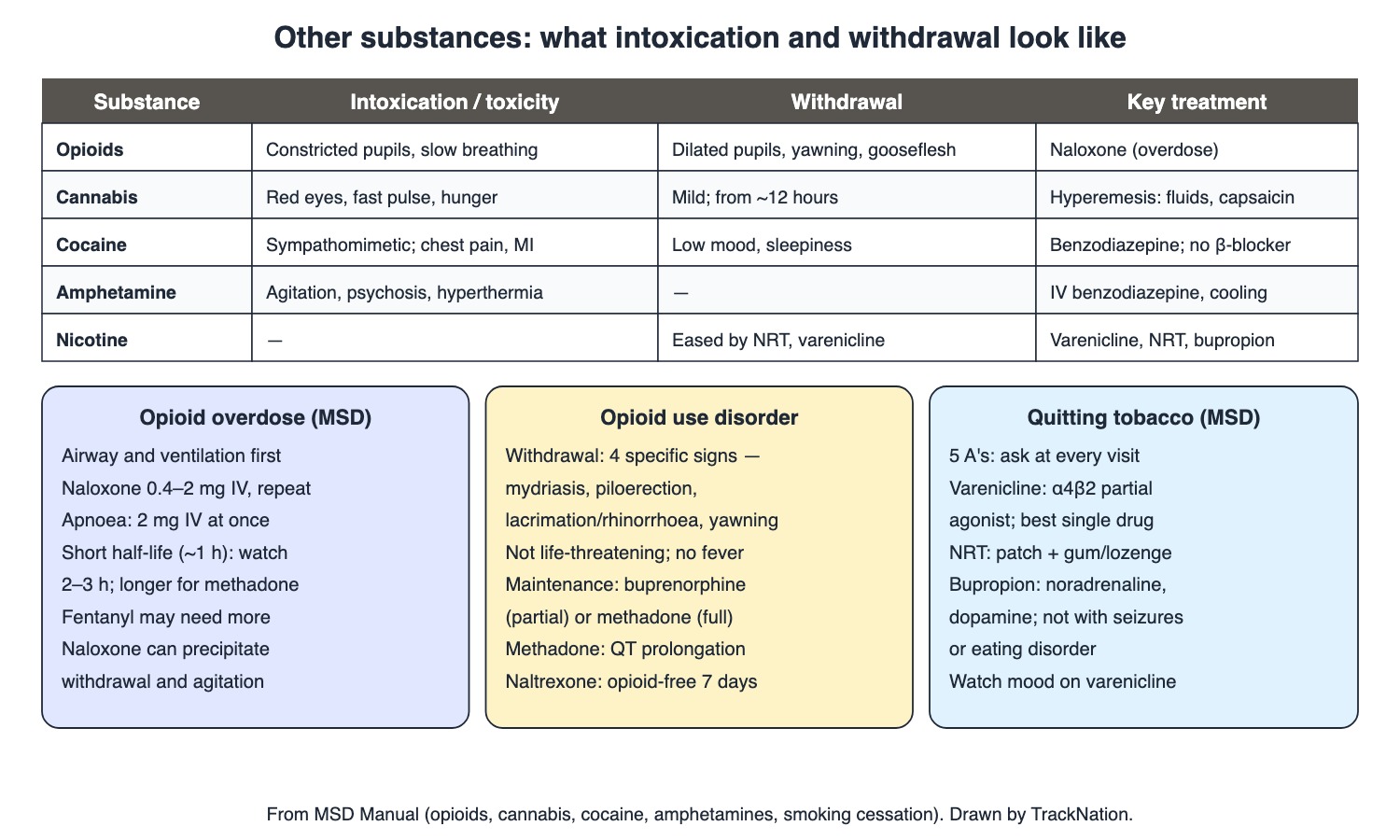
Opioids, cannabis, cocaine, amphetamine and nicotine compared; opioid overdose; opioid use disorder; quitting tobacco. Drawn by TrackNation.
Opioids
Toxicity: the main danger is respiratory depression progressing to apnoea; pupils are constricted. First secure the airway and ventilation, then naloxone 0.4–2 mg IV in 0.4 mg steps (2 mg straight away if apnoeic); fentanyl may need more. Naloxone lasts about 1 hour, so watch 2–3 hours — breathing can fail again after long-acting opioids such as methadone. Reversal can precipitate withdrawal and agitation.
Withdrawal: anxiety and craving, then sweating, yawning, lacrimation, rhinorrhoea, dilated pupils, cramps, gooseflesh, diarrhoea. Four signs are specific: mydriasis, piloerection, lacrimation/rhinorrhoea, yawning. It does not cause fever, seizures or confusion and is not life-threatening — if those occur, look for another cause.
Treatment: agonist therapy — buprenorphine (partial agonist with a ceiling on respiratory depression; combined with naloxone, which is inactive sublingually but causes withdrawal if injected) or methadone (full agonist; QT prolongation) — plus clonidine and symptomatic drugs. Maintenance lowers relapse and fatal overdose; it is also the standard of care in pregnancy. Naltrexone needs 7 opioid-free days.
Opioids such as tramadol, fentanyl and methadone given with SSRIs or MAOIs can cause serotonin syndrome.
Drug (MSD) | Type | Use | Watch |
Naloxone | Antagonist, short half-life (~1 h) | Reverse overdose | Re-sedation with long-acting opioids; precipitates withdrawal |
Buprenorphine (± naloxone) | Partial mu agonist, ceiling effect | Withdrawal and maintenance | Naloxone in the tablet deters injection |
Methadone | Full agonist, long-acting | Withdrawal and maintenance | QT prolongation, torsades |
Naltrexone (long-acting) | Antagonist | Relapse prevention | Needs 7 opioid-free days |
Clonidine | Central adrenergic | Autonomic withdrawal symptoms | Hypotension, drowsiness |
Cannabis, Cocaine and Amphetamines
Cannabis (THC): fast pulse, red eyes (conjunctival injection), dry mouth, increased appetite, impaired cognition. Chronic heavy use is linked to psychosis/schizophrenia, depression and anxiety; cannabinoid hyperemesis syndrome responds to fluids, antiemetics, haloperidol and topical capsaicin. Mild withdrawal starts around 12 hours. Urine tests show use within the last month.
Cocaine: dopamine (euphoria) and noradrenaline excess → tachycardia, hypertension, dilated pupils, sweating, hyperthermia, coronary vasospasm and MI, aortic dissection, stroke, seizures. Chest pain: benzodiazepines first; beta-blockers are contraindicated. Withdrawal ("washout"): depression, poor concentration, sleepiness.
Amphetamines: catecholamine excess → agitation, delirium, hypertension, seizures, hyperthermia, rhabdomyolysis, arrhythmias; paranoia or psychosis that usually fades with abstinence; "meth mouth". Treat with IV benzodiazepines and external cooling.
Tobacco
Use the 5 A's, starting with asking about tobacco at every visit.
Varenicline — partial agonist at the α4β2 nicotinic receptor — is the most effective single drug; avoid in active suicidal risk. Nicotine replacement (about 1 mg per cigarette a day): a patch plus a short-acting form beats either alone. Bupropion raises noradrenaline and dopamine; contraindicated with seizures, eating disorders or recent MAOI use.
Traps the Examiner Sets
Opioid toxicity = small pupils; opioid withdrawal = dilated pupils.
Opioid withdrawal is miserable but not fatal; alcohol withdrawal (delirium tremens) can kill.
No beta-blockers for cocaine chest pain.
Naloxone reverses; naltrexone maintains (after 7 opioid-free days).
Memory Hooks & Shortcuts
Shortcuts to lock in this article's numbers and lists. Each one only re-packages facts proven above.
🧠 Opioid pupils: 'Pinned when High, Wide when Withdrawing' — pupils
🧠 Opioid withdrawal specific 'MPLY': Mydriasis, Piloerection, Lacrimation, Yawning — withdrawal
🧠 'NaloXONE = reverse at Once; NaltreXONE = for the long run' — antagonists
🧠 Cocaine chest pain: 'Benzo, Not Beta' — cocaine
🧠 Quit smoking: 'Varenicline Vanquishes; NRT doubles up' — tobacco
Rapid-Revision Cards
Opioid overdose
Respiratory depression; small pupils.
Naloxone dose
0.4–2 mg IV; 2 mg if apnoeic.
Naloxone half-life
~1 h; watch 2–3 h.
Re-sedation
Methadone outlasts naloxone.
Specific withdrawal signs
Mydriasis, piloerection, lacrimation, yawning.
Withdrawal danger
Not life-threatening.
Fever/seizure in withdrawal
Look for another cause.
Clonidine
Autonomic withdrawal symptoms.
Buprenorphine
Partial agonist; ceiling effect.
Bup + naloxone
Deters injection.
Methadone
Full agonist; QT.
Naltrexone
7 opioid-free days.
Pregnancy OUD
Methadone or buprenorphine.
Cannabis
Red eyes, tachycardia, hunger.
Hyperemesis
Fluids, haloperidol, capsaicin.
Cannabis link
Psychosis/schizophrenia.
Cocaine chest pain
Benzodiazepine; no β-blocker.
Cocaine washout
Depression, sleepiness.
Amphetamine
Hyperthermia → cooling.
Varenicline
Best monotherapy; α4β2 partial agonist.
Bupropion CI
Seizures, eating disorder, MAOI.
Sources
Facts in this article were checked against these documents.
MSD Manual Professional: Opioid Toxicity and Withdrawal; Opioid Use Disorder; Marijuana (Cannabis); Cocaine; Amphetamines; Smoking Cessation — Merck & Co. (MSD Manuals), reviewed 2025–26 (link)
Competency Based Undergraduate Curriculum, Psychiatry (PS 3) — National Medical Commission, 2024
Test Yourself: Practice Questions
Thirty questions in NEET PG style, most of them clinical vignettes.
Practice Questions (NEET PG pattern)
Original questions written in the style of the exam: +4 for a correct answer, −1 for a wrong one. Every answer was checked against the sources listed above. NEET PG papers are not published by NBEMS, so these are not past-paper questions.
Q1. The main life-threatening effect of an opioid overdose is
(a) arrhythmia
(b) seizures
(c) hyperthermia
(d) respiratory depression
Show answer
Answer: (d) — Can progress to apnoea.
Q2. A young man is found unresponsive with slow shallow breathing and constricted pupils. After securing the airway, give
(a) naloxone IV
(b) flumazenil
(c) physostigmine
(d) atropine
Show answer
Answer: (a) — Airway and ventilation come first.
Q3. The initial IV naloxone dose for an apnoeic patient with suspected opioid overdose is
(a) 0.04 mg
(b) 10 mg
(c) 0.4 mg/kg
(d) 2 mg
Show answer
Answer: (d) — Somnolent patients: 0.4 mg increments.
Q4. A patient revived with naloxone after a methadone overdose becomes drowsy again 2 hours later because
(a) of hypoglycaemia
(b) naloxone is an agonist
(c) naloxone's half-life (~1 h) is shorter than methadone's
(d) methadone is short-acting
Show answer
Answer: (c) — Re-dose or infuse naloxone.
Q5. Overdose with fentanyl derivatives may need
(a) no naloxone
(b) flumazenil
(c) higher doses of naloxone
(d) dialysis
Show answer
Answer: (c) — Potent synthetic opioids.
Q6. A heroin user becomes agitated and combative right after naloxone. The reason is
(a) allergy
(b) hypoxic brain injury always
(c) naloxone precipitated acute opioid withdrawal
(d) naloxone toxicity
Show answer
Answer: (c) — Manage agitation for safety.
Q7. Which set of signs is specific to opioid withdrawal?
(a) fever, seizures and confusion
(b) miosis and bradycardia
(c) mydriasis, piloerection, lacrimation/rhinorrhoea and yawning
(d) tremor and hallucinations
Show answer
Answer: (c) — Per MSD.
Q8. A patient in apparent opioid withdrawal also has fever and a seizure. You should
(a) diagnose severe opioid withdrawal
(b) look for another cause or co-existing substance withdrawal
(c) give naloxone
(d) reassure
Show answer
Answer: (b) — Opioid withdrawal does not cause these.
Q9. Opioid withdrawal, though distressing, is
(a) always needing ICU
(b) not life-threatening
(c) the same as delirium tremens
(d) commonly fatal
Show answer
Answer: (b) — Contrast alcohol withdrawal.
Q10. A non-opioid drug that suppresses the autonomic symptoms of opioid withdrawal is
(a) clonidine
(b) naloxone
(c) haloperidol
(d) propranolol
Show answer
Answer: (a) — Causes hypotension, drowsiness.
Q11. Buprenorphine is
(a) a pure antagonist
(b) a partial mu-opioid agonist with a ceiling effect on respiratory depression
(c) a full agonist
(d) a GABA agonist
Show answer
Answer: (b) — First-line maintenance.
Q12. Naloxone is added to sublingual buprenorphine tablets because
(a) it is inactive sublingually but causes withdrawal if the tablet is injected
(b) it boosts the effect
(c) it treats pain
(d) it prevents constipation
Show answer
Answer: (a) — Deters misuse.
Q13. The important cardiac adverse effect of methadone is
(a) pericarditis
(b) bradycardia only
(c) heart block
(d) QTc prolongation and torsades de pointes
Show answer
Answer: (d) — Check ECG.
Q14. Before starting naltrexone for opioid use disorder, the patient must be opioid-free for
(a) 7 days
(b) 3 months
(c) 1 day
(d) 1 hour
Show answer
Answer: (a) — Else precipitated withdrawal.
Q15. Compared with detoxification alone, maintenance with buprenorphine or methadone
(a) reduces relapse and fatal overdose
(b) increases overdose deaths
(c) has no effect
(d) is unsafe in pregnancy
Show answer
Answer: (a) — Standard of care in pregnancy too.
Q16. A pregnant woman with opioid use disorder is best managed with
(a) naltrexone
(b) no treatment
(c) abrupt detoxification
(d) methadone or buprenorphine maintenance
Show answer
Answer: (d) — Per MSD.
Q17. Naloxone vs naltrexone: which statement is correct?
(a) naltrexone reverses overdose
(b) both reverse overdose
(c) both are agonists
(d) naloxone reverses overdose; naltrexone prevents relapse
Show answer
Answer: (d) — Both antagonists.
Q18. A student has red eyes, a fast pulse, dry mouth and the munchies. The likely drug is
(a) cannabis
(b) alcohol
(c) cocaine
(d) heroin
Show answer
Answer: (a) — Conjunctival injection.
Q19. The main psychoactive ingredient of cannabis is
(a) cannabidiol
(b) nicotine
(c) cathinone
(d) delta-9-tetrahydrocannabinol (THC)
Show answer
Answer: (d) — Acts on cannabinoid receptors.
Q20. A chronic heavy cannabis user has recurrent bouts of severe vomiting. The syndrome and a treatment are
(a) pancreatitis — surgery
(b) pregnancy — reassurance
(c) cannabinoid hyperemesis syndrome — fluids, antiemetics, haloperidol, topical capsaicin
(d) gastric ulcer — PPI
Show answer
Answer: (c) — Chronic users.
Q21. Chronic heavy cannabis use is linked with
(a) asthma only
(b) Parkinson disease
(c) schizophrenia and other psychiatric disorders
(d) vitiligo
Show answer
Answer: (c) — Also depression, anxiety.
Q22. Cocaine's sympathomimetic effects (tachycardia, hypertension, mydriasis, hyperthermia) come from increased
(a) GABA activity
(b) opioid activity
(c) noradrenergic activity
(d) cholinergic activity
Show answer
Answer: (c) — Dopamine explains euphoria.
Q23. A cocaine user presents with chest pain and hypertension. First-line drug therapy is
(a) propranolol
(b) atropine
(c) naloxone
(d) benzodiazepines; beta-blockers are contraindicated
Show answer
Answer: (d) — Coronary vasospasm risk.
Q24. Cocaine withdrawal ('washout') mainly causes
(a) hypertension
(b) depression, poor concentration and sleepiness
(c) seizures
(d) delirium tremens
Show answer
Answer: (b) — Craving follows.
Q25. An amphetamine user is agitated with a temperature of 41 °C. Besides IV benzodiazepines, the key step is
(a) antipyretic paracetamol only
(b) naloxone
(c) haloperidol only
(d) external cooling
Show answer
Answer: (d) — Hyperthermia can be rapidly fatal.
Q26. Amphetamine-induced psychosis usually
(a) never occurs
(b) resolves with cessation of use
(c) needs ECT
(d) is lifelong
Show answer
Answer: (b) — Fades in days to weeks.
Q27. Smoking-cessation counselling follows
(a) CAGE
(b) SPIKES
(c) the 5 A's, asking about tobacco at every visit
(d) FRAMES
Show answer
Answer: (c) — Per MSD.
Q28. The most effective single drug for smoking cessation is
(a) nicotine gum alone
(b) bupropion
(c) varenicline
(d) clonidine
Show answer
Answer: (c) — α4β2 partial agonist.
Q29. Bupropion for smoking cessation is contraindicated in a patient with
(a) diabetes
(b) a seizure disorder or an eating disorder
(c) hypertension
(d) asthma
Show answer
Answer: (b) — Also recent MAOI use.
Q30. Combining nicotine replacement products, for example a patch with gum or lozenge,
(a) is more effective than a single product
(b) is never advised
(c) is dangerous
(d) is less effective
Show answer
Answer: (a) — Comparable to varenicline.
Active Recall
From memory: describe opioid overdose and its treatment, the specific signs of opioid withdrawal, the maintenance drugs, the effects of cannabis, cocaine and amphetamines with their treatment, and the drugs for quitting smoking.