Alcohol Use Disorders for NEET PG Psychiatry: Dependence Criteria, Withdrawal Timeline, Delirium Tremens, Wernicke, Disulfiram and Naltrexone
Start Here
🎯 Exam priority: High. Expect: binge definition, dependence criteria, AUDIT and CAGE, FRAMES, withdrawal timing (6 h, 12–24 h, 6–48 h, 48–72 h), delirium tremens, why diazepam and when lorazepam, thiamine before glucose, Wernicke triad, Korsakoff confabulation, and how disulfiram, naltrexone and acamprosate work.
CBME mapping: PS 3.1. Alcoholic liver disease is in Medicine; disulfiram pharmacology in Pharmacology.
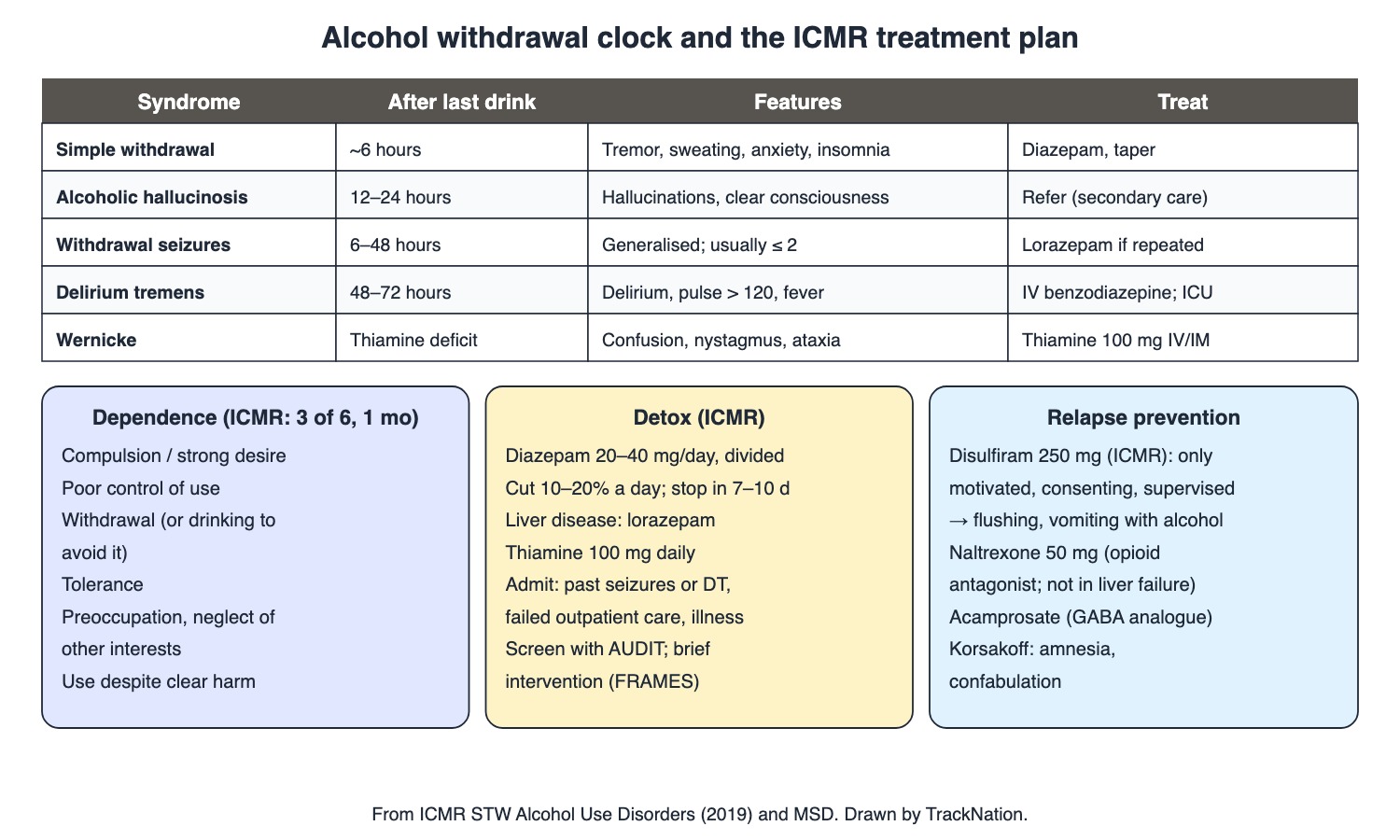
Alcohol withdrawal syndromes by timing; ICMR dependence criteria; detoxification; relapse prevention. Drawn by TrackNation.
Assessment and Diagnosis (ICMR)
Screen every patient in any health facility (AUDIT or CAGE). Ask age at onset, quantity, frequency, daily or morning drinking, time of the last drink, binge drinking (men 5 drinks, women 4 drinks within 2 hours), withdrawal, tolerance, craving, past attempts at stopping and complications — gastritis, neuropathy, liver damage, injuries, job loss, family fights, legal problems.
Hazardous or harmful use: heavy drinking (men ≥ 5, women ≥ 4 drinks a day) or risky behaviour with physical or psychosocial harm.
Dependence: 3 of 6 for at least 1 month — strong desire or compulsion; poor control; withdrawal (or drinking to avoid it); tolerance; preoccupation with neglect of other interests; continued use despite clear harm.
Examine for withdrawal (tremor, sweating, tachycardia), liver disease (enlarged liver, jaundice, ascites) and neurological signs (cerebellar signs, neuropathy, confusion). Tests: CBC, LFT, sugar, electrolytes; CT head after a seizure or delirium tremens.
Brief intervention (FRAMES): Feedback, Responsibility, Advice, Menu of options, Empathy, Self-efficacy — for harmful users to cut down and dependent users to seek treatment.
Withdrawal, Wernicke and Korsakoff
Alcohol acts on GABA receptors; stopping after heavy use causes CNS hyperactivity. Mild withdrawal (tremor, sweating, headache, weakness, tachycardia) starts within about 6 hours. Seizures ("rum fits", usually not more than 2) come at 6–48 hours. Alcoholic hallucinosis — hallucinations with clear consciousness, without thought disorder — appears at 12–24 hours. Delirium tremens begins at 48–72 hours: delirium, sweating, pulse > 120, temperature > 37.8 °C, high risk of death.
ICMR detox: diazepam 20–40 mg/day in divided doses by severity, reduce 10–20% a day and stop within 7–10 days; with significant liver disease use lorazepam (2 mg ≈ 5 mg diazepam); thiamine 100 mg daily. Admit for past withdrawal seizures or delirium tremens, failed outpatient treatment, serious medical or psychiatric illness or poly-substance use. Delirium tremens needs tertiary/ICU care with IV benzodiazepines; exclude head injury, hepatic encephalopathy and Wernicke encephalopathy.
Wernicke encephalopathy: acute confusion, nystagmus or partial ophthalmoplegia, and ataxia from thiamine deficiency → immediate thiamine 100 mg IV/IM daily for 3–5 days (give thiamine especially when IV dextrose is needed) and correct magnesium. Korsakoff psychosis follows in 80% of untreated survivors: anterograde and retrograde amnesia with striking confabulation.
Relapse-prevention drug | Action (MSD) | Key cautions |
Disulfiram 250 mg daily (ICMR) | Blocks acetaldehyde metabolism → flushing, headache, vomiting, BP fall, arrhythmia with alcohol | Motivated patient, written consent, family supervision; not in pregnancy or cardiac failure |
Naltrexone 50 mg daily | Opioid antagonist; fewer relapses and drinking days | Not in acute hepatitis, liver failure or opioid dependence |
Acamprosate 2 g daily | Synthetic GABA analogue; fewer relapses | — |
Alcoholics Anonymous | Commonest self-help group; 12-step approach | With relapse-prevention counselling (identify cues) |
Traps the Examiner Sets
Delirium tremens comes at 48–72 hours; seizures earlier (6–48 hours).
Lorazepam (or oxazepam) in liver disease, not long-acting diazepam.
Thiamine before or with glucose in an alcohol-dependent patient.
Disulfiram only with written consent, motivation and family supervision.
Memory Hooks & Shortcuts
Shortcuts to lock in this article's numbers and lists. Each one only re-packages facts proven above.
🧠 Withdrawal clock '6–12–48–72': tremor 6 h, hallucinosis 12–24 h, fits to 48 h, DTs 48–72 h — timeline
🧠 Wernicke 'COAT': Confusion, Ophthalmoplegia, Ataxia — give Thiamine — Wernicke
🧠 Korsakoff 'Can't remember, Confabulates' — Korsakoff
🧠 Relapse drugs 'DNA': Disulfiram (aversion), Naltrexone (opioid block), Acamprosate (GABA) — relapse prevention
🧠 'Liver bad? Lorazepam' — detox in liver disease
Rapid-Revision Cards
Binge
Men 5, women 4 drinks in 2 h.
Dependence
3 of 6 for 1 month.
Six criteria
Compulsion, control, withdrawal, tolerance, preoccupation, harm.
Screening
AUDIT, CAGE; screen everyone.
Brief intervention
FRAMES.
Mechanism
GABA receptors.
Mild withdrawal
~6 h: tremor, sweating.
Seizures
6–48 h; rum fits.
Hallucinosis
12–24 h; clear consciousness.
Delirium tremens
48–72 h; pulse > 120, fever.
Detox
Diazepam 20–40 mg/day; taper 10–20%/day.
Liver disease
Lorazepam or oxazepam.
Thiamine
100 mg daily; before dextrose.
Admit
Past seizures/DT, failed OP care.
Wernicke
Confusion, ophthalmoplegia, ataxia.
Korsakoff
Amnesia + confabulation; 80% of untreated.
Disulfiram
Acetaldehyde ↑; consent, supervision.
Disulfiram CI
Pregnancy, cardiac failure.
Naltrexone
Opioid antagonist; not in liver failure.
Acamprosate
GABA analogue.
AA
Commonest self-help group.
Sources
Facts in this article were checked against these documents.
Standard Treatment Workflow: Alcohol Use Disorders — Indian Council of Medical Research, DHR, 2019 (link)
MSD Manual Professional: Alcohol Toxicity and Withdrawal; Alcohol Use Disorder and Rehabilitation; Wernicke Encephalopathy; Korsakoff Psychosis — Merck & Co. (MSD Manuals), reviewed 2025–26 (link)
Competency Based Undergraduate Curriculum, Psychiatry (PS 3) — National Medical Commission, 2024
Test Yourself: Practice Questions
Thirty questions in NEET PG style, most of them clinical vignettes.
Practice Questions (NEET PG pattern)
Original questions written in the style of the exam: +4 for a correct answer, −1 for a wrong one. Every answer was checked against the sources listed above. NEET PG papers are not published by NBEMS, so these are not past-paper questions.
Q1. Per ICMR, binge drinking in a man means
(a) 2 drinks a day
(b) drinking on weekends
(c) 5 or more drinks within 2 hours
(d) any drink before noon
Show answer
Answer: (c) — Women: 4 drinks in 2 hours.
Q2. Alcohol dependence is diagnosed (ICMR) when
(a) any drinking is present
(b) 1 criterion for a week
(c) liver tests are abnormal
(d) 3 of 6 criteria are present for at least 1 month
Show answer
Answer: (d) — Compulsion, poor control, withdrawal, tolerance, preoccupation, use despite harm.
Q3. Needing more alcohol to get the same effect is called
(a) tolerance
(b) craving
(c) relapse
(d) withdrawal
Show answer
Answer: (a) — A dependence criterion.
Q4. Two screening questionnaires for alcohol problems are
(a) PHQ-9 and GAD-7
(b) Y-BOCS and HAM-D
(c) AUDIT and CAGE
(d) MMSE and MoCA
Show answer
Answer: (c) — ICMR advises universal screening.
Q5. The ICMR brief intervention framework for harmful drinkers is
(a) SBAR
(b) SPIKES
(c) FRAMES: feedback, responsibility, advice, menu, empathy, self-efficacy
(d) ABCDE
Show answer
Answer: (c) — Motivational approach.
Q6. Alcohol produces sedation mainly by acting on
(a) GABA receptors
(b) nicotinic receptors
(c) opioid receptors only
(d) dopamine D2 receptors
Show answer
Answer: (a) — Withdrawal = CNS hyperactivity.
Q7. A heavy drinker develops tremor, sweating and headache about 6 hours after his last drink. This is
(a) delirium tremens
(b) mild alcohol withdrawal
(c) hepatic encephalopathy
(d) Wernicke encephalopathy
Show answer
Answer: (b) — Starts within ~6 hours.
Q8. Alcohol withdrawal seizures usually occur
(a) 6–48 hours after the last drink
(b) only during intoxication
(c) at 2 weeks
(d) after 7 days
Show answer
Answer: (a) — Usually not more than 2.
Q9. A patient hears frightening voices 18 hours after stopping heavy drinking, with a clear sensorium and no thought disorder. The diagnosis is
(a) delirium tremens
(b) alcoholic hallucinosis
(c) schizophrenia
(d) Korsakoff psychosis
Show answer
Answer: (b) — Clear consciousness distinguishes it.
Q10. Three days after admission for a fracture, a heavy drinker becomes disoriented, agitated, sweaty, with pulse 130 and fever. The diagnosis is
(a) sepsis only
(b) alcoholic hallucinosis
(c) simple withdrawal
(d) delirium tremens
Show answer
Answer: (d) — 48–72 hours; high mortality.
Q11. Delirium tremens is managed with
(a) IV benzodiazepines in a high-dependency or ICU setting
(b) naltrexone
(c) disulfiram
(d) haloperidol alone
Show answer
Answer: (a) — Exclude head injury, hepatic encephalopathy, Wernicke.
Q12. The ICMR outpatient detox drug and dose is
(a) phenobarbitone 60 mg
(b) naltrexone 50 mg
(c) diazepam 20–40 mg/day in divided doses, tapered
(d) chlorpromazine 300 mg
Show answer
Answer: (c) — Reduce 10–20% a day.
Q13. ICMR advises tapering diazepam in alcohol withdrawal by about
(a) 10–20% a day, finishing within 7–10 days
(b) stopping abruptly
(c) over 3 months
(d) 50% a day
Show answer
Answer: (a) — Titrate to symptoms.
Q14. For alcohol withdrawal in a patient with significant liver disease, the preferred benzodiazepine is
(a) clonazepam
(b) lorazepam (or oxazepam)
(c) chlordiazepoxide
(d) diazepam
Show answer
Answer: (b) — Short-acting / glucuronidated.
Q15. Every patient undergoing alcohol detox should receive
(a) vitamin C
(b) thiamine 100 mg daily
(c) iron
(d) folic acid only
Show answer
Answer: (b) — Prevents Wernicke.
Q16. Which is an ICMR indication to admit for alcohol withdrawal?
(a) patient wants outpatient care
(b) past withdrawal seizures or delirium tremens
(c) binge drinking only
(d) first episode with mild tremor
Show answer
Answer: (b) — Also failed outpatient care, comorbidity, poly-substance use.
Q17. After an alcohol withdrawal seizure, ICMR recommends
(a) lumbar puncture in all
(b) CT head
(c) EEG only
(d) no investigation
Show answer
Answer: (b) — Also after delirium tremens.
Q18. A malnourished alcoholic is confused, has nystagmus with a lateral rectus palsy and a wide-based gait. The diagnosis and treatment are
(a) delirium tremens — diazepam
(b) cerebellar stroke — thrombolysis
(c) Wernicke encephalopathy — thiamine 100 mg IV/IM immediately
(d) hepatic encephalopathy — lactulose
Show answer
Answer: (c) — Thiamine deficiency.
Q19. In an alcohol-dependent patient who needs IV dextrose, thiamine should be given because
(a) glucose without thiamine can precipitate Wernicke encephalopathy
(b) it prevents seizures
(c) thiamine lowers sugar
(d) dextrose is toxic
Show answer
Answer: (a) — Give thiamine first or with dextrose.
Q20. If Wernicke encephalopathy is untreated, the proportion of survivors who develop Korsakoff psychosis is about
(a) 5%
(b) 20%
(c) 100%
(d) 80%
Show answer
Answer: (d) — Wernicke–Korsakoff syndrome.
Q21. A chronic alcoholic cannot form new memories and fills the gaps with invented stories. The striking feature is
(a) delusion
(b) hallucination
(c) confabulation (Korsakoff psychosis)
(d) malingering
Show answer
Answer: (c) — Anterograde and retrograde amnesia.
Q22. Disulfiram works by
(a) blocking acetaldehyde metabolism so acetaldehyde accumulates
(b) acting as a GABA analogue
(c) reducing alcohol absorption
(d) blocking opioid receptors
Show answer
Answer: (a) — Aversive reaction.
Q23. A patient on disulfiram drinks alcohol. Expect
(a) hypertension crisis only
(b) no effect
(c) flushing, throbbing headache, tachycardia, vomiting
(d) sedation only
Show answer
Answer: (c) — Within minutes.
Q24. ICMR pre-requisites before starting disulfiram include
(a) active drinking
(b) heart failure
(c) pregnancy
(d) a motivated patient, written consent and family supervision
Show answer
Answer: (d) — Inform about the reaction.
Q25. Disulfiram is contraindicated in
(a) hypertension controlled on drugs
(b) asthma
(c) diabetes
(d) pregnancy and cardiac decompensation
Show answer
Answer: (d) — Per MSD.
Q26. Naltrexone reduces relapse in alcohol dependence as a
(a) GABA analogue
(b) opioid antagonist
(c) aldehyde dehydrogenase inhibitor
(d) benzodiazepine
Show answer
Answer: (b) — 50 mg daily.
Q27. Naltrexone must not be given to a patient who
(a) is over 60
(b) smokes
(c) is depressed
(d) is opioid dependent or has liver failure
Show answer
Answer: (d) — Precipitates withdrawal.
Q28. Acamprosate is
(a) an opioid antagonist
(b) a benzodiazepine
(c) an aversive agent
(d) a synthetic GABA analogue that lowers relapse
Show answer
Answer: (d) — 2 g daily.
Q29. The most common self-help group for alcohol dependence is
(a) Narcotics Anonymous
(b) Samaritans
(c) Al-Anon only
(d) Alcoholics Anonymous
Show answer
Answer: (d) — 12-step approach.
Q30. Physical complications of chronic alcohol use listed by ICMR include
(a) psoriasis
(b) gout only
(c) gastritis, peripheral neuropathy, liver dysfunction and injuries
(d) hyperthyroidism
Show answer
Answer: (c) — Plus psychosocial problems.
Active Recall
From memory: give the binge and dependence criteria and the brief intervention model, describe the withdrawal syndromes with their timing, outline ICMR detoxification and admission criteria, describe Wernicke and Korsakoff, and compare the relapse-prevention drugs.