Paediatric Respiratory for NEET PG: ICMR Pneumonia Classification and Antibiotics, Bronchiolitis, Croup vs Epiglottitis, Asthma Attack and Cystic Fibrosis
Start Here
🎯 Exam priority: Very high. Expect: fast-breathing cut-offs, what makes pneumonia "severe", first-line IV antibiotics, when to add cloxacillin, bronchiolitis organism and what not to give, croup vs epiglottitis (age, signs, X-ray, treatment), asthma rescue steps, sweat chloride cut-off.
CBME mapping: PE25, PE28. Fact-checked against the ICMR Standard Treatment Workflow for Severe Pneumonia in Children (2019) and the MSD Manual.
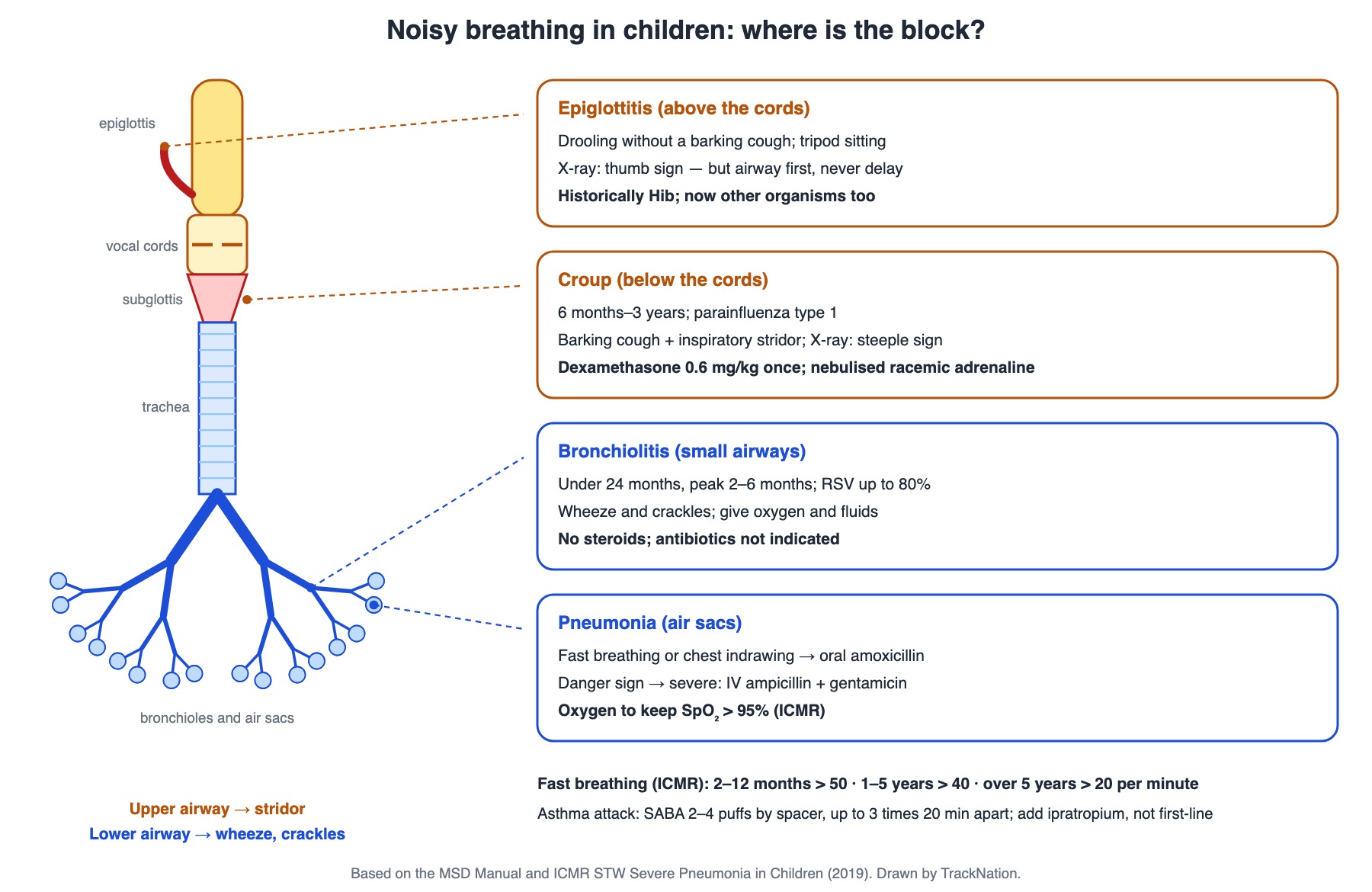
Where the block is: epiglottitis, croup, bronchiolitis and pneumonia along the airway. Drawn by TrackNation.
Pneumonia (ICMR, 2–59 Months)
Cough or difficult breathing for less than 2 weeks. Fast breathing: 2–12 months > 50, 1–5 years > 40, over 5 years > 20 per minute.
No pneumonia (cough/cold, no difficulty) → home care. Pneumonia (fast breathing and/or chest indrawing, SpO₂ > 92%) → oral amoxicillin, follow up. Severe pneumonia = these plus a danger sign (cannot drink, persistent vomiting, convulsions, lethargy, stridor in a calm child, severe malnutrition) → admit. Red flags (gasping, cold limbs, altered sensorium, cyanosis) → ICU.
Think foreign body with sudden choking and breathlessness; think asthma with past episodes eased by nebulisation.
Treatment: oxygen by mask 1–2 L/min or hood 4–6 L/min to keep SpO₂ > 95%; IV ampicillin 100–200 mg/kg/day + gentamicin 5–7.5 mg/kg/day; over 5 years ampicillin/amoxicillin ± a macrolide for atypicals. Suspected staphylococcal (pneumatocele, after measles, infected scabies or pyoderma) → add cloxacillin or use amoxiclav.
Switch to oral amoxicillin when afebrile, breathing normal and feeding — 5–7 days in total. No response at 48–72 h → change antibiotics. Empyema → chest drain; lung abscess → 4–6 weeks.
Bronchiolitis (MSD)
Viral infection of the small airways in children under 24 months, peak 2–6 months; RSV causes up to 80%. Distress, wheeze and crackles.
Supportive: oxygen and fluids. No glucocorticoids for a first episode; antibiotics not indicated unless secondary infection; bronchodilators may ease symptoms but do not shorten admission; ribavirin no benefit in uncomplicated RSV.
Croup vs Epiglottitis (MSD)
Croup (laryngotracheobronchitis): parainfluenza type 1, ages 6 months–3 years, barking (seal-like) cough, hoarseness and inspiratory stridor, worse at night. Neck X-ray: steeple sign (subglottic narrowing). Treat with dexamethasone 0.6 mg/kg once and nebulised racemic adrenaline.
Epiglottitis: severe sore throat, high fever, dysphagia, drooling without a barking cough, stridor, tripod position. Lateral X-ray: thumb sign — but never delay airway care for an X-ray. Historically Hib. Treat with airway protection and antibiotics.
Wheeze, Asthma and Cystic Fibrosis (MSD)
Recurrent wheeze in young children is often viral; in about one-third it is the first sign of asthma. RSV/metapneumovirus wheeze raises later asthma risk. Remember foreign body and reflux.
Asthma attack: SABA 2–4 puffs, up to 3 times 20 minutes apart; MDI with spacer works as well as a nebuliser; add ipratropium (not first line); systemic steroids for all but the mildest attacks; IV magnesium for severe, unresponsive attacks.
Cystic fibrosis: autosomal recessive CFTR chloride-channel defect; F508del in about 85% of alleles. Lung disease, pancreatic insufficiency, liver disease; meconium ileus in about 20% of newborns with CF. Sweat chloride ≥ 60 mmol/L (pilocarpine iontophoresis).
Traps the Examiner Sets
Fast breathing is 50 (2–12 months) and 40 (1–5 years) — the cut-off drops with age.
Stridor in a calm child is a danger sign → severe pneumonia.
Steeple sign = croup (subglottic); thumb sign = epiglottitis (supraglottic).
Drooling and no barking cough = epiglottitis; throat and larynx are examined only by trained staff in an operating room — never send for X-ray first.
Bronchiolitis: no steroids, no routine antibiotics.
Memory Hooks & Shortcuts
Shortcuts to lock in this article's numbers and lists. Each one only re-packages facts proven above.
🧠 '50-40-20' — the breathing cut-off falls as the child grows — fast breathing
🧠 Steeple = Subglottic (croup); Thumb = Top (epiglottitis) — X-ray signs
🧠 Croup BARKS, epiglottitis DROOLS — clinical
🧠 Bronchiolitis 'RSV — Rest, Sats, Volume': no steroids, no antibiotics — bronchiolitis
🧠 CF 'Sixty and salty' — sweat chloride ≥ 60 — cystic fibrosis
Rapid-Revision Cards
Fast breathing
2–12 mo > 50; 1–5 y > 40; > 5 y > 20.
Pneumonia
Fast breathing/indrawing, SpO₂ > 92% → oral amoxicillin.
Severe pneumonia
+ danger sign (stridor calm, can't drink, convulsions...).
Oxygen
Mask 1–2 or hood 4–6 L/min; SpO₂ > 95%.
IV antibiotics
Ampicillin + gentamicin.
Staph clues
Pneumatocele, post-measles, scabies → cloxacillin.
Duration
5–7 days total.
Non-responder
48–72 h → change; look for empyema.
Bronchiolitis
< 24 mo; peak 2–6 mo; RSV ≤ 80%.
Bronchiolitis Rx
O₂, fluids; no steroids/antibiotics.
Croup
Parainfluenza 1; 6 mo–3 y; barking cough.
Croup X-ray
Steeple sign.
Croup Rx
Dexamethasone 0.6 mg/kg once; racemic adrenaline.
Epiglottitis
Drooling, no bark, tripod; Hib.
Epiglottitis X-ray
Thumb sign (don't delay airway).
Recurrent wheeze
⅓ become asthma.
Asthma rescue
SABA 2–4 puffs × 3, 20 min apart.
Spacer
= nebuliser.
Add-ons
Ipratropium, steroids, IV magnesium.
CF
AR, CFTR, F508del ~85%.
Sweat test
Cl ≥ 60 mmol/L; meconium ileus ~20%.
Sources
Facts in this article were checked against these documents.
Standard Treatment Workflow: Severe Pneumonia in Children — ICMR / Department of Health Research, MoHFW, 2019
MSD Manual Professional: Bronchiolitis; Croup; Epiglottitis; Wheezing and Asthma in Infants and Young Children; Treatment of Acute Asthma Exacerbations; Cystic Fibrosis — Merck & Co., 2025–2026 (link)
Test Yourself: Practice Questions
Thirty questions in NEET PG style, many of them OPD and ward scenarios.
Practice Questions (NEET PG pattern)
Original questions written in the style of the exam: +4 for a correct answer, −1 for a wrong one. Every answer was checked against the sources listed above. NEET PG papers are not published by NBEMS, so these are not past-paper questions.
Q1. In the ICMR workflow, fast breathing in an 8-month-old is a rate above
(a) 50 per minute
(b) 40 per minute
(c) 60 per minute
(d) 30 per minute
Show answer
Answer: (a) — 2–12 months.
Q2. Fast breathing in a 3-year-old (ICMR) is a rate above
(a) 40 per minute
(b) 50 per minute
(c) 20 per minute
(d) 30 per minute
Show answer
Answer: (a) — 1–5 years.
Q3. A 2-year-old with fast breathing, chest indrawing and SpO₂ 95% who drinks well has
(a) severe pneumonia
(b) bronchiolitis only
(c) pneumonia — oral amoxicillin
(d) no pneumonia
Show answer
Answer: (c) — No danger sign.
Q4. Which makes it severe pneumonia in the ICMR workflow?
(a) fever 38 °C
(b) runny nose
(c) stridor in a calm child
(d) cough for 5 days
Show answer
Answer: (c) — Danger sign.
Q5. Sudden choking then breathlessness in a toddler suggests
(a) croup
(b) bronchiolitis
(c) foreign body aspiration
(d) asthma
Show answer
Answer: (c) — ICMR.
Q6. Oxygen in severe pneumonia (ICMR) aims for SpO₂
(a) > 85%
(b) 88–92%
(c) > 95%
(d) 100%
Show answer
Answer: (c) — Mask 1–2 L/min or hood 4–6 L/min.
Q7. First-line IV antibiotics for severe pneumonia at 2–59 months (ICMR) are
(a) ceftriaxone alone
(b) azithromycin alone
(c) ampicillin + gentamicin
(d) vancomycin + meropenem
Show answer
Answer: (c) — ICMR.
Q8. A child with pneumonia after measles has pneumatoceles on X-ray. Add
(a) cloxacillin
(b) fluconazole
(c) azithromycin
(d) metronidazole
Show answer
Answer: (a) — Suspected staphylococcal.
Q9. Total duration of antibiotics for uncomplicated severe pneumonia (ICMR) is
(a) 21 days
(b) 14 days
(c) 2–3 days
(d) 5–7 days
Show answer
Answer: (d) — Including IV days.
Q10. If a child with pneumonia does not respond after 48–72 hours, you should
(a) change antimicrobials and look for complications
(b) discharge
(c) stop antibiotics
(d) add steroids
Show answer
Answer: (a) — ICMR.
Q11. Empyema in a child with pneumonia is treated with
(a) bronchoscopy
(b) oral antibiotics only
(c) steroids
(d) intercostal drainage
Show answer
Answer: (d) — ICMR.
Q12. Bronchiolitis mainly affects children
(a) 3–6 years
(b) school-age
(c) under 24 months, peak 2–6 months
(d) newborns only
Show answer
Answer: (c) — MSD.
Q13. The commonest cause of bronchiolitis is
(a) parainfluenza 1
(b) respiratory syncytial virus
(c) Mycoplasma
(d) Hib
Show answer
Answer: (b) — Up to 80%.
Q14. In a first episode of bronchiolitis, which is NOT recommended?
(a) fluids
(b) systemic or inhaled glucocorticoids
(c) monitoring oxygen saturation
(d) oxygen if hypoxic
Show answer
Answer: (b) — Supportive care only.
Q15. Antibiotics in bronchiolitis are
(a) first-line
(b) not indicated unless secondary bacterial infection
(c) needed if fever
(d) always needed
Show answer
Answer: (b) — MSD.
Q16. Croup is most commonly caused by
(a) RSV
(b) adenovirus
(c) parainfluenza virus type 1
(d) Hib
Show answer
Answer: (c) — MSD.
Q17. Croup typically affects children aged
(a) 5–10 years
(b) under 2 months
(c) 6 months to 3 years
(d) adolescents
Show answer
Answer: (c) — MSD.
Q18. The X-ray sign of croup is
(a) sail sign
(b) thumb sign
(c) double bubble
(d) steeple sign on AP neck film
Show answer
Answer: (d) — Subglottic narrowing.
Q19. A barking cough with stridor at night in a 2-year-old is treated with
(a) salbutamol only
(b) IV antibiotics
(c) single-dose dexamethasone 0.6 mg/kg ± nebulised racemic adrenaline
(d) intubation for all
Show answer
Answer: (c) — Croup.
Q20. A febrile 4-year-old sits leaning forward, drooling, with stridor and no barking cough. Most likely
(a) epiglottitis
(b) asthma
(c) croup
(d) bronchiolitis
Show answer
Answer: (a) — Tripod, drooling.
Q21. The lateral neck X-ray sign of epiglottitis is
(a) thumb sign
(b) steeple sign
(c) ground glass
(d) air bronchogram
Show answer
Answer: (a) — MSD.
Q22. In suspected epiglottitis with distress, the first priority is
(a) blood culture
(b) securing the airway
(c) throat swab
(d) lateral neck X-ray
Show answer
Answer: (b) — X-ray must not delay.
Q23. Epiglottitis in children was classically caused by
(a) RSV
(b) Haemophilus influenzae type b
(c) Mycoplasma
(d) parainfluenza
Show answer
Answer: (b) — Hib vaccine changed this.
Q24. About what proportion of young children with recurrent wheeze turn out to have asthma?
(a) all
(b) one-third
(c) one-tenth
(d) none
Show answer
Answer: (b) — MSD.
Q25. First home step in an asthma attack (MSD) is
(a) montelukast only
(b) SABA 2–4 puffs, up to 3 times 20 minutes apart
(c) theophylline
(d) oral antibiotics
Show answer
Answer: (b) — Then assess.
Q26. Compared with a nebuliser, an MDI with spacer in acute asthma is
(a) less effective
(b) equally effective
(c) only for adults
(d) contraindicated
Show answer
Answer: (b) — MSD.
Q27. Ipratropium in acute asthma is
(a) first-line alone
(b) added to beta-agonists, not first-line
(c) an oral steroid
(d) contraindicated
Show answer
Answer: (b) — MSD.
Q28. Cystic fibrosis is inherited as
(a) mitochondrial
(b) X-linked recessive
(c) autosomal recessive
(d) autosomal dominant
Show answer
Answer: (c) — CFTR.
Q29. A sweat chloride consistent with cystic fibrosis is
(a) ≥ 120 mmol/L
(b) ≥ 20 mmol/L
(c) ≥ 30 mmol/L
(d) ≥ 60 mmol/L
Show answer
Answer: (d) — Pilocarpine iontophoresis.
Q30. The earliest sign of cystic fibrosis in about 20% of affected newborns is
(a) meconium ileus
(b) nasal polyps
(c) clubbing
(d) diabetes
Show answer
Answer: (a) — MSD.
Active Recall
From memory: give fast-breathing cut-offs and classify pneumonia, list danger signs, ICMR oxygen and antibiotic choices, switch and duration; describe bronchiolitis and its care; contrast croup and epiglottitis; outline an asthma attack plan; and give cystic fibrosis basics.