Medical Mycology for NEET PG Microbiology: Candida, Cryptococcus, Aspergillus, Mucormycosis, Histoplasma, Pneumocystis and Skin Fungi
Start Here
🎯 Exam priority: High. Expect: fungal cell-wall and membrane targets, which fungus has a capsule, septate vs non-septate hyphae, risk settings (DKA and deferoxamine for mucor, neutropenia for Aspergillus, CD4 thresholds for Cryptococcus and Pneumocystis), first-line drugs, microscopy clues (India ink, KOH, "spaghetti and meatballs", Medlar bodies, grains) and actinomycetoma vs eumycetoma.
CBME mapping: MI5.x, MI7.3, MI9.2. Fact-checked against OpenStax Microbiology and the MSD Manual.
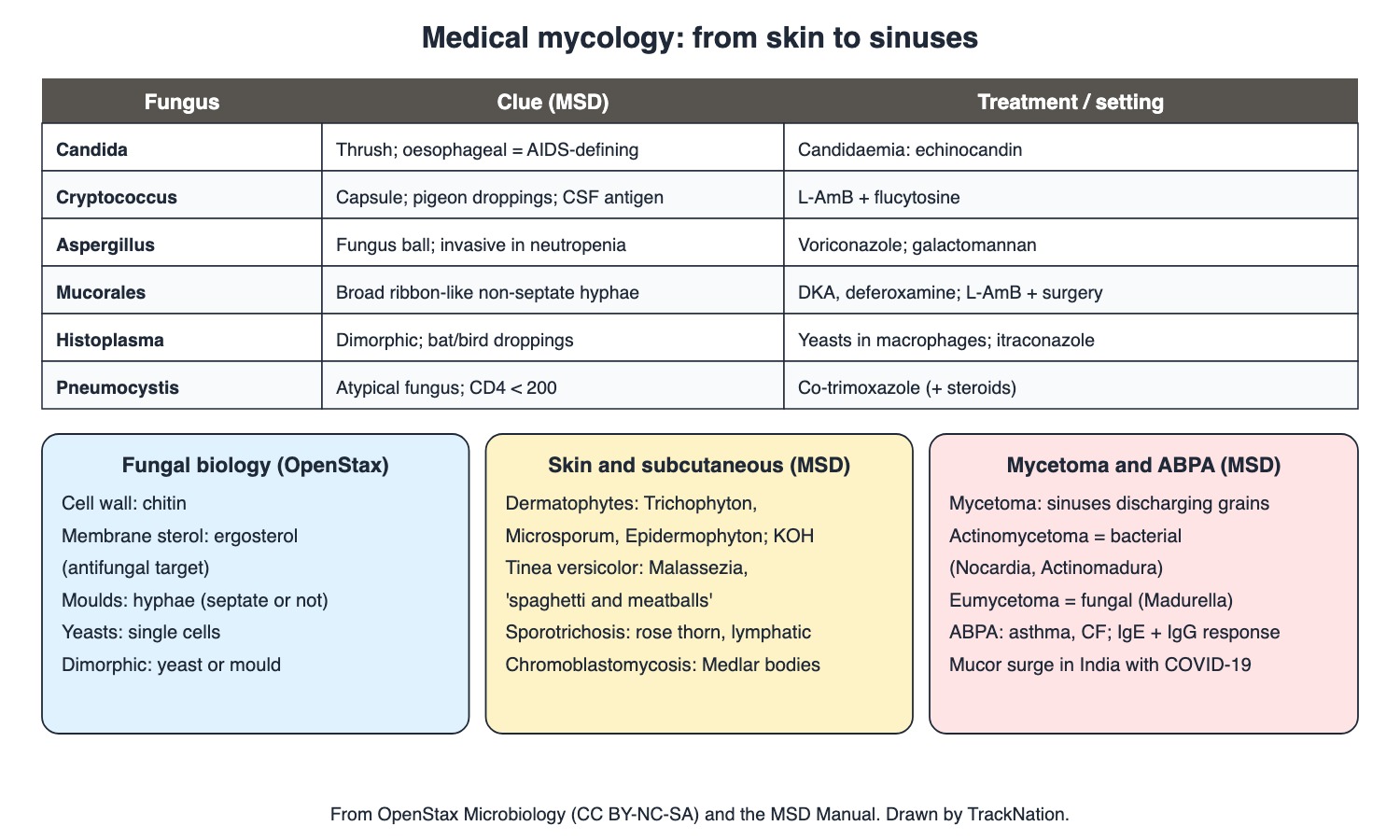
Fungi from skin to sinuses. Drawn by TrackNation.
Fungal Biology and Diagnosis (OpenStax, MSD)
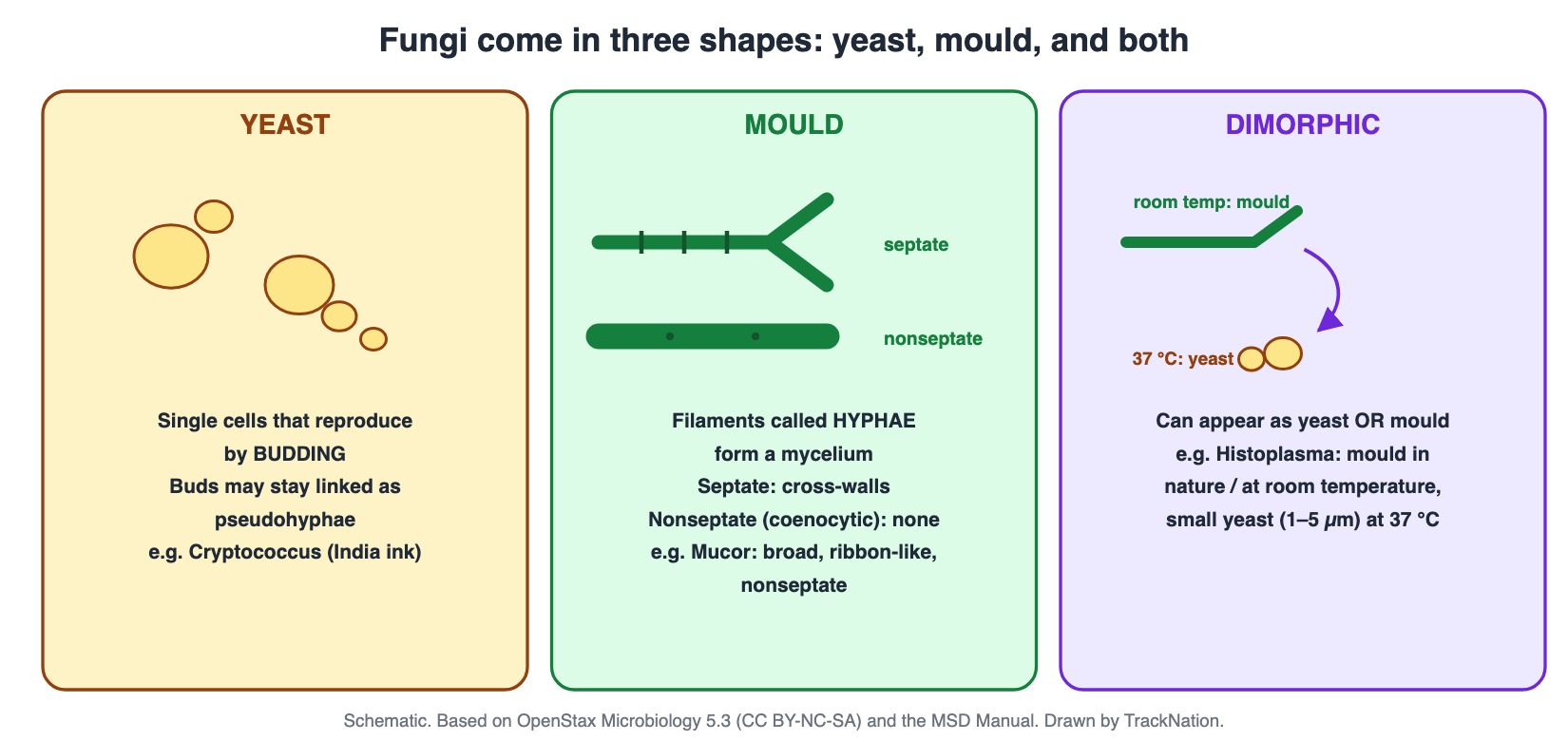
Yeasts, moulds and dimorphic fungi. Drawn by TrackNation.
Fungal cell walls contain chitin; membranes contain ergosterol instead of cholesterol — the target of many antifungals.
Moulds grow as hyphae (septate or not); yeasts are single cells; dimorphic fungi switch — e.g. Histoplasma is a mould at room temperature and a small yeast at 37 °C.
Microscopy: 10% KOH dissolves tissue to show fungi; calcofluor white highlights fungi (especially dermatophytes); India ink shows the cryptococcal capsule.
Opportunistic Mycoses (MSD)
Candida (mostly C. albicans): thrush; oesophageal candidiasis is AIDS-defining. Candidaemia risks: central lines, major abdominal surgery, broad-spectrum antibiotics, parenteral nutrition. Treat candidaemia with an echinocandin, step down to fluconazole. C. auris — emerging multidrug-resistant hospital pathogen.
Cryptococcus neoformans (encapsulated yeast) from soil with pigeon droppings; C. gattii from trees such as eucalyptus. Meningitis in advanced HIV (CD4 <100); diagnose with CSF cryptococcal antigen (India ink less sensitive); treat with liposomal amphotericin B + flucytosine.
Aspergillus: aspergilloma (fungus ball, may need resection), invasive aspergillosis in neutropenia, steroids, haematological cancer and transplants — galactomannan helps; treat with voriconazole (or posaconazole/isavuconazole). Positive sputum may be colonisation. ABPA — asthma or cystic fibrosis with an IgE/IgG response; steroids ± itraconazole.
Mucormycosis (Rhizopus, Mucor): diabetic ketoacidosis, deferoxamine (iron feeds the fungus), COVID-19 — a surge was seen in India. Tissue shows broad, ribbon-like, non-septate hyphae; treat with liposomal amphotericin B plus surgical debridement; mortality stays high.
Histoplasma: inhaled from soil with bird or bat droppings; intracellular yeasts in macrophages (Wright–Giemsa); itraconazole. Pneumocystis jirovecii (atypical fungus): pneumonia with CD4 <200 or steroids; co-trimoxazole first line, adding steroids if PaO2 <70 mmHg.
Superficial and Subcutaneous Mycoses (MSD)
Dermatophytes — Trichophyton, Microsporum, Epidermophyton — infect keratin of skin, hair and nails; KOH mount or culture.
Tinea versicolor: Malassezia furfur; scaly hypo- or hyperpigmented patches; KOH shows "spaghetti and meatballs".
Sporotrichosis: Sporothrix on rose bushes, sphagnum moss, hay — nodules spreading along lymphatics; itraconazole. Chromoblastomycosis: verrucous lesions with pathognomonic Medlar (muriform, sclerotic) bodies.
Mycetoma: swelling with sinuses discharging grains; actinomycetoma is bacterial (Nocardia, Streptomyces, Actinomadura), eumycetoma fungal (Madurella and others).
Traps the Examiner Sets
Mucor shows broad, ribbon-like, non-septate hyphae in tissue.
Cryptococcus is the encapsulated yeast — CSF antigen beats India ink.
Deferoxamine predisposes to mucormycosis.
Actinomycetoma is bacterial — antifungals will not cure it.
Pneumocystis is a fungus but is treated with co-trimoxazole.
Memory Hooks & Shortcuts
Shortcuts to lock in this article's numbers and lists. Each one only re-packages facts proven above.
🧠 'Mucor Must have Money (iron) and Misery (DKA)' — mucormycosis
🧠 'Crypto has a Coat and loves Coos (pigeons)' — cryptococcus
🧠 'Rose-gardener's Rash Runs up the lymphatics' — sporotrichosis — sporotrichosis
🧠 'Spaghetti and meatballs = Malassezia' — tinea versicolor
🧠 'Actino = bActerial, Eu = fUngal' mycetoma — mycetoma
Rapid-Revision Cards
Fungal wall / membrane
Chitin / ergosterol.
Dimorphic
Mould at 25 °C, yeast at 37 °C (Histoplasma).
Oesophageal candida
AIDS-defining.
Candidaemia
Echinocandin; lines, TPN, surgery.
C. auris
MDR hospital yeast.
Cryptococcus
Capsule; pigeons; CSF antigen.
Crypto Rx
L-AmB + flucytosine.
Aspergilloma
Fungus ball; resection.
Invasive aspergillosis
Neutropenia; galactomannan; voriconazole.
ABPA
Asthma, CF; steroids ± itraconazole.
Mucor risk
DKA, deferoxamine, COVID-19.
Mucor tissue
Broad ribbon-like non-septate hyphae.
Mucor Rx
L-AmB + surgery.
Histoplasma
Bird/bat droppings; yeasts in macrophages.
PCP
CD4 <200; co-trimoxazole ± steroids.
Dermatophytes
Trichophyton, Microsporum, Epidermophyton.
Tinea versicolor
Malassezia; spaghetti and meatballs.
Sporotrichosis
Rose thorn; lymphatic nodules.
Chromoblastomycosis
Medlar bodies.
Mycetoma
Grains; actinomycetoma bacterial.
Fungal microscopy
KOH, calcofluor, India ink.
Sources
Facts in this article were checked against these documents.
Microbiology (section 5.3) — Parker N, Schneegurt M, Thi Tu A-H, Lister P, Forster BM (OpenStax), 2016 (link)
MSD Manual Professional: Candidiasis; Cryptococcosis; Aspergillosis; ABPA; Mucormycosis; Histoplasmosis; Pneumocystis Pneumonia; Dermatophytoses; Tinea Versicolor; Sporotrichosis; Chromoblastomycosis; Mycetoma; Microscopy — Merck & Co. (MSD Manuals), 2024–26 (link)
Competency Based Undergraduate Curriculum, Vol I: Microbiology (fungal competencies in MI5, MI7.3, MI9.2) — National Medical Commission, 2024
Test Yourself: Practice Questions
Thirty questions in NEET PG style, many of them clinical vignettes.
Practice Questions (NEET PG pattern)
Original questions written in the style of the exam: +4 for a correct answer, −1 for a wrong one. Every answer was checked against the sources listed above. NEET PG papers are not published by NBEMS, so these are not past-paper questions.
Q1. The fungal cell wall contains
(a) peptidoglycan
(b) teichoic acid
(c) cellulose
(d) chitin
Show answer
Answer: (d) — OpenStax.
Q2. Many antifungal drugs target the membrane sterol
(a) cholesterol
(b) ergosterol
(c) lanosterol only
(d) hopanoid
Show answer
Answer: (b) — OpenStax.
Q3. A fungus that grows as a mould at room temperature and as a yeast at 37 °C is
(a) a dermatophyte
(b) dimorphic (e.g. Histoplasma)
(c) Candida only
(d) Mucor
Show answer
Answer: (b) — MSD.
Q4. Oesophageal candidiasis in an HIV patient
(a) is an AIDS-defining opportunistic infection
(b) is a normal finding
(c) excludes HIV
(d) is caused by Aspergillus
Show answer
Answer: (a) — MSD.
Q5. Initial treatment of candidaemia is
(a) griseofulvin
(b) itraconazole only
(c) nystatin
(d) an echinocandin, stepping down to fluconazole
Show answer
Answer: (d) — MSD.
Q6. A risk factor for candidaemia is
(a) tinea pedis
(b) pigeon exposure
(c) rose thorn injury
(d) a central venous catheter
Show answer
Answer: (d) — Also TPN, surgery, antibiotics.
Q7. An emerging multidrug-resistant yeast causing hospital outbreaks is
(a) Histoplasma
(b) Malassezia furfur
(c) Cryptococcus gattii
(d) Candida auris
Show answer
Answer: (d) — Often misidentified.
Q8. Cryptococcus neoformans is found in soil contaminated with
(a) cattle dung
(b) rat urine
(c) bat guano only
(d) pigeon droppings
Show answer
Answer: (d) — C. gattii: eucalyptus.
Q9. The most useful test for cryptococcal meningitis is
(a) Gram stain
(b) CSF cryptococcal antigen
(c) KOH mount
(d) galactomannan
Show answer
Answer: (b) — India ink less sensitive.
Q10. Cryptococcal meningitis is treated initially with
(a) liposomal amphotericin B plus flucytosine
(b) fluconazole alone
(c) caspofungin
(d) co-trimoxazole
Show answer
Answer: (a) — MSD.
Q11. Cryptococcal meningitis in HIV typically occurs with CD4 counts below
(a) 350/µL
(b) 500/µL
(c) 800/µL
(d) 100/µL
Show answer
Answer: (d) — MSD.
Q12. Invasive aspergillosis is most typical in
(a) neutropenic or transplant patients
(b) children with eczema
(c) pregnant women
(d) healthy athletes
Show answer
Answer: (a) — Also steroids.
Q13. A biomarker supporting invasive aspergillosis is
(a) galactomannan
(b) beta-hCG
(c) CSF cryptococcal antigen
(d) procalcitonin only
Show answer
Answer: (a) — MSD.
Q14. Drug of choice for invasive aspergillosis is
(a) voriconazole
(b) griseofulvin
(c) nystatin
(d) fluconazole
Show answer
Answer: (a) — Or posaconazole, isavuconazole.
Q15. A cavity containing a mobile fungal mass on CT is
(a) an aspergilloma (fungus ball)
(b) mucormycosis
(c) a hydatid cyst
(d) histoplasmoma only
Show answer
Answer: (a) — May need resection.
Q16. ABPA occurs commonly in patients with
(a) HIV
(b) asthma (and less often cystic fibrosis)
(c) neutropenia
(d) diabetes
Show answer
Answer: (b) — Steroids ± itraconazole.
Q17. A diabetic in ketoacidosis develops necrotic lesions of the nose and palate with proptosis. The organism is most likely
(a) Cryptococcus
(b) Aspergillus
(c) Candida
(d) Mucorales (Rhizopus, Mucor)
Show answer
Answer: (d) — Rhino-orbital-cerebral.
Q18. Tissue showing broad, ribbon-like, non-septate hyphae indicates
(a) candidiasis
(b) dermatophytosis
(c) mucormycosis
(d) aspergillosis
Show answer
Answer: (c) — MSD.
Q19. An iron-chelating drug that predisposes to mucormycosis is
(a) penicillamine
(b) EDTA
(c) deferasirox only
(d) deferoxamine
Show answer
Answer: (d) — Fungus uses the bound iron.
Q20. Treatment of mucormycosis is
(a) liposomal amphotericin B with surgical debridement
(b) observation
(c) voriconazole alone
(d) fluconazole alone
Show answer
Answer: (a) — High mortality.
Q21. Histoplasmosis is acquired by inhaling spores from soil contaminated with
(a) cattle urine
(b) bird or bat droppings
(c) rose bushes
(d) pigeon droppings only
Show answer
Answer: (b) — Construction sites.
Q22. Pneumocystis jirovecii is
(a) a virus
(b) a protozoan
(c) an atypical fungus
(d) a bacterium
Show answer
Answer: (c) — MSD.
Q23. First-line treatment of Pneumocystis pneumonia is
(a) amphotericin B
(b) fluconazole
(c) voriconazole
(d) co-trimoxazole (with steroids if PaO2 < 70 mmHg)
Show answer
Answer: (d) — MSD.
Q24. The dermatophyte genera are
(a) Trichophyton, Microsporum and Epidermophyton
(b) Sporothrix, Histoplasma, Blastomyces
(c) Aspergillus, Mucor, Rhizopus
(d) Candida, Malassezia, Cryptococcus
Show answer
Answer: (a) — Keratin.
Q25. Hypopigmented scaly patches on the trunk with 'spaghetti and meatballs' on KOH are
(a) leprosy
(b) vitiligo
(c) tinea versicolor (Malassezia furfur)
(d) tinea corporis
Show answer
Answer: (c) — MSD.
Q26. A gardener pricked by a rose thorn develops nodules spreading up the arm along lymphatics. Diagnosis is
(a) mycetoma
(b) chromoblastomycosis
(c) cutaneous anthrax
(d) sporotrichosis
Show answer
Answer: (d) — Itraconazole.
Q27. Pathognomonic Medlar (muriform, sclerotic) bodies are seen in
(a) mycetoma
(b) histoplasmosis
(c) chromoblastomycosis
(d) sporotrichosis
Show answer
Answer: (c) — Verrucous lesions.
Q28. A foot swelling with sinuses discharging grains caused by Nocardia or Actinomadura is
(a) eumycetoma (fungal)
(b) actinomycetoma (bacterial)
(c) sporotrichosis
(d) chromoblastomycosis
Show answer
Answer: (b) — Eumycetoma: Madurella.
Q29. The KOH preparation is used to
(a) dissolve tissue and reveal fungal elements
(b) culture fungi
(c) detect acid-fast bacilli
(d) stain capsules
Show answer
Answer: (a) — MSD.
Q30. A surge of mucormycosis linked with COVID-19 was noted particularly in
(a) Australia
(b) India
(c) Canada
(d) Scandinavia
Show answer
Answer: (b) — Poor diabetes control, steroids.
Active Recall
From memory: describe fungal cell structure and dimorphism, the lab tools for fungi, and for Candida, Cryptococcus, Aspergillus, Mucorales, Histoplasma and Pneumocystis give the risk setting, key finding and first-line treatment; then list the superficial and subcutaneous mycoses with their clues.