Psychiatric Assessment for NEET PG: Classification, History, Mental Status Examination and Key Psychopathology Terms
Start Here
🎯 Exam priority: Moderate (foundation for all of Psychiatry). Expect: mood vs affect, delusion vs obsession, hallucination definitions, ideas of reference, negative symptoms, catatonia with echolalia and echopraxia, the MSE cognitive items, insight, why you must ask about past mania, and which disorders make cognition abnormal.
CBME mapping: PS 1.1–1.3 — classification and its basis, eliciting history, performing an MSE.
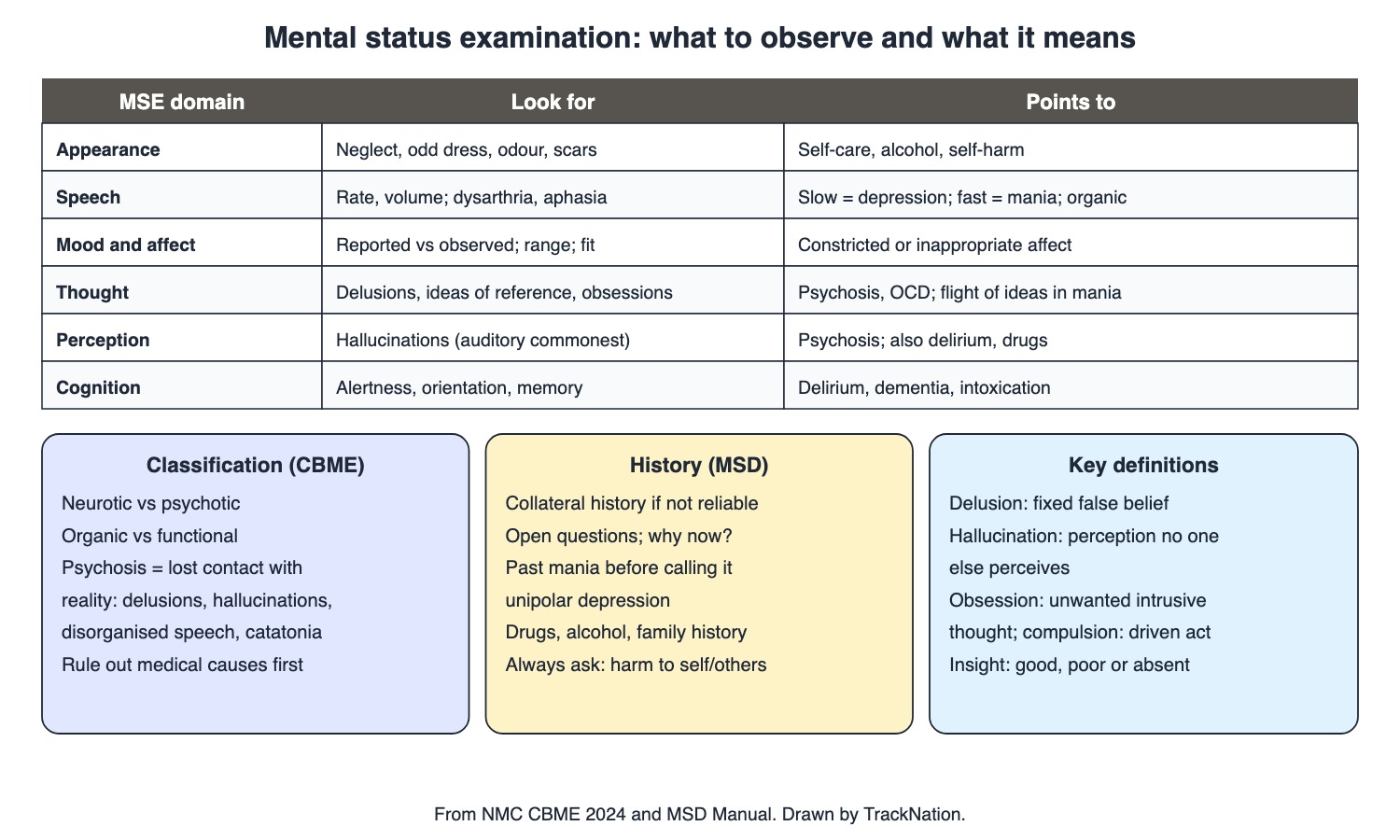
Mental status examination domains; classification; history; key psychopathology definitions. Drawn by TrackNation.
Classification and Psychosis
The NMC curriculum asks you to explain the basis of classification: neurotic vs psychotic and organic vs non-organic (functional). The curriculum's organic psychiatric disorders are chiefly delirium and dementia.
Psychosis means loss of contact with reality — delusions, hallucinations, disorganised thinking and speech, and bizarre motor behaviour including catatonia. Insight is graded too: in OCD it can range from good to absent.
Always ask whether a medical condition or its treatment is causing or worsening the symptoms — for example hyperthyroidism causing anxiety, or dysarthria and aphasia pointing to stroke, tumour, head injury or multiple sclerosis. Serious medical illness often brings an adjustment disorder.
Taking the History
First decide whether the patient can give a reliable history; if not, take collateral history from family, carers or others. Use open-ended questions and enough time.
Cover the presenting problem and its effect on functioning, past psychiatric history (psychosis, manic episodes, ECT, admissions), medical history and drugs, family and social history, development, personality and substance use.
Missing a past manic episode turns bipolar depression into a wrong diagnosis of unipolar depression — and the wrong treatment.
Always assess risk: suicidal thoughts, plans and intent, past attempts and means, and intent to harm others.
The Mental Status Examination
Appearance and behaviour: self-care, dress, odour of alcohol, scars of injection or self-harm, body language that contradicts what is said.
Speech: spontaneity, rate, volume — slow and soft in depression, fast and loud in mania; dysarthria or aphasia suggests an organic cause.
Mood vs affect: mood is what the patient reports; affect is what you observe. Note range (full vs constricted) and appropriateness (smiling while describing a tragedy).
Thought: content (delusions, ideas of reference, obsessions) and form (are ideas linked and goal-directed? flight of ideas, disorganisation). Perception: hallucinations, most often auditory.
Cognition: alertness, attention, orientation to time, place and person, immediate, short- and long-term memory, abstract reasoning, insight and judgment. Abnormal cognition points to delirium, dementia, intoxication or withdrawal, and sometimes depression. Screening questionnaires help but do not replace a full MSE.
Term (MSD) | Meaning | Typical setting |
Delusion | Fixed false belief held despite contrary evidence | Psychosis, delusional disorder, psychotic depression |
Idea of reference | Coincidental events felt to carry personal meaning | Psychosis |
Hallucination | Sensory perception not perceived by anyone else; auditory commonest | Psychosis; also delirium and drugs |
Obsession | Recurrent, unwanted, intrusive thought, urge or image | OCD |
Compulsion | Excessive repetitive purposeful act the person feels driven to do | OCD |
Flight of ideas | Abrupt jumps between ideas | Mania, psychosis |
Catatonia | Rigid posture, resisting movement, purposeless activity; echolalia, echopraxia | Schizophrenia, severe depression |
Negative symptoms | Alogia (poverty of speech), anhedonia, avolition, blunted affect | Schizophrenia |
Traps the Examiner Sets
Mood = patient's words; affect = your observation.
Obsessions are unwanted and distressing; delusions are firmly believed.
Marked cognitive abnormality points to delirium, dementia or substances.
Ask about mania before diagnosing depression.
Memory Hooks & Shortcuts
Shortcuts to lock in this article's numbers and lists. Each one only re-packages facts proven above.
🧠 MSE order 'ASMTPC': Appearance, Speech, Mood/affect, Thought, Perception, Cognition — MSE
🧠 'Mood = Mouth (they tell you); Affect = Appearance (you see it)' — mood vs affect
🧠 'Obsession: I hate this thought; Delusion: I know this is true' — obsession vs delusion
🧠 Negative symptoms 'the 4 As': Alogia, Anhedonia, Avolition, flat Affect — negative symptoms
🧠 'Confused? Think Organic' — delirium, dementia, drugs — organic vs functional
Rapid-Revision Cards
Classification basis
Neurotic vs psychotic; organic vs functional.
Psychosis
Lost contact with reality.
Collateral history
When the patient is unreliable.
Ask about mania
Before calling it unipolar depression.
Medical mimic
Hyperthyroidism → anxiety.
Risk questions
Thoughts, plans, intent, attempts, harm to others.
Speech
Slow/soft = depression; fast/loud = mania.
Dysarthria/aphasia
Think organic.
Mood
Reported by patient.
Affect
Observed; full or constricted.
Delusion
Fixed false belief.
Idea of reference
Coincidence feels personal.
Hallucination
Perception no one else has.
Commonest hallucination
Auditory.
Obsession
Unwanted intrusive thought.
Compulsion
Driven repetitive act.
Catatonia
Rigidity; echolalia, echopraxia.
Negative symptoms
Alogia, anhedonia, avolition.
Cognition items
Alertness, orientation, memory, abstraction, insight, judgment.
Cognitive deficit
Delirium, dementia, intoxication.
Insight levels
Good, poor, absent.
Sources
Facts in this article were checked against these documents.
Competency Based Undergraduate Curriculum, Psychiatry (PS 1) — National Medical Commission, 2024
MSD Manual Professional: Initial Psychiatric Assessment; Schizophrenia; Depressive Disorders; Bipolar Disorders; OCD; Body Dysmorphic Disorder — Merck & Co. (MSD Manuals), reviewed 2024–26 (link)
MSD Manual Professional: Delirium — Merck & Co. (MSD Manuals), reviewed 2025–26 (link)
Test Yourself: Practice Questions
Thirty questions in NEET PG style, most of them clinical vignettes.
Practice Questions (NEET PG pattern)
Original questions written in the style of the exam: +4 for a correct answer, −1 for a wrong one. Every answer was checked against the sources listed above. NEET PG papers are not published by NBEMS, so these are not past-paper questions.
Q1. The NMC curriculum describes the basis of psychiatric classification as
(a) child vs adult
(b) acute vs chronic only
(c) neurotic vs psychotic and organic vs functional
(d) inpatient vs outpatient
Show answer
Answer: (c) — PS 1.1.
Q2. Psychosis is best defined as
(a) symptoms such as delusions and hallucinations indicating loss of contact with reality
(b) low mood with guilt
(c) any severe anxiety
(d) memory loss
Show answer
Answer: (a) — Includes disorganised speech and catatonia.
Q3. A confused elderly patient cannot give a reliable account. The first step in history-taking is to
(a) order an MRI
(b) obtain collateral history from family or carers
(c) rely only on the patient
(d) skip the history
Show answer
Answer: (b) — Also previous records.
Q4. A patient presents with depression. Failing to ask about past manic episodes risks
(a) nothing
(b) missing schizophrenia
(c) misdiagnosing bipolar disorder as major depressive disorder
(d) missing dementia
Show answer
Answer: (c) — Wrong treatment follows.
Q5. Which medical condition is cited as a cause of anxiety to rule out?
(a) anaemia only
(b) hypothyroidism only
(c) hyperthyroidism
(d) gout
Show answer
Answer: (c) — Always consider medical causes.
Q6. Every psychiatric history must include
(a) only medication list
(b) suicidal thoughts, plans, intent, past attempts and intent to harm others
(c) only the chief complaint
(d) only family history
Show answer
Answer: (b) — Risk assessment.
Q7. On examination, a patient speaks very slowly and softly. This speech pattern is typical of
(a) depression
(b) mania
(c) delirium tremens
(d) anxiety
Show answer
Answer: (a) — Mania: rapid and loud.
Q8. Rapid, loud, pressured speech with jumps between ideas suggests
(a) catatonia
(b) mania
(c) depression
(d) dementia
Show answer
Answer: (b) — Flight of ideas.
Q9. Dysarthria or aphasia noted during an MSE suggests
(a) personality disorder
(b) a general medical (neurological) cause
(c) schizophrenia
(d) OCD
Show answer
Answer: (b) — Stroke, tumour, head injury, MS.
Q10. 'Mood' in the MSE refers to
(a) facial expression only
(b) thought content
(c) the emotion observed by the examiner
(d) the emotional state reported by the patient
Show answer
Answer: (d) — Affect is observed.
Q11. A patient smiles while describing the death of a child. The examiner records
(a) elevated mood
(b) inappropriate affect
(c) a delusion
(d) flight of ideas
Show answer
Answer: (b) — Affect not matching content.
Q12. Range of affect is described as
(a) full or constricted
(b) oriented or disoriented
(c) good or poor
(d) fixed or false
Show answer
Answer: (a) — Also appropriateness.
Q13. A fixed false belief held firmly despite clear contrary evidence is a
(a) overvalued idea
(b) delusion
(c) obsession
(d) illusion
Show answer
Answer: (b) — Thought content.
Q14. A patient feels that strangers laughing on the street are laughing at him. This is
(a) an obsession
(b) an idea of reference
(c) a hallucination
(d) a compulsion
Show answer
Answer: (b) — Innocuous events given personal meaning.
Q15. Recurrent, unwanted, intrusive thoughts that the patient finds distressing are
(a) hallucinations
(b) ideas of reference
(c) delusions
(d) obsessions
Show answer
Answer: (d) — OCD.
Q16. Repetitive purposeful acts a person feels driven to perform, such as repeated hand-washing, are
(a) compulsions
(b) obsessions
(c) mannerisms
(d) tics
Show answer
Answer: (a) — Often relieve anxiety from obsessions.
Q17. A sensory perception that no one else perceives is a
(a) delusion
(b) obsession
(c) hallucination
(d) illusion of reference
Show answer
Answer: (c) — Perception, not belief.
Q18. The most common type of hallucination in schizophrenia is
(a) auditory
(b) visual
(c) olfactory
(d) tactile
Show answer
Answer: (a) — Per MSD.
Q19. A patient holds a rigid posture for hours and resists being moved. This is
(a) akathisia
(b) malingering
(c) catatonia
(d) dystonia
Show answer
Answer: (c) — Extreme bizarre behaviour.
Q20. A patient repeats the examiner's words and copies their movements. These are
(a) tics
(b) flight of ideas
(c) perseveration
(d) echolalia and echopraxia (catatonic features)
Show answer
Answer: (d) — Seen in catatonia.
Q21. Poverty of speech with terse replies, as a negative symptom, is called
(a) aphasia
(b) avolition
(c) alogia
(d) anhedonia
Show answer
Answer: (c) — Negative symptoms of schizophrenia.
Q22. Lack of motivation and reduced goal-directed activity is
(a) akathisia
(b) alogia
(c) avolition
(d) apathy of delirium
Show answer
Answer: (c) — Negative symptom.
Q23. Which items belong to the cognitive part of the MSE?
(a) orientation, memory, abstract reasoning, insight and judgment
(b) speech rate
(c) appearance and dress
(d) mood and affect
Show answer
Answer: (a) — Plus alertness and attention.
Q24. Marked cognitive abnormalities on MSE most often point to
(a) OCD
(b) schizophrenia
(c) phobia
(d) delirium, dementia or substance intoxication/withdrawal
Show answer
Answer: (d) — Sometimes depression.
Q25. A confused patient with fluctuating attention also has hallucinations and paranoia. These features can occur in
(a) specific phobia
(b) delirium
(c) panic disorder
(d) OCD
Show answer
Answer: (b) — Organic cause.
Q26. Insight in OCD may be specified as
(a) always absent
(b) not assessed
(c) good or fair, poor, or absent (delusional beliefs)
(d) always good
Show answer
Answer: (c) — Also in BDD.
Q27. A manic patient gambles recklessly without recognising the harm. This reflects
(a) compulsion
(b) impaired insight
(c) intact judgment
(d) obsession
Show answer
Answer: (b) — Lack of insight is common in mania.
Q28. During the MSE, an odour of alcohol and scars along the forearm veins suggest
(a) anorexia
(b) substance use, including possible IV drug use
(c) dementia
(d) OCD
Show answer
Answer: (b) — Appearance gives clues.
Q29. Brief standardised screening questionnaires for mood or cognition
(a) are diagnostic alone
(b) are never used
(c) replace the MSE
(d) help screen but cannot replace a full MSE
Show answer
Answer: (d) — Useful baseline.
Q30. A patient with a new serious medical illness develops distress and poor coping. This commonly represents
(a) OCD
(b) dementia
(c) schizophrenia
(d) an adjustment disorder
Show answer
Answer: (d) — Coping with illness.
Active Recall
From memory: explain the basis of psychiatric classification and what psychosis means, list what a psychiatric history must cover, and go through the MSE domains defining mood, affect, delusion, hallucination, obsession, compulsion and catatonia.