Delirium and Dementia for NEET PG Psychiatry: Attention vs Memory, Causes, Reversible Dementia, Alzheimer Pathology and Drugs
Start Here
🎯 Exam priority: High. Expect: delirium = acute fluctuating inattention; dementia = slow memory loss; depression vs dementia on testing; drugs that cause delirium; haloperidol vs benzodiazepines; reversible dementias and their tests; Alzheimer plaques, tangles, APOE4 and presenilins; donepezil and memantine; ICMR red flags.
CBME mapping: PS 2.1. Neurology detail is in Medicine; pathology of Alzheimer disease in Pathology.
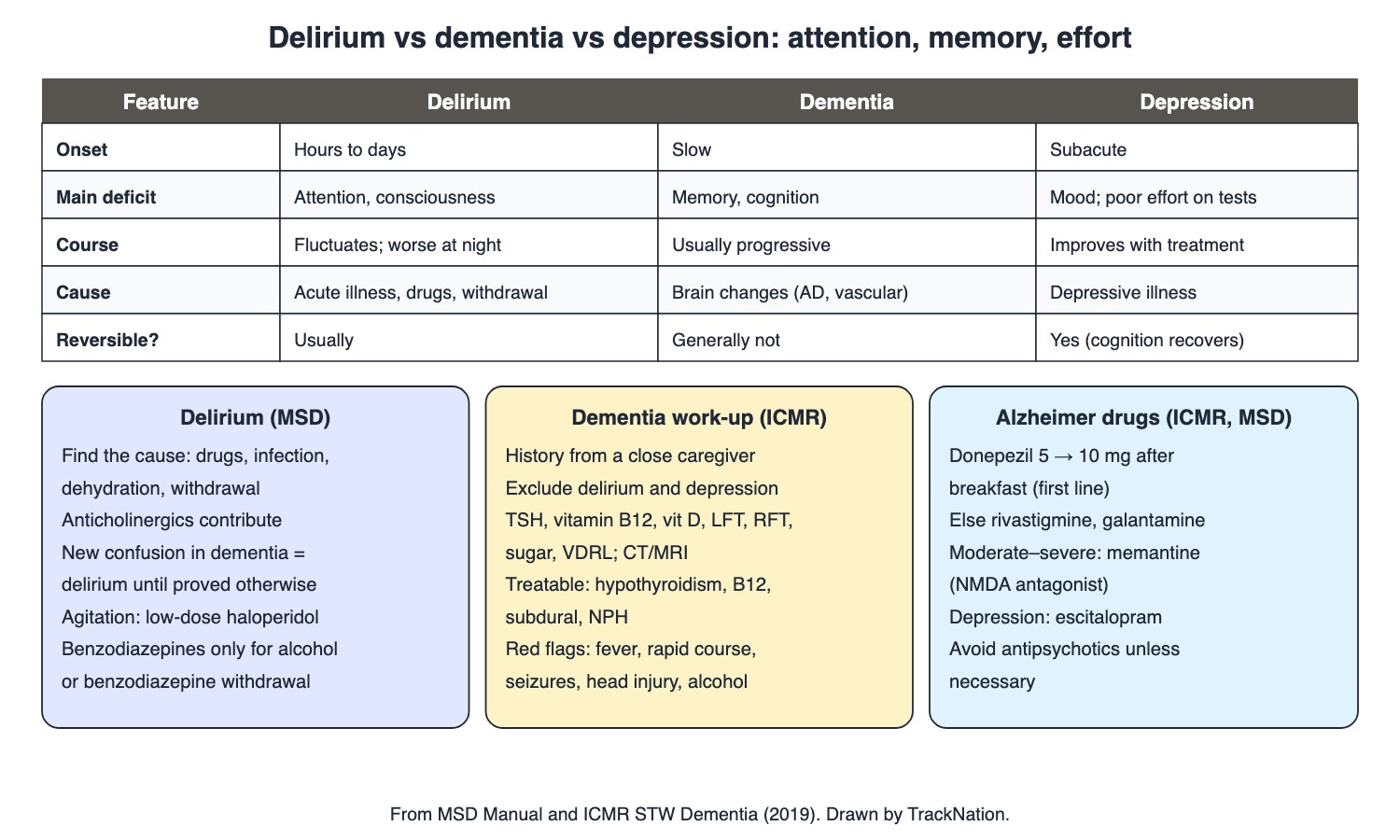
Delirium, dementia and depression compared; delirium management; dementia work-up; Alzheimer drugs. Drawn by TrackNation.
Delirium
An acute, fluctuating, usually reversible disturbance of attention, cognition and consciousness (acute confusional state). Develops over hours to days, often worse at night. Patients may be hyperactive (agitated, hyperalert) or hypoactive (quiet, withdrawn, lethargic); hallucinations, delusions and paranoia can occur.
Inattention (the patient does not register information) is the core sign — different from poor short-term memory. Psychiatric disorders almost never cause inattention or fluctuating consciousness. Diagnose with DSM-5-TR or the Confusion Assessment Method.
Causes: almost any medical illness or drug — commonly drugs (especially anticholinergics), dehydration, infections such as UTI, withdrawal. In older people delirium is often the first sign of serious illness; new deterioration in a person with dementia is delirium until proved otherwise.
Treat the cause; low-dose haloperidol for agitation or psychosis. Benzodiazepines only for alcohol or benzodiazepine withdrawal — otherwise they worsen confusion. Cognition may take weeks to months to recover.
Dementia
Chronic, global, usually irreversible decline in cognition, a change from the person's baseline; classified as Alzheimer or not, cortical or subcortical, reversible or not. Commonest mixed type: Alzheimer plus vascular. Focal deficits come early in vascular dementia and late in Alzheimer disease.
ICMR evaluation: history from a close caregiver; decline in more than one cognitive domain with functional decline; exclude delirium and depression; tests — TSH, B12, vitamin D, LFT, RFT, sugar, VDRL, CBC, lipids, CT/MRI. No single test diagnoses dementia. Red flags for referral: fever, rapid progression, seizures, recent head injury, alcoholism and falls.
Depression vs dementia: depressed patients make little effort on testing; people with dementia try hard but answer wrongly. Depressive cognitive symptoms resolve with treatment (old term pseudodementia).
Alzheimer disease: beta-amyloid plaques and neurofibrillary tangles of hyperphosphorylated tau; CSF shows high phospho-tau and low amyloid. Two APOE ε4 alleles raise risk up to 15-fold; APP and presenilin I/II mutations cause early-onset autosomal dominant forms.
Drugs: cholinesterase inhibitors — donepezil first line (ICMR: 5 mg then 10 mg after breakfast), rivastigmine, galantamine; memantine (NMDA antagonist) for moderate–severe disease; anti-amyloid antibodies (lecanemab, donanemab) in selected early disease, with ARIA (brain oedema, microbleeds) risk — test APOE ε4 first. Depression: SSRI (escitalopram); avoid antipsychotics unless necessary.
Potentially reversible cause (MSD, ICMR) | Clue / test |
Hypothyroidism | TSH |
Vitamin B12 deficiency | B12 level |
Normal pressure hydrocephalus | CT/MRI |
Subdural haematoma | CT/MRI; head injury, falls, alcohol |
Neurosyphilis, chronic meningitis | VDRL; lumbar puncture |
Depression (cognitive symptoms) | Poor effort on testing; improves with treatment |
Drugs and toxins (e.g. lead) | Drug history |
Traps the Examiner Sets
Inattention and fluctuating consciousness = delirium, not schizophrenia.
Benzodiazepines worsen delirium except in alcohol or benzodiazepine withdrawal.
Always check TSH and B12 in new dementia.
Poor effort on testing suggests depression; trying hard but failing suggests dementia.
Memory Hooks & Shortcuts
Shortcuts to lock in this article's numbers and lists. Each one only re-packages facts proven above.
🧠 'Delirium = Distracted; Dementia = Doesn't remember' — core difference
🧠 'In the elderly, new confusion = Delirium till proven otherwise' — rule
🧠 'Haloperidol for the delirious, benzos only for the withdrawing' — drugs
🧠 Reversible dementias 'THINS': Thyroid, Hydrocephalus (NPH), Infection (syphilis), Nutrition (B12), Subdural — work-up
🧠 Alzheimer = 'A and T': Amyloid plaques, Tau tangles — pathology
Rapid-Revision Cards
Delirium
Acute, fluctuating, reversible; attention.
Dementia
Chronic, global, irreversible; memory.
Delirium sign
Inattention; worse at night.
Hypoactive delirium
Quiet, withdrawn, missed.
Tool
Confusion Assessment Method.
Common causes
Drugs (anticholinergics), dehydration, UTI.
Delirium drug
Low-dose haloperidol.
Benzodiazepines
Only for alcohol/BZD withdrawal.
New confusion in dementia
Delirium until proved otherwise.
Reversible dementia
Hypothyroid, B12, NPH, subdural, syphilis.
Must-do tests
TSH, B12.
Depression vs dementia
Little effort vs tries but fails.
Vascular dementia
Early focal signs.
Mixed dementia
Alzheimer + vascular.
Alzheimer pathology
Amyloid plaques, tau tangles.
APOE ε4
Up to 15× risk with two copies.
Early-onset AD
APP, presenilin I/II.
CSF
High p-tau, low amyloid.
First-line drug
Donepezil 5 → 10 mg.
Memantine
NMDA antagonist; moderate–severe.
Anti-amyloid
ARIA; test APOE ε4.
Sources
Facts in this article were checked against these documents.
Standard Treatment Workflow: Dementia — Indian Council of Medical Research, DHR, 2019 (link)
MSD Manual Professional: Delirium; Dementia; Alzheimer Disease — Merck & Co. (MSD Manuals), reviewed 2025–26 (link)
Competency Based Undergraduate Curriculum, Psychiatry (PS 2) — National Medical Commission, 2024
Test Yourself: Practice Questions
Thirty questions in NEET PG style, most of them clinical vignettes.
Practice Questions (NEET PG pattern)
Original questions written in the style of the exam: +4 for a correct answer, −1 for a wrong one. Every answer was checked against the sources listed above. NEET PG papers are not published by NBEMS, so these are not past-paper questions.
Q1. Delirium is best defined as
(a) an acute, fluctuating, usually reversible disturbance of attention, cognition and consciousness
(b) chronic irreversible memory loss
(c) a primary psychotic disorder
(d) lifelong intellectual disability
Show answer
Answer: (a) — Acute confusional state.
Q2. The core feature that separates delirium from dementia is
(a) inattention with fluctuating consciousness
(b) old age
(c) memory loss
(d) hallucinations
Show answer
Answer: (a) — Dementia affects mainly memory.
Q3. On a medical ward, an 80-year-old becomes confused over a day, is worse at night and cannot follow instructions. The likely diagnosis is
(a) depression
(b) delirium
(c) Alzheimer disease
(d) schizophrenia
Show answer
Answer: (b) — Develops over hours to days, fluctuates.
Q4. A quiet, withdrawn, drowsy elderly patient with new confusion may have
(a) malingering
(b) normal ageing
(c) hypoactive delirium
(d) catatonic schizophrenia
Show answer
Answer: (c) — Easily missed.
Q5. A validated bedside tool for diagnosing delirium is the
(a) Y-BOCS
(b) AUDIT
(c) Confusion Assessment Method (CAM)
(d) Hamilton scale
Show answer
Answer: (c) — Or DSM-5-TR criteria.
Q6. Which drug class commonly contributes to delirium in the elderly?
(a) anticholinergics
(b) statins
(c) vitamins
(d) proton pump inhibitors only
Show answer
Answer: (a) — Review all drugs.
Q7. A common treatable cause of delirium in an older woman is
(a) urinary tract infection
(b) OCD
(c) personality disorder
(d) schizophrenia
Show answer
Answer: (a) — Also drugs, dehydration.
Q8. An agitated, hallucinating patient with delirium after pneumonia needs a drug to calm him. The preferred drug is
(a) diazepam
(b) lorazepam
(c) amitriptyline
(d) low-dose haloperidol
Show answer
Answer: (d) — Benzodiazepines worsen most delirium.
Q9. Benzodiazepines are the drugs of choice in delirium only when it is caused by
(a) alcohol or benzodiazepine withdrawal
(b) UTI
(c) anticholinergic drugs
(d) hypoglycaemia
Show answer
Answer: (a) — Intravenous benzodiazepines.
Q10. A nursing-home resident with known dementia becomes newly more confused. The correct assumption is
(a) depression
(b) normal progression
(c) delirium until proved otherwise
(d) sundowning only
Show answer
Answer: (c) — Look for a cause.
Q11. Dementia is best defined as
(a) any memory complaint
(b) low mood
(c) chronic, global, usually irreversible deterioration of cognition
(d) acute fluctuating confusion
Show answer
Answer: (c) — Change from baseline.
Q12. Which of these is a potentially reversible cause of dementia?
(a) Alzheimer disease
(b) Lewy body dementia
(c) frontotemporal dementia
(d) vitamin B12 deficiency
Show answer
Answer: (d) — Also hypothyroidism, NPH, subdural.
Q13. Two blood tests MSD says should be done in every new dementia are
(a) HbA1c and lipids
(b) TSH and vitamin B12
(c) ANA and RF
(d) ESR and CRP
Show answer
Answer: (b) — ICMR adds vitamin D, VDRL and others.
Q14. CT or MRI in dementia is mainly done to exclude
(a) delirium
(b) Alzheimer disease
(c) subdural haematoma, tumour or normal pressure hydrocephalus
(d) depression
Show answer
Answer: (c) — Surgically remediable causes.
Q15. An elderly man with memory complaints answers 'I don't know' to most test questions with little effort, and has low mood. The likely cause is
(a) delirium
(b) vascular dementia
(c) Alzheimer disease
(d) depression mimicking dementia
Show answer
Answer: (d) — Formerly pseudodementia.
Q16. Early focal neurological deficits in a patient with dementia suggest
(a) depression
(b) vascular dementia
(c) Alzheimer disease
(d) delirium
Show answer
Answer: (b) — Focal signs are late in Alzheimer.
Q17. The most common type of mixed dementia is
(a) Alzheimer disease with vascular dementia
(b) Alzheimer with prion disease
(c) Lewy body with frontotemporal
(d) vascular with Huntington
Show answer
Answer: (a) — Per MSD.
Q18. The hallmark pathology of Alzheimer disease is
(a) Pick bodies
(b) beta-amyloid plaques and neurofibrillary tangles
(c) Lewy bodies
(d) lacunar infarcts
Show answer
Answer: (b) — Tangles contain hyperphosphorylated tau.
Q19. Neurofibrillary tangles are made of
(a) prion protein
(b) beta-amyloid
(c) hyperphosphorylated tau
(d) alpha-synuclein
Show answer
Answer: (c) — Tau stabilises microtubules.
Q20. The genetic factor that increases Alzheimer risk up to 15-fold when two copies are present is
(a) APOE ε2
(b) BRCA1
(c) APOE ε4
(d) HLA-B27
Show answer
Answer: (c) — ε2 may protect.
Q21. Early-onset autosomal dominant Alzheimer disease is linked to mutations in
(a) APP and presenilin I and II
(b) APOE ε2
(c) SOD1
(d) huntingtin
Show answer
Answer: (a) — Typically early onset.
Q22. The CSF signature of Alzheimer disease is
(a) high protein, low sugar
(b) oligoclonal bands
(c) high amyloid and low tau
(d) high phosphorylated tau and low beta-amyloid
Show answer
Answer: (d) — Biomarker testing in selected patients.
Q23. The first-line drug for Alzheimer dementia is
(a) haloperidol
(b) lorazepam
(c) donepezil
(d) memantine
Show answer
Answer: (c) — Once daily, well tolerated.
Q24. The ICMR starting regimen of donepezil is
(a) 10 mg at night from day 1
(b) 5 mg after breakfast for 1 month, then 10 mg
(c) 5 mg twice daily
(d) 23 mg daily
Show answer
Answer: (b) — Rivastigmine or galantamine if not tolerated.
Q25. Memantine acts as
(a) an anti-amyloid antibody
(b) a dopamine agonist
(c) an NMDA receptor antagonist used in moderate–severe dementia
(d) a cholinesterase inhibitor
Show answer
Answer: (c) — Can be combined with a cholinesterase inhibitor.
Q26. A serious adverse effect of anti-amyloid antibodies such as lecanemab is
(a) hepatic failure
(b) amyloid-related imaging abnormalities (ARIA) — oedema or microbleeds
(c) agranulocytosis
(d) lactic acidosis
Show answer
Answer: (b) — Test APOE ε4 first.
Q27. Depression in a patient with dementia is best treated with
(a) an antipsychotic
(b) amitriptyline
(c) an SSRI such as escitalopram
(d) a benzodiazepine
Show answer
Answer: (c) — Avoid anticholinergic antidepressants.
Q28. ICMR advice on antipsychotics in dementia is to
(a) start them in all patients
(b) avoid them unless necessary
(c) combine two antipsychotics
(d) use them for memory
Show answer
Answer: (b) — Non-drug measures first for agitation.
Q29. Which is an ICMR red flag needing referral in dementia?
(a) rapid progression or seizures
(b) gradual memory loss over years
(c) age over 65
(d) mild forgetfulness
Show answer
Answer: (a) — Also fever, head injury, alcoholism and falls.
Q30. In dementia the history should be taken from
(a) the patient alone
(b) a close caregiver who has lived with the patient
(c) a neighbour
(d) hospital records only
Show answer
Answer: (b) — ICMR.
Active Recall
From memory: contrast delirium, dementia and depression, list the causes and drug treatment of delirium, give the ICMR dementia work-up and red flags, and describe Alzheimer pathology, genetics and drugs.