Women and Child Schemes for UPSC: Mission Shakti (Sambal, Samarthya), PMMVY, Palna, Poshan 2.0, Mission Vatsalya and the Maternity Benefit Act
Three Missions for Women and Children
🎯 Exam priority: Important. The Ministry's schemes now sit in three umbrella missions, and Mission Shakti alone has nine components in two halves. Prelims asks which component belongs where and what each one gives; the 2019 paper asked the maternity-leave law.
Since 2022 the Women and Child Development Ministry's Centrally Sponsored Schemes are grouped under three verticals. Learn the three, then what sits inside each.
Vertical | Purpose | Inside it |
Mission Shakti | Safety, protection and empowerment of women | Sambal (safety) and Samarthya (empowerment) |
Saksham Anganwadi & Poshan 2.0 | Nutrition and health indicators | Anganwadi Services, Poshan Abhiyaan, Scheme for Adolescent Girls |
Mission Vatsalya | Children in difficult circumstances | Child protection services, adoption, Child Helpline |
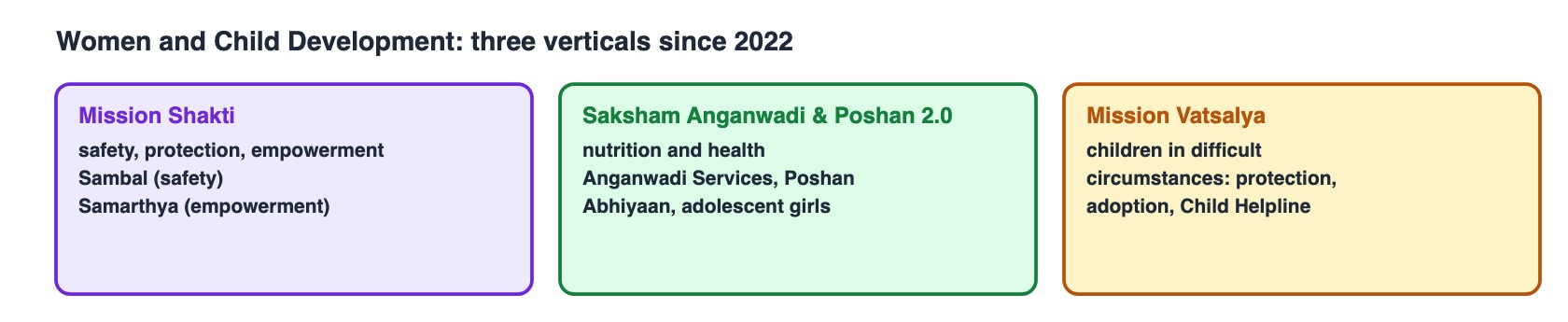
The Women and Child Development Ministry's three verticals.
Mission Shakti: Sambal and Samarthya
Mission Shakti is the vertical UPSC can test component by component.
Mission Shakti: Sambal and Samarthya
Mission Shakti is a Centrally Sponsored Scheme implemented by the States and UTs. It has two halves:
Sambal (safety and security) | Samarthya (empowerment) |
One Stop Centre (OSC) | Shakti Sadan |
Women Helpline 181 | Sakhi Niwas |
Beti Bachao Beti Padhao | PM Matru Vandana Yojana (PMMVY) |
Nari Adalat | Palna |
SANKALP: Hub for Empowerment of Women |
One Stop Centre: medical aid, legal aid, temporary shelter, police assistance and counselling under one roof for women affected by violence. 991 are working (661 of them now linked with the 181 helpline), and 15.20 lakh women were helped between 1 April 2015 and 30 June 2026.
Women Helpline 181: 24-hour toll-free help in emergencies and otherwise, now integrated with the emergency number ERSS-112; over 1.04 crore women helped since 2015.
Beti Bachao Beti Padhao: addresses the child sex ratio by changing attitudes towards the girl child; its tenth anniversary was marked from 22 January to 8 March 2025.
Nari Adalat: women-led forums at the village level that settle domestic and other gender-based disputes by mediation and consent. It began in phases: first in 7 blocks of 7 Assam districts and in Kupwara and Baramulla in Jammu and Kashmir (2023), and by mid-2025 it ran in 50 gram panchayats each in Assam and J&K.
Shakti Sadan: the old Swadhar Greh (homes for women in difficulty) and Ujjawala (homes for women rescued from trafficking) were merged into it from 1 April 2022; 433 are working.
Sakhi Niwas: the renamed Working Women Hostel scheme, with day care for children.
Palna (from 1 April 2022): creches for children aged 6 months to 6 years of all mothers, employed or not; 4,172 Anganwadi-cum-creches were running by July 2026.
PM Matru Vandana Yojana (from 1 January 2017): a Centrally Sponsored maternity-benefit scheme paying Rs 5,000 by direct benefit transfer for the first child, and Rs 6,000 for a second child if she is a girl. More than 4.56 crore women have received Rs 21,171.32 crore. Face-recognition verification has been mandatory for new enrolments since 21 May 2025.
SANKALP: HEW is the project monitoring unit for all of Mission Shakti and a single window for women's schemes.
Saksham Anganwadi and Poshan 2.0
The nutrition vertical touches the largest number of people.
Saksham Anganwadi and Poshan 2.0
This mission merges three older schemes: Anganwadi Services, Poshan Abhiyaan and the Scheme for Adolescent Girls. It reached over 8.69 crore pregnant women, lactating mothers, adolescent girls and children by November 2025.
Saksham Anganwadi: 2 lakh Anganwadi Centres are approved for upgrading; 94,077 have been upgraded.
Poshan Tracker (March 2021): a real-time app tracking growth, attendance, hot-cooked meals and take-home ration; it won the Prime Minister's Award for Excellence in Public Administration 2024 (Innovation, Centre). Take-home ration is now verified by face recognition.
Poshan Bhi Padhai Bhi: early childhood education at Anganwadis with two curricula, Aadharshila (0-3 years) and Navchetana (3-6 years). Guidelines of 3 September 2025 encourage putting Anganwadis on school campuses; 2.9 lakh already are.
Campaigns: the Suposhit Gram Panchayat Abhiyan (26 December 2024) rewards 1,000 high-performing panchayats; the 8th Rashtriya Poshan Maah began on 17 September 2025 from Dhar, Madhya Pradesh. The helpline for Poshan, PMMVY and PM CARES for Children is now 1515.
Mission Vatsalya, Child Protection and Workplace Laws
Child protection and two laws for working women complete the picture.
Mission Vatsalya and the Juvenile Justice Act
Mission Vatsalya is a Centrally Sponsored Scheme that carries out the Juvenile Justice (Care and Protection of Children) Act, 2015, the main child-protection law. It serves two groups the Act defines:
Group | Who | Decided by |
Children in Need of Care and Protection (CNCP) | Orphaned, abandoned or surrendered children; children working against labour laws, begging or living on the street | Child Welfare Committee (Sections 27-30) |
Children in Conflict with Law (CCL) | Children alleged or found to have committed an offence | Juvenile Justice Board |
Two kinds of care: institutional care in Child Care Institutions (education, vocational training, health care, counselling), and non-institutional care through adoption, foster care, sponsorship and after-care. After-care supports young people past 18 as they leave institutions.
Structures under the Act: State Child Protection Society, Child Welfare Committees, Juvenile Justice Boards and District Child Protection Units. The NCPCR and the State commissions monitor the Act.
Funding: Centre and States share 60:40; 90:10 for the North-Eastern States, Himachal Pradesh, Uttarakhand and J&K; the Centre pays all in UTs without a legislature.
Outreach: the Child Helpline 1098 runs round the clock in all 36 States and UTs and is integrated with ERSS-112. The Mission Vatsalya portal links the CARINGS adoption platform and the TrackChild and Khoya-Paya tools for missing children.
Begging: children found begging are CNCP under the JJ Act; adults are covered by the Social Justice Ministry's SMILE scheme (Support for Marginalized Individuals for Livelihood and Enterprise).
Policing tools for crimes against women and children
These Home Ministry systems are named in the Ministry's 2026 reply on women's and children's safety and are frequent one-liner options in Prelims:
Tool | What it does |
ERSS-112 | One emergency number with computer-aided dispatch, in all 36 States and UTs; the 112 India app can alert volunteers and contacts |
CCTNS (from 2009) | Links every police station on one network to share crime and criminal records |
NDSO | National Database on Sexual Offenders, to track known and habitual offenders |
ITSSO | Investigation Tracking System for Sexual Offences: monitors time-bound investigation |
AHTUs | Anti Human Trafficking Units planned in every district |
Cri-MAC and NDHTO | Real-time crime alerts across States; a database of trafficking offenders |
I4C and cybercrime.gov.in | Cyber-crime coordination centre and reporting portal; CCPWC scheme funds State capacity |
The new criminal laws, including the Bharatiya Nyaya Sanhita, 2023, took effect on 1 July 2024.
Child marriage and the workplace laws
Bal Vivah Mukt Bharat: the national campaign against child marriage completed a year on 27 November 2025, and a 100-day intensive phase began on 4 December 2025.
Maternity Benefit (Amendment) Act, 2017: paid maternity leave rose from 12 weeks to 26 weeks, of which not more than 8 may come before the expected delivery. A woman with two or more surviving children gets 12 weeks. Every establishment with 50 or more employees must have a creche, and a mother may visit it four times a day.
POSH Act, 2013 (Sexual Harassment of Women at Workplace): the SHe-Box portal, launched on 29 August 2024, gives women in any sector a single window to file complaints.
How UPSC asks it
Which component is Sambal and which Samarthya; what was merged into Shakti Sadan.
PMMVY amounts and the girl-child condition; Palna's age band; the Maternity Benefit Act's weeks and creche rules.
Mains: nutrition, the role of Anganwadis, women's safety and the gap between laws and enforcement.
Further Reading
PIB press releases, ministry websites and annual reports, the Gazette of India, MEA and UN documents and the official sources named in each note — the primary sources behind every fact above.
Test Yourself: Practice Questions & PYQs
18 practice questions, then a real UPSC question on the maternity-benefit law.
Practice Questions
Q1. Which of the following is NOT one of the three verticals of the Ministry of Women and Child Development's schemes?
(a) Mission Indradhanush
(b) Saksham Anganwadi & Poshan 2.0
(c) Mission Shakti
(d) Mission Vatsalya
Show answer
Answer: (a) — The three verticals are Mission Shakti, Saksham Anganwadi & Poshan 2.0 and Mission Vatsalya. Mission Indradhanush is an immunisation drive of the Health Ministry.
Q2. Under Mission Shakti, the 'Sambal' sub-scheme includes
(a) One Stop Centre, Women Helpline, Beti Bachao Beti Padhao and Nari Adalat
(b) Shakti Sadan, Sakhi Niwas and Palna
(c) Poshan Tracker and Poshan Maah
(d) PMMVY and SANKALP
Show answer
Answer: (a) — Sambal is the safety vertical: One Stop Centre, Women Helpline, BBBP and Nari Adalat. Shakti Sadan, Sakhi Niwas, PMMVY, Palna and SANKALP form Samarthya.
Q3. Shakti Sadan was formed by merging which two schemes?
(a) Swadhar Greh and Ujjawala
(b) STEP and Mahila Shakti Kendra
(c) Ujjwala Yojana and Swachh Bharat
(d) Sakhi Niwas and Palna
Show answer
Answer: (a) — From 1 April 2022 Swadhar Greh (homes for women in difficulty) and Ujjawala (homes for women rescued from trafficking) were merged into Shakti Sadan.
Q4. Under PM Matru Vandana Yojana, a cash incentive is paid for the second child
(a) never; PMMVY covers only the first child
(b) only in aspirational districts
(c) only if the second child is a girl
(d) only for BPL families
Show answer
Answer: (c) — PMMVY pays Rs 5,000 for the first child and Rs 6,000 for the second child, subject to the second child being a girl.
Q5. The Palna scheme provides creche facilities for children aged
(a) 0 to 3 years
(b) 6 months to 6 years
(c) 1 to 10 years
(d) 3 to 6 years
Show answer
Answer: (b) — Palna (from 1 April 2022) gives creches for children aged 6 months to 6 years of all mothers, whatever their employment status.
Q6. Consider the following statements:
1. Saksham Anganwadi & Poshan 2.0 merges Anganwadi Services, Poshan Abhiyaan and the Scheme for Adolescent Girls.
2. The Poshan Tracker app was launched in 2015.
Which of the statements given above is/are correct?
(a) 1 only
(b) 2 only
(c) Both 1 and 2
(d) Neither 1 nor 2
Show answer
Answer: (a) — Only 1 is correct. The Poshan Tracker was launched in March 2021.
Q7. Under the Poshan Bhi Padhai Bhi initiative, the curriculum for children aged 3-6 years at Anganwadis is called
(a) Navchetana
(b) Nipun
(c) Vidya Pravesh
(d) Aadharshila
Show answer
Answer: (a) — Aadharshila is for 0-3 years and Navchetana for 3-6 years.
Q8. Which of the following is the project monitoring unit and single window for all components of Mission Shakti?
(a) SANKALP: Hub for Empowerment of Women
(b) Nari Adalat
(c) One Stop Centre
(d) Poshan Tracker
Show answer
Answer: (a) — SANKALP: HEW functions as the project monitoring unit for all components of Mission Shakti.
Q9. Under the Maternity Benefit (Amendment) Act, 2017, a woman with two or more surviving children is entitled to
(a) 6 weeks of maternity benefit
(b) 12 weeks of maternity benefit
(c) no maternity benefit
(d) 26 weeks of maternity benefit
Show answer
Answer: (b) — The Act raised leave to 26 weeks, but a woman with two or more surviving children gets 12 weeks, of which not more than 6 precede delivery.
Q10. Under the Maternity Benefit (Amendment) Act, 2017, a creche is mandatory for every establishment having at least
(a) 100 employees
(b) 50 employees
(c) 30 women employees
(d) 10 employees
Show answer
Answer: (b) — Section 11A requires a creche in every establishment with 50 or more employees, and the employer must allow four visits a day.
Q11. The SHe-Box portal, launched on 29 August 2024, is meant for
(a) registration for PMMVY
(b) booking a One Stop Centre bed
(c) complaints under the Sexual Harassment of Women at Workplace Act, 2013
(d) reporting child marriage
Show answer
Answer: (c) — SHe-Box gives women in organised and unorganised sectors a single window to file complaints under the POSH Act.
Q12. The Women Helpline 181 and the Child Helpline have both been integrated with
(a) Ayushman Bharat
(b) the UPI network
(c) eSanjeevani
(d) ERSS-112
Show answer
Answer: (d) — Both helplines are integrated with the Emergency Response Support System, ERSS-112.
Q13. The Suposhit Gram Panchayat Abhiyan, launched on 26 December 2024, aims to
(a) build 1,000 new Anganwadi Centres
(b) train 1,000 women panchayat leaders
(c) give mobile phones to all Anganwadi workers
(d) identify and reward 1,000 high-performing panchayats in nutrition
Show answer
Answer: (d) — It identifies and rewards 1,000 panchayats that excel in nutrition security and malnutrition outcomes.
Q14. Under the Juvenile Justice Act, 2015, decisions about a 'child in need of care and protection' are taken by the
(a) National Commission for Protection of Child Rights
(b) Juvenile Justice Board
(c) Child Welfare Committee
(d) District Magistrate
Show answer
Answer: (c) — Sections 27-30 empower Child Welfare Committees to decide on children in need of care and protection. Juvenile Justice Boards deal with children in conflict with law; the NCPCR monitors the Act.
Q15. Consider the following statements:
1. Mission Vatsalya is a Central Sector Scheme fully funded by the Centre.
2. Non-institutional care under Mission Vatsalya includes adoption, foster care, sponsorship and after-care.
3. A child found begging is a 'child in need of care and protection' under the JJ Act, 2015.
Which of the statements given above are correct?
(a) 1 and 2 only
(b) 2 and 3 only
(c) 1 and 3 only
(d) 1, 2 and 3
Show answer
Answer: (b) — 2 and 3 are correct. Mission Vatsalya is a Centrally Sponsored Scheme: 60:40 for most States, 90:10 for the North-East, Himachal, Uttarakhand and J&K, and 100% central only in UTs without a legislature.
Q16. Nari Adalat, a component of Mission Shakti, was first implemented in
(a) Bihar and Uttar Pradesh
(b) Kerala and Tamil Nadu
(c) Assam and Jammu & Kashmir
(d) all aspirational districts
Show answer
Answer: (c) — The first phase (2023) covered 7 blocks in 7 Assam districts and Kupwara and Baramulla in J&K; by mid-2025 it ran in 50 gram panchayats each in Assam and J&K.
Q17. ITSSO, used by police in India, is
(a) an online tool to monitor time-bound investigation of sexual offences
(b) a scheme for one stop centres
(c) a database of human trafficking offenders
(d) a cyber-crime reporting portal
Show answer
Answer: (a) — ITSSO is the Investigation Tracking System for Sexual Offences. The trafficking database is NDHTO, the reporting portal is cybercrime.gov.in.
Q18. The Child Helpline number that runs 24x7 under Mission Vatsalya is
(a) 1515
(b) 181
(c) 14408
(d) 1098
Show answer
Answer: (d) — 1098 is the Child Helpline, integrated with ERSS-112. 181 is the Women Helpline; 1515 is the Poshan, PMMVY and PM CARES helpline (earlier 14408).
UPSC Previous Year Questions (PYQs)
Real UPSC Prelims question, checked against the official paper and answer key.
Q1. Which of the following statements is/are correct regarding the Maternity Benefit (Amendment) Act, 2017?
1. Pregnant women are entitled for three months pre-delivery and three months post-delivery paid leave.
2. Enterprises with creches must allow the mother minimum six creche visits daily.
3. Women with two children get reduced entitlements.
Select the correct answer using the code given below. (UPSC CSE 2019)
(a) 1 and 2 only
(b) 2 only
(c) 3 only
(d) 1, 2 and 3
Show answer
Answer: (c) — Only 3. The Act gives 26 weeks, of which not more than 8 may precede delivery, not three months plus three months. The creche rule is four visits a day, not six. A woman with two or more surviving children gets a reduced 12 weeks.
Mains Practice Questions
Use these to frame full-length answers. You don't have to answer one exactly — they show the angles UPSC tests, so let them guide which points you cover.
Examine how Mission Shakti's 'Sambal' and 'Samarthya' together address women's safety and empowerment, and identify gaps in implementation.
Anganwadis are being turned into centres of both nutrition and early learning. Discuss the promise and the challenges of this approach under Poshan 2.0.
Evaluate the Maternity Benefit (Amendment) Act, 2017 in the light of women's participation in the formal workforce.