Mycobacteria for NEET PG Microbiology: Tuberculosis Under NTEP, Drug-Resistant TB, NTM and Leprosy (NLEP 2025)
Start Here
🎯 Exam priority: Very high. Expect: droplet-nuclei spread, Ghon vs Ranke complex, latent reactivation risk, sites of reactivation, Xpert/Truenat, liquid vs LJ culture times, TST/BCG, the NTEP DS-TB regimen and doses, the new DR-TB definitions (pre-XDR, XDR) and BPaLM, TPT for contacts, NTM matching (MAC, marinum, ulcerans, scrofulaceum), and leprosy PB/MB criteria, MDT duration and reactions.
CBME mapping: MI7.3, MI5.4. Fact-checked against the MSD Manual, the ICMR–NTEP DS-TB workflow (2022), NTEP DR-TB (2025) and TPT (2021) guidelines, the India TB Report 2024 and NLEP (2025).
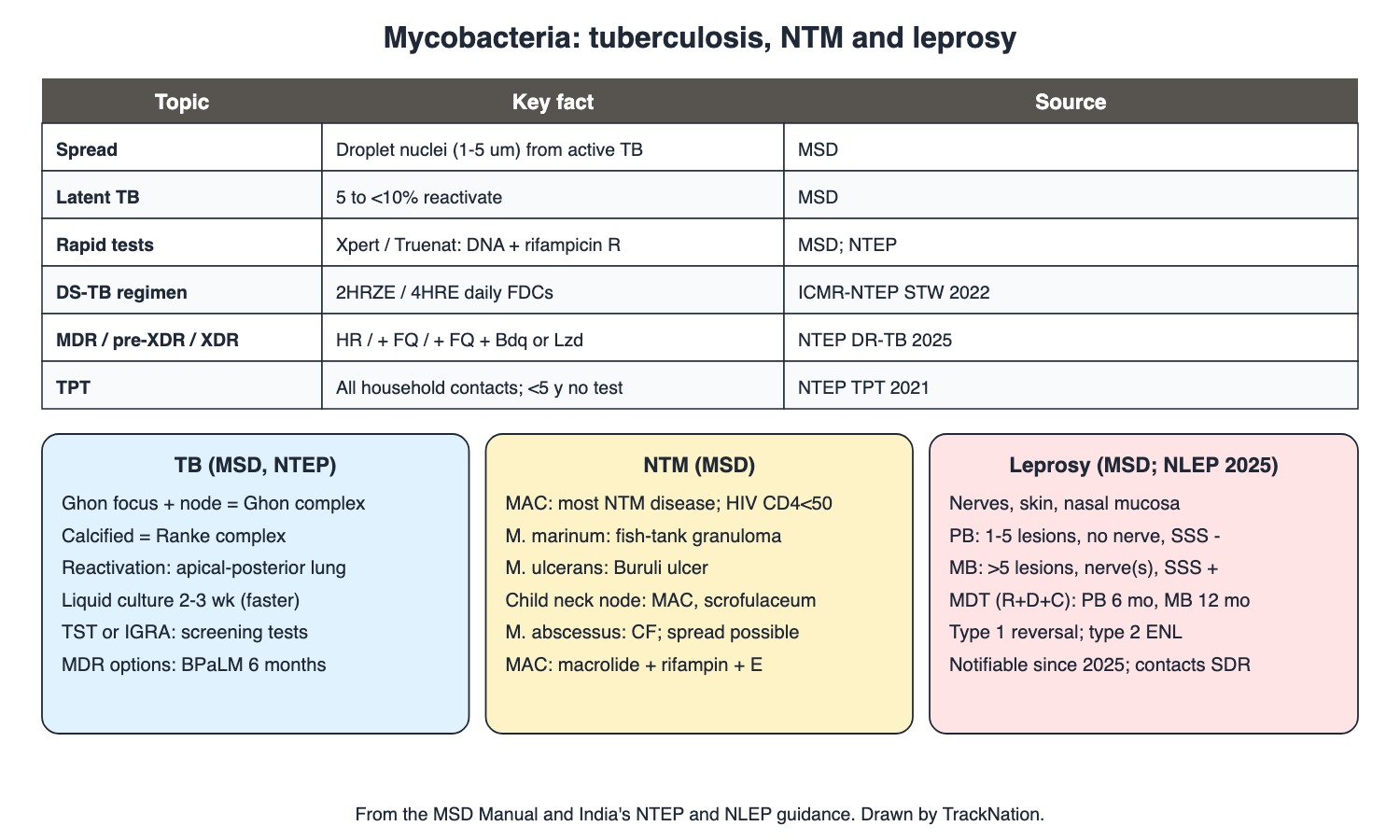
TB, drug resistance, NTM and leprosy. Drawn by TrackNation.
The Organism and the Disease (MSD)
Mycobacteria are slow-growing aerobic bacilli with a mycolic-acid envelope — acid-fast and poorly Gram-staining. The M. tuberculosis complex includes M. tuberculosis, M. bovis, M. africanum and M. microti.
Spread is by droplet nuclei (1–5 µm) from people with active pulmonary or laryngeal TB; cavitary disease is most infectious. Primary and latent infection are usually not transmissible.
>90–95% of primary infections are asymptomatic. A primary focus is a Ghon focus; with its node it is a Ghon complex; calcified, a Ranke complex. 5 to <10% of latent infections reactivate — favoured sites are the apical-posterior lung, kidneys, epiphyses, vertebrae and meninges.
Suspect TB with cough >2–3 weeks, haemoptysis, night sweats, weight loss. HIV is the strongest risk factor; presentations are atypical. India 2023: 25.52 lakh notified cases; estimated incidence 199 per lakh (217 in 2015).
Diagnosis (MSD, NTEP)
Smear (ZN/auramine; needs ≥10,000 bacilli/mL — article 04), NAATs and culture. Xpert MTB/RIF (Ultra) and Truenat detect M. tuberculosis DNA in about 2 hours and rifampicin resistance.
Culture: liquid media are faster and more sensitive (2–3 weeks) than Lowenstein–Jensen (≥4 weeks); hold 8 weeks. Liquid-culture DST guides DR-TB regimens.
Screening for infection: tuberculin skin test or IGRA; BCG's effect on TST wanes after several years.
Treatment and Prevention in India (NTEP)
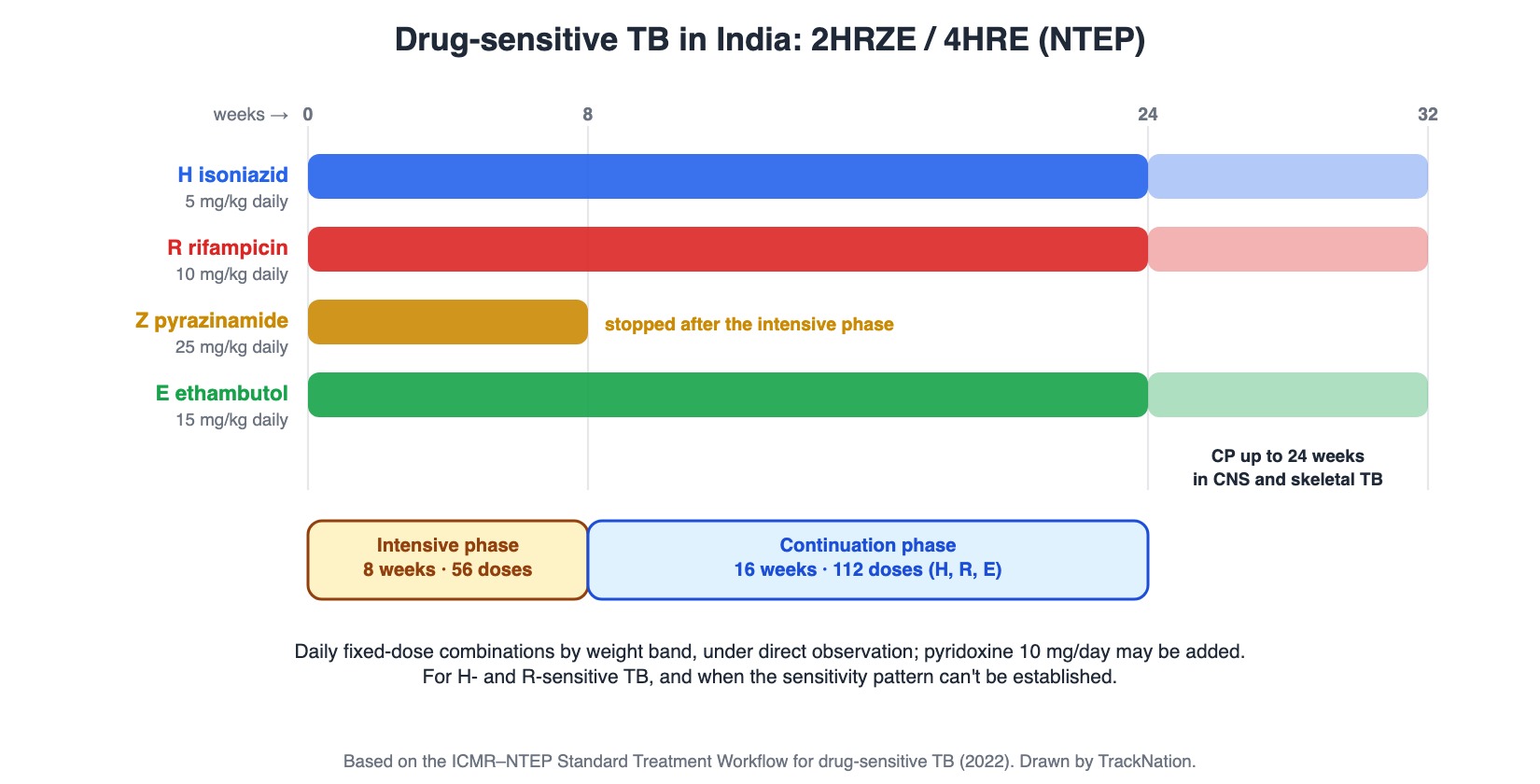
The NTEP drug-sensitive TB regimen 2HRZE/4HRE as a timeline. Drawn by TrackNation.
DS-TB (ICMR–NTEP 2022): 2HRZE / 4HRE daily weight-band FDCs — intensive phase 8 weeks (56 doses), continuation 16 weeks (112 doses), extended to 24 weeks for CNS and skeletal TB. Doses: H 5, R 10, Z 25, E 15 mg/kg; pyridoxine 10 mg/day.
Drug-resistance definitions (NTEP 2025): RR-TB — rifampicin resistance; MDR-TB — H + R; pre-XDR — MDR/RR + any fluoroquinolone; XDR — MDR/RR + fluoroquinolone + bedaquiline or linezolid; Hr-TB — isoniazid-resistant, rifampicin-sensitive.
Regimens: BPaLM (bedaquiline, pretomanid, linezolid 600 mg, moxifloxacin 400 mg) for 6 months (26 weeks, extendable) in eligible patients; otherwise the 9–11-month shorter oral or 18–20-month longer oral regimen.
TPT (NTEP 2021): all household contacts of pulmonary TB, any age, after ruling out active TB; under-5s need no infection test. Options include 6H (daily isoniazid, 6 months), 3HP (weekly rifapentine + isoniazid, 3 months); 6Lfx (levofloxacin, 6 months) for contacts of rifampicin-resistant, fluoroquinolone-sensitive TB; 4R for contacts of isoniazid-resistant TB.
NTM and Leprosy (MSD, NLEP)
NTM: lungs commonest site; MAC (M. avium, M. intracellulare) causes most disease — prophylaxis in HIV with CD4 <50 when not suppressed; treated with a macrolide + rifampicin/rifabutin + ethambutol. M. abscessus can spread between cystic-fibrosis patients. M. marinum — swimming-pool / fish-tank granuloma; M. ulcerans — Buruli ulcer (grows at 32 °C over up to 12 weeks); child cervical lymphadenitis — MAC or M. scrofulaceum.
Leprosy (M. leprae; M. lepromatosis since 2008): affinity for peripheral nerves, skin and upper-airway mucosa; spread by nasal droplets, not casual contact; ~95% of exposed people never develop disease; peaks at 5–15 and >30 years; armadillos are a zoonotic reservoir in the US.
Spectrum: tuberculoid — strong cell-mediated immunity, few lesions (paucibacillary); lepromatous — weak CMI, widespread bacilli (multibacillary). Reactions: type 1 = reversal; type 2 = erythema nodosum leprosum (immune complex), less common since clofazimine.
NLEP (2023 classification, 2025 regimen): PB = 1–5 lesions, no nerve, slit-skin smear negative; MB = >5 lesions, nerve involvement, smear positive. Both get 3-drug MDT — rifampicin 600 mg monthly, clofazimine 300 mg monthly + 50 mg daily, dapsone 100 mg daily — PB 6 months, MB 12 months. Leprosy became notifiable in 2025; contacts get single-dose rifampicin. Prevalence 0.57 per 10,000 (2024–25).
Traps the Examiner Sets
Ranke = calcified Ghon complex.
Pre-XDR adds fluoroquinolone resistance; XDR adds bedaquiline or linezolid resistance too.
India's NLEP now gives clofazimine to PB patients as well — 3 drugs for 6 months.
Fish-tank granuloma is M. marinum; Buruli ulcer is M. ulcerans.
Under-5 household contacts get TPT without a TST or IGRA once active TB is excluded.
Memory Hooks & Shortcuts
Shortcuts to lock in this article's numbers and lists. Each one only re-packages facts proven above.
🧠 'Ghon goes Gone-calcified = Ranke' — R for Rock-hard calcium — TB pathology
🧠 NTEP doses '5-10-25-15': H-R-Z-E mg/kg — DS-TB
🧠 Resistance ladder 'R → M → Pre → X': Rif, then H+R, then +FQ, then +Bdq/Lzd — DR-TB
🧠 'Fish Marinum, Buruli Ulcerans, Avium for AIDS' — NTM
🧠 'PB = Pretty Brief (6 months), MB = Much Bigger (12 months) — same 3 drugs now' — leprosy
Rapid-Revision Cards
Mycolic acid
Acid-fast; poor Gram stain.
MTB complex
M. tb, bovis, africanum, microti.
Spread
Droplet nuclei 1–5 µm.
Ghon / Ranke
Focus + node / calcified complex.
Latent → active
5 to <10%.
Reactivation site
Apical-posterior lung.
Xpert / Truenat
DNA + rifampicin R in ~2 h.
Culture
Liquid 2–3 wk; LJ ≥4 wk.
DS-TB
2HRZE / 4HRE; CP 24 wk for CNS, bone.
Doses
H5 R10 Z25 E15 mg/kg.
MDR
H + R.
Pre-XDR / XDR
+FQ / +FQ + Bdq or Lzd.
BPaLM
6 months; Bdq, Pa, Lzd, Mfx.
TPT
All HHC; <5 y no test; 6H, 3HP.
MAC
Most NTM; HIV CD4 <50.
M. marinum
Fish-tank granuloma.
M. ulcerans
Buruli ulcer.
Leprosy tropism
Nerves, skin, nasal mucosa.
NLEP PB / MB
1–5, no nerve, SSS − / >5, nerve, SSS +.
NLEP MDT
R + C + D: PB 6 mo, MB 12 mo.
Lepra reactions
Type 1 reversal; type 2 ENL.
Sources
Facts in this article were checked against these documents.
MSD Manual Professional: Tuberculosis; Nontuberculous Mycobacterial Infections; Leprosy; Culture — Merck & Co. (MSD Manuals), 2024–26 (link)
Standard Treatment Workflow: Drug-Sensitive TB Treatment as per NTEP — ICMR / Department of Health Research, 2022
Guidelines for Programmatic Management of Drug-Resistant TB in India — Central TB Division, MoHFW, 2024–25
Guidelines for Programmatic Management of TB Preventive Treatment in India — Central TB Division, MoHFW, 2021
India TB Report 2024 — Central TB Division, MoHFW, 2024
National Leprosy Eradication Programme — Directorate General of Health Services, MoHFW, 2025
Competency Based Undergraduate Curriculum, Vol I: Microbiology (MI7.3, MI5.4) — National Medical Commission, 2024
Test Yourself: Practice Questions
Thirty questions in NEET PG style, many of them programme and clinical scenarios.
Practice Questions (NEET PG pattern)
Original questions written in the style of the exam: +4 for a correct answer, −1 for a wrong one. Every answer was checked against the sources listed above. NEET PG papers are not published by NBEMS, so these are not past-paper questions.
Q1. Mycobacteria resist Gram staining and are acid-fast because of
(a) mycolic acid in a lipid-rich envelope
(b) spores
(c) a thick capsule
(d) lack of peptidoglycan
Show answer
Answer: (a) — MSD.
Q2. The M. tuberculosis complex includes M. tuberculosis and
(a) M. leprae
(b) M. avium and M. intracellulare
(c) M. bovis, M. africanum and M. microti
(d) M. marinum
Show answer
Answer: (c) — MSD.
Q3. TB is transmitted mainly by
(a) droplet nuclei of 1–5 µm from people with active pulmonary TB
(b) faeco-oral route
(c) fomites
(d) insect vectors
Show answer
Answer: (a) — Cavitary disease most infectious.
Q4. A calcified primary focus with its calcified hilar node on chest X-ray is a
(a) Simon focus
(b) Ranke complex
(c) Ghon focus
(d) Assmann focus
Show answer
Answer: (b) — Ghon complex when not calcified.
Q5. The proportion of latent TB infections that later reactivate is about
(a) 50%
(b) 5 to less than 10%
(c) 90%
(d) under 0.1%
Show answer
Answer: (b) — Higher with HIV.
Q6. Reactivation pulmonary TB typically involves the
(a) apical-posterior segments of the lung
(b) middle lobe only
(c) lingula
(d) lower lobes
Show answer
Answer: (a) — MSD.
Q7. The single most important factor predisposing to TB disease and death where both infections are common is
(a) diabetes
(b) HIV infection
(c) alcohol
(d) smoking
Show answer
Answer: (b) — Atypical presentation.
Q8. Xpert MTB/RIF and Truenat tests detect M. tuberculosis DNA and
(a) rifampicin resistance, in about 2 hours
(b) all drug resistance
(c) latent TB
(d) isoniazid resistance only
Show answer
Answer: (a) — MSD.
Q9. Compared with Lowenstein–Jensen medium, liquid culture for M. tuberculosis is
(a) less sensitive
(b) slower
(c) not used
(d) faster and more sensitive (2–3 weeks)
Show answer
Answer: (d) — LJ ≥4 weeks.
Q10. TB infection is screened for with
(a) sputum culture only
(b) Widal
(c) tuberculin skin test or interferon-gamma release assay
(d) chest X-ray only
Show answer
Answer: (c) — MSD.
Q11. The NTEP regimen for drug-sensitive TB is
(a) 9HR
(b) 2HRZE / 4HR thrice weekly
(c) 6HRZE
(d) 2HRZE / 4HRE
Show answer
Answer: (d) — Daily FDCs.
Q12. In the NTEP DS-TB regimen, the drug stopped after the intensive phase is
(a) pyrazinamide
(b) rifampicin
(c) isoniazid
(d) ethambutol
Show answer
Answer: (a) — ICMR–NTEP STW.
Q13. For TB meningitis and skeletal TB, NTEP extends the continuation phase to
(a) 4 weeks
(b) 52 weeks
(c) 24 weeks
(d) 8 weeks
Show answer
Answer: (c) — ICMR–NTEP STW.
Q14. The daily dose of rifampicin in adult DS-TB (NTEP) is
(a) 10 mg/kg
(b) 25 mg/kg
(c) 15 mg/kg
(d) 5 mg/kg
Show answer
Answer: (a) — H 5, Z 25, E 15.
Q15. MDR-TB is resistance to
(a) isoniazid and rifampicin
(b) ethambutol and pyrazinamide
(c) rifampicin alone
(d) any fluoroquinolone
Show answer
Answer: (a) — NTEP.
Q16. Pre-XDR TB is MDR/RR-TB with additional resistance to
(a) bedaquiline and linezolid
(b) any fluoroquinolone
(c) ethambutol
(d) streptomycin
Show answer
Answer: (b) — NTEP 2025.
Q17. XDR-TB (current definition) is MDR/RR-TB resistant to a fluoroquinolone and
(a) bedaquiline or linezolid
(b) an injectable aminoglycoside
(c) pyrazinamide
(d) isoniazid only
Show answer
Answer: (a) — Group A drug.
Q18. The 6-month all-oral regimen prioritised for eligible MDR/RR-TB patients is
(a) 2HRZE/4HRE
(b) streptomycin-based
(c) BPaLM
(d) 18–20 month longer regimen
Show answer
Answer: (c) — Bedaquiline, pretomanid, linezolid, moxifloxacin.
Q19. Under NTEP TPT guidelines, a 3-year-old household contact of a sputum-positive patient, with active TB excluded, should
(a) receive TPT without TST or IGRA
(b) receive full ATT
(c) receive nothing
(d) have IGRA first
Show answer
Answer: (a) — NTEP 2021.
Q20. 3HP preventive therapy is
(a) levofloxacin for 6 months
(b) weekly rifapentine plus isoniazid for 3 months
(c) daily isoniazid for 3 months
(d) daily rifampicin for 4 months
Show answer
Answer: (b) — NTEP.
Q21. Most non-tuberculous mycobacterial disease is due to
(a) M. ulcerans
(b) M. marinum
(c) Mycobacterium avium complex
(d) M. kansasii
Show answer
Answer: (c) — M. avium + M. intracellulare.
Q22. A nodular ulcerating lesion on the hand of someone who cleans a home aquarium is due to
(a) M. ulcerans
(b) Mycobacterium marinum
(c) M. leprae
(d) Sporothrix
Show answer
Answer: (b) — Fish-tank granuloma.
Q23. Buruli ulcer is caused by
(a) M. abscessus
(b) M. ulcerans
(c) M. fortuitum
(d) M. marinum
Show answer
Answer: (b) — Grows at 32 °C.
Q24. In people with HIV not on effective ART, MAC prophylaxis is indicated when CD4 is below
(a) 200 cells/µL
(b) 500 cells/µL
(c) 350 cells/µL
(d) 50 cells/µL
Show answer
Answer: (d) — MSD.
Q25. M. leprae shows special tropism for
(a) peripheral nerves, skin and upper-airway mucosa
(b) bone marrow
(c) liver and spleen only
(d) the CNS
Show answer
Answer: (a) — MSD.
Q26. Leprosy is transmitted mainly through
(a) insect bites
(b) casual touch
(c) blood transfusion
(d) nasal droplets and secretions with prolonged contact
Show answer
Answer: (d) — ~95% of exposed never get disease.
Q27. Under India's revised NLEP classification, a patient with 3 skin lesions, no nerve involvement and negative slit-skin smear has
(a) multibacillary leprosy
(b) indeterminate leprosy requiring no treatment
(c) pure neural leprosy
(d) paucibacillary leprosy
Show answer
Answer: (d) — PB = 1–5, no nerve, smear negative.
Q28. The 2025 NLEP regimen for adult paucibacillary leprosy is
(a) dapsone alone for 12 months
(b) rifampicin and dapsone for 6 months
(c) rifampicin, clofazimine and dapsone for 6 months
(d) rifampicin, clofazimine and dapsone for 12 months
Show answer
Answer: (c) — MB: 12 months.
Q29. Erythema nodosum leprosum is
(a) a type 1 reversal reaction
(b) a type IV skin test
(c) a type 2 lepra reaction (immune complex)
(d) a drug allergy to dapsone
Show answer
Answer: (c) — Less common since clofazimine.
Q30. Contacts of a new leprosy patient in India receive
(a) dapsone for 6 months
(b) BCG revaccination only
(c) single-dose rifampicin as post-exposure prophylaxis
(d) nothing
Show answer
Answer: (c) — Leprosy notifiable since 2025.
Active Recall
From memory: describe the mycobacterial envelope and TB complex, how TB spreads and progresses (Ghon, Ranke, reactivation), the rapid tests and culture times, the NTEP DS-TB regimen and doses, the drug-resistance definitions and BPaLM, TB preventive treatment for contacts, the main NTM and their clues, and leprosy biology, classification, reactions and the 2025 NLEP regimen.