Syphilis, Chlamydia, Rickettsiae and STI Agents for NEET PG Microbiology: Spirochaetes, Scrub Typhus, Leptospirosis and NACO Kits
Start Here
🎯 Exam priority: High. Expect: painful vs painless genital ulcers and their organisms, syphilis stages, dark-field and serology, Jarisch–Herxheimer, chlamydial elementary/reticulate bodies and LGV serovars, gonococcal Gram stain, mycoplasma and cell-wall drugs, scrub typhus eschar and Weil–Felix limits, leptospirosis phases and Weil syndrome, Q fever without a vector, and NACO kit colours.
CBME mapping: MI8.2, MI8.4, MI9.1. Fact-checked against the MSD Manual and the NACO National Technical Guidelines on STI/RTI (2024).
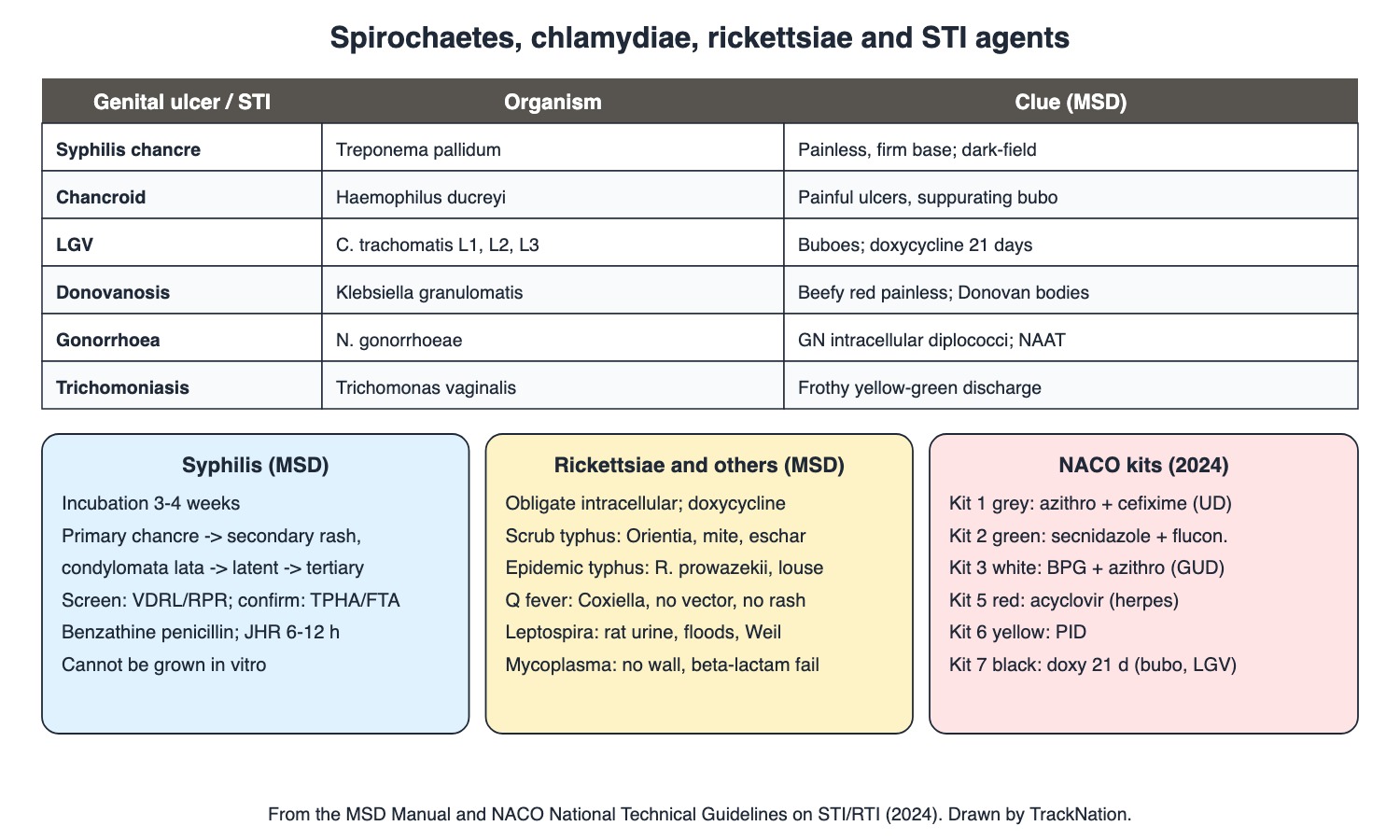
STI agents, syphilis, rickettsiae and NACO kits. Drawn by TrackNation.
Syphilis (MSD)
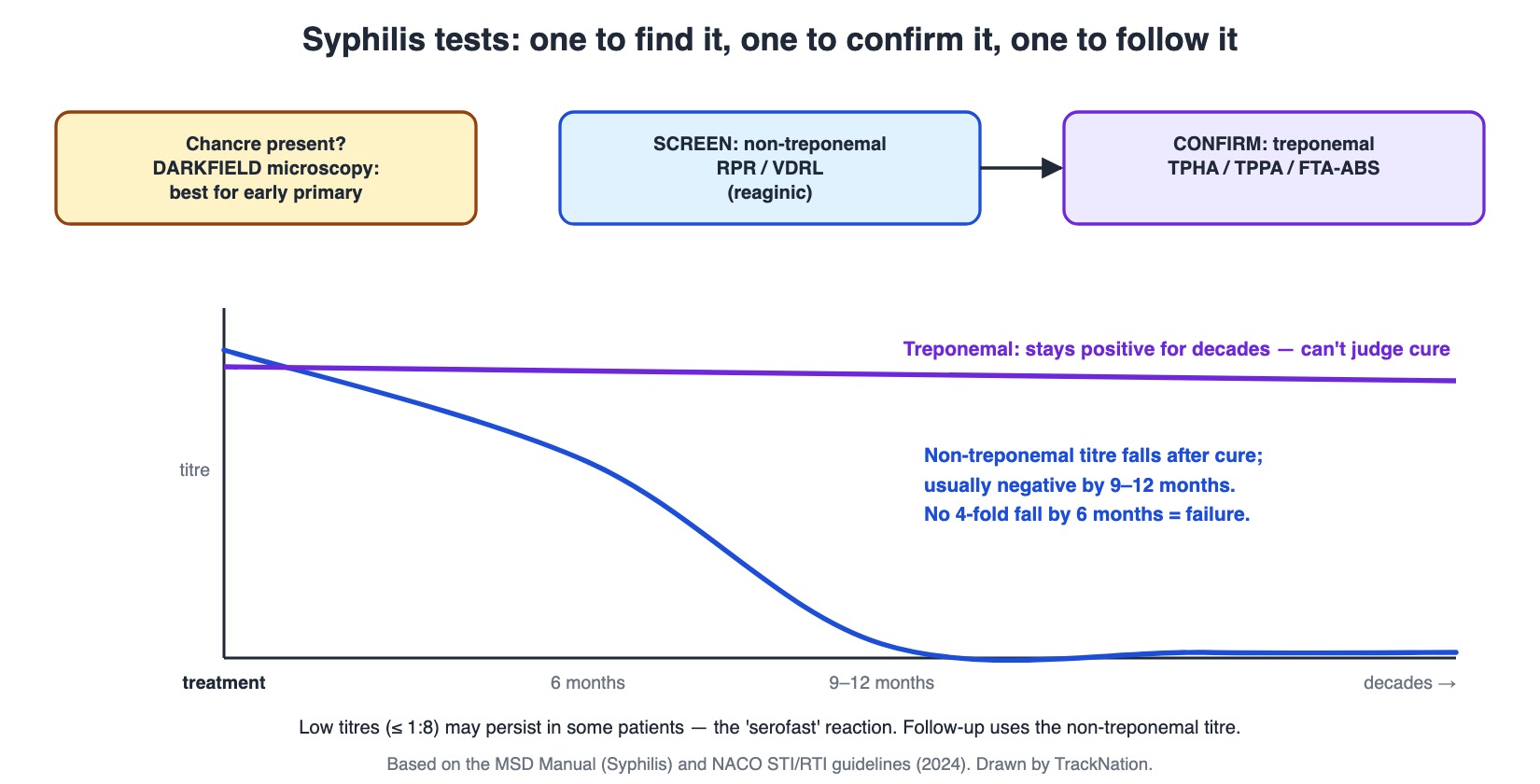
Which syphilis test to screen, confirm and follow treatment. Drawn by TrackNation.
Treponema pallidum: three symptomatic stages separated by latent periods; it cannot be grown in vitro.
Primary: after 3–4 weeks (1–13), a painless chancre with a firm base whose fluid teems with spirochaetes; firm nodes. Secondary: rash and condylomata lata. Tertiary: gummas, cardiovascular (aortic) and neurosyphilis — tabes dorsalis with Argyll Robertson pupils (accommodate, do not react to light).
Tests: dark-field microscopy — most sensitive and specific for early primary syphilis; non-treponemal (reaginic) screening — VDRL, RPR; treponemal confirmation — FTA-ABS, TPHA/MHA-TP (NACO: TPHA, TPPA, TP-ELISA).
Treatment: benzathine penicillin G in all stages and in pregnancy; aqueous penicillin for neurosyphilis and ocular syphilis. Jarisch–Herxheimer reaction within 6–12 hours of starting therapy (fever, rigors), especially in secondary syphilis.
Congenital: early (up to 2 years) vs late (Hutchinson incisors, eye and bone changes); untreated maternal syphilis → >30% stillbirth or neonatal death.
Gonorrhoea, Chlamydia and Other STI Agents (MSD)
N. gonorrhoeae: male urethritis after 2–14 days with purulent discharge; gram-negative intracellular diplococci on urethral smear (Gram stain unreliable for cervix, pharynx, rectum); ~90% of women asymptomatic. NAAT is standard; culture on modified Thayer–Martin in CO2. Disseminated infection → skin lesions, migratory polyarthritis or septic arthritis. Treat with single-dose ceftriaxone plus chlamydia cover; resistance is rising.
Chlamydiae: gram-negative, non-motile, obligate intracellular; infectious elementary body → replicating reticulate body. C. trachomatis — the most commonly reported STI in the US (WHO: 128 million new cases a year worldwide): cervicitis, PID (ectopic risk), Fitz-Hugh–Curtis perihepatitis, urethritis, reactive arthritis; doxycycline or azithromycin. C. pneumoniae — pneumonia; C. psittaci — psittacosis (a zoonosis).
LGV — C. trachomatis L1, L2, L3: inguinal buboes; doxycycline for 21 days. Chancroid — H. ducreyi: painful ulcers with suppurating buboes. Donovanosis — Klebsiella granulomatis: beefy red, painless ulcers, few nodes, Donovan bodies (Giemsa/Leishman stain).
Trichomonas vaginalis (a flagellate): frothy yellow-green fishy discharge; NAAT beats wet mount; metronidazole, tinidazole or secnidazole for patient and partner. Mycoplasma: no cell wall — invisible on Gram stain and resistant to beta-lactams ("atypical" pneumonia; M. genitalium urethritis).
Rickettsiae, Leptospira and Borrelia (MSD)
Rickettsiae: small gram-negative obligate intracellular coccobacilli; most are zoonoses spread by arthropods; they infect endothelium → vasculitis (rash, thrombocytopenia). Doxycycline is first-line.
Scrub typhus — Orientia tsutsugamushi; mites (chiggers) are reservoir and vector; a black-scabbed eschar at the bite, fever, rash, nodes. Weil–Felix OX-K is not recommended (poor sensitivity and specificity) — use serology or PCR. Epidemic typhus — R. prowazekii, humans are the reservoir, spread by body lice; recrudescence = Brill–Zinsser disease. Q fever — Coxiella burnetii from ruminants by aerosol, no vector, no rash; chronic form → endocarditis.
Leptospirosis: animals (rats, dogs, cattle) shed leptospires in urine; outbreaks after heavy rain and flooding. Biphasic illness with conjunctival suffusion; Weil syndrome = jaundice, renal failure, bleeding. Diagnosis by MAT (paired sera) or culture; doxycycline or penicillin.
Lyme disease — Borrelia burgdorferi via Ixodes ticks: erythema migrans, later Bell palsy (can be bilateral), heart block, arthritis. Relapsing fever — Borrelia via lice or ticks: recurrent fevers; spirochaetes seen on peripheral blood smear.
India: NACO Syndromic Management (2024)
Syndromic case management is the universal strategy; district STI clinics are branded Suraksha Clinics.
Colour-coded kits: Kit 1 grey — azithromycin 1 g + cefixime 800 mg (urethral discharge, cervicitis, scrotal swelling); Kit 2 green — secnidazole 2 g + fluconazole 150 mg (vaginitis); Kit 3 white — benzathine penicillin 2.4 MU + azithromycin 1 g (genital ulcer: syphilis, chancroid); Kit 4 blue — doxycycline + azithromycin (penicillin allergy); Kit 5 red — acyclovir (herpetic ulcer); Kit 6 yellow — cefixime + metronidazole + doxycycline (PID); Kit 7 black — doxycycline 21 days (bubo, LGV proctitis); Kit 8 brown — anorectal discharge.
Lab support for ulcers: Tzanck smear (HSV), RPR/VDRL + TPHA/TPPA (syphilis), culture (chancroid), Giemsa/Leishman (donovanosis); test all clients for HIV and syphilis.
Traps the Examiner Sets
Painful ulcers = chancroid; painless = syphilitic chancre and donovanosis.
T. pallidum cannot be cultured — dark-field and serology only.
Weil–Felix is outdated for scrub typhus; Q fever has no rash and no arthropod in human infection.
Mycoplasma pneumonia does not respond to beta-lactams.
NACO Kit 7 (black) = 21 days of doxycycline for bubo/LGV.
Memory Hooks & Shortcuts
Shortcuts to lock in this article's numbers and lists. Each one only re-packages facts proven above.
🧠 'Chancroid makes you Cry (painful); Chancre is Calm (painless)' — ulcers
🧠 'Eat the Elementary, Replicate the Reticulate' — chlamydial bodies — Chlamydia
🧠 'Scrub = Scab': eschar of scrub typhus; 'Lice → Prowazekii' — rickettsiae
🧠 'Q fever = Quiet skin, no Quarrelsome vector' — Q fever
🧠 NACO 'Grey Goes for discharge, White for Wounds (ulcers), Black for Buboes' — NACO kits
Rapid-Revision Cards
Chancre
Painless, firm base; 3–4 weeks.
Syphilis tests
Dark-field; VDRL/RPR screen; TPHA/FTA confirm.
T. pallidum
Cannot be cultured.
JHR
Within 6–12 h of treatment.
Argyll Robertson
Accommodates, no light reflex.
Neurosyphilis
Aqueous penicillin.
Gonorrhoea
GN intracellular diplococci; ceftriaxone.
Women + gonococcus
~90% asymptomatic.
Chlamydia forms
Elementary (infectious) / reticulate.
Fitz-Hugh–Curtis
Perihepatitis after PID.
LGV
L1–L3; doxycycline 21 days.
Chancroid
H. ducreyi; painful ulcer, bubo.
Donovanosis
K. granulomatis; beefy red; Donovan bodies.
Trichomonas
Frothy yellow-green; metronidazole.
Mycoplasma
No wall; beta-lactams fail.
Rickettsiae
Endothelium → vasculitis; doxycycline.
Scrub typhus
Orientia; mite; eschar; no Weil–Felix.
Epidemic typhus
R. prowazekii; body louse.
Q fever
Coxiella; no vector, no rash.
Leptospirosis
Rat urine, floods; Weil; MAT.
NACO kits
1 grey UD; 3 white GUD; 7 black bubo.
Sources
Facts in this article were checked against these documents.
MSD Manual Professional: Syphilis; Gonorrhea; Urogenital Chlamydial Infections; Chlamydiae; Chancroid; LGV; Granuloma Inguinale; Trichomoniasis; Mycoplasmas; Rickettsial Infections; Epidemic Typhus; Q Fever; Scrub Typhus; Leptospirosis; Lyme Disease; Relapsing Fever — Merck & Co. (MSD Manuals), 2024–26 (link)
National Technical Guidelines on STI and RTI — National AIDS Control Organisation, MoHFW, 2024
Competency Based Undergraduate Curriculum, Vol I: Microbiology (MI8.2, MI8.4, MI9.1) — National Medical Commission, 2024
Test Yourself: Practice Questions
Thirty questions in NEET PG style, most of them clinical vignettes.
Practice Questions (NEET PG pattern)
Original questions written in the style of the exam: +4 for a correct answer, −1 for a wrong one. Every answer was checked against the sources listed above. NEET PG papers are not published by NBEMS, so these are not past-paper questions.
Q1. A painless genital ulcer with a firm base appears about 3 weeks after exposure. The organism is
(a) Haemophilus ducreyi
(b) HSV-2
(c) Treponema pallidum
(d) Klebsiella granulomatis
Show answer
Answer: (c) — Chancre.
Q2. The most sensitive and specific test for early primary syphilis is
(a) culture
(b) TPHA
(c) dark-field microscopy of chancre fluid
(d) VDRL
Show answer
Answer: (c) — MSD.
Q3. Treponema pallidum cannot be
(a) treated with penicillin
(b) grown in vitro
(c) seen by dark-field
(d) detected by serology
Show answer
Answer: (b) — MSD.
Q4. VDRL and RPR are
(a) culture methods
(b) treponemal confirmatory tests
(c) non-treponemal (reaginic) screening tests
(d) PCR tests
Show answer
Answer: (c) — TPHA/FTA confirm.
Q5. Fever, rigors and headache within hours of the first penicillin dose for secondary syphilis is
(a) serum sickness
(b) penicillin anaphylaxis
(c) the Jarisch–Herxheimer reaction
(d) neurosyphilis
Show answer
Answer: (c) — 6–12 h.
Q6. Pupils that accommodate but do not react to light are seen in
(a) botulism
(b) tabes dorsalis (neurosyphilis)
(c) LGV
(d) diabetes only
Show answer
Answer: (b) — Argyll Robertson.
Q7. Neurosyphilis is treated with
(a) doxycycline 7 days
(b) benzathine penicillin single dose
(c) azithromycin 1 g
(d) aqueous penicillin
Show answer
Answer: (d) — MSD.
Q8. Hutchinson incisors are a feature of
(a) LGV
(b) late congenital syphilis
(c) leprosy
(d) primary syphilis
Show answer
Answer: (b) — After age 2.
Q9. A man has purulent urethral discharge; Gram stain shows gram-negative intracellular diplococci. Treatment is
(a) acyclovir
(b) single-dose ceftriaxone plus chlamydia cover
(c) penicillin G
(d) metronidazole
Show answer
Answer: (b) — Rising resistance.
Q10. In women, genital gonococcal infection is
(a) never disseminated
(b) always symptomatic
(c) asymptomatic in about 90%
(d) diagnosed reliably by cervical Gram stain
Show answer
Answer: (c) — MSD.
Q11. Disseminated gonococcal infection presents with
(a) skin lesions and migratory polyarthritis or septic arthritis
(b) hepatitis
(c) chancre
(d) pneumonia only
Show answer
Answer: (a) — MSD.
Q12. The infectious form of Chlamydia is the
(a) reticulate body
(b) cyst
(c) elementary body
(d) spore
Show answer
Answer: (c) — Reticulate body replicates.
Q13. A woman with chlamydial PID develops right upper quadrant pain. This is
(a) Fitz-Hugh–Curtis syndrome (perihepatitis)
(b) liver abscess
(c) hepatitis B
(d) cholecystitis due to Salmonella
Show answer
Answer: (a) — MSD.
Q14. Psittacosis is caused by
(a) C. pneumoniae
(b) Mycoplasma pneumoniae
(c) Chlamydia psittaci
(d) Coxiella burnetii
Show answer
Answer: (c) — Zoonosis.
Q15. Lymphogranuloma venereum is caused by C. trachomatis serovars
(a) O1 and O139
(b) L1, L2 and L3
(c) D–K
(d) A–C
Show answer
Answer: (b) — Doxycycline 21 days.
Q16. Multiple painful genital ulcers with suppurating inguinal nodes suggest
(a) chancroid (H. ducreyi)
(b) syphilis
(c) LGV
(d) donovanosis
Show answer
Answer: (a) — MSD.
Q17. Beefy red, painless, slowly spreading genital ulcers with Donovan bodies are due to
(a) HSV
(b) T. pallidum
(c) H. ducreyi
(d) Klebsiella granulomatis
Show answer
Answer: (d) — Granuloma inguinale.
Q18. Frothy yellow-green vaginal discharge with a fishy odour is typical of
(a) Candida
(b) Trichomonas vaginalis
(c) Chlamydia
(d) Neisseria gonorrhoeae
Show answer
Answer: (b) — Treat partner too.
Q19. Mycoplasma infections do not respond to penicillins because mycoplasmas
(a) form spores
(b) are intracellular
(c) make beta-lactamase
(d) lack a cell wall
Show answer
Answer: (d) — Atypical pathogens.
Q20. Rickettsiae cause rash and thrombocytopenia mainly by
(a) infecting endothelial cells and causing vasculitis
(b) producing exotoxin
(c) immune complexes only
(d) invading red cells
Show answer
Answer: (a) — MSD.
Q21. A febrile patient has a black-scabbed eschar, a macular rash and lymphadenopathy. The vector is a
(a) mite (chigger)
(b) tick
(c) louse
(d) flea
Show answer
Answer: (a) — Scrub typhus, Orientia.
Q22. For diagnosing scrub typhus, the Weil–Felix OX-K test is
(a) not recommended because of low sensitivity and specificity
(b) the gold standard
(c) the only test available
(d) used to monitor cure
Show answer
Answer: (a) — Use serology or PCR.
Q23. First-line treatment for rickettsial infections including scrub typhus is
(a) ceftriaxone
(b) vancomycin
(c) doxycycline
(d) penicillin
Show answer
Answer: (c) — MSD.
Q24. Epidemic typhus is caused by R. prowazekii and spread by
(a) body lice
(b) ticks
(c) mosquitoes
(d) mites
Show answer
Answer: (a) — Humans are reservoir.
Q25. A rickettsia-like infection acquired from ruminants by inhalation, with no vector and no rash, is
(a) Lyme disease
(b) scrub typhus
(c) epidemic typhus
(d) Q fever (Coxiella burnetii)
Show answer
Answer: (d) — Chronic → endocarditis.
Q26. After wading through flood water, a man develops fever, myalgia and conjunctival suffusion, then jaundice and renal failure. The diagnosis is
(a) dengue
(b) malaria
(c) hepatitis A
(d) leptospirosis (Weil syndrome)
Show answer
Answer: (d) — Rat urine.
Q27. The serological test used to confirm leptospirosis is the
(a) VDRL
(b) Widal test
(c) Weil–Felix test
(d) microscopic agglutination test (MAT)
Show answer
Answer: (d) — Paired sera.
Q28. Lyme disease is transmitted by
(a) Ixodes ticks
(b) sandflies
(c) Anopheles mosquitoes
(d) body lice
Show answer
Answer: (a) — Erythema migrans.
Q29. Relapsing fever is confirmed by
(a) stool PCR
(b) seeing spirochaetes on a peripheral blood smear
(c) Weil–Felix
(d) urine culture
Show answer
Answer: (b) — Lice or ticks.
Q30. In NACO's syndromic kits (2024), the kit for genital ulcer disease due to syphilis and chancroid (Kit 3, white) contains
(a) doxycycline for 21 days
(b) acyclovir
(c) benzathine penicillin 2.4 MU plus azithromycin 1 g
(d) secnidazole and fluconazole
Show answer
Answer: (c) — Kit 7 black = doxycycline 21 days.
Active Recall
From memory: describe syphilis stages, tests and treatment, compare the genital-ulcer organisms, outline gonorrhoea and chlamydia biology and complications, explain why mycoplasma resists beta-lactams, describe scrub typhus, epidemic typhus, Q fever and leptospirosis, give the vectors of Lyme and relapsing fever, and list the main NACO kits.