Acne and Rosacea for NEET PG Dermatology: Comedones, ICMR Treatment Ladder, Isotretinoin, Steroid-Induced Acne, Rosacea
Start Here
🎯 Exam priority: High. Expect: the four steps of acne pathogenesis, comedones vs rosacea, acne variants, the ICMR treatment ladder, isotretinoin monitoring and contraception, acne fulminans, hormonal acne and PCOS, steroid-induced acne and rosacea, rosacea triggers and drugs.
CBME mapping: DR 1.1–1.2. Retinoid pharmacology is in Pharmacology; PCOS in OBG.
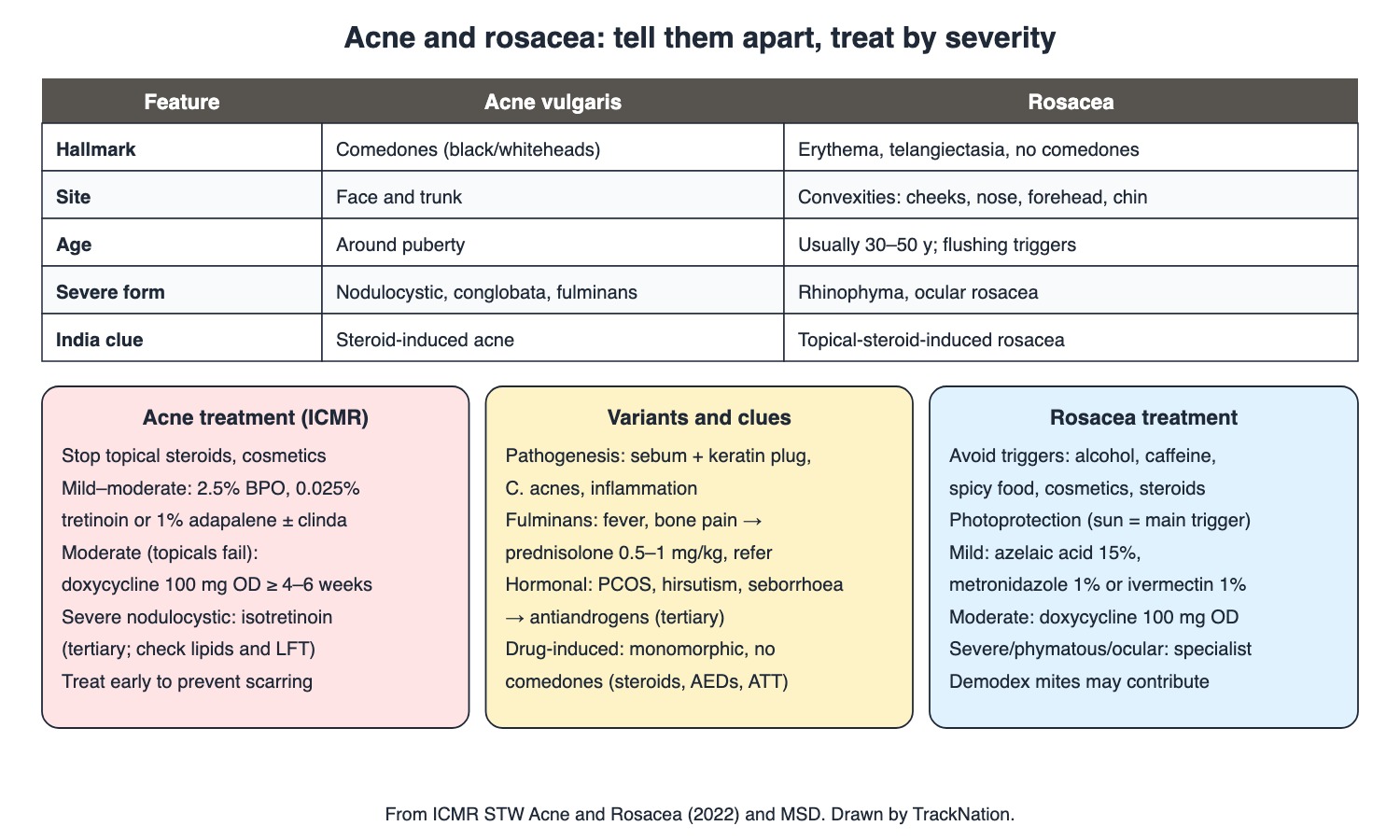
Acne versus rosacea, ICMR treatment, variants. Drawn by TrackNation.
Acne Vulgaris
Disease of the pilosebaceous unit on the face and upper trunk: follicular plugging with sebum and keratinocytes, colonisation by Cutibacterium acnes, and inflammation. Lesions: comedones (open = blackheads, closed = whiteheads), papules, pustules, nodules, cysts, scars.
Usually starts around puberty; onset before 8 years needs hormonal evaluation. Ask about cosmetics, fairness creams and topical steroids, recent drugs, and menstrual irregularity with hirsutism and weight gain (PCOS).
ICMR treatment: stop unsupervised topical steroids and cosmetics on the face; mild–moderate — 2.5% benzoyl peroxide gel, 0.025% tretinoin cream or 1% adapalene gel ± clindamycin gel at night; moderate not controlled with topicals — doxycycline 100 mg once daily for at least 4–6 weeks; severe nodulocystic — isotretinoin at tertiary level after normal lipids and liver tests. Benzoyl peroxide helps prevent bacterial resistance. Treat early to prevent scarring.
Isotretinoin is teratogenic: two methods of contraception from 1 month before to at least 1 month after treatment. Cystic lesions may get intralesional triamcinolone; oral antibiotics take ≥ 12 weeks for full benefit; spironolactone helps some women.
Acne variant (ICMR) | Clue |
Acne conglobata | Severe nodular acne with scarring on trunk and face (men > women — MSD) |
Acne fulminans | Fever and bone pain with severe necrotic acne → prednisolone 0.5–1 mg/kg/day, refer |
Hormonal acne | Adult woman, seborrhoea, hirsutism, PCOS, premenstrual flare → antiandrogens |
Drug-induced | Monomorphic papules and pustules, no comedones (steroids, antiepileptics, ATT, supplements) |
Topical-steroid-induced | Hypertrichosis, shiny thin skin, pigmentary change with papulopustules |
Occupational | Mainly comedones after cutting oil or petroleum exposure |
Hidradenitis suppurativa | Axillae, groins, flexures: nodules, abscesses, scarring |
Rosacea
Chronic facial flushing, persistent erythema, telangiectasia, papules and pustules without comedones on the convexities (cheeks, nose, forehead, chin); severe — rhinophyma; dry gritty eyes → ocular rosacea (eye referral). Usually age 30–50 with fair skin.
Triggers: sunlight (commonest), alcohol, caffeine, spicy food, emotions, cosmetics, topical steroids. In India, consider topical-steroid-induced rosacea. Demodex mites may contribute.
ICMR treatment: avoid triggers, photoprotection; mild papulopustular — topical azelaic acid 15%, metronidazole 1% or ivermectin 1%; moderate — doxycycline 100 mg daily for 4–6 weeks; severe, phymatous or ocular — specialist referral (isotretinoin or interventional treatment).
Traps the Examiner Sets
Comedones mean acne; their absence favours rosacea or drug-induced acne.
Acne fulminans: fever and bone pain → steroids.
Isotretinoin: check lipids and LFT; strict contraception.
Indian patient using a steroid 'fairness' cream → steroid-induced acne or rosacea.
Memory Hooks & Shortcuts
Shortcuts to lock in this article's numbers and lists. Each one only re-packages facts proven above.
🧠 Acne 'SPIC': Sebum, Plugging, Inflammation, C. acnes — pathogenesis
🧠 'Comedones = acne; no comedones = rosacea or drugs' — distinction
🧠 Isotretinoin: '2 pills, 2 months either side' (contraception) — isotretinoin
🧠 Fulminans: 'Fever + Fractures-feel (bone pain) = Feed steroids' — acne fulminans
🧠 Rosacea 'Red, Rash, Rhinophyma, no Rods (comedones)' — rosacea
Rapid-Revision Cards
Acne site
Pilosebaceous unit, face and trunk.
Pathogenesis
Plugging, C. acnes, inflammation.
Comedones
Open blackheads, closed whiteheads.
Mild–moderate (ICMR)
BPO 2.5%, tretinoin 0.025%, adapalene 1% ± clinda.
Moderate
Doxycycline 100 mg OD ≥ 4–6 wk.
Severe nodulocystic
Isotretinoin (lipids, LFT).
Isotretinoin
Teratogenic: 2 contraceptives ±1 month.
Fulminans
Fever, bone pain → prednisolone.
Conglobata
Most severe; men.
Hormonal acne
PCOS, hirsutism → antiandrogens.
Drug-induced
Monomorphic, no comedones.
Steroid-induced acne
Thin shiny skin, hypertrichosis.
Occupational
Comedones; cutting oils.
Early onset < 8 y
Hormonal work-up.
Rosacea
Flushing, erythema, telangiectasia, no comedones.
Rosacea age
30–50, fair skin.
Rosacea trigger
Sunlight (also alcohol, spice).
Rhinophyma
Bulbous nose.
Ocular rosacea
Gritty eyes → eye referral.
Rosacea topicals
Azelaic 15%, metronidazole 1%, ivermectin 1%.
Rosacea oral
Doxycycline 100 mg OD.
Sources
Facts in this article were checked against these documents.
Standard Treatment Workflows: Acne and Rosacea; Rational Use of Topical Medications — Indian Council of Medical Research, DHR, 2022 (link)
MSD Manual Professional: Acne Vulgaris; Rosacea — Merck & Co. (MSD Manuals), reviewed 2025–26 (link)
Competency Based Undergraduate Curriculum, Dermatology (DR 1) — National Medical Commission, 2024
Test Yourself: Practice Questions
Thirty questions in NEET PG style, most of them clinical vignettes.
Practice Questions (NEET PG pattern)
Original questions written in the style of the exam: +4 for a correct answer, −1 for a wrong one. Every answer was checked against the sources listed above. NEET PG papers are not published by NBEMS, so these are not past-paper questions.
Q1. Acne vulgaris is a disorder of the
(a) dermal blood vessels
(b) eccrine sweat gland
(c) apocrine gland only
(d) pilosebaceous unit
Show answer
Answer: (d) — Hair follicle with its sebaceous gland.
Q2. The organism implicated in acne pathogenesis is
(a) Staphylococcus aureus
(b) Cutibacterium acnes
(c) Streptococcus pyogenes
(d) Malassezia furfur
Show answer
Answer: (b) — Formerly Propionibacterium acnes.
Q3. The lesion that distinguishes acne from rosacea is the
(a) papule
(b) comedone
(c) pustule
(d) erythema
Show answer
Answer: (b) — Rosacea has no comedones.
Q4. A 16-year-old has blackheads, whiteheads and a few papules on the face. ICMR first-line treatment is
(a) oral isotretinoin
(b) topical steroid
(c) topical 2.5% benzoyl peroxide, 0.025% tretinoin or 1% adapalene (± clindamycin) at night
(d) oral prednisolone
Show answer
Answer: (c) — Mild–moderate acne.
Q5. Moderate acne not controlled with topical therapy is treated (ICMR) with
(a) doxycycline 100 mg once daily for at least 4–6 weeks
(b) isotretinoin immediately
(c) topical steroids
(d) oral steroids
Show answer
Answer: (a) — Add to topicals.
Q6. Severe nodulocystic acne is treated at tertiary level with isotretinoin after documenting
(a) normal lipid profile and liver function
(b) normal thyroid function
(c) normal ECG
(d) HIV status
Show answer
Answer: (a) — Monitor during treatment.
Q7. A woman starting isotretinoin must use
(a) no contraception
(b) two methods of contraception from 1 month before to at least 1 month after treatment
(c) contraception only for 1 week
(d) one method only during treatment
Show answer
Answer: (b) — Isotretinoin is teratogenic.
Q8. A teenager with severe necrotic acne develops fever and bone pains. The diagnosis and initial step are
(a) acne vulgaris — benzoyl peroxide
(b) acne excoriée — counselling
(c) rosacea — metronidazole
(d) acne fulminans — prednisolone 0.5–1 mg/kg/day and refer
Show answer
Answer: (d) — A severe variant.
Q9. The most severe form of acne vulgaris, with abscesses, sinuses and scarring on the trunk and face, is
(a) drug-induced acne
(b) occupational acne
(c) acne excoriée
(d) acne conglobata
Show answer
Answer: (d) — More common in men.
Q10. An adult woman has acne along the jaw with irregular periods, hirsutism and weight gain. The likely underlying cause is
(a) polycystic ovary syndrome (hormonal acne)
(b) occupational acne
(c) rosacea
(d) drug-induced acne
Show answer
Answer: (a) — Antiandrogens at tertiary level.
Q11. A patient on antitubercular drugs develops sudden widespread monomorphic papules and pustules without comedones. The likely diagnosis is
(a) rosacea
(b) acne conglobata
(c) drug-induced acne
(d) acne vulgaris
Show answer
Answer: (c) — Also steroids, antiepileptics, supplements.
Q12. A woman who has used a steroid-containing fairness cream on her face for months has papulopustules with thin shiny skin and excess hair. This is
(a) topical-corticosteroid-induced acne
(b) acne vulgaris
(c) seborrhoeic dermatitis
(d) lupus
Show answer
Answer: (a) — Stop the steroid.
Q13. A machinist exposed to cutting oils develops mainly comedones on exposed skin. This is
(a) hidradenitis
(b) rosacea
(c) occupational acne
(d) acne fulminans
Show answer
Answer: (c) — Petroleum products.
Q14. Acne starting before 8 years of age requires
(a) isotretinoin
(b) skin biopsy
(c) no action
(d) hormonal evaluation
Show answer
Answer: (d) — Early onset is abnormal.
Q15. Painful nodules, abscesses and scarring in the axillae and groins suggest
(a) scabies
(b) hidradenitis suppurativa
(c) acne vulgaris
(d) rosacea
Show answer
Answer: (b) — Flexural disease.
Q16. A benefit of including benzoyl peroxide in acne regimens is that it
(a) is an oral antiandrogen
(b) treats rosacea flushing
(c) is a retinoid
(d) helps prevent bacterial resistance
Show answer
Answer: (d) — Combine with topical or oral antibiotics.
Q17. A single inflamed acne cyst can be treated with
(a) oral prednisolone
(b) cryotherapy only
(c) intralesional triamcinolone
(d) topical steroid
Show answer
Answer: (c) — Per MSD.
Q18. Why does ICMR stress early treatment of acne?
(a) to prevent scarring
(b) to prevent PCOS
(c) to prevent hirsutism
(d) to prevent rosacea
Show answer
Answer: (a) — Treat acne early to prevent scarring.
Q19. A 40-year-old fair-skinned woman has facial flushing, persistent erythema and telangiectasia with papules on the cheeks and nose, no comedones. The diagnosis is
(a) rosacea
(b) seborrhoeic dermatitis
(c) lupus
(d) acne vulgaris
Show answer
Answer: (a) — Peak age 30–50.
Q20. Bulbous enlargement of the nose in long-standing rosacea is
(a) rhinophyma
(b) rhinoscleroma
(c) lupus pernio
(d) saddle nose
Show answer
Answer: (a) — Phymatous change.
Q21. The most common trigger of rosacea is
(a) cold weather only
(b) chocolate
(c) sunlight exposure
(d) milk
Show answer
Answer: (c) — Also alcohol, spicy food, heat.
Q22. A rosacea patient complains of dry, gritty eyes. ICMR advises
(a) topical steroid eye drops
(b) isotretinoin at once
(c) ignore it
(d) ophthalmological evaluation for ocular rosacea
Show answer
Answer: (d) — Ocular rosacea needs specialist care.
Q23. ICMR topical options for mild papulopustular rosacea include
(a) azelaic acid 15%, metronidazole 1% or ivermectin 1%
(b) potent topical steroids
(c) tretinoin 0.1%
(d) benzoyl peroxide 10%
Show answer
Answer: (a) — Plus trigger avoidance and sun protection.
Q24. Rosacea not controlled with topicals is treated (ICMR) with
(a) oral steroids
(b) potent topical steroids
(c) antihistamines only
(d) doxycycline 100 mg daily for 4–6 weeks
Show answer
Answer: (d) — Severe/phymatous: specialist.
Q25. In India, a patient with facial erythema, photosensitivity, atrophy and hypertrichosis after long-term steroid cream use most likely has
(a) vitiligo
(b) topical-steroid-induced rosacea
(c) acne vulgaris
(d) psoriasis
Show answer
Answer: (b) — ICMR highlights this.
Q26. Rosacea patients are advised to avoid
(a) alcohol, caffeine, spicy food, cosmetics and topical steroids
(b) water
(c) all fruits
(d) exercise always
Show answer
Answer: (a) — And to use photoprotection.
Q27. A mite implicated in rosacea is
(a) Dermatophagoides
(b) Pediculus capitis
(c) Demodex folliculorum
(d) Sarcoptes scabiei
Show answer
Answer: (c) — Increased follicle mites.
Q28. An antiandrogen often useful for acne in women is
(a) doxycycline
(b) isotretinoin
(c) finasteride in pregnancy
(d) spironolactone
Show answer
Answer: (d) — Also combined oral contraceptives.
Q29. Full benefit of oral antibiotics for acne takes at least
(a) 12 weeks
(b) 3 days
(c) 1 week
(d) 1 year
Show answer
Answer: (a) — Limit systemic antibiotic use.
Q30. The first step in a patient with acne who uses cosmetics and topical steroids on the face is to
(a) start antihistamines
(b) add a stronger steroid
(c) stop the unsupervised steroid and cosmetic use
(d) start isotretinoin
Show answer
Answer: (c) — Then treat by severity.
Active Recall
From memory: explain acne pathogenesis and lesions, list the acne variants with clues, give the ICMR acne ladder with isotretinoin precautions, describe rosacea, its triggers and its treatment, and how to tell acne from rosacea.