Scabies and Pediculosis for NEET PG Dermatology: Burrows, Crusted Scabies, Permethrin and Ivermectin Regimens, Head, Body and Pubic Lice
Start Here
🎯 Exam priority: High. Expect: night itch with affected family, typical sites, the burrow, incubation 3–6 weeks vs 2–3 days on reinfestation, nodular and crusted scabies, how to apply permethrin 5% and when to repeat, ivermectin dose and who cannot take it, treating contacts and fomites, post-scabetic itch, and the three lice with their clues and treatment.
CBME mapping: DR 5.1, DR 6.1. Louse-borne typhus and relapsing fever are also in Microbiology and Medicine.
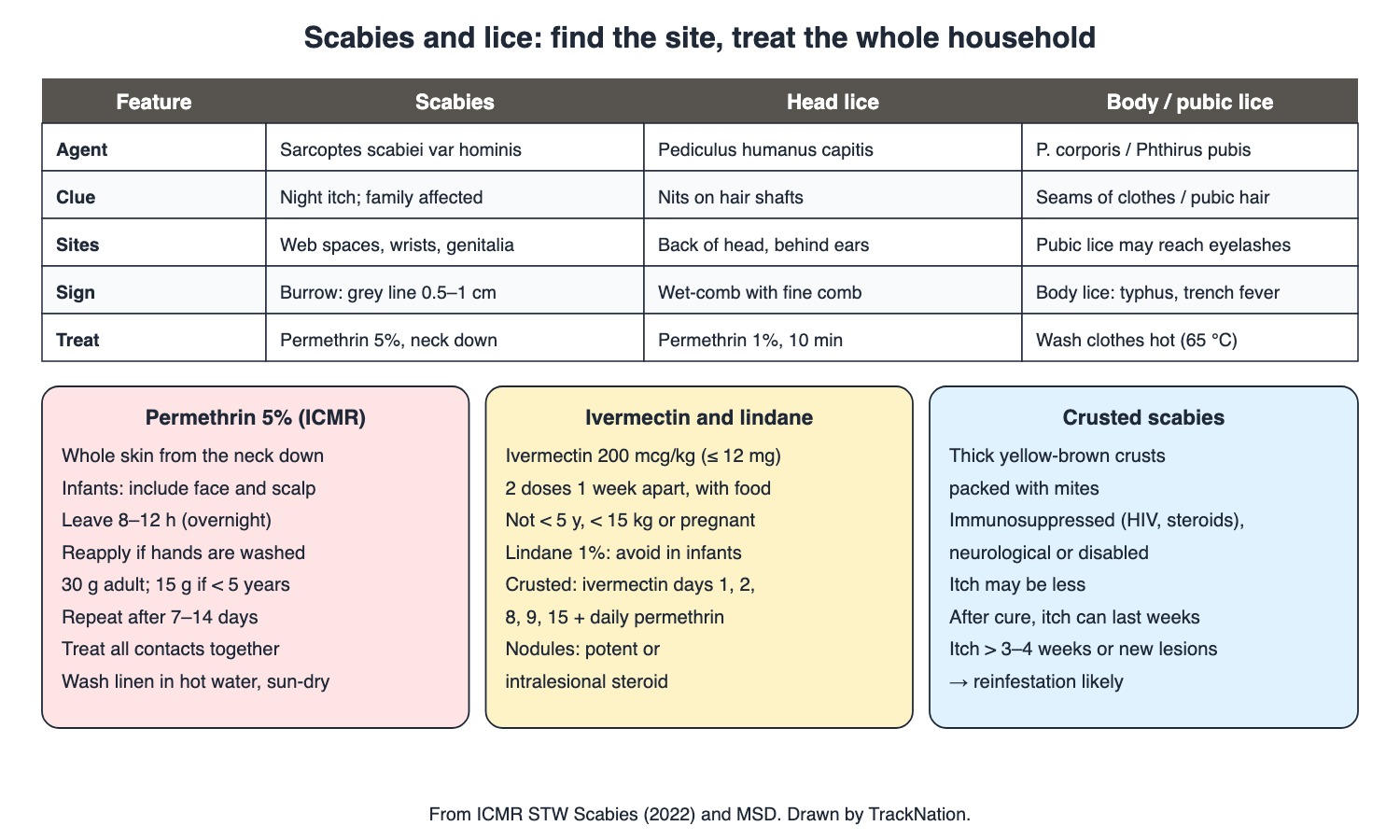
Scabies, head lice and body or pubic lice compared; permethrin and ivermectin regimens; crusted scabies. Drawn by TrackNation.
Scabies
Mite Sarcoptes scabiei var hominis; spread by skin-to-skin and sexual contact and by fomites (towels, clothes, bedding); clusters in schools and orphanages. Symptoms begin 3–6 weeks after first infestation but within 2–3 days of reinfestation.
Intense itch worse at night, often with other family members affected. Itchy papules and excoriations in finger webs, wrists, periumbilical area, breasts, buttocks, axillary folds, waist, genitalia and extensor limbs. Face, palms and soles are spared in adults but involved in young children. The burrow — a thin brown-grey line of 0.5–1 cm in web spaces and wrists — is the most characteristic lesion but is often not seen.
Nodular scabies: very itchy persistent nodules, typically on male genitalia; commoner in infants and young children. Secondary bacterial infection (weeping yellow crusts) needs anti-staphylococcal/streptococcal antibiotics.
Crusted (Norwegian) scabies: thick yellow-brown crusts packed with mites (they can number in the millions), often less itchy; in immunosuppression (HIV, steroids including topical), neurological disease or disability.
Diagnosis is clinical; mites, eggs or faeces (scybala) can be shown from burrows, by dermoscopy, or easily from crusts.
Treatment (ICMR)
Treat the entire skin, not lesions alone; treat the family and contacts, not the patient alone — all close contacts at the same time. Wash clothes, towels and linen used in the previous 3 days in hot water and dry in the sun, or seal non-washables in a plastic bag for at least 3 days.
Permethrin 5%: on dry, clean skin from the neck down (web spaces, axillae, under nails, wrists, genitalia, buttocks), late evening, wash off after 8–12 hours; reapply if hands are washed; repeat after 7–14 days.
Nodules: potent topical steroid (clobetasol) or intralesional triamcinolone 10 mg/mL. Antihistamines for itch.
After treatment: itch can continue for several weeks — do not repeat applications. Itch beyond 3–4 weeks or new lesions mean reinfestation, usually because contacts were not treated together.
Drug (ICMR / MSD) | How | Watch-outs |
Permethrin 5% cream | Whole skin neck down (face and scalp too in infants), 8–12 h, repeat in 7–14 days; 30 g adult, 15 g under 5 | First line; safe in infants and pregnancy |
Lindane 1% (GBHC) | Applied as for permethrin | Avoid in infants |
Ivermectin oral | 200 mcg/kg (max 12 mg), 2 doses 1 week apart, with food | Not under 5 y, under 15 kg or in pregnancy |
Crusted scabies | Ivermectin days 1, 2, 8, 9, 15 (± 22, 29) + permethrin daily × 7 days, then twice weekly; salicylic acid 3–6% for crusts | Crusts are packed with mites |
Sulphur 6–10% in petrolatum | Alternative (MSD) | Infants under 2 months, pregnancy |
Pediculosis (Lice)
Wingless blood-sucking insects: head (Pediculus humanus capitis), body (P. h. corporis), pubic (Phthirus pubis).
Head lice: close contact in homes and classrooms. Wet-comb with a fine-tooth comb; lice sit at the back of the head and behind the ears. Nits are greyish-white eggs fixed to hair shafts and outnumber lice; live nits fluoresce under Wood lamp; dead nits do not mean active infestation. Treat with permethrin 1% (10 minutes, repeat in 7 days if live nits), malathion (effective but flammable, not first line); oral ivermectin for refractory cases.
Body lice live in clothing — look at the seams; wash clothes and linen and dry at 65 °C. They transmit epidemic typhus, trench fever and relapsing fever (Borrelia recurrentis).
Pubic lice (crabs) are sexually transmitted; they may spread to the beard, moustache and eyelashes (itchy, burning eyes) — treated with petrolatum, physostigmine ointment, oral ivermectin or forceps removal.
Traps the Examiner Sets
Scabies in an adult spares the face; in an infant treat the face and scalp too.
Itch after a correct course is expected for weeks; do not keep reapplying.
Ivermectin: not under 5 years, under 15 kg or in pregnancy — use permethrin.
Pubic lice are sexually transmitted in adults; a child may acquire them through close parental contact (MSD).
Memory Hooks & Shortcuts
Shortcuts to lock in this article's numbers and lists. Each one only re-packages facts proven above.
🧠 Scabies 'Night itch, whole family, finger webs' — diagnosis
🧠 Permethrin '5 for scabies, 1 for lice' — concentrations
🧠 'Neck down, night long, again in a week' — permethrin technique
🧠 Ivermectin 'Not for the Five, the Fifteen or the Foetus' (< 5 y, < 15 kg, pregnancy) — ivermectin
🧠 Body lice 'TTR': Typhus, Trench fever, Relapsing fever — vectors
Rapid-Revision Cards
Scabies mite
Sarcoptes scabiei var hominis.
Classic history
Night itch; family affected.
Incubation
3–6 wk; reinfestation 2–3 days.
Sites
Web spaces, wrists, umbilicus, genitals.
Spared in adults
Face, palms, soles.
Burrow
Brown-grey line 0.5–1 cm.
Nodular
Male genitalia; steroid.
Crusted
Immunosuppressed; mite-packed crusts.
Permethrin 5%
Neck down, 8–12 h, repeat 7–14 d.
Infants
Face and scalp too.
Amount
30 g adult; 15 g < 5 y.
Ivermectin
200 mcg/kg ×2, 1 week apart.
No ivermectin
< 5 y, < 15 kg, pregnancy.
Lindane
Avoid in infants.
Contacts
Treat all together.
Post-scabetic itch
Weeks; no repeat.
Head lice
Wet comb; permethrin 1%.
Nits
Eggs on hair shafts.
Body lice
Clothing seams; wash at 65 °C.
Body lice diseases
Typhus, trench fever, relapsing fever.
Pubic lice
STI; eyelashes.
Sources
Facts in this article were checked against these documents.
Test Yourself: Practice Questions
Thirty questions in NEET PG style, most of them clinical vignettes.
Practice Questions (NEET PG pattern)
Original questions written in the style of the exam: +4 for a correct answer, −1 for a wrong one. Every answer was checked against the sources listed above. NEET PG papers are not published by NBEMS, so these are not past-paper questions.
Q1. A child has intense itching that is worse at night; the mother and a sibling have similar itching. Papules are seen in the finger webs and around the wrists. The diagnosis is
(a) scabies
(b) atopic dermatitis
(c) pediculosis capitis
(d) urticaria
Show answer
Answer: (a) — Night itch with affected family.
Q2. The causative organism of scabies is
(a) Sarcoptes scabiei var hominis
(b) Pediculus humanus
(c) Trichophyton rubrum
(d) Demodex folliculorum
Show answer
Answer: (a) — A mite.
Q3. After a first infestation, scabies symptoms usually begin after
(a) 1 day
(b) 6 months
(c) 1 hour
(d) 3–6 weeks
Show answer
Answer: (d) — Only 2–3 days on reinfestation.
Q4. The most characteristic lesion of scabies is the
(a) burrow
(b) herald patch
(c) wheal
(d) target lesion
Show answer
Answer: (a) — Thin brown-grey line 0.5–1 cm in web spaces and wrists.
Q5. In an adult with scabies, which areas are usually spared?
(a) finger webs
(b) genitalia
(c) face, palms and soles
(d) wrists
Show answer
Answer: (c) — Involved in young children.
Q6. After scabies treatment, a boy still has extremely itchy persistent nodules on the penis and scrotum. These are treated with
(a) oral antibiotics only
(b) repeat permethrin daily for a month
(c) lindane
(d) potent topical or intralesional steroid
Show answer
Answer: (d) — Nodular scabies.
Q7. A patient with HIV has thick yellow-brown crusts on the hands and feet, with little itch; scrapings show numerous mites. The diagnosis is
(a) eczema
(b) psoriasis
(c) crusted (Norwegian) scabies
(d) tinea manuum
Show answer
Answer: (c) — Mites proliferate in large numbers.
Q8. Permethrin 5% for scabies in an adult should be applied
(a) to the whole skin from the neck down and washed off after 8–12 hours
(b) only to itchy lesions for 10 minutes
(c) to the face only
(d) twice daily for a month
Show answer
Answer: (a) — Late evening, overnight.
Q9. In an infant with scabies, permethrin must additionally be applied to the
(a) mouth
(b) eyes
(c) face and scalp
(d) palms only
Show answer
Answer: (c) — Avoid periorbital and perioral areas (MSD).
Q10. A permethrin application for scabies is repeated after
(a) 7–14 days
(b) never
(c) 1 day
(d) 1 month
Show answer
Answer: (a) — Two applications.
Q11. A patient washes their hands 2 hours after applying permethrin. ICMR advises
(a) no action
(b) apply lindane
(c) reapply to the hands to keep 8 hours of contact
(d) start ivermectin
Show answer
Answer: (c) — Contact time matters.
Q12. How much permethrin 5% cream is used for one application in an adult?
(a) about 30 g
(b) about 1 g
(c) about 100 g
(d) about 5 g
Show answer
Answer: (a) — 15 g under 5 years.
Q13. The oral ivermectin dose for scabies (ICMR) is
(a) 6 mg daily for a month
(b) 200 mcg/kg (up to 12 mg), two doses 1 week apart
(c) 50 mcg/kg once
(d) 2 mg/kg once
Show answer
Answer: (b) — Taken with food.
Q14. A pregnant woman has scabies. Which drug should be avoided?
(a) antihistamines
(b) oral ivermectin
(c) permethrin 5%
(d) emollients
Show answer
Answer: (b) — Also avoided under 5 y or 15 kg.
Q15. Lindane (gamma benzene hexachloride) for scabies should be avoided in
(a) infants
(b) the elderly
(c) men
(d) adults
Show answer
Answer: (a) — Per ICMR.
Q16. The ICMR ivermectin schedule for crusted scabies is
(a) weekly for 2 weeks only
(b) days 1, 2, 8, 9 and 15 with daily permethrin for 7 days
(c) monthly for a year
(d) a single dose
Show answer
Answer: (b) — Extra doses on days 22 and 29 if severe.
Q17. Bedding and clothes used by a scabies patient in the previous three days should be
(a) sprayed with steroid
(b) burned
(c) ignored
(d) washed in hot water and sun-dried, or sealed in a bag for 3 days
Show answer
Answer: (d) — Fomites.
Q18. The most important step to prevent scabies recurrence in a family is to
(a) give antibiotics
(b) treat only the patient twice
(c) treat all close contacts at the same time
(d) use topical steroids
Show answer
Answer: (c) — Treat the family, not the patient alone.
Q19. Two weeks after a correct two-dose permethrin course, a patient still itches but has no new lesions. The correct advice is
(a) itch can persist for weeks; continue antihistamines, do not repeat applications
(b) start oral steroids
(c) switch to lindane
(d) repeat permethrin daily
Show answer
Answer: (a) — Post-scabetic itch.
Q20. Itch persisting beyond 3–4 weeks with new lesions after treatment most likely means
(a) drug allergy
(b) reinfestation, often from untreated contacts
(c) psychogenic itch
(d) permethrin resistance always
Show answer
Answer: (b) — Treat contacts together.
Q21. An alternative scabicide for infants under 2 months or pregnant women is
(a) precipitated sulphur 6–10% in petrolatum
(b) lindane
(c) malathion
(d) oral ivermectin
Show answer
Answer: (a) — Per MSD.
Q22. The organism of head lice is
(a) Pediculus humanus capitis
(b) Cimex lectularius
(c) Sarcoptes scabiei
(d) Phthirus pubis
Show answer
Answer: (a) — Body louse is P. h. corporis.
Q23. Head lice are best detected by
(a) skin biopsy
(b) wet combing with a fine-tooth comb, looking behind the ears and at the back of the head
(c) KOH mount
(d) patch test
Show answer
Answer: (b) — Nits outnumber lice.
Q24. Nits are
(a) adult lice
(b) fungal spores
(c) greyish-white eggs fixed to the hair shafts
(d) mite faeces
Show answer
Answer: (c) — Live nits fluoresce under Wood lamp.
Q25. A first-line topical treatment for head lice is
(a) permethrin 5% overnight on the body
(b) lindane in infants
(c) permethrin 1% for 10 minutes, repeated in 7 days if live nits
(d) oral ivermectin first
Show answer
Answer: (c) — Malathion is not first line.
Q26. Malathion is not first-line for head lice because
(a) it causes alopecia
(b) it is teratogenic
(c) it is ineffective
(d) it is flammable and has an unpleasant odour
Show answer
Answer: (d) — Highly effective otherwise.
Q27. Body lice are diagnosed by finding lice and nits
(a) in the eyelashes
(b) on the scalp
(c) in the seams of clothing
(d) in finger webs
Show answer
Answer: (c) — Body lice live in clothes.
Q28. A person infested with body lice develops fever. Body lice transmit
(a) Lyme disease
(b) malaria
(c) scrub typhus
(d) epidemic typhus, trench fever and relapsing fever
Show answer
Answer: (d) — Relapsing fever = Borrelia recurrentis.
Q29. Body lice are treated mainly by
(a) shaving all hair
(b) oral ivermectin only
(c) permethrin 5% overnight
(d) washing clothes and linen and drying them at 65 °C
Show answer
Answer: (d) — Topical treatment usually not needed.
Q30. An adult with pubic lice also complains of itchy, burning eyelids; lice are seen on the eyelashes. The organism and an accepted eyelash treatment are
(a) Phthirus pubis — petrolatum or physical removal with forceps
(b) Demodex — tea tree oil
(c) Sarcoptes — ivermectin cream
(d) Pediculus capitis — permethrin 5% on lids
Show answer
Answer: (a) — Pubic lice spread to eyelashes.
Active Recall
From memory: describe the history, sites and signs of scabies and its variants, give the ICMR permethrin and ivermectin regimens with contact care and post-treatment advice, and compare head, body and pubic lice.