Eczema, Erythroderma and Drug Reactions for NEET PG Dermatology: Atopic and Contact Dermatitis, FDE, DRESS, SJS/TEN, SCORTEN
Start Here
🎯 Exam priority: High. Expect: atopic dermatitis distribution by age and its stigmata, filaggrin, eczema herpeticum, patch testing, nickel and parthenium, seborrhoeic dermatitis with HIV and Parkinson, the ICMR eczema ladder, erythroderma causes, and drug reactions — FDE, DRESS, SJS/TEN cut-offs, culprit drugs, SCORTEN, HLA-B*15:02.
CBME mapping: DR 12.1–12.5. Drug allergy mechanisms are also in Pharmacology.
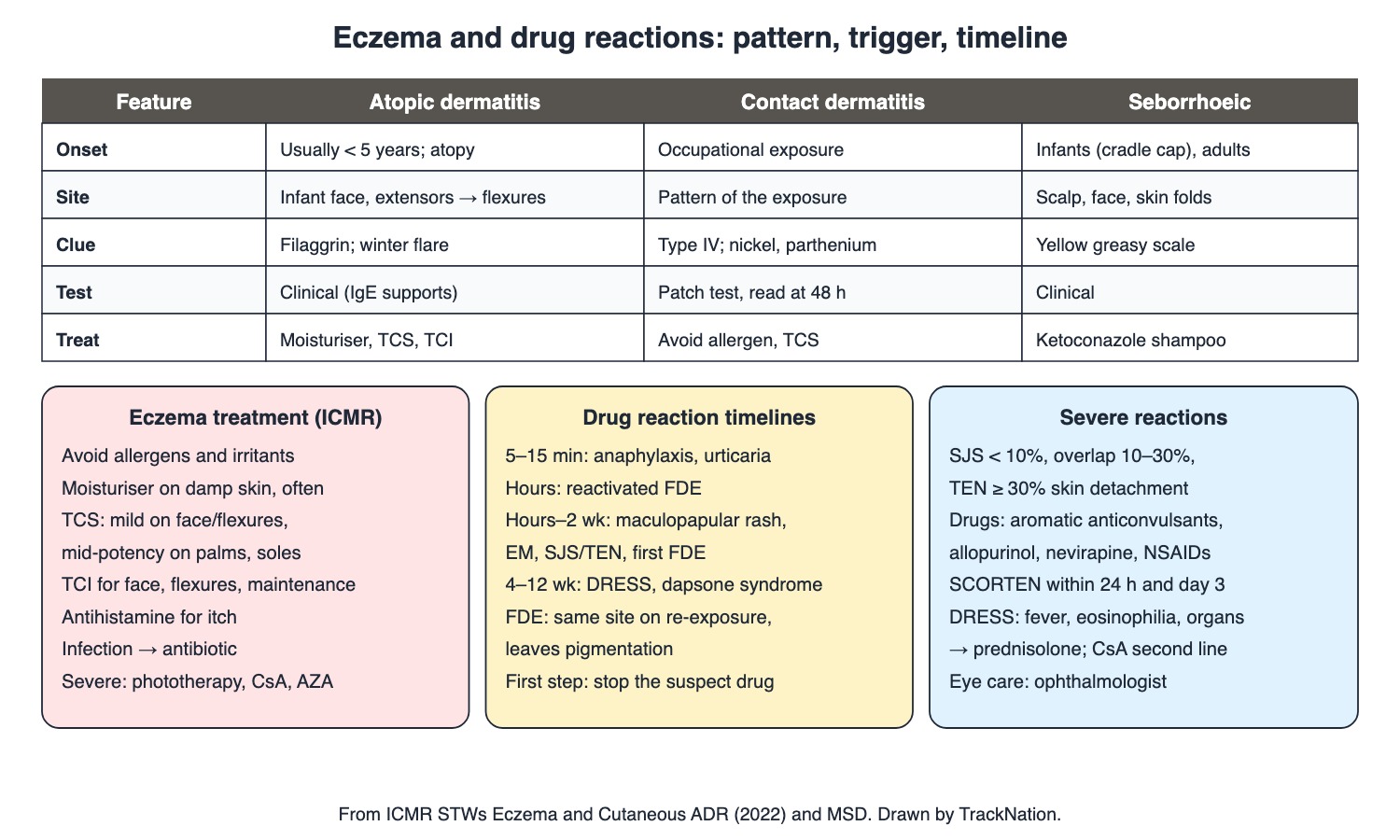
Atopic, contact and seborrhoeic dermatitis compared; eczema treatment; drug reaction timelines; SJS, TEN, DRESS. Drawn by TrackNation.
Eczema (Dermatitis)
Stages (ICMR): acute — red oedematous plaques with grouped vesicles; subacute — scaling, crusting; chronic — scaling and lichenification. Exogenous eczemas (contact, photoallergic, infective) have a trigger to remove; endogenous ones (atopic, seborrhoeic, nummular, venous, asteatotic) need drugs.
Atopic dermatitis: onset usually before 5 years with personal or family atopy; winter flare. Infants — face, scalp and extensors; older children and adults — flexures (antecubital, popliteal). Barrier defect from filaggrin loss → Th2 inflammation, IgE and the "atopic march". Stigmata: Dennie–Morgan fold, Hertoghe sign, white dermographism, palmar hyperlinearity, keratosis pilaris. S. aureus superinfection is common; eczema herpeticum (HSV) needs systemic antivirals. Dupilumab blocks IL-4 and IL-13.
Contact dermatitis: irritant or allergic; allergic is a type IV delayed reaction. Shape follows exposure (watch, waistband). Nickel is the commonest allergen; in India parthenium dermatitis is photosensitive and worse in summer. Patch test: allergens on the back for 48 h, read at 48 h and 72–96 h.
Seborrhoeic dermatitis: yellow greasy scale on scalp, hairline, face and folds; Malassezia; commoner and worse in HIV and Parkinson disease; infants get cradle cap. Ketoconazole shampoo works well.
ICMR treatment: avoid allergens and irritants; moisturiser is the cornerstone, applied right after bathing on damp skin; mild TCS on face and flexures, mid-potency on palms, soles and lichenified skin; TCI for face and flexures or maintenance; antihistamine for itch; antibiotics for infection; severe — phototherapy, short oral steroid, cyclosporine, azathioprine. Avoid prolonged potent steroids in infants (adrenal suppression).
Erythroderma
Erythema with scaling over most of the skin (MSD: more than 70% of BSA; ICMR uses > 90% for erythrodermic psoriasis); old name exfoliative dermatitis. Causes: eczemas, psoriasis, drug reactions, pityriasis rubra pilaris, lichen planus, cutaneous T-cell lymphoma (Sézary syndrome), ichthyosis.
Heat and fluid loss through hyperperfused skin cause chills and dehydration: correct fluids, electrolytes and nutrition, emollients, stop suspect drugs, treat the cause.
Cutaneous Adverse Drug Reactions (ICMR)
First step: withdraw the suspect drug(s) (keep life-saving drugs that are not suspects). Red flags — mucosal lesions, purpura, skin tenderness, blisters, facial oedema, erythroderma, high fever, hepatitis, renal injury, marked eosinophilia — mean urgent specialist care.
FDE: sulphonamides, tetracyclines, quinolones, NSAIDs, dapsone, antimalarials, barbiturates, nitroimidazoles. SJS/TEN: aromatic anticonvulsants, allopurinol, nevirapine, abacavir, NSAIDs, co-trimoxazole. DRESS: anticonvulsants, dapsone, allopurinol, abacavir, leflunomide, minocycline — check heart (ECG, echo) for myocarditis.
SJS/TEN: SCORTEN within 24 h and again on day 3 (age > 40, heart rate > 120, cancer, detachment > 10%, urea, bicarbonate, glucose). Detachment > 10% → ICU-capable centre; leave detached skin in place; eye referral; steroids only early and briefly; cyclosporine 3–5 mg/kg for 10–14 days. Mimics: staphylococcal scalded skin syndrome, pemphigus. HLA-B*15:02 (carbamazepine) and HLA-B*58:01 (allopurinol) screening may be considered in Asian populations.
Drug provocation (oral challenge) is the only reliable way to find the culprit; avoid it in pregnancy, active illness and DRESS. Patch tests have low sensitivity in severe reactions.
Erythema multiforme: target (iris) lesions with violaceous centre, pale ring and pink halo, often on palms and soles; most often after HSV (also Mycoplasma, drugs). Supportive care; antiviral prophylaxis for frequent HSV-linked recurrences.
Reaction (ICMR) | Onset | Key features | Management pointer |
Fixed drug eruption | Hours (re-exposure); up to 2 weeks first time | Dusky violaceous plaque at the same site each time (lip, genitals); leaves pigmentation | Stop drug; topical steroid; antihistamine |
Maculopapular rash | Hours to 2 weeks | Starts on trunk, spreads symmetrically; mild fever, eosinophilia | Stop drug; pheniramine, calamine; watch red flags |
DRESS | 2–6 weeks (up to 12) | Fever, rash > 50% BSA, facial oedema, eosinophilia, nodes, liver/kidney injury | Prednisolone 0.5–2 mg/kg, slow taper; CsA second line |
SJS / TEN | Hours to 2 weeks | Atypical targets, mucosal erosions, skin detachment: SJS < 10%, TEN ≥ 30% | Stop all suspects; ICU if > 10%; eye care; CsA 3–5 mg/kg |
Traps the Examiner Sets
Infant eczema on the face and extensors; adult eczema in the flexures.
FDE recurs at the same site; DRESS appears weeks (2–6) after the drug.
SJS < 10%, overlap 10–30%, TEN ≥ 30% detachment.
Severe seborrhoeic dermatitis: think HIV.
Memory Hooks & Shortcuts
Shortcuts to lock in this article's numbers and lists. Each one only re-packages facts proven above.
🧠 Atopic eczema 'Infants Face Extensors, Adults Flex' — distribution
🧠 FDE = 'Fixed, Familiar spot, Fades brown' — fixed drug eruption
🧠 SJS/TEN '10–30': under 10 SJS, over 30 TEN, overlap between — classification
🧠 SJS culprits 'CANNA': Carbamazepine (anticonvulsants), Allopurinol, Nevirapine, NSAIDs, Antibiotics (co-trimoxazole) — drugs
🧠 DRESS = 'Delayed' (2–6 weeks) with Eosinophils and organs — DRESS
Rapid-Revision Cards
Eczema stages
Acute vesicles; chronic lichenification.
Atopic onset
Usually < 5 years; winter flare.
Infant AD
Face, scalp, extensors.
Adult AD
Flexures.
Filaggrin
Barrier defect in AD.
Stigmata
Dennie–Morgan, Hertoghe, white dermographism.
Eczema herpeticum
HSV → systemic antivirals.
Dupilumab
Blocks IL-4, IL-13.
Eczema cornerstone
Moisturiser on damp skin.
ACD
Type IV; nickel commonest.
Parthenium
Photosensitive, summer flare.
Patch test
48 h on, read 48 and 72–96 h.
Seborrhoeic
Malassezia; HIV, Parkinson.
Erythroderma causes
Eczema, psoriasis, drugs, Sézary.
FDE
Same site; pigmentation.
Timelines
Minutes urticaria; weeks DRESS.
DRESS
2–6 wk; eosinophilia; prednisolone.
SJS/TEN
< 10% / 10–30% / ≥ 30%.
SJS drugs
Anticonvulsants, allopurinol, nevirapine, co-trimoxazole.
SCORTEN
Day 1 and day 3.
HLA-B*15:02
Carbamazepine.
EM
Targets; HSV.
Sources
Facts in this article were checked against these documents.
Standard Treatment Workflows: Eczema/Dermatitis; Cutaneous Adverse Drug Reactions Parts A and B — Indian Council of Medical Research, DHR, 2022 (link)
MSD Manual Professional: Atopic Dermatitis; Contact Dermatitis; Seborrheic Dermatitis; Erythroderma; SJS and TEN; Erythema Multiforme — Merck & Co. (MSD Manuals), reviewed 2025–26 (link)
Competency Based Undergraduate Curriculum, Dermatology (DR 12) — National Medical Commission, 2024
Test Yourself: Practice Questions
Thirty questions in NEET PG style, most of them clinical vignettes.
Practice Questions (NEET PG pattern)
Original questions written in the style of the exam: +4 for a correct answer, −1 for a wrong one. Every answer was checked against the sources listed above. NEET PG papers are not published by NBEMS, so these are not past-paper questions.
Q1. An infant has itchy eczema on the cheeks, scalp and extensor surfaces of the limbs; the father has asthma. The likely diagnosis is
(a) contact dermatitis
(b) atopic dermatitis
(c) seborrhoeic dermatitis
(d) psoriasis
Show answer
Answer: (b) — Infant pattern: face and extensors.
Q2. In older children and adults, atopic dermatitis typically affects the
(a) scalp only
(b) antecubital and popliteal fossae (flexures)
(c) extensor elbows only
(d) palms only
Show answer
Answer: (b) — Pattern shifts to flexures.
Q3. A loss-of-function mutation predisposing to atopic dermatitis affects the gene for
(a) keratin 5
(b) filaggrin
(c) desmoglein 3
(d) collagen VII
Show answer
Answer: (b) — Skin barrier defect.
Q4. An infraorbital skin fold in a child with eczema is called the
(a) Darier sign
(b) Dennie–Morgan fold
(c) Nikolsky sign
(d) Hertoghe sign
Show answer
Answer: (b) — Hertoghe = thinning of lateral eyebrows.
Q5. A child with atopic dermatitis suddenly develops a widespread vesicular eruption over the eczema. The likely diagnosis and treatment are
(a) impetigo — topical mupirocin only
(b) eczema herpeticum — systemic antivirals
(c) flare — stronger steroid
(d) scabies — permethrin
Show answer
Answer: (b) — HSV infection of eczematous skin.
Q6. Dupilumab acts by blocking
(a) IL-17
(b) IgE directly
(c) TNF-alpha
(d) IL-4 and IL-13 signalling
Show answer
Answer: (d) — Th2 cytokines.
Q7. The cornerstone of eczema management, applied right after bathing on damp skin, is
(a) potent topical steroid
(b) moisturiser
(c) oral antibiotic
(d) antifungal
Show answer
Answer: (b) — ICMR general principle.
Q8. For eczema on the face and flexures, ICMR prefers
(a) mild topical steroid or a topical calcineurin inhibitor
(b) oral steroids
(c) coal tar
(d) clobetasol
Show answer
Answer: (a) — Thin skin; TCI for maintenance.
Q9. Allergic contact dermatitis is which type of hypersensitivity?
(a) type III
(b) type I
(c) type II
(d) type IV (delayed, T-cell mediated)
Show answer
Answer: (d) — Sensitisation then elicitation.
Q10. A woman has an itchy eczematous patch exactly under her wristwatch buckle. The most common responsible allergen is
(a) nickel
(b) fragrance
(c) latex
(d) parthenium
Show answer
Answer: (a) — Commonest contact allergen.
Q11. An agricultural worker has itchy eczema that worsens every summer and with sun exposure. The likely cause is
(a) seborrhoeic dermatitis
(b) pellagra
(c) atopic dermatitis
(d) parthenium contact dermatitis
Show answer
Answer: (d) — Photosensitive, summer flare.
Q12. The investigation for suspected allergic contact dermatitis is
(a) Tzanck smear
(b) KOH mount
(c) prick test
(d) patch test
Show answer
Answer: (d) — ICMR and MSD.
Q13. Patch test allergens are left on the back for
(a) 15 minutes
(b) 48 hours, then read at 48 and 72–96 hours
(c) 24 hours only
(d) 1 week
Show answer
Answer: (b) — Delayed reaction.
Q14. Yellow greasy scaling of the scalp, hairline and face is linked to which organism?
(a) Staphylococcus
(b) Candida
(c) Malassezia yeast
(d) Trichophyton
Show answer
Answer: (c) — Seborrhoeic dermatitis.
Q15. Severe, extensive seborrhoeic dermatitis should prompt testing for
(a) thyroid disease
(b) HIV
(c) diabetes
(d) iron deficiency
Show answer
Answer: (b) — Also commoner in Parkinson disease.
Q16. A newborn has a thick yellow crusted scalp. This is
(a) cradle cap (infantile seborrhoeic dermatitis)
(b) tinea capitis
(c) psoriasis
(d) atopic dermatitis
Show answer
Answer: (a) — Self-limiting.
Q17. Which is a recognised cause of erythroderma?
(a) acne vulgaris
(b) alopecia areata
(c) vitiligo
(d) Sézary syndrome (cutaneous T-cell lymphoma)
Show answer
Answer: (d) — Also eczema, psoriasis, drugs, PRP.
Q18. A patient gets an itchy dusky violaceous plaque on the lip every time they take a particular NSAID; it heals with pigmentation. The diagnosis is
(a) erythema multiforme
(b) fixed drug eruption
(c) urticaria
(d) herpes labialis
Show answer
Answer: (b) — Same site on re-exposure.
Q19. Which drug group is a common cause of fixed drug eruption?
(a) proton pump inhibitors
(b) statins
(c) sulphonamides
(d) insulin
Show answer
Answer: (c) — Also tetracyclines, quinolones, NSAIDs, dapsone.
Q20. The FIRST step in any suspected cutaneous drug reaction is to
(a) withdraw the suspect drug(s)
(b) rechallenge
(c) start oral steroids
(d) do a patch test
Show answer
Answer: (a) — Keep life-saving non-suspect drugs.
Q21. Which finding is a red flag in a drug rash?
(a) low-grade fever only
(b) mild itch
(c) mucosal lesions or skin tenderness
(d) rash on the trunk
Show answer
Answer: (c) — Also purpura, blisters.
Q22. Five weeks after starting an anticonvulsant, a patient has fever, facial oedema, a rash over more than half the body, eosinophilia and raised liver enzymes. The diagnosis is
(a) erythema multiforme
(b) urticaria
(c) DRESS syndrome
(d) fixed drug eruption
Show answer
Answer: (c) — Onset 2–6 weeks.
Q23. First-line treatment of DRESS without major organ failure (ICMR) is
(a) IVIG
(b) antihistamines alone
(c) rechallenge
(d) prednisolone 0.5–2 mg/kg with slow taper
Show answer
Answer: (d) — Cyclosporine second line.
Q24. In DRESS, ECG and echocardiography are done to rule out
(a) endocarditis
(b) myocarditis
(c) pericardial effusion from uraemia
(d) valve disease
Show answer
Answer: (b) — Cardiac involvement.
Q25. Skin detachment of 20% of body surface area with mucosal erosions after starting allopurinol is classified as
(a) SJS
(b) SJS/TEN overlap
(c) TEN
(d) erythema multiforme major
Show answer
Answer: (b) — SJS < 10%, overlap 10–30%, TEN ≥ 30%.
Q26. Which drug is commonly implicated in SJS/TEN?
(a) omeprazole
(b) nevirapine
(c) metformin
(d) paracetamol at normal doses
Show answer
Answer: (b) — Also aromatic anticonvulsants, allopurinol, co-trimoxazole.
Q27. SCORTEN in TEN should be calculated
(a) weekly
(b) only if mucosa is involved
(c) only at discharge
(d) within 24 hours and repeated on day 3
Show answer
Answer: (d) — Predicts mortality.
Q28. HLA-B*15:02 screening may be considered before starting which drug in Asian patients?
(a) abacavir
(b) allopurinol
(c) carbamazepine
(d) nevirapine
Show answer
Answer: (c) — HLA-B*58:01 is for allopurinol.
Q29. The ICMR cyclosporine dose for SJS/TEN is
(a) not used
(b) 10 mg/kg for 6 months
(c) 0.5 mg/kg for 1 day
(d) 3–5 mg/kg for 10–14 days
Show answer
Answer: (d) — With monitoring.
Q30. A patient has recurrent target lesions with a violaceous centre and pink halo on the palms, each episode following a cold sore. The diagnosis and prevention are
(a) SJS — cyclosporine
(b) FDE — avoid drug
(c) urticaria — antihistamines
(d) erythema multiforme — antiviral prophylaxis
Show answer
Answer: (d) — HSV is the commonest cause.
Active Recall
From memory: describe eczema stages, the age pattern and features of atopic dermatitis, contact and seborrhoeic dermatitis, the ICMR eczema treatment, causes of erythroderma, and how FDE, DRESS and SJS/TEN differ in timing, drugs and management.