Urticaria and Angioedema for NEET PG Dermatology: Wheals, Chronic Urticaria Ladder, Anaphylaxis Adrenaline, Hereditary Angioedema
Start Here
🎯 Exam priority: High. Expect: wheal duration, the 6-week cut-off, inducible types and dermographism, urticarial vasculitis clues, the ICMR stepwise ladder (second-generation antihistamine → 4-fold dose → omalizumab, cyclosporine or montelukast), the adrenaline dose in anaphylaxis, ACE-inhibitor angioedema, and hereditary angioedema with low C4 that does not respond to steroids or adrenaline.
CBME mapping: DR 14.1–14.3. Anaphylaxis is also in Medicine and Pharmacology; HAE in Medicine (immunology).
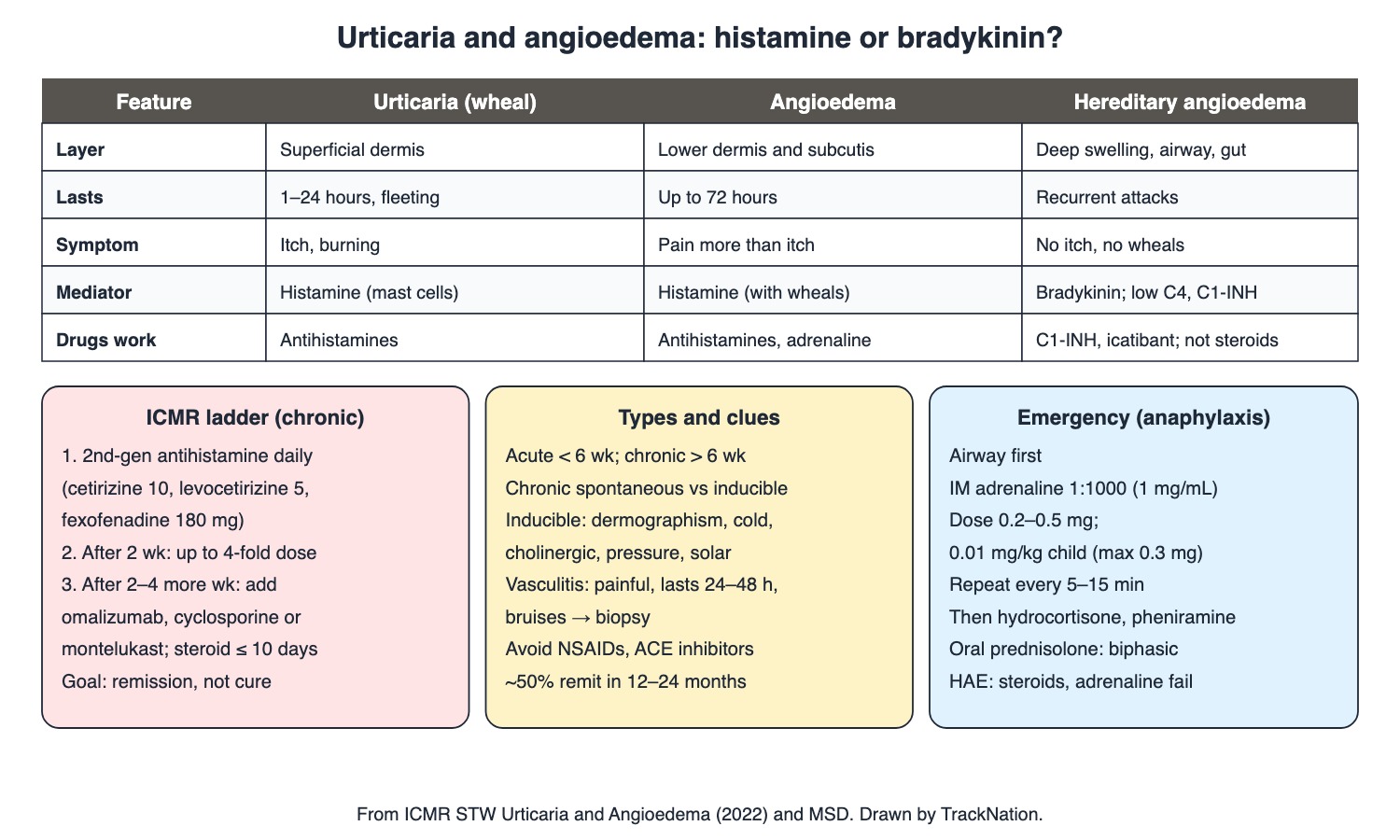
Urticaria, angioedema and hereditary angioedema compared; ICMR chronic urticaria ladder; anaphylaxis. Drawn by TrackNation.
Urticaria and Angioedema
Wheal: sharply circumscribed superficial swelling with surrounding reflex erythema, itchy or burning, fleeting — resolves within 1–24 hours. Mast cells and basophils in the superficial dermis release histamine and other mediators.
Angioedema: swelling of the lower dermis and subcutis, often mucosa; painful rather than itchy; resolves more slowly, up to 72 hours. With wheals it is histamine-mediated; without wheals think bradykinin (hereditary angioedema, ACE inhibitors).
Acute (< 6 weeks; about 70%) is nearly always due to a defined exposure — drug, food, physical stimulus or infection. Chronic (> 6 weeks) is spontaneous (mostly idiopathic, then autoimmune) or inducible (physical). About half of chronic cases remit in 12–24 months.
Urticarial vasculitis: painful wheals lasting 24–48 h or more that leave bruising, ± fever and arthralgia, linked to SLE and Sjögren syndrome → skin biopsy. Other mimics: insect bites, pre-bullous pemphigoid, drug or viral rash.
Investigations are usually not needed (ICMR). Thyroid tests, ASST and prick tests have limited use. Angioedema without wheals → C4 and C1 inhibitor levels.
Chronic inducible urticaria | Trigger or test |
Symptomatic dermographism | Light scratching → raised red lines (skin-writing) |
Cholinergic | Sweating: warm bath, exercise |
Cold / heat | Ice cube or cold object; warmth |
Delayed pressure | Sustained pressure |
Solar / aquagenic | Sunlight; water contact |
Contact urticaria | Wheals where a substance touches skin |
Treatment (ICMR)
Avoid triggers, including NSAIDs, paracetamol and ACE inhibitors when the history suggests drug-induced or drug-aggravated urticaria. Reassure that long-term non-sedating antihistamines are safe. Topical steroids and topical antihistamines do not help (MSD).
Step 1: second-generation non-sedating antihistamine once daily — cetirizine 10 mg, levocetirizine 5 mg, loratadine 10 mg or fexofenadine 180 mg. Avoid long-term first-generation drugs (chlorphenamine, hydroxyzine) — sedation and psychomotor impairment.
Step 2 (no control after 2 weeks): increase the dose up to fourfold.
Step 3 (no control after 2–4 more weeks): add omalizumab 300 mg SC every 4 weeks (anti-IgE), cyclosporine 3–5 mg/kg or montelukast 10 mg at night; a short steroid course (maximum 10 days) only for uncontrolled disease or breathing symptoms. Goal: remission, not cure.
Anaphylaxis / airway angioedema: secure the airway; IM adrenaline 1:1000 (1 mg/mL), 0.2–0.5 mg (children 0.01 mg/kg, maximum 0.3 mg), repeated every 5–15 minutes; injectable hydrocortisone and pheniramine; oral prednisolone for the biphasic response; refer after stabilisation.
Hereditary Angioedema
Deficiency (type 1, 85%, low level) or dysfunction (type 2, 15%, normal level) of C1 inhibitor, autosomal dominant. Unchecked kallikrein raises bradykinin.
Recurrent swelling of face, lips, tongue, limbs or genitals without itch or wheals; gut attacks mimic intestinal obstruction; laryngeal oedema can kill. Triggers: minor trauma such as dental work, infection, cold, pregnancy, oestrogens, tamoxifen.
Diagnosis: low C4 even between attacks and low C1 inhibitor level or function; screen all first-degree relatives.
Acute attack: airway first; C1 inhibitor concentrate, kallikrein inhibitors (ecallantide) or icatibant; fresh frozen plasma if none is available. Antihistamines, steroids and adrenaline usually fail. Prophylaxis: C1 inhibitor, lanadelumab (anti-kallikrein), attenuated androgens (danazol, stanozolol); short-term before dental or airway procedures.
Traps the Examiner Sets
Wheals lasting more than 24–48 hours with bruising → urticarial vasculitis, biopsy.
Chronic means more than 6 weeks.
Updose the same second-generation antihistamine up to 4 times before adding omalizumab.
Angioedema without wheals and low C4 → hereditary angioedema; steroids and adrenaline do not work.
Memory Hooks & Shortcuts
Shortcuts to lock in this article's numbers and lists. Each one only re-packages facts proven above.
🧠 'Wheal goes in a day, angioedema stays three' (24 h vs 72 h) — duration
🧠 Chronic urticaria ladder '1 – 4 – Xolair': one tablet, up to four, then omalizumab — ICMR ladder
🧠 Anaphylaxis: 'IM, 1:1000, 0.2–0.5 mg, repeat 5–15' — adrenaline
🧠 HAE: 'No itch, no wheal, low C4, no steroid deal' — hereditary angioedema
🧠 Urticarial vasculitis: 'Hurts, lasts, bruises — biopsy' — vasculitis
Rapid-Revision Cards
Wheal
Superficial, itchy, resolves 1–24 h.
Angioedema
Deep, painful, up to 72 h.
Chronic
> 6 weeks.
Acute cause
Defined exposure.
Chronic cause
Idiopathic, then autoimmune.
Dermographism
Scratch → red lines.
Cholinergic
Sweating, exercise, warm bath.
Urticarial vasculitis
Painful, > 24–48 h, bruising → biopsy.
Step 1
2nd-gen antihistamine OD.
Doses
Cetirizine 10, levocetirizine 5, fexofenadine 180 mg.
Step 2
Up to 4× dose after 2 weeks.
Step 3
Omalizumab, cyclosporine, montelukast.
Omalizumab
Anti-IgE 300 mg SC 4-weekly.
Steroids
Max 10 days.
Avoid
NSAIDs, ACE inhibitors.
Adrenaline
IM 1:1000, 0.2–0.5 mg; child 0.01 mg/kg.
Repeat
Every 5–15 min.
ACE inhibitor
Angioedema without wheals.
HAE
C1-INH deficit; bradykinin; AD.
HAE test
Low C4.
HAE drugs
C1-INH, icatibant, FFP; not steroids.
Sources
Facts in this article were checked against these documents.
Standard Treatment Workflow: Urticaria and Angioedema — Indian Council of Medical Research, DHR, 2022 (link)
MSD Manual Professional: Urticaria; Hereditary and Acquired Angioedema — Merck & Co. (MSD Manuals), reviewed 2025–26 (link)
Competency Based Undergraduate Curriculum, Dermatology (DR 14) — National Medical Commission, 2024
Test Yourself: Practice Questions
Thirty questions in NEET PG style, most of them clinical vignettes.
Practice Questions (NEET PG pattern)
Original questions written in the style of the exam: +4 for a correct answer, −1 for a wrong one. Every answer was checked against the sources listed above. NEET PG papers are not published by NBEMS, so these are not past-paper questions.
Q1. An individual urticarial wheal typically resolves within
(a) 1–24 hours
(b) 3–7 days
(c) 2–4 weeks
(d) 6 weeks
Show answer
Answer: (a) — Fleeting lesions.
Q2. Urticaria is called chronic when it lasts more than
(a) 6 weeks
(b) 6 months
(c) 2 weeks
(d) 48 hours
Show answer
Answer: (a) — Acute < 6 weeks.
Q3. Compared with a wheal, angioedema
(a) is superficial and fleeting
(b) involves the lower dermis and subcutis, is painful and lasts up to 72 hours
(c) never involves mucosa
(d) is always itchy
Show answer
Answer: (b) — Deeper swelling.
Q4. Acute urticaria is most often due to
(a) autoimmune thyroid disease
(b) C1 inhibitor deficiency
(c) malignancy
(d) a defined exposure such as a drug, food, physical stimulus or infection
Show answer
Answer: (d) — Chronic is mostly idiopathic.
Q5. The commonest cause of chronic spontaneous urticaria is
(a) food allergy
(b) parasites
(c) idiopathic
(d) drugs
Show answer
Answer: (c) — Then autoimmune.
Q6. Lightly scratching the skin of a patient produces raised red lines within minutes. This is
(a) Darier sign
(b) cholinergic urticaria
(c) Koebner phenomenon
(d) symptomatic dermographism
Show answer
Answer: (d) — Skin-writing.
Q7. Small itchy wheals appear whenever a patient exercises or takes a warm bath. The type is
(a) cold urticaria
(b) cholinergic urticaria
(c) solar urticaria
(d) pressure urticaria
Show answer
Answer: (b) — Triggered by sweating.
Q8. A patient has painful urticarial lesions that persist beyond 24–48 hours and fade leaving bruises, with arthralgia. The next step is
(a) patch test
(b) skin biopsy for urticarial vasculitis
(c) C1 inhibitor level
(d) double antihistamine dose only
Show answer
Answer: (b) — Persistent wheals.
Q9. Urticarial vasculitis is associated with
(a) vitiligo
(b) SLE and Sjögren syndrome
(c) acne
(d) psoriasis
Show answer
Answer: (b) — Systemic rheumatic disease.
Q10. For typical chronic urticaria, ICMR says investigations are
(a) generally not needed
(b) always needed — ASST
(c) always needed — IgE
(d) always needed — thyroid antibodies
Show answer
Answer: (a) — Guided by history.
Q11. The first-line drug for chronic urticaria (ICMR) is
(a) a second-generation non-sedating antihistamine once daily
(b) oral prednisolone
(c) hydroxyzine long term
(d) topical steroid
Show answer
Answer: (a) — Cetirizine, levocetirizine, loratadine, fexofenadine.
Q12. The ICMR dose of fexofenadine for urticaria is
(a) 60 mg four times daily
(b) 10 mg once daily
(c) 180 mg once daily
(d) 5 mg once daily
Show answer
Answer: (c) — Cetirizine 10 mg, levocetirizine 5 mg.
Q13. Chronic urticaria is not controlled after 2 weeks on standard-dose levocetirizine. The next ICMR step is
(a) increase the antihistamine dose up to fourfold
(b) start oral steroids long term
(c) stop antihistamines
(d) add a topical steroid
Show answer
Answer: (a) — Then add-on therapy.
Q14. Long-term first-generation antihistamines such as hydroxyzine are avoided in urticaria because of
(a) sedation and psychomotor impairment
(b) QT prolongation only
(c) nephrotoxicity
(d) hepatotoxicity
Show answer
Answer: (a) — Prefer second-generation drugs.
Q15. Urticaria persists despite fourfold antihistamine dosing for a further 2–4 weeks. The anti-IgE add-on at tertiary level is
(a) dupilumab weekly
(b) omalizumab 300 mg SC every 4 weeks
(c) rituximab
(d) infliximab
Show answer
Answer: (b) — Or cyclosporine, montelukast.
Q16. Omalizumab works in chronic urticaria by targeting
(a) circulating IgE
(b) CD20
(c) TNF-alpha
(d) IL-4 receptor
Show answer
Answer: (a) — Monoclonal anti-IgE.
Q17. ICMR limits corticosteroid courses in urticaria to a maximum of
(a) 6 weeks
(b) 10 days
(c) 3 months
(d) they are first line
Show answer
Answer: (b) — Only uncontrolled disease or respiratory symptoms.
Q18. Which is NOT useful for urticaria?
(a) topical glucocorticoids
(b) montelukast add-on
(c) second-generation antihistamines
(d) omalizumab
Show answer
Answer: (a) — Topical steroids and antihistamines do not help.
Q19. A patient with urticaria that worsens after painkillers should avoid
(a) NSAIDs
(b) fexofenadine
(c) cetirizine
(d) montelukast
Show answer
Answer: (a) — Also ACE inhibitors.
Q20. A patient with urticaria develops lip swelling, choking and breathlessness. After securing the airway, the drug of choice is
(a) oral cetirizine
(b) IV adrenaline 1:1000 bolus
(c) IM adrenaline 1:1000, 0.2–0.5 mg
(d) oral prednisolone alone
Show answer
Answer: (c) — Repeat every 5–15 minutes.
Q21. The IM adrenaline dose for a child in anaphylaxis (ICMR) is
(a) 0.01 mg/kg, maximum 0.3 mg
(b) 1 mg fixed
(c) 0.5 mg/kg
(d) 0.1 mg/kg, maximum 1 mg
Show answer
Answer: (a) — Using 1 mg/mL.
Q22. IM adrenaline in anaphylaxis can be repeated every
(a) never
(b) 6 hours
(c) 1 hour
(d) 5 to 15 minutes
Show answer
Answer: (d) — If choking, distress or shock persist.
Q23. Oral prednisolone is started after stabilising anaphylaxis mainly to cover the
(a) rash
(b) itch
(c) biphasic response
(d) bronchospasm only
Show answer
Answer: (c) — Late recurrence.
Q24. A hypertensive patient develops recurrent tongue and lip swelling without wheals after starting a new drug. The most likely culprit is
(a) a beta-blocker
(b) a calcium channel blocker
(c) an ACE inhibitor
(d) a thiazide
Show answer
Answer: (c) — Bradykinin-mediated angioedema.
Q25. A teenager has recurrent non-itchy swellings of the face and limbs without wheals, colicky abdominal attacks, and a parent with similar episodes. The most useful screening test is
(a) ASST
(b) serum IgE
(c) serum C4 (with C1 inhibitor level and function)
(d) skin prick test
Show answer
Answer: (c) — Low C4 even between attacks.
Q26. The mediator responsible for swelling in hereditary angioedema is
(a) histamine
(b) bradykinin
(c) IgE
(d) leukotriene
Show answer
Answer: (b) — C1 inhibitor normally inhibits kallikrein.
Q27. Hereditary angioedema type 2 shows
(a) normal C4 always
(b) normal C1 inhibitor level but abnormal function
(c) IgE excess
(d) low C1 inhibitor level
Show answer
Answer: (b) — Type 1 (85%) low level.
Q28. Which drugs usually DO NOT work in an acute attack of hereditary angioedema?
(a) ecallantide
(b) icatibant
(c) antihistamines, glucocorticoids and adrenaline
(d) C1 inhibitor concentrate
Show answer
Answer: (c) — Bradykinin, not histamine.
Q29. If C1 inhibitor concentrate and icatibant are unavailable during an acute HAE attack, an alternative is
(a) oral cetirizine
(b) fresh frozen plasma
(c) IM adrenaline
(d) IV hydrocortisone
Show answer
Answer: (b) — Supplies C1 inhibitor.
Q30. A patient with known hereditary angioedema needs a dental extraction. The recommended step is
(a) short-term prophylaxis (C1 inhibitor, or attenuated androgens/FFP if unavailable)
(b) steroid cover only
(c) no precaution
(d) antihistamine premedication only
Show answer
Answer: (a) — Dental work triggers attacks.
Active Recall
From memory: define wheal and angioedema, classify urticaria by duration and trigger, list the clues to urticarial vasculitis, give the ICMR treatment ladder and the anaphylaxis adrenaline dose, and explain how hereditary angioedema differs in mechanism, tests and treatment.