Vesiculobullous Disorders for NEET PG Dermatology: Pemphigus, Bullous Pemphigoid, Nikolsky Sign, Immunofluorescence, Dermatitis Herpetiformis
Start Here
🎯 Exam priority: High. Expect: flaccid vs tense blisters, the level of split, desmoglein 3 vs 1, BP180/BP230, Nikolsky and Asboe-Hansen signs, immunofluorescence patterns (cell-surface, linear, granular), oral lesions in pemphigus, drug-induced pemphigus and pemphigoid, dermatitis herpetiformis with coeliac disease and dapsone, and ICMR treatment by body surface area.
CBME mapping: DR 13.1–13.2. Coeliac disease is also in Medicine; dapsone in Pharmacology.
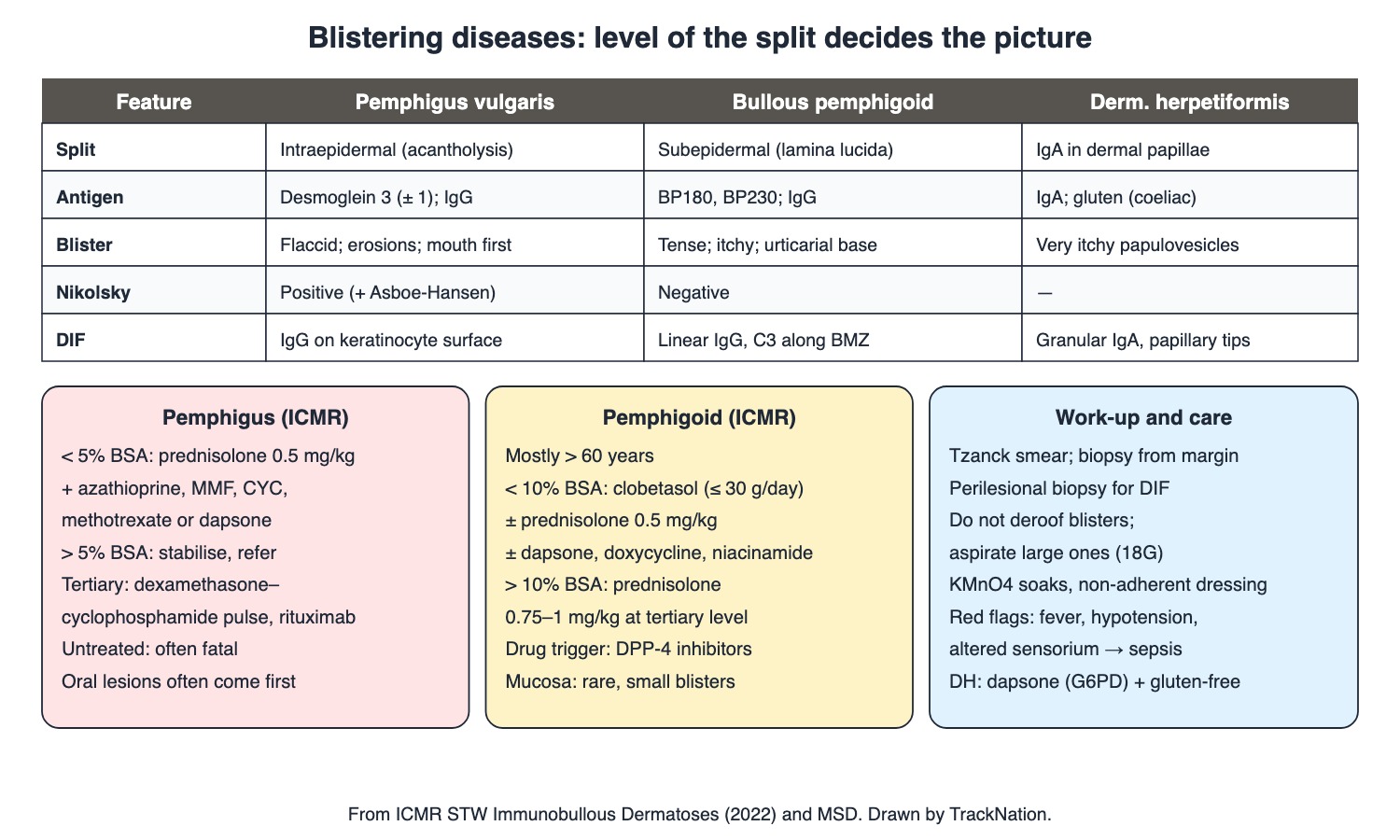
Pemphigus vulgaris, bullous pemphigoid and dermatitis herpetiformis compared; ICMR treatment; work-up. Drawn by TrackNation.
Approach to a Blistering Patient (ICMR)
Look at the blister: flaccid blisters and erosions ± crusts on skin and mucosa → pemphigus group (adults). Tense blisters with clear or haemorrhagic fluid on an itchy, red or urticarial base, healing with hypopigmentation → subepidermal disease; bullous pemphigoid is the commonest.
A child under 5 with erosions ringed by tense blisters on an urticarial base, on the face or around the genitals → chronic bullous disease of childhood (linear IgA disease).
Tests: Tzanck smear; biopsy from the margin of a lesion for histology; perilesional biopsy for direct immunofluorescence.
Differentials: bullous impetigo, varicella, SJS/TEN, epidermolysis bullosa (infancy, pressure sites, scarring, teeth and nail changes); congenital syphilis in a neonate — VDRL for mother and child.
Red flags: fever with chills and rigors, hypotension (fluid loss or sepsis), altered sensorium. Care: monitor vitals, fluids and electrolytes, cultures, clean non-adherent dressings, dilute potassium permanganate soaks, chlorhexidine mouthwash, soft diet. Do not deroof blisters — the roof is a natural dressing; aspirate large ones with an 18G needle.
Disease | Target | Direct immunofluorescence (MSD) | Clue |
Pemphigus vulgaris | Desmoglein 3 (± 1), IgG | IgG on keratinocyte cell surface | Oral erosions first; Nikolsky + |
Pemphigus foliaceus | Desmoglein 1, IgG | IgG on keratinocyte cell surface | Superficial crusted erosions; mucosa spared |
Bullous pemphigoid | BP180, BP230, IgG | Linear IgG and C3 along basement membrane zone | > 60 y; tense itchy bullae; Nikolsky − |
Dermatitis herpetiformis | Gluten-related, IgA | Granular IgA in dermal papillary tips | Elbows, knees, buttocks; coeliac |
Pemphigus
Pemphigus vulgaris: middle-aged adults; IgG against desmoglein 3 (± 1) → acantholysis and intraepidermal blisters. About half have only oral erosions, and oral lesions often come before skin lesions (painful mouth, poor intake). Nikolsky (epidermis shears with sideways pressure) and Asboe-Hansen (pressure spreads the bulla) signs are positive. Untreated, it is often fatal within 5 years. Variants: pemphigus vegetans (folds), paraneoplastic pemphigus.
Pemphigus foliaceus: IgG against desmoglein 1, superficial split, crusted erosions, mucosa rarely involved; drugs — penicillamine, nifedipine, captopril; endemic form fogo selvagem; pemphigus erythematosus on the cheeks.
ICMR treatment (only where monitoring exists): mucosal or < 5% BSA — prednisolone 0.5 mg/kg/day with azathioprine, mycophenolate, cyclophosphamide, methotrexate or dapsone; > 5% BSA — stabilise and refer; tertiary — dexamethasone–cyclophosphamide pulse or rituximab (MSD lists rituximab as first line).
Bullous Pemphigoid and Dermatitis Herpetiformis
Bullous pemphigoid: commonest autoimmune blistering disease, mostly over 60. IgG against hemidesmosomal BP180 and BP230 → complement → subepidermal blister (lamina lucida) rich in eosinophils. Itchy urticarial plaques, then tense bullae on trunk and flexures; mucosa rarely; Nikolsky negative; DIF — linear IgG and C3 along the basement membrane zone. Drug triggers include DPP-4 inhibitors (gliptins) and PD-1 inhibitors.
ICMR: limited (< 10% BSA) — topical clobetasol up to 30 g/day ± prednisolone 0.5 mg/kg/day ± dapsone, doxycycline, niacinamide or immunosuppressants; extensive (> 10%) — prednisolone 0.75–1 mg/kg/day at tertiary level.
Dermatitis herpetiformis: intensely itchy papulovesicles on extensor elbows and knees, sacrum, buttocks and occiput; nearly all have (often silent) coeliac disease; DIF — granular IgA in dermal papillary tips; tTG and endomysial IgA support it. Treat with dapsone (test G6PD first; haemolysis, methaemoglobinaemia) and a strict gluten-free diet, which can later stand alone. Risk of small-bowel lymphoma.
Traps the Examiner Sets
Mouth ulcers before skin blisters in a middle-aged adult → pemphigus vulgaris.
Elderly, itchy, tense blisters, Nikolsky negative → bullous pemphigoid.
Linear IgG = pemphigoid; granular IgA in papillae = dermatitis herpetiformis.
Never deroof blisters; check G6PD before dapsone.
Memory Hooks & Shortcuts
Shortcuts to lock in this article's numbers and lists. Each one only re-packages facts proven above.
🧠 'Vulgaris = mouth first (Dsg3); Foliaceus = superficial Flakes, mouth Free (Dsg1)' — pemphigus types
🧠 'Pemphigoid = Pensioners, Pruritus, Pressure-tense blisters' — bullous pemphigoid
🧠 Immunofluorescence: 'Pemphigus Paints cell surfaces; Pemphigoid Pencils a Line; DH Dots the papillae' — DIF patterns
🧠 DH = 'Dapsone + Diet (gluten-free)' — dermatitis herpetiformis
🧠 Blister roof = 'nature's dressing — never deroof' — care
Rapid-Revision Cards
Flaccid blisters
Pemphigus group.
Tense blisters
Subepidermal; pemphigoid commonest.
PV antigen
Desmoglein 3 (± 1).
PF antigen
Desmoglein 1; mucosa spared.
PV first sign
Oral erosions.
Nikolsky
Epidermis shears: PV +, BP −.
Asboe-Hansen
Bulla spreads on pressure.
PV DIF
IgG on keratinocyte surface.
PF drugs
Penicillamine, captopril, nifedipine.
BP age
> 60 years.
BP antigens
BP180, BP230.
BP DIF
Linear IgG + C3 at BMZ.
BP drug
DPP-4 inhibitors.
BP < 10%
Clobetasol ≤ 30 g/day.
DH
Coeliac; elbows, knees, buttocks.
DH DIF
Granular IgA, papillary tips.
DH treatment
Dapsone + gluten-free diet.
Dapsone
G6PD first; methaemoglobinaemia.
Child < 5, ring of blisters
Chronic bullous disease of childhood.
DIF biopsy
Perilesional skin.
Blister care
Don't deroof; aspirate 18G.
Sources
Facts in this article were checked against these documents.
Standard Treatment Workflow: Immunobullous Dermatoses — Indian Council of Medical Research, DHR, 2022 (link)
MSD Manual Professional: Pemphigus Vulgaris; Pemphigus Foliaceus; Bullous Pemphigoid; Dermatitis Herpetiformis — Merck & Co. (MSD Manuals), reviewed 2024–26 (link)
Competency Based Undergraduate Curriculum, Dermatology (DR 13) — National Medical Commission, 2024
Test Yourself: Practice Questions
Thirty questions in NEET PG style, most of them clinical vignettes.
Practice Questions (NEET PG pattern)
Original questions written in the style of the exam: +4 for a correct answer, −1 for a wrong one. Every answer was checked against the sources listed above. NEET PG papers are not published by NBEMS, so these are not past-paper questions.
Q1. A middle-aged adult has painful oral erosions for months, followed by flaccid blisters and raw erosions on the trunk. The most likely diagnosis is
(a) bullous pemphigoid
(b) dermatitis herpetiformis
(c) pemphigus foliaceus
(d) pemphigus vulgaris
Show answer
Answer: (d) — Oral lesions often precede skin.
Q2. The main target antigen in pemphigus vulgaris is
(a) type VII collagen
(b) tissue transglutaminase
(c) desmoglein 3
(d) BP180
Show answer
Answer: (c) — Sometimes also desmoglein 1.
Q3. Loss of adhesion between keratinocytes producing an intraepidermal blister is called
(a) spongiosis
(b) parakeratosis
(c) hyperkeratosis
(d) acantholysis
Show answer
Answer: (d) — The mechanism of pemphigus.
Q4. Rubbing apparently normal skin next to a blister makes the upper epidermis slide off. This sign is
(a) Darier sign
(b) Nikolsky sign
(c) Koebner phenomenon
(d) Auspitz sign
Show answer
Answer: (b) — Positive in pemphigus vulgaris.
Q5. Gentle pressure on an intact bulla makes the fluid spread under the adjacent skin. This is the
(a) Asboe-Hansen sign
(b) Auspitz sign
(c) Darier sign
(d) Nikolsky sign
Show answer
Answer: (a) — Also reflects poor epidermal cohesion.
Q6. Direct immunofluorescence in pemphigus vulgaris shows
(a) IgG on the keratinocyte cell surface (intercellular)
(b) linear IgG along the basement membrane
(c) granular IgA in papillary tips
(d) no deposits
Show answer
Answer: (a) — Cell-surface (intercellular) pattern.
Q7. Without treatment, pemphigus vulgaris
(a) is harmless
(b) is often fatal, usually within 5 years
(c) always resolves in weeks
(d) only scars
Show answer
Answer: (b) — Steroids and immunosuppressants improved prognosis.
Q8. A patient develops superficial skin erosions without mouth lesions after starting captopril. The likely diagnosis and antigen are
(a) dermatitis herpetiformis — IgA
(b) bullous pemphigoid — BP180
(c) pemphigus foliaceus — desmoglein 1
(d) pemphigus vulgaris — desmoglein 3
Show answer
Answer: (c) — Also penicillamine, nifedipine.
Q9. An endemic form of pemphigus foliaceus seen in children and young adults in South America is
(a) fogo selvagem
(b) pemphigus vegetans
(c) Hailey–Hailey disease
(d) paraneoplastic pemphigus
Show answer
Answer: (a) — Endemic PF.
Q10. ICMR first-line treatment for mucosal or limited (< 5% BSA) pemphigus is
(a) dapsone alone at home without monitoring
(b) antibiotics only
(c) topical steroid only
(d) oral prednisolone 0.5 mg/kg/day with an adjuvant such as azathioprine
Show answer
Answer: (d) — Only where monitoring is available.
Q11. Extensive pemphigus at a tertiary centre may be treated with
(a) antihistamines
(b) topical clobetasol alone
(c) dexamethasone–cyclophosphamide pulse therapy or rituximab
(d) gluten-free diet
Show answer
Answer: (c) — ICMR tertiary options.
Q12. An 80-year-old has itchy urticarial plaques followed by large tense blisters on the trunk and flexures; Nikolsky sign is negative and the mouth is spared. The diagnosis is
(a) pemphigus vulgaris
(b) SJS
(c) pemphigus foliaceus
(d) bullous pemphigoid
Show answer
Answer: (d) — Most common autoimmune blistering disease.
Q13. The antigens targeted in bullous pemphigoid are
(a) tissue transglutaminase
(b) desmoglein 1 and 3
(c) type VII collagen
(d) BP180 and BP230 (hemidesmosomal)
Show answer
Answer: (d) — Complement-activating IgG.
Q14. The level of split in bullous pemphigoid is
(a) subcorneal
(b) within the dermis
(c) subepidermal (lamina lucida)
(d) suprabasal intraepidermal
Show answer
Answer: (c) — Hence tense blisters.
Q15. Direct immunofluorescence in bullous pemphigoid shows
(a) intercellular IgG
(b) IgM in vessels
(c) linear IgG and C3 along the basement membrane zone
(d) granular IgA in papillary tips
Show answer
Answer: (c) — Linear pattern.
Q16. A diabetic patient develops bullous pemphigoid after starting a new oral antidiabetic drug. The likely culprit class is
(a) alpha-glucosidase inhibitors
(b) DPP-4 inhibitors (gliptins)
(c) biguanides
(d) sulfonylureas
Show answer
Answer: (b) — Drug-induced pemphigoid.
Q17. ICMR treatment for limited bullous pemphigoid (< 10% BSA) begins with
(a) cyclophosphamide pulse
(b) rituximab
(c) gluten-free diet
(d) topical clobetasol propionate up to 30 g/day
Show answer
Answer: (d) — ± prednisolone 0.5 mg/kg, dapsone, doxycycline, niacinamide.
Q18. For extensive bullous pemphigoid (> 10% BSA), ICMR advises
(a) prednisolone 0.75–1 mg/kg/day at tertiary level
(b) no treatment
(c) antibiotics alone
(d) topical steroid only at home
Show answer
Answer: (a) — With steroid-sparing agents.
Q19. Doxycycline with niacinamide is an ICMR option in
(a) epidermolysis bullosa
(b) dermatitis herpetiformis
(c) bullous pemphigoid
(d) pemphigus vulgaris
Show answer
Answer: (c) — Anti-inflammatory regimen.
Q20. A patient has intensely itchy papulovesicles on the elbows, knees and buttocks. The disease is strongly associated with
(a) diabetes
(b) coeliac disease
(c) hepatitis C
(d) HIV
Show answer
Answer: (b) — Dermatitis herpetiformis.
Q21. Direct immunofluorescence in dermatitis herpetiformis shows
(a) granular IgA in the dermal papillary tips
(b) linear IgA
(c) linear IgG along the BMZ
(d) intercellular IgG
Show answer
Answer: (a) — Linear IgA = linear IgA disease.
Q22. The drug that rapidly controls the itch of dermatitis herpetiformis is
(a) methotrexate
(b) cyclosporine
(c) prednisolone
(d) dapsone
Show answer
Answer: (d) — Plus a gluten-free diet.
Q23. Before starting dapsone, which test is needed to reduce the risk of haemolysis?
(a) thyroid function
(b) serum IgA
(c) G6PD level
(d) HLA-B*15:02
Show answer
Answer: (c) — Haemolysis risk is higher in G6PD deficiency.
Q24. A common adverse effect of dapsone is
(a) hyperkalaemia
(b) methaemoglobinaemia
(c) hirsutism
(d) gingival hyperplasia
Show answer
Answer: (b) — Also haemolysis, agranulocytosis, dapsone syndrome.
Q25. Long-term control of dermatitis herpetiformis without drugs is possible with
(a) sun avoidance
(b) a strict gluten-free diet
(c) topical steroids
(d) antihistamines
Show answer
Answer: (b) — Drug may be stopped later.
Q26. A 3-year-old has erosions surrounded by a ring of tense blisters on an urticarial base around the genitals and face. The likely diagnosis is
(a) bullous impetigo only
(b) chronic bullous disease of childhood
(c) epidermolysis bullosa
(d) pemphigus vulgaris
Show answer
Answer: (b) — Linear IgA disease of childhood.
Q27. For direct immunofluorescence, the biopsy should be taken from
(a) the centre of an old erosion
(b) distant normal skin of the back
(c) the blister roof only
(d) perilesional skin
Show answer
Answer: (d) — Histology from the lesion margin.
Q28. ICMR advice on intact large blisters is to
(a) deroof all blisters
(b) apply potent steroid under occlusion
(c) excise them
(d) avoid deroofing; aspirate with an 18G needle if needed
Show answer
Answer: (d) — The roof is a natural dressing.
Q29. A patient with extensive pemphigus develops fever with rigors, hypotension and confusion. These red flags indicate
(a) steroid response
(b) drug allergy only
(c) fluid loss or sepsis needing urgent care
(d) a normal course
Show answer
Answer: (c) — ICMR red flag signs.
Q30. A neonate is born with blisters and erosions. Besides epidermolysis bullosa, ICMR asks you to consider
(a) bullous pemphigoid
(b) congenital syphilis — VDRL for mother and child
(c) pemphigus foliaceus
(d) dermatitis herpetiformis
Show answer
Answer: (b) — Bullous lesions in neonates.
Active Recall
From memory: contrast pemphigus vulgaris, pemphigus foliaceus, bullous pemphigoid and dermatitis herpetiformis by antigen, split, blister, mucosa, Nikolsky sign and immunofluorescence, and give the ICMR treatment and general blister care.